For any SaaS business, a solid online presence is important. SaaS SEO helps you optimize your website so that you can outperform your competitors and outshine them in search engines like Google and Bing, thereby attracting the right audience. And of course, increased organic traffic means more conversions and more revenue.

Since SaaS SEO is such an essential part of your business’s organic growth, we thought of helping you understand what it means and how you can create a winning SaaS SEO strategy for your business with our SaaS SEO guide.

TL;DR

  • SaaS SEO is a process that a SaaS company uses to rank high in search engines like Google and Bing to get organic traffic and convert viewers into paying customers.
  • A good SaaS SEO strategy aims to understand the target audience, create high-value content to resolve customer issues, deliver a seamless experience, and drive long-term organic traffic. It generally includes keyword and competitor research, content strategy, link building, and technical SEO.

Why SEO Matters for SaaS Businesses?

Let’s face it. Attracting the right customers is not easy for any SaaS business. It’s an industry where information is flooding, options are numerous, and customers compare and evaluate tools even before signing up for a free trial.

The right SEO strategies for SaaS put you in front of the right people at the right time. Here is more about why SEO matters for SaaS businesses.

Highly Scalable

With SEO, you can grow your business predictably by constantly measuring organic traffic, keyword rankings, conversions, and engagement. It’s a scalable strategy that can grow with your business at a lower cost than paid channels while attracting and converting new customers for you.

Assists SaaS Buyers with Decision Making

SaaS buyers today rely heavily on online research. According to a 2024 study, 84% of B2B software buyers self-educate as much as they can when evaluating solutions. This means you must expect your target audience to be comparing you with your competitors and checking your reviews.

With the right SEO techniques, you can appear in the search engines and help your customers with the information they seek. Work on ranking for the keywords that match user intent to attract high-quality leads who are already interested in what you sell.

Reduces Customer Acquisition Cost

As SaaS companies are built on a recurring revenue model, they need to keep their Customer Acquisition Cost (CAC) low and improve the lifetime value (LTV) of each user. Here, SaaS SEO can help you generate consistent traffic without the need for paid advertising. Once your content starts ranking, you can get continued traffic without additional costs.

What Makes a Good SaaS SEO Strategy?

SEO is not just meant to help rank your keywords but to build a predictable growth engine that drives conversions. No SaaS buyer commits before doing ample research. This means your SaaS SEO strategy needs to be good enough to guide them throughout their customer journey- from being aware of their issue to finding the solution with you. You must be able to answer their real questions and have a website that is easy to navigate.

Here is our SaaS SEO guide that will help you create your winning strategy that drives the results you seek.

Keyword Research and Strategy for SaaS

The beginning of any SEO strategy is keyword research. You can survive in the market only if your keywords align with the intent of your buyers at every stage because they already know what they want.

You must segment your keywords into different types:

  • Informational Keywords: They bring you customers looking for solutions.
  • Navigational Keywords: They bring you customers looking for your brand.
  • Commercial Keywords: They bring you customers looking for reviews and comparisons before making a purchase.
  • Transactional Keywords: They bring you customers who have a high intent to take an action or buy.

These keywords are directly linked to the SaaS buyer journey.

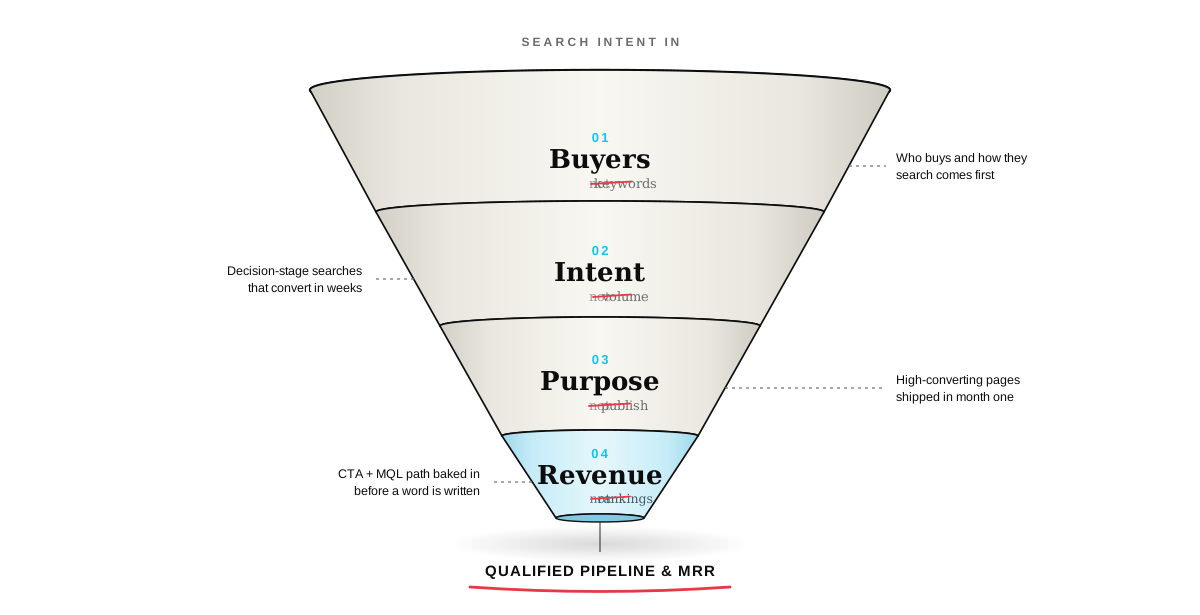
  • Top-of-Funnel (ToFu): Best targeted with informational keywords aimed at users who are just becoming aware of a problem or exploring a broad topic. For example, “What is email automation?”, “How does CRM software work?”, “Benefits of workflow automation”, etc.
  • Middle-of-Funnel (MoFu): Works great with commercial keywords where users are actively researching and comparing available options. For example, “Best email automation tools”, “Top CRM software for small businesses”, “Workflow automation software comparison”, etc.
  • Bottom-of-Funnel (BoFu): Focuses on transactional keywords and conversion-driven content where users are ready to make a decision and are looking for specific product details before signing up, booking a demo, or purchasing. For example, “HubSpot pricing”, “Mailchimp vs ActiveCampaign”, “Project management software free trial”, etc.

As a SaaS marketer, you can also use tools like Google Keyword Planner, Ahrefs, and SEMrush to get an idea of the keyword difficulty, search volume, and related keywords. With these tools, you can also identify long-term keywords that target your customer pain points.

Map keywords as per the stages of the funnel, and you can ensure ongoing traffic with high conversions.

Competitor Research

For any SaaS SEO strategy to be effective, in-depth competitor research lays the foundation. In SaaS, you are competing against two types of competitors: one, those who are selling the same software, and two, the ones who are dominating the search engines.

The second ones may be using great content, structured review pages, and comparison sites to reach their customers. This makes it essential for you to analyze both your direct competitors and SERP competitors.

With tools such as Ahrefs, you can easily determine the keywords for which your competitors are ranking, which of their pages are attracting customers, and what they are missing in content that you can take advantage of.

You can also check your competitors’ content patterns. For instance, some SaaS businesses rank for detailed comparisons, while some rank for their elaborate integration-related content.

Some SaaS companies share content in the form of templates, step-by-step guides, and even case studies. Based on what your competitors are ranking for, you can create your own content roadmap and create content that is meant to rank in Google and other search engines.

Create Topic Clusters

To scale organic growth with SaaS SEO, you need to master the game of content. The topic cluster model or the hub-and-spoke strategy can prove to be quite helpful. Using this structure, you must create one “pillar” page that is about a broad topic in depth, and then publish multiple “cluster” articles that explain subtopics.

For example, project management software can be your pillar topic, and everything related to project management software, such as project workflows, integrations, use cases, etc., can be your cluster topics.

Also, make sure that these cluster topics link back to the pillar page and to each other. This will tell the search engine that you are seriously doing what you do and help improve your ranking across the entire cluster.

Choose from a Variety of Content Types

While publishing content,  make sure that you choose a variety of content types in order to target the whole funnel.

  • How-to Guides (For ToFu customers): Educate problem-aware users and attract early-stage researchers.
  • Comparison Pages (For MoFu customers): Help prospects evaluate options and position your SaaS against competitors.
  • Integration Pages: Show how your product works seamlessly with other tools your audience already uses.
  • Case Studies: Provide social proof by demonstrating real customer results and success stories.
  • Free Tools & Templates: Build trust and authority by offering practical value upfront.

Create a Content Calendar for your Content Strategy

To keep up with the rising competition, the best is to create a content calendar. Like many other SaaS businesses, you can divide your content into different parts, such as 70% core blog content, 20% tool-led content, and 10% experimental content to test new ideas or target emerging queries. A structured approach helps you build authority and leaves room for innovation.

Another important part of your content strategy is the internal linking system. This will help you distribute authority across your site and guide users from education blogs to the integration pages, and improve conversions in return.

For instance, you can link your feature page to your productivity blog or your demos and free trials to the comparison pages. Internal linking should act as the route your customer takes to navigate through your website.

Link Building & Authority Growth

Google’s algorithms may come and go. But what doesn’t change is how much Google trusts backlinks when ranking content. If your content is backed by high authority backlinks, you have a greater chance of leaving your competitors behind.

Being in the SaaS industry, you can win if your link-building is as per your business. Here’s what can benefit you.

  • Utility Tools: Offer ROI calculators, task templates, or other helpful resources to easily attract backlinks.
  • Guest Posting: Publish content on partner blogs and niche SaaS publications to reach a new audience and build strategic authority.
  • Integrations: Provide integrations with other SaaS tools so both companies benefit from cross-linked documentation, creating relevant and high-quality backlinks.
  • Digital PR: Share research reports, benchmarks, trend studies, or data insights to position yourself as an industry leader and earn organic press coverage and authoritative backlinks.

While you do all this, make sure that you always choose quality over quantity. Go for SaaS relevant domains so that your anchor text fits naturally and you don’t get unnecessary links from low-quality websites. In your industry, a handful of high-quality backlinks is sufficient for you to stand out from the rest.

Technical SEO

To help search engines discover, crawl, and index your content effectively, technical SEO is what works for you. To start, make sure that you don’t overlook essentials such as robots.txt and XML sitemaps. All your important pages must be worth indexing and crawling.

Next, keep an eye on the site loading speed for both mobile and desktop, as it can hurt the user experience and your ranking in the SERP.

You must also take care of the schema markup. When you use structured data for  FAQs, product pages, blogs, and review pages, you make it easy for Google to understand your page.

Measurement & Growth Metrics

You must keep checking whether your SEO efforts are working or not. Track the right KPIs so you can see what’s performing well and what needs improvement. Some key metrics to track include:

  • Organic sessions
  • Keyword rankings
  • Sign-ups
  • Click-through rate (CTR),
  • The number of MQLs (Marketing Qualified Leads); and
  • SQLs (Sales Qualified Leads) generated from organic traffic.

For SaaS specifically, monitoring churn and customer lifetime value (LTV) is essential to understand long-term performance.

You should also measure results by funnel stage.

  • ToFu Metrics: new visitors, impressions, and reach
  • MoFu Metrics: engagement levels, time on page, and content downloads
  • BoFu Metrics: free trials, demo bookings, and conversions

A funnel-based view helps you see whether your content is successfully guiding users from awareness to decision.

Tools like Google Search Console, GA4, Ahrefs, and SEMrush provide valuable insights into keyword performance, user behavior, and overall organic growth. By reviewing this data regularly and refining your approach, you can build a strong, data-driven SaaS SEO strategy that improves over time.

While these SaaS SEO best practices work for most businesses, remember that no single approach fits everyone. Keep adapting and optimizing your strategy so you stay ahead of your competitors.

Common Mistakes SaaS Companies Make with SEO

By understanding these common mistakes, you can save your SaaS agency from wasting its efforts and build a SaaS SEO strategy that gets your results in the form of demos, sign-ups, and revenue.

Let’s take a look at what they are.

Targeting Irrelevant High-Volume Keywords

A number of SaaS companies chase high-volume keywords that have no relevance to their audience, product, or buyer intent. Such keywords may bring traffic, but they don’t bring conversions. For SaaS SEO to work, it’s important that you stay relevant to your business and align with your customers’ pain points. Simply put, your goal is not just to boost visibility but to find people who want to buy from you.

Treating Vanity Metrics as Success

Your success is not in rising social shares, pageviews, or impressions. These vanity metrics may appear impressive, but they deliver no value in terms of business. What matters is how much of your organic traffic is signing up, taking demos, and trials, or bringing long-term revenue. SaaS SEO should be able to bring monetary results and not just surface-level numbers.

Poor Internal Linking and Isolation of Blog Content

The blog section on your website is not a standalone content library. It must be integrated into your sales funnel. If you can link your product and feature pages in your blogs properly, you can never attract customers the way you want. The goal of the content you post in your blogs must be to guide your readers from educational content to solution-driven pages, such as your feature and product pages. If you don’t follow this structure, any written content will underperform.

Rise of AI and 2026 Outlook for SaaS SEO

It goes without saying that AI has changed the way people search. By 2026, it is expected to strongly impact SaaS SEO. For AI-powered platforms like ChatGPT, Google’s AI Overviews, Gemini, and Perplexity, Generative Engine Optimization (GEO) and Answer Engine Optimization (AEO) have proved to be critical strategies. In fact, according to recent data, 58% of searches now result in zero clicks due to AI summaries.

This clearly means that for SaaS agencies, their content must be optimized for how AI systems understand and cite information, and not just according to the traditional search engine guidelines. So, instead of just trying to rank higher in the search engines, brands must create content as per the AI models.

As per Gartner, by 2026, a 25% decline in traditional organic search volume as more traffic shifts toward AI-driven responses. This requires SaaS businesses to invest their efforts in GEO and structure their content as per machine readability and optimize it for entity-based SEO. By doing so, SaaS businesses can become visible and relevant in the rising AI-first search world.


Conclusion

As the SaaS market expands and AI reshapes the way people search and find answers, SEO remains the most important lever of their growth. From targeted keyword research and competitor insights to strong content clusters, technical optimisation, and authority building, each pillar becomes critical in attracting qualified, paying users.

Also, because GEO and AEO are set to influence a brand’s visibility in 2026, it would be better if SaaS companies don’t overlook SEO. As a brand that invests in SEO and keeps its SaaS SEO guide handy now, you can easily scale and compound your growth in the long term.

Frequently Asked Questions

1. What is SaaS SEO?

SaaS SEO is the process of optimizing a Software-as-a-Service (SaaS) website to improve visibility on search engines and attract high-paying customers. It’s not like general SEO because it focuses on getting product demos, sign-ups, and trials, and not just one-time purchases. It combines technical optimization, content marketing, user intent marketing, and a product-led growth mechanism so that your target audience finds you when they need what you sell.

2. How is SaaS SEO different from traditional SEO?

Traditional SEO focuses on a broader audience and aims to increase organic traffic and improve brand visibility. On the other hand, SaaS SEO aims at acquiring and retaining customers. It takes into account the buyer journey, awareness, evaluation, decision-making, comparison pages, feature breakdowns, etc. It prioritizes repeated conversions, churn reduction, and user onboarding. Simply put, it focuses on recurring revenue rather than one-time sales.

3. How to start with SaaS SEO?

To start with SaaS SEO, here is what you can do.

  • Map your customer journey and, based on that, identify keywords for each stage of the funnel.
  • Analyze your competitors to get an idea of what they are ranking for.
  • Understand the content gap and improve it wherever needed.
  • Build your content strategy to improve your blogs, landing pages, and product pages while keeping in mind both informational and transactional intent.
  • Work on your technical SEO tactics; improve site loading time and internal links.
  • Track performance continuously and refine your strategies with time.

4. What are some SEO tools we can use for a SaaS SEO strategy?

For keyword research and competitor insights, you can use Ahrefs, SEMrush, and Moz. To optimize content, use SurferSEO and Clearscope. Use Google Search Console, Google Analytics, Screaming Frog, and PageSpeed Insights for technical monitoring. 

Subscribe to our blog now!

Get fresh ideas, actionable insights and expert guidance for B2B events delivered
directly to your inbox!