SaaS PPC
The SaaS PPC Checklist for 2026: With Detailed Guidance
Praveen Ravi
|
Last updated on 09 March, 2026

SaaS PPC
Praveen Ravi
|
Last updated on 09 March, 2026
Running PPC for a SaaS company is fundamentally different from standard e-commerce. You aren’t just looking for a quick transaction; you are hunting for a long-term relationship within a complex buying committee. To win, you need a strategy that balances high-intent search with laser-focused professional targeting.
This guide explores the exact framework used to scale SaaS products through LinkedIn and Google Ads, moving from foundational strategy to advanced AI-driven discovery.
Before diving into platforms, bids, or creatives, run through this checklist. If most of these are not locked in, scaling PPC will feel chaotic no matter how good the ads look.
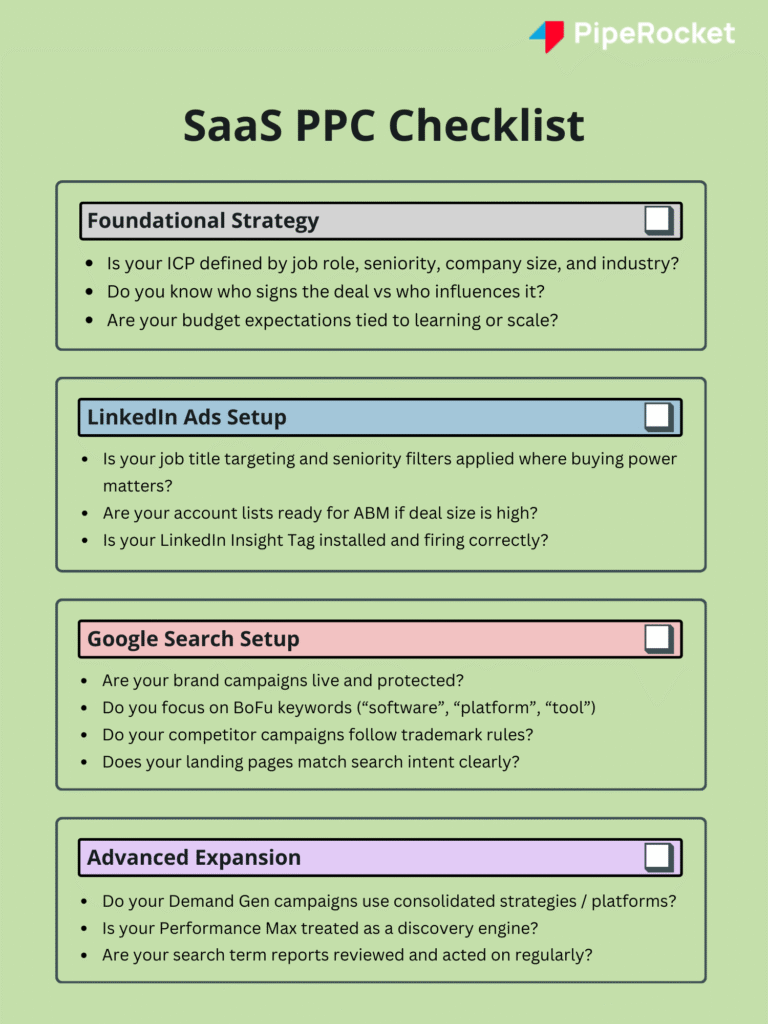
If this checklist already feels solid, PPC becomes a system. If it doesn’t, the rest of this guide will show you where things usually break and how to fix them.
Most SaaS PPC failures aren’t actually “ads” problems; they are “foundation” problems. If you don’t understand who you are talking to, no amount of bidding optimization will save your ROI. As emphasized in the core strategy, the first step is always Product Understanding. You must be able to describe the “Pain-Point-to-Product” bridge.
In B2B SaaS, your product is a solution to a specific professional friction. To market it, you need to know:
Budgeting for SaaS is rarely about having a fixed number; it’s about understanding the scope of the opportunity.
LinkedIn is the gold mine for SaaS because it allows for Identity-Based Targeting. While Google relies on what people search for, LinkedIn relies on who they actually are.
LinkedIn’s biggest advantage is its “Job Title” targeting. This allows you to bypass the noise and speak directly to decision-makers.
For high-ticket SaaS, broad targeting is too expensive. You need to move toward Account Lists.
To move prospects effectively through the funnel, you should implement three specific types of remarketing:
Continuing from our foundation, we move into the “Capture” phase. If LinkedIn is about identifying who your buyer is, Google Search is about identifying exactly when they are ready to solve their problem.
Check out our dedicated blog to avoid the common SaaS LinkedIn Ads mistakes
Google Search is the ultimate intent engine. In SaaS, people don’t just “browse” search results; they are looking for a tool to fix a specific friction in their workflow. To dominate this space, you must organize your account into three strategic pillars.
It is a common mistake for SaaS marketers to assume they don’t need to bid on their own brand name because they “already rank number one organically.” This is a dangerous oversight.
Generic campaigns focus on category keywords like “CRM software” or “Project Management tools.” The key here is segmenting by BOFU (Bottom of Funnel) intent.
In the SaaS world, bidding on your rivals’ brand names is standard practice. It allows you to present your software as the better alternative right when a user is researching the competition.
Once your core Search and LinkedIn engines are stable, you can leverage Google’s broader network. This is where you move from capturing demand to generating demand at scale.
Google’s “Demand Gen” campaigns are designed to simplify your workflow while maximizing reach across visual platforms like YouTube, Discovery feeds, and Gmail.
Many SaaS marketers fear PMax because it can feel like a “black box.” However, it is an incredible tool for Keyword Discovery.
It also targets high-intent users who have searched for your relevant terms and displays ads across places like discovery, YouTube, and display.
SaaS PPC works best when it is treated as a system, not a set of disconnected tactics. From building a strong strategic foundation to activating LinkedIn’s identity-based targeting and capturing real purchase intent on Google, every phase in this checklist serves a clear purpose. When these layers work together, PPC stops feeling reactive and starts becoming predictable.
Add AI-led expansion through Demand Gen and Performance Max, and you move from simply capturing demand to shaping it at scale. Use this checklist as your operating framework to keep strategy focused, execution disciplined, and growth sustainable.
A SaaS PPC checklist covers every stage of building a predictable acquisition system. It includes ICP definition, buyer vs. user mapping, budget strategy, LinkedIn targeting setup, Google Search structure, competitor campaigns, remarketing flows, and AI-led expansion through Demand Gen and Performance Max. The goal is to replace guesswork with a repeatable framework that supports long sales cycles and multi-stakeholder buying.
Start with the foundation before touching ads. Lock in your ICP, decision-maker roles, and budget expectations first. Then move step by step through LinkedIn and Google setup instead of launching everything at once. Treat the checklist as a diagnostic tool. Review it quarterly to identify weak links in targeting, intent capture, or funnel progression.
Yes, because the framework stays the same while execution changes. Startups use it to validate channels and find pockets of intent. Enterprises use it to bring consistency across large budgets, multiple regions, and complex account-based programs. The checklist adapts to scale without losing strategic discipline.
During an audit, open your ad accounts alongside the checklist and review each section one by one. Check if your ICP targeting is still accurate, whether brand and competitor campaigns are active, and if remarketing is set up across LinkedIn and Google. Then verify basics like tracking tags, conversion events, and landing page alignment. Use every unchecked item as a task for your next optimization cycle, so the audit leads directly to improvements instead of just observations.
Get fresh ideas, actionable insights and expert guidance for B2B events delivered
directly to your inbox!
Let’s be honest, most fixes to SaaS LinkedIn Ads mistakes are recycled and incomplete. “Define...
Read More →
I’ve sat in your chair. The pressure to fill the pipeline is real, and Google...
Read More →
You’ve probably heard of Account-based Marketing (ABM), the strategy where instead of casting a wide...
Read More →Please note that we only partner with 1-2 new clients per month
Book for Consultation