On This Page
If you run marketing for a B2B SaaS company right now, you've probably heard some version of this: "AI is killing organic search." Or the opposite: "AI is just a distraction — SEO still works." The problem is, most people saying either thing are working off vibes, not data.
We wanted to know what's actually happening. So we pulled 8 months of real analytics and CRM data from 53 B2B SaaS brands we work with — and looked at how organic search and AI referral traffic actually compare across traffic, leads, conversions, and pipeline. No estimates. No surveys. Just what we saw in the numbers.
Every stat you see with a copy button comes directly from that dataset. The industry stats in the final section are sourced separately, with links to the original research.
Key Takeaways
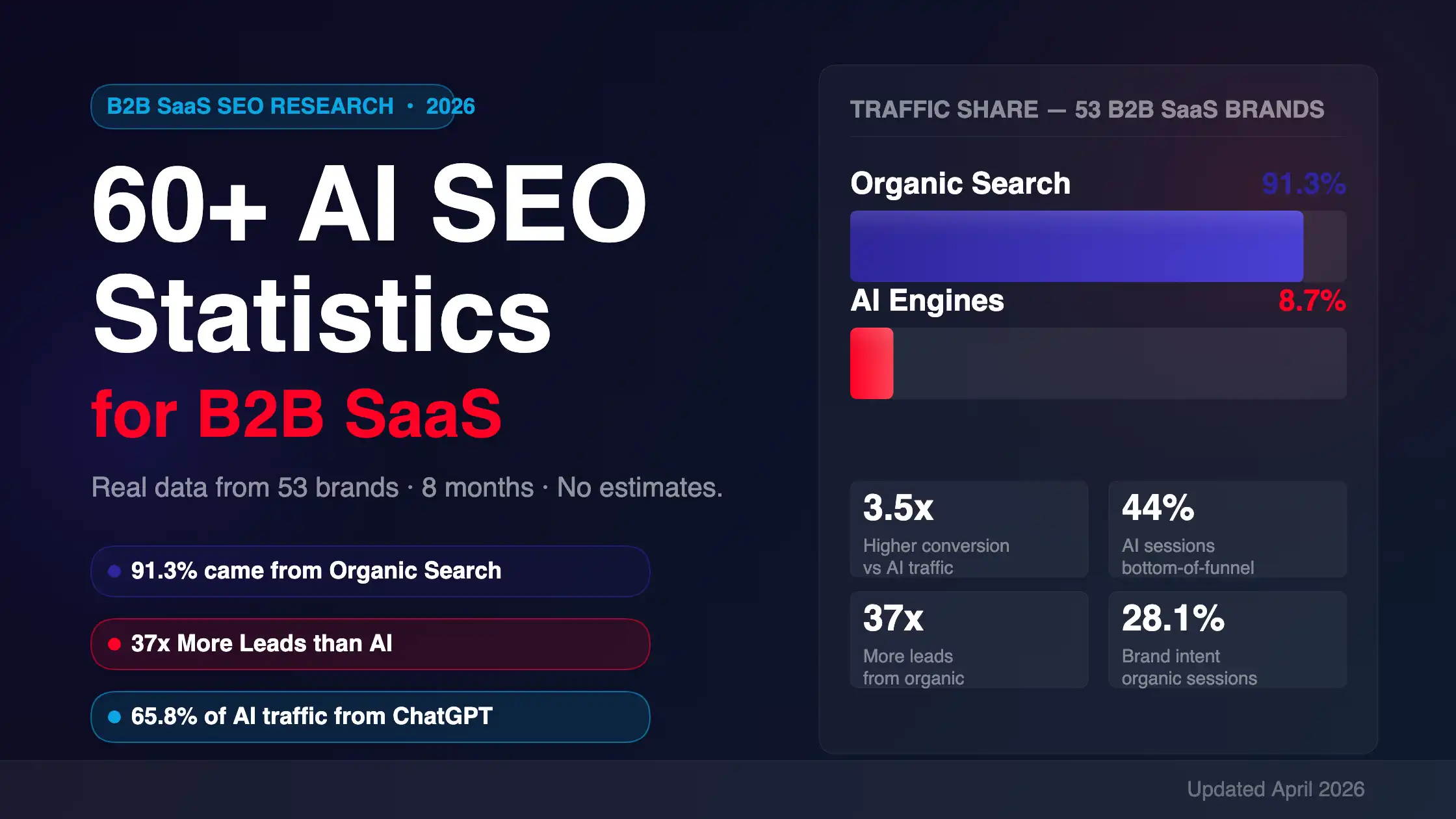
- Of all traffic analyzed across 53 B2B SaaS brands, 91.3% came from organic search and only 8.7% from AI engines.
- Organic generated 37x more leads than AI — and converted visitors at 3.5x higher rates.
- AI traffic skews harder toward BoFu: 44% of AI sessions were bottom-of-funnel vs. 41% for organic.
- Only 11.8% of AI-referred sessions carried brand intent, vs. 28.1% for organic.
- ChatGPT drove 65.8% of all AI referral traffic. Microsoft Copilot delivered the highest Lead-to-SQL rate at 35%.
- In cybersecurity SaaS, organic leads closed at 81% Lead-to-SQL vs. just 20% for AI-referred leads.
- Homepage conversions grew 6–9% MoM for 6 consecutive months — a signal of AI-driven discovery flowing into branded organic searches.
- The dark funnel hides an estimated 57–73% of the B2B buying journey from standard attribution tools.
AI vs. Organic Traffic Volume Statistics for B2B SaaS in 2026
These figures reflect the share of traffic across the 53 B2B SaaS brands we analyzed over 8 months — not industry-wide estimates.
- Of all traffic analyzed across 53 B2B SaaS brands, 91.3% came from organic search and 8.7% from AI engines combined.
- Organic search drove 11x more traffic than all AI engines combined across the brands studied.
- Of the AI referral traffic analyzed, ChatGPT accounted for 65.8% — by far the dominant AI referral source.
- Perplexity was the second-largest AI referrer, accounting for 24.6% of all AI-sourced traffic.
- ChatGPT and Perplexity combined accounted for 90.4% of all AI referral traffic to B2B SaaS sites.
- Google Gemini contributed 5.4% of AI referral traffic, Microsoft Copilot 3.1%, and Claude just 1.1%.
- Not a single vertical in the dataset showed AI traffic surpassing organic in absolute visit volume.
- Of all Top-of-Funnel traffic recorded, 83.4% came from organic search and 16.6% from AI engines.
- Of all Bottom-of-Funnel traffic recorded, 81.5% came from organic search and 18.5% from AI engines.
- In Customer Support SaaS, organic accounted for 87% of all traffic — the highest organic dominance of any vertical studied.
- Homepage conversions grew 6–9% month-over-month for 6 consecutive months, consistent with AI-driven discovery feeding into branded organic searches.
Image source: PipeRocket Digital — Share of total traffic across 53 B2B SaaS brands (8-month window)
AI vs. Organic Lead Generation and Pipeline Conversion Statistics for B2B SaaS
These figures compare how organic and AI-referred visitors converted across the funnel — from first visit, to lead, to Sales Qualified Lead — across the 53 brands in our dataset.
- Organic search visitors converted to leads at 0.92% — nearly 3.5x higher than AI-referred visitors at 0.26%.
- Across the dataset, organic generated 37x more leads in absolute terms than all AI referral sources combined.
- Organic leads converted to Sales Qualified Leads at 33.3%, compared to 28.6% for AI-sourced leads.
- Among AI platforms, Microsoft Copilot produced the highest Lead-to-SQL rate at 35%, ahead of ChatGPT (30%), Perplexity (25%), Gemini (20%), and Claude (15%).
- Copilot's Lead-to-SQL rate of 35% was 133% higher than Claude's 15%, despite both platforms sending comparable volumes of raw traffic.
- There was a 20-percentage-point spread in Lead-to-SQL rates across the five AI platforms tracked (35% Copilot to 15% Claude).
Engagement and On-Site Behaviour: Organic Search vs. AI Referral Traffic in B2B SaaS
Once visitors landed on site, organic and AI-referred users behaved very differently. These metrics reflect average on-site behaviour across the full dataset.
- Organic visitors spent an average of 4 minutes and 40 seconds on page — 75 seconds longer than AI-referred visitors (3m 25s).
- AI-referred visitors were 27% less engaged by time-on-page than organic visitors across the dataset.
- The bounce rate for organic traffic was 36.7%, vs. 43.6% for AI-referred traffic — a 6.9-point gap.
- Among AI platforms, Copilot-referred users had the highest engagement rate at 73.4%, followed by ChatGPT (69.1%), Perplexity (61.8%), Gemini (58.0%), and Claude (43.9%).
- There was a 29.5-percentage-point spread in engagement rates across the five AI platforms (73.4% Copilot vs. 43.9% Claude).
- Copilot's higher engagement is attributed to its embedding inside enterprise productivity tools — users arrive already in active "work mode."
Funnel Stage and Search Intent Distribution: AI Traffic vs. Organic in B2B SaaS
These figures show how the funnel composition and brand intent differed between organic and AI-referred sessions across the full dataset.
Image source: PipeRocket Digital — Funnel composition of organic vs. AI sessions
- Of all organic sessions analyzed, 59% were Top-of-Funnel and 41% were Bottom-of-Funnel.
- Of all AI-referred sessions analyzed, 56% were Top-of-Funnel and 44% were Bottom-of-Funnel — a proportionally stronger BoFu skew than organic.
- Despite AI's higher BoFu share, organic still drove 4.4x more BoFu traffic in absolute volume than AI across the dataset.
- 28.1% of organic sessions carried brand-name search intent. Only 11.8% of AI-referred sessions did — a 16.3-point gap.
- 88.2% of AI-referred sessions were non-branded, vs. 71.9% for organic — confirming AI surfaces categories before brands.
- In HRTech, 64% of organic sessions included branded queries, vs. just 4% of AI-referred sessions — a 60-point brand-intent gap.
Lead-to-SQL Conversion Rates by SaaS Vertical: Organic Search vs. AI Referral
Organic and AI traffic behaved very differently depending on the SaaS vertical — particularly where trust, compliance, or risk played a major role in the buying decision.
Image source: PipeRocket Digital — Lead-to-SQL conversion rate by SaaS vertical
- In Cybersecurity SaaS, organic leads converted to SQLs at 81%. AI-referred leads converted at just 20% — a 61-point gap driven by trust requirements.
- In Procurement SaaS, organic leads converted at 75% Lead-to-SQL, while AI-referred leads converted at 54% — the highest AI conversion rate of any vertical studied.
- In Fintech SaaS, both channels underperformed: organic at 25% Lead-to-SQL and AI at 20%, reflecting a high-scrutiny due diligence buying process.
- In Customer Support SaaS, organic held 87% of all traffic. Buyers in established categories appear to bypass AI and search directly for known vendors.
- In HRTech, 64% of organic traffic was branded vs. only 4% of AI traffic — AI functions almost entirely as a top-of-funnel discovery tool in this vertical.
- In Fintech, buyers appear to use AI to shortlist vendors, then switch to organic search for compliance and security verification before converting.
AI Platform Performance Statistics: ChatGPT, Perplexity, Copilot, Gemini and Claude for B2B SaaS
Across the five AI platforms tracked, traffic volume, on-site engagement, and pipeline conversion varied significantly.
Image source: PipeRocket Digital — Share of AI referral traffic by platform
| AI platform | Share of AI traffic | Engagement rate | Lead-to-SQL rate |
|---|---|---|---|
| Microsoft Copilot | 3.1% | 73.4% | 35.0% |
| ChatGPT | 65.8% | 69.1% | 30.0% |
| Perplexity | 24.6% | 61.8% | 25.0% |
| Gemini | 5.4% | 58.0% | 20.0% |
| Claude | 1.1% | 43.9% | 15.0% |
- ChatGPT drove 65.8% of all AI referral traffic — more than 2.6x Perplexity's share and over 60x Copilot's share.
- Despite contributing only 3.1% of AI traffic, Copilot delivered the highest Lead-to-SQL rate (35%) and highest engagement rate (73.4%) of any AI platform.
- Claude contributed only 1.1% of AI referral traffic and had the lowest engagement (43.9%) and Lead-to-SQL rate (15%) of all platforms tracked.
- Gemini's 20% Lead-to-SQL rate matched Fintech organic performance — suggesting Gemini-referred users were in early, exploratory research phases.
AEO and GEO Statistics: How B2B Buyers Use AI in the Purchase Journey
Beyond our proprietary dataset, here is what broader industry research tells us about AI's role in B2B buying behaviour and how to optimize for AI citation and visibility.
- 89% of B2B buyers now use generative AI at some point in their buying process. (source — Forrester, via Discovered Labs)
- B2B buyers complete 60–70% of their purchase research before ever contacting a vendor's sales team. (source — Gartner, via Martal)
- 92% of B2B buyers start with at least one vendor already in mind, and 41% have a single preferred vendor selected before formal evaluation begins.
- 95% of the time, the winning vendor is already on the buyer's Day One shortlist — before a single sales conversation takes place.
- Adding statistics and data points to content increases AI visibility by 22%. Including direct quotations boosts it by 37%.
- Pages with proper schema markup are 30–40% more likely to be cited in AI-generated answers.
- GEO optimization techniques can boost AI content visibility by up to 40% through statistics inclusion, structured formatting, and comprehensive topic coverage.
- Content with clear, verifiable data points earns roughly 30–40% more visibility in LLM-generated answers than purely qualitative content.
- Brand search volume — not backlinks — is the strongest predictor of AI citations, with a 0.334 correlation to LLM visibility.
- Establishing entity presence across 4+ third-party platforms increases AI citation likelihood by 2.8x.
- Only 11% of domains are cited by both ChatGPT and Perplexity — platform-specific GEO optimization is essential, not optional.
- Brands in the top quartile for web mentions receive over 10x more citations in AI Overviews than those in the second quartile.
- AI referral traffic grew 527% year-over-year between January and May 2025 — yet most analytics platforms still misattribute it as direct traffic.
- The dark funnel hides an estimated 57–73% of the B2B buying journey from attribution tools.
- When AI Overviews appear in Google results, organic CTR drops from 1.41% to 0.64% — a 54.6% decline.
- Only 38% of AI citations now come from top-10 organic results, down from 76% in mid-2025.
- Across all industries, YouTube (~23.3%), Wikipedia (~18.4%), and Google.com (~16.4%) are the three most cited domains in AI Overviews.
- 38% of Americans now use AI tools like ChatGPT and Perplexity as their primary search interface as of 2026.
- Listicle and comparison formats are selected for AI citation approximately 2.5x more often than narrative content — comparative listicles win 32.5% of all AI citations.
- Nearly half of SEO experts (48.6%) identified Digital PR as the most effective link-building tactic for 2025.
- The overlap between top Google results and AI-cited sources has dropped from 70% to below 20% as of late 2025.
- Organic search is projected to remain the #1 B2B pipeline channel through at least 2028 — but brands winning AI citation will hold a decisive share-of-voice advantage in the discovery phase.
- AI platforms generated over 1.1 billion referral visits in June 2025 — up 357% year-over-year.
- Despite this growth, AI platforms drive an average of only 1% of overall web traffic across 10 major industries — organic search still dominates in absolute volume.
- From September to November 2025, ChatGPT referrals increased 52% year-over-year, while Gemini referral traffic grew 388% in the same period.
- Analysis of 12 million website visits found AI search traffic converts at 14.2% compared to Google organic's 2.8% — roughly 5x higher.
- Gartner predicts traditional search volume will drop 25% by 2026 as AI agents replace Google for product research among B2B buyers.
- Gartner also projects that 90% of B2B purchases will be agent-driven by 2028 — making AI visibility a prerequisite for pipeline, not just awareness.
- Nearly half of B2B buyers now use AI platforms like ChatGPT and Claude for vendor research, according to HG Insights' 2025 buyer behavior analysis.
- When an LLM surfaces a vendor a B2B buyer had not previously considered, 51% go directly to that vendor's website — making AI citation a new top-of-funnel acquisition channel.
- The GEO market was valued at approximately $848 million in 2025 and is projected to reach $33.7 billion by 2034 — a 50.5% CAGR.
- AI search traffic across SaaS brands is growing at an average of 41% month-over-month, while organic grows at roughly 2–3% MoM — but organic still leads in absolute conversion volume.
- Between 40% and 60% of cited sources change month-to-month across Google AI Mode and ChatGPT — making AI citation far less stable than organic rankings.
- 44.2% of all LLM citations come from the first 30% of a page — your intro and opening paragraphs are your highest-leverage section for AI visibility.
- Commercial intent prompts are much more likely to trigger a web search in ChatGPT (53.5%) compared to informational queries (18.7%) — making BoFu content critical for AI citations.
- ChatGPT only cites 15% of the pages it retrieves — 85% of sources retrieved during a search session are never cited in the final response.
- Sites with over 32,000 referring domains are 3.5x more likely to be cited by ChatGPT than sites with up to 200 referring domains.
- The zero-click rate on Google exceeded 65% in Q1 2026, up from 58.5% in late 2025. On mobile, it reaches 77%.
- AI Overviews now trigger on 30%+ of Google queries in 2026, up from just 13% in March 2025 — and when they appear, organic CTR drops by 61%.
What the Data Means for Your B2B SaaS Strategy in 2026
AI is not replacing organic search — it is acting as an untracked discovery layer that ultimately fuels branded organic searches. The brands that win in 2026 will be those that protect their organic foundation while surgically optimizing for AI citation.
- Double down on core SEO. Organic is still the primary engine of predictable pipeline. Do not divert core SEO budget to LLM optimization prematurely.
- Optimize BoFu pages for AI. Surgically optimize high-intent, feature-comparison, and bottom-of-funnel pages for LLM crawlers using clear HTML tables, "X vs Y" headings, and FAQ sections.
- Target the right AI platforms. Prioritize ChatGPT for general visibility. Build specific strategies for Microsoft Copilot and Gemini to capture high-intent enterprise buyers in "work mode."
- Close the attribution gap. Add a "How did you hear about us?" field to your demo forms. AI's true impact on pipeline is being significantly underreported by standard attribution tools.
Stats in sections 1–6 are sourced from PipeRocket Digital's proprietary 8-month analysis of 53 B2B SaaS brands. Stats in section 7 are drawn from third-party industry research published in 2025–2026, with individual sources linked inline.