SEO
SaaS SEO: How to do SEO for SaaS Companies (From Experience)
PipeRocket
|
24 November, 2025
SEO
PipeRocket
|
24 November, 2025
If you’re running a SaaS company in 2026, you probably already know that the old playbooks for SEO are dead. It is no longer enough to just stuff keywords into a blog post or chase traffic numbers. I believe we need to strip away the vanity metrics to focus on what actually matters: revenue.
The reality is that SaaS SEO requires a blend of deep product knowledge, technical precision, and a shift in how we view topical authority.
Based on my 10+ years of experience, I want to walk you through building a complete SaaS SEO strategy. From defining your Ideal Customer Profile (ICP) to mastering the nuances of brand citations over backlinks, this blog teaches how you can build a search presence that actually converts.
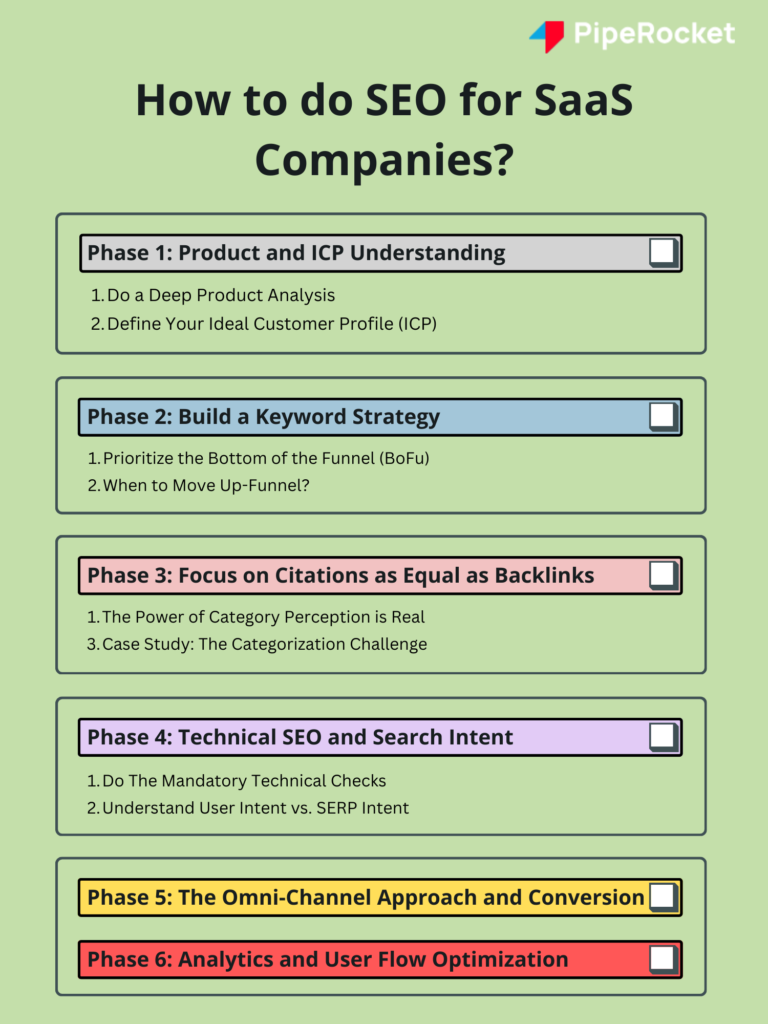
Before I even touch a keyword tool or write a single line of content, I always start with the absolute basics: a complete “download” of the product. Many SEO strategies fail because the marketing team doesn’t truly understand what they are selling.
The first step is achieving a complete understanding of the product itself. This goes far beyond just reading a feature list. You need to intimately understand the Unique Selling Proposition (USP) and, more importantly, the specific business problem the software solves.
You have to ask the hard questions: What are the exact pain points we are addressing? What features are available to solve them? These are the important especially for SaaS SEO.
You must also understand how your features differentiate you from the competition. How is your positioning different from other brands in the same space?
Without this foundational knowledge, you cannot market a product effectively. While this sounds like the general Go-To-Market strategy, the SaaS SEO lead must fully internalize this perspective to move forward and succeed.
Once the product is understood, we move to the audience. You need to define the ICP at two distinct levels: the company level and the employee level.
In B2B SaaS, the person searching for a solution isn’t always the person signing the deal. This is why I always segregate ICPs into specific roles:
For example: Support agents who deal with repetitive tickets every day and feel the pain of slow response times.
For example: The Head of Customer Experience who wants better CSAT scores and smoother workflows.
For example: The VP of Operations and the CFO who approves the purchase after seeing how the Customer Support tool can cut costs and improve retention.
By mapping these out, we can identify specific pain points for each level of the persona. The frustrations of a User are different from those of an Influencer, and your SaaS SEO strategy must address both.
With our ICPs defined and pain points mapped, we can finally move to step-by-step keyword research. But I’m not just gathering high-volume terms; I’m building a revenue engine.
Traditionally there are three levels in the marketing funnel:
Top of the funnel (ToFu): Where the user is either unaware of the problem or mildly aware of it.
Middle of the funnel (MoFu): Where the user is looking out for solutions for their problem
Bottom of the funnel (BoFu): Where the user is on the verge of buying and is actively comparing different solutions to make a decision.
Here is where my strategy diverges from the traditional “marketing funnel” approach which focuses on ToFu content first. I, however, prioritize Bottom of the Funnel (BoFu) content first.
Why? Because BoFu queries are transactional. These are users who are ready to buy or are actively comparing solutions. Since every marketing effort needs to be geared toward generating revenue, I focus my energy here to capture high-intent leads coming in as soon as possible.
Only after we have pushed the BoFu content as much as possible do we move up the funnel to “Middle of the Funnel” (MoFu) or “Top of the Funnel” (ToFu) content.
The logic is simple: if you want immediate leads, you go for BoFu. If you want to position yourself as a subject matter expert for the long term, that is when ToFu becomes the priority.
One of the most critical shifts in the industry is the changing nature of off-page SEO. In the past, it was all about building backlinks. Today, for SaaS companies, it is about brand citations and how authority websites perceive you.
SaaS SEO is heavily influenced by how the internet sees your brand. This means it matters what credible, authoritative websites say about you. I’m talking about platforms like Gartner, G2, and Capterra.
This also includes community forums like Reddit and Quora. If you have noticed, Reddit and Quora queries have crept up in searches as they present the people’s voice.
These platforms effectively define your category for search engines. If you are a procurement tool, but the internet thinks you are a “spend management” tool, you are going to face an uphill battle.
To illustrate this, let’s look at a real-world example involving one of our clients.
The company wanted to shift its positioning and rank for keywords in a new category – let’s call it ” X “. However, historically, their webinars, events, and existing citations had positioned them in the category ” Y ” – the one they were initially focusing on.
When looking at the search results for ” X “, the rankings were dominated by lists from G2 and Capterra.
The client wasn’t getting listed in those lists because the authority sites categorized them in ” Y “. Even though they had a relevant product, the “internet” didn’t see it that way.
The solution is not as easy as writing more blogs for ” X “. We had to actively go out and re-change the citations. We had to ensure that wherever the brand was mentioned, it was updated to match the new category.
After which, we started to rank for keywords in the new category. This proves that managing your citations on review sites is often equally important as traditional backlinks.
While brand positioning is strategic, the technical foundation of your website must be flawless.
I consider technical SEO aspects like crawling, page speed insights, and mobile responsiveness to be a mandatory standard, not an option. You must ensure these elements are implemented with 100% accuracy. The goal is to make the search engine’s job easy. If you make Google’s effort effortless, it is far more likely to consider ranking your content.
When creating content, we often look at the SERP Intent, i.e, what Google currently shows for a query. For example, if you search for “best CRM software,” Google might show ten listicle type blogs.
However, I warn against blindly following the SERP intent. You must balance it with User Intent, i.e, what the user actually wants. Sometimes, optimizing your homepage for a high-value keyword and matching it with the user intent is more effective than writing a listicle, even if the search results mostly consist of lists.
Driving traffic to your site is meaningless if that traffic doesn’t convert. This brings us to Conversion Rate Optimization (CRO) and the omni-channel approach.
SaaS SEO is about bringing in traffic that converts. This requires running multi-variation tests to ensure users engage with the website. When a user engages with your content, it builds brand recognition and increases the likelihood of them coming back.
SaaS SEO does not exist in a vacuum. It is evolving into an omni-channel approach. I recommend integrating SaaS SEO with paid ads and outbound sales to generate revenue.
Here is how the loop works:
This is an active strategy we use at PipeRocket Digital ourselves and the journey of the user can be clearly seen using tools like Factors AI. You see them first interact with your blog, then interact with your LinkedIn retargeting ads, then come back to the website a week or so later.
Finally, we must use data to refine the user experience continuously. Tools like Google Analytics (GA4), and Microsoft Clarity allow us to track where users are engaging and where they are dropping off.
Small tweaks in user flow can yield massive results. In one instance, our team analyzed the data for a homepage and realized the user flow was broken. The users weren’t moving down the page as intended. They didn’t rewrite the copy or add new content. Instead, they simply rearranged the existing sections to match the logical flow the users expected.
This simple mismatching of sections increased user engagement, session duration, and overall flow efficiency by 30%. This proves that sometimes your content is good, but your structure needs to be optimized to help the user digest it effortlessly.
By understanding these common mistakes, you can save your SaaS agency from wasting its efforts and build a SaaS SEO strategy that gets your results in the form of demos, sign-ups, and revenue.
Let’s take a look at what they are.
A number of SaaS companies chase high-volume keywords that have no relevance to their audience, product, or buyer intent. Such keywords may bring traffic, but they don’t bring conversions. For SaaS SEO to work, it’s important that you stay relevant to your business and align with your customers’ pain points. Simply put, your goal is not just to boost visibility but to find people who want to buy from you.
Your success is not in rising social shares, page views, or impressions. These vanity metrics may appear impressive, but they deliver no value in terms of business. What matters is how much of your organic traffic is signing up, taking demos, and trials, or bringing long-term revenue. SaaS SEO should be able to bring monetary results and not just surface-level numbers.
The blog section on your website is not a standalone content library. It must be integrated into your sales funnel. If you can link your product and feature pages in your blogs properly, you can never attract customers the way you want. The goal of the content you post in your blogs must be to guide your readers from educational content to solution-driven pages, such as your feature and product pages. If you don’t follow this structure, any written content will underperform.
It goes without saying that AI has changed the way people search. By 2026, it is expected to strongly impact SaaS SEO. For AI-powered platforms like ChatGPT, Google’s AI Overviews, Gemini, and Perplexity, Generative Engine Optimization (GEO) and Answer Engine Optimization (AEO) have proved to be critical strategies. In fact, according to recent data, 58% of searches now result in zero clicks due to AI summaries.
This clearly means that for SaaS agencies, their content must be optimized for how AI systems understand and cite information, and not just according to the traditional search engine guidelines. So, instead of just trying to rank higher in the search engines, brands must create content as per the AI models.
As per Gartner, by 2026, a 25% decline in traditional organic search volume as more traffic shifts toward AI-driven responses. This requires SaaS businesses to invest their efforts in GEO and structure their content as per machine readability and optimize it for entity-based SEO. By doing so, SaaS businesses can become visible and relevant in the rising AI-first search world.
Mastering SEO for SaaS companies in 2026 requires a fundamental shift in mindset. It is all about building a revenue-focused engine that aligns product, technical excellence, and brand authority.
Success only comes when you define a granular ICP, prioritize the transactional content that drives revenue, and meticulously manage how your brand is cited across the web. When you combine this with an omni-channel approach, by retargeting your organic traffic and optimizing your user flow based on hard data, SaaS SEO becomes more than just a marketing tactic. It becomes a reliable, scalable driver of business growth.
My goal for you is simple: make the experience effortless for Google, and indispensable for your user.
If you need any help with SEO for your SaaS company, PipeRocket Digital is always ready to lend our experienced hands. Contact us and let’s discuss how we can generate your pipeline.
1. What is SaaS SEO?
SaaS SEO is the process of optimizing a Software-as-a-Service (SaaS) website to improve visibility on search engines and attract high-paying customers. It combines product and ICP understanding to create useful resources for the ideal customers. SaaS SEO includes technical optimization, content marketing, user intent marketing, and a product-led growth mechanism so that your target audience finds you when they need what you sell.
2. How to start with SaaS SEO?
To effectively start with SaaS SEO, you need to move beyond basic keyword research and build a revenue-first foundation that deeply aligns your product with the specific intent of your buyers.
Deep Product & USP Analysis: Before writing a single word, map out exactly what business problem you solve and how you differ from competitors. You cannot market what you do not fully understand.
Granular ICP Segmentation: In SaaS SEO, you should not just target “companies.” Split your audience into daily users, influencers, and the buyers. You must map unique pain points to each role to capture the entire buying committee.
Flip the Content Funnel: Prioritize Bottom of the Funnel (BoFu) content first. Target high-intent, transactional keywords (like “best [category] software” or “competitor alternatives”) to generate leads immediately before focusing on broader educational traffic.
Audit Your Category Perception: Ensure your brand is accurately categorized on authority platforms like G2, Capterra, and Gartner. Search engines rely on these citations to understand what you do, often more than they rely on traditional backlinks.
3. What are some SEO tools we can use for a SaaS SEO strategy?
For SaaS SEO keyword research and competitor insights, you can use Ahrefs, SEMrush, and Moz. To optimize content, use SurferSEO and Clearscope. Use Google Search Console, Google Analytics, Screaming Frog, and PageSpeed Insights for technical monitoring.
Get fresh ideas, actionable insights and expert guidance for B2B events delivered
directly to your inbox!
Running a SaaS company right now… it feels like standing in a room that just...
Read More →
I see this mistake constantly. A marketing VP at a massive enterprise company decides to...
Read More →