SaaS Content Marketing: A Complete, No-Fluff Guide
 Kamaraj Mathiarasan (Kim)
Last updated on
Kamaraj Mathiarasan (Kim)
Last updated on
Ever feel like SaaS marketing moves faster than you can keep up? You publish a blog, it ranks on page one, and next week it’s gone. That’s the reality of SaaS Content Marketing in 2026, where AI search, GPT and Gemini keep changing how people find you. Buyers don’t want buzzwords. They want clear answers the moment they search.
SaaS is different because the journey is longer and people don’t just buy once, they subscribe. Your content has to do more than attract clicks. It needs to guide, teach, and support users before and after they become customers.
In this guide, we’ll show you what works now and how to build a content engine that keeps you visible, trusted, and chosen.
What is SaaS Content Marketing?
SaaS content marketing is the practice of creating simple, helpful content that explains your SaaS product and guides people from first search to becoming loyal users. It answers common questions, shows real use cases, and connects features to outcomes.
Instead of just chasing clicks, SaaS content supports trials, demos, onboarding and ongoing product usage. It helps buyers compare tools, see value faster and feel confident in their choice. In short, it uses content to reduce confusion and grow subscription revenue.
TL;DR
-
SaaS content marketing creates simple, helpful content that explains your product and guides buyers from first search to onboarding and long-term adoption.
-
It matters because SaaS buyers do deep research, compare many tools, and prefer self-serve learning before talking to sales.
-
A strategy starts with business goals and KPIs tied to MRR, ARR, and churn, not just traffic.
-
Content is mapped to buyer personas and their specific jobs-to-be-done.
-
Keyword and topic research is grouped into clusters that match informational, commercial, and transactional intent.
-
The strongest SaaS content in 2026 leads with original data and firsthand product experience over AI-generated summaries of what competitors already said.
-
Retention content (onboarding, knowledge bases, feature guides) matters as much as acquisition content because SaaS revenue is recurring.
Why SaaS Content Marketing Is Different?
SaaS Content Marketing is different from generic content marketing because it has to support a longer journey and a subscription business model. You’re not just making a one-time purchase, you’re trying to earn trust, close deals, keep customers, and grow accounts over years.
1. The SaaS Buyer Journey is Complex
Most SaaS deals don’t have a single buyer. Users, managers, technical evaluators, founders, and finance all care about different things. The journey is non-linear: people bounce between search, review sites, your blog, docs, and demos. Content has to answer each persona’s questions, reduce risk, and help the group align on a choice.
2. Subscription Model Requires Retention & Expansion
Because revenue is recurring, churn hurts more. Content must go beyond acquisition: onboarding guides, how-to content, and success playbooks help users get value faster and stay longer. Advanced use-case content and integration stories make upgrades and expansion feel like a natural next step.
3. Educate-before-you-sell is Critical
Many SaaS products solve complex or unfamiliar problems. Buyers research before they talk to sales. Educational content that explains problems, frameworks, and options builds trust, so your product pitch feels like a helpful next step, not a hard sell.
4. Organic & SEO Matter More in SaaS
Paid channels are expensive for long SaaS cycles. High-intent organic traffic is cheaper over time and compounds. Strong SEO content around problems, use cases, and comparisons becomes a library of always-on assets that support marketing, sales, and success.
Building Your SaaS Content Marketing Strategy
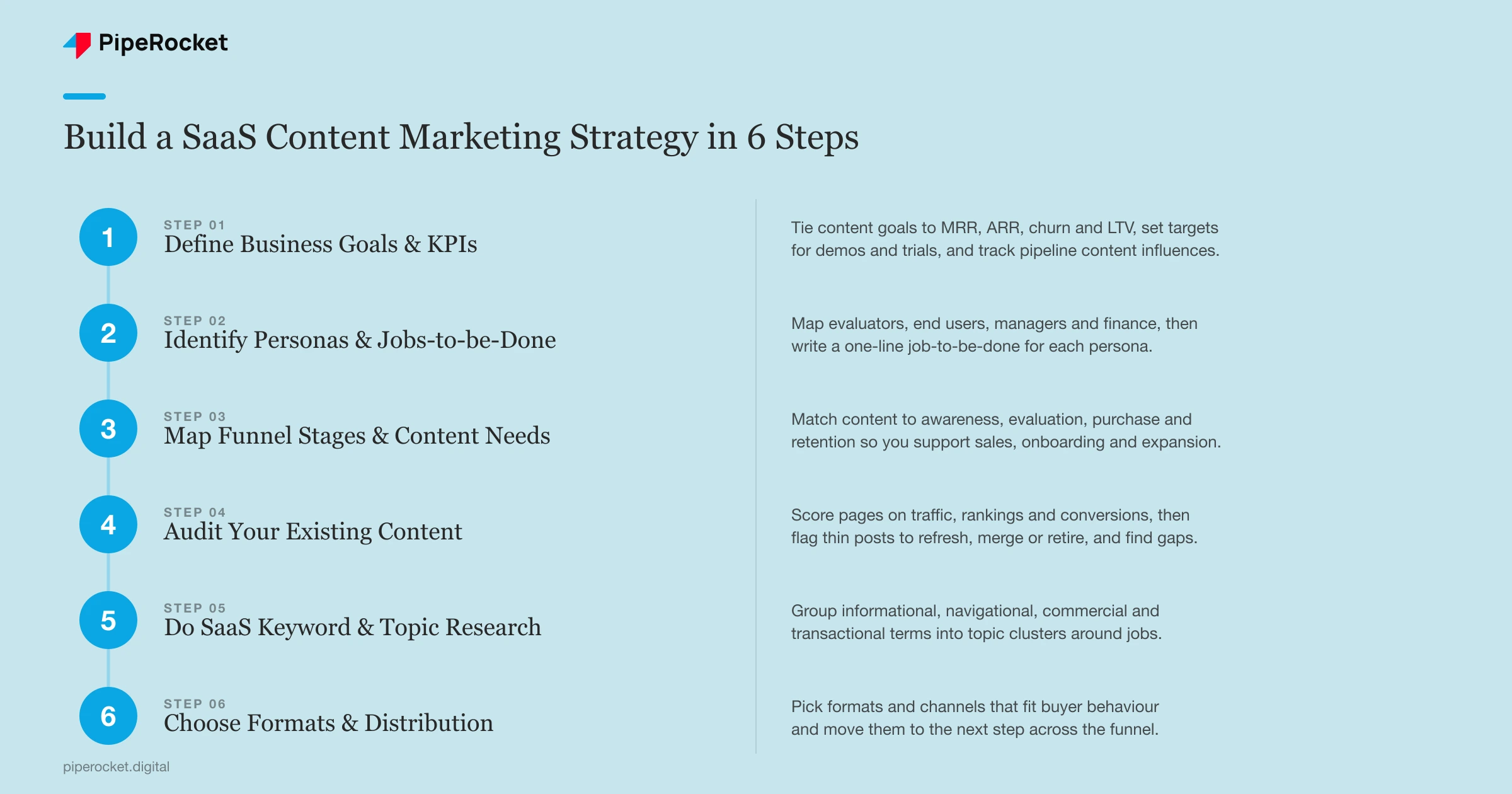
Build a SaaS content marketing strategy in six steps: set business goals and KPIs, define personas and their jobs-to-be-done, map content to funnel stages, audit existing content, do SaaS keyword research , then pick formats and distribution channels. This is the marketing execution guide; for the deeper planning framework, see our companion SaaS content strategy resource.
SaaS Content Marketing works best when you treat it like a system. The goal is to design a saas content marketing strategy that connects content to revenue, not traffic.
Step 1: Define Business Goals & KPIs
Start with what the business needs and how content should support growth.
- Link content goals to MRR, ARR , churn and LTV.
- Set targets for organic demos, trials or signups.
- Track pipeline and closed-won deals influenced by content.
This keeps your SaaS content strategy tied to real outcomes and makes reporting simple for leaders.
Step 2: Identify Buyer Personas & Map to Job-to-be-Done
Then get clear on who you’re talking to and what they’re trying to do.
- Technical evaluators: care about stack, security, reliability.
- End users: care about ease of use and workflow.
- Managers / GMs: care about results and team performance.
- Finance / procurement: care about price and risk.
For each persona, write a one-line job-to-be-done. This keeps your content strategy for saas sharp and focused.
Step 3: Map Funnel Stages & Content Needs
Next, map content to each stage of the SaaS funnel.
- Awareness: problem and “how-to” content.
- Evaluation: comparisons, case studies, buying guides.
- Purchase: ROI pages and pricing explainers.
- Onboarding / retention: tutorials and success playbooks.
This stops you from over-focusing on top-of-funnel and ensures you support sales, onboarding and expansion.
Step 4: Audit Your Existing Content
Before creating anything new, audit what you already have to find winners, gaps, and outdated pages. A content audit shows which articles to refresh, merge, or retire.
- Score existing pages on traffic, rankings, and conversions.
- Flag thin or outdated posts to update or consolidate.
- Spot missing topics and funnel stages your library never covers.
A regular SaaS content audit stops you rebuilding assets you already own and points your budget at the pages closest to ranking.
Step 5: Perform Keyword & Topic Research Tailored for SaaS
Now match topics to how people search.
- Informational: “how to”, problems, frameworks.
- Navigational: brand and competitor searches.
- Commercial: “best”, “vs”, “alternatives”.
- Transactional: “pricing”, “demo”, “trial”.
Group these into topic clusters around problems, features and jobs. This helps your SaaS Content Marketing show up in organic search, AI Overviews and answer boxes.
Step 6: Choose Content Formats & Distribution Channels
Finally, pick formats and channels that fit buyer behaviour.
- Blog posts, ebooks, webinars, docs, case studies, community content.
- SEO, email, in-app prompts, social, review sites, partners.
Together, these form a complete content marketing strategy for saas that meets buyers where they are and moves them to the next step.
Content Formats & Examples That Work in SaaS
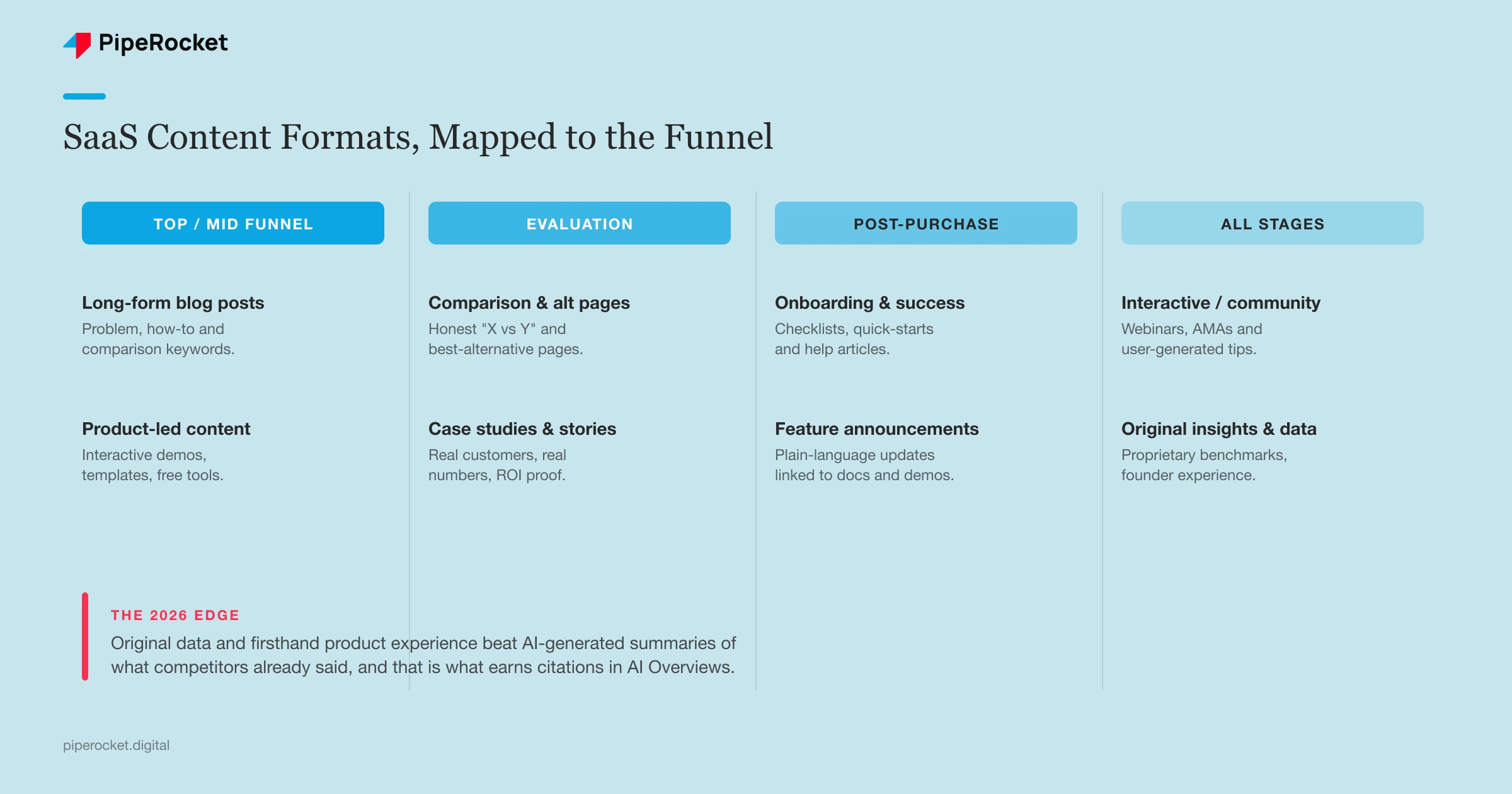
The SaaS content formats that convert are long-form educational posts, product-led content, comparison and alternative pages, case studies, onboarding and success content, feature updates, and community content. Each one maps to a funnel stage, so buyers get the right proof at the right moment.
| Content Type | Funnel Stage | Example / Use |
|---|---|---|
| Long-form educational blog posts | Top / mid | Problem, “how-to,” and comparison keywords |
| Product-led content | Top / mid | Interactive demos, template libraries, free tools |
| Comparison & alternative pages | Evaluation | Honest “X vs Y” and “best alternative to Y” pages |
| Case studies & user stories | Evaluation / purchase | Real customers, real numbers, ROI proof |
| Onboarding & customer success content | Post-purchase | Checklists, quick-start guides, help articles |
| Feature announcements & release notes | Post-purchase | Plain-language updates linked to docs and demos |
| Interactive / community content | All stages | Webinars, AMAs, user-generated tips and templates |
| Original insights & first-party data | All stages | Proprietary benchmarks, founder experience |
1. Long-Form Educational Blog Posts (Top/Mid Funnel)
Long-form posts are the core of SaaS Content Marketing at the top and middle of the funnel. They help buyers understand problems and options before they speak to sales.
- Target problem, “how-to,” and comparison keywords.
- Add simple examples and light product walkthroughs.
According to Gartner, B2B buyers spend only 17% of the purchase journey meeting with potential suppliers, so strong educational content lets you join their shortlist early.
2. Product-Led Content (Top/Mid Funnel)
Product-led content lets buyers experience your SaaS before they ever talk to sales, using interactive demos, template libraries, and free tools instead of a pitch.
- Publish interactive demos and sandbox walkthroughs of core workflows.
- Offer template libraries, calculators, and free tools tied to real jobs.
This format turns your product into the marketing asset, so prospects reach an “aha” moment on their own and arrive at demos already convinced.
3. Comparison & Alternative Pages (Evaluation)
Comparison and alternative pages capture high-intent buyers who are actively choosing between tools, using honest “X vs Y” and “best alternative to Y” content.
- Build “vs” pages and use case pages around the competitors buyers weigh.
- Be honest about where each tool fits, including where a rival wins.
These pages rank for commercial-intent searches and let you frame the decision on your terms while buyers are close to purchase.
4. Case Studies & User Stories (Evaluation / Purchase)
Case studies turn SaaS Content Marketing from promise into proof with real customers and real numbers.
- Highlight the customer, their problem, and starting point.
- Share clear, specific results tied to impact.
In Storylane’s case, PipeRocket’s campaigns drove 2.5X growth and 62% more demos in one quarter while keeping per-SQL costs steady, showing how focused content plus demand gen can lift pipeline and revenue.
5. Onboarding Content & Customer Success Content (Post-Purchase)
Post-purchase content keeps new users moving after signup so they reach value fast.
- Use checklists, quick-start guides, and short videos .
- Turn common support questions into simple help articles.
Clear onboarding and success content reduce confusion and churn and help users discover more features on their own.
6. Feature Announcements, Release Notes & Product Marketing Content
Feature content shows that your SaaS is improving all the time.
- Explain what changed and why it matters in plain language.
- Link to docs, tutorials, or a short product demo.
Done well, these updates keep customers engaged and make upsell and cross-sell feel like a natural next step.
7. Interactive / Community Content (e.g., Q&A, Webinars, User-Generated)
Interactive and community content lets buyers learn with you, not just from you.
- Host webinars, office hours, or AMAs around key problems.
- Encourage user-generated tips, templates, and examples.
These formats humanise your brand and create high-intent content you can slice, repurpose, and use across the funnel.
8. Original Insights Over Generic or AI-Written Content
The strongest SaaS content in 2026 leads with original data and firsthand product experience, because AI-generated summaries of what competitors already said add nothing a buyer (or an answer engine) cannot find elsewhere.
- Publish proprietary benchmarks, survey data, and results from your own accounts.
- Bring in founder and practitioner experience, real numbers, and specific examples.
On using AI well: treat it as a drafting and editing assistant that speeds up structure and cleanup, not as the source of the ideas. Use AI to improve clarity and pace, then layer in the original data, opinions, and stories only your team can provide. That mix is what earns citations in AI Overviews and keeps your content from blending into the sea of generic posts.
Distribution & Promotion for SaaS Content
Distribution and promotion for SaaS content is the process of getting your content in front of the right buyers through search, email, social, paid channels , and in-product experiences. It ensures your SaaS Content Marketing doesn’t sit unnoticed and instead becomes a steady, predictable growth engine.
1. SEO & Organic Search as a Backbone
Search is where most SaaS research begins, so SEO should anchor your distribution plan.
- Fix on-page basics: titles, H1s, meta descriptions , alt text , internal links .
- Build topic clusters and pillar pages around core problems and use cases.
According to Gartner’s 2026 B2B Sales Survey, 67% of B2B buyers now prefer a rep-free buying experience, meaning they rely heavily on search, online content, and AI-driven results, making organic visibility essential.
2. Email & Drip Campaigns for Nurture
Email keeps your best content in front of people who already raised their hand.
- Turn blog downloads, signups, trials, and demos into segmented nurture flows.
- Share onboarding guides, tutorials, comparison content, and feature education gradually.
Email builds trust over time and helps move prospects from reading your content to actually using your product.
3. Social & Community Channels
Social platforms and communities are where SaaS conversations happen.
- Post bite-sized insights on LinkedIn and niche industry groups.
- Join communities where your ICP hangs out and answer questions simply.
This boosts reach, brand recall, and credibility without sounding salesy.
4. Paid Amplification & Partnerships
Paid channels help new content get early momentum.
- Boost high-value assets with paid social or search.
- Co-create guides, webinars, and case studies with integration partners.
Partnerships give you access to warm, high-intent audiences without high CAC.
5. Integrating with Product/UX
Your product is a powerful distribution channel on its own.
- Embed guides, tooltips, videos, and checklists directly inside the product.
- Link blog posts, docs, and help articles to relevant in-app moments.
This improves activation, reduces support load, and supports adoption naturally.
How to Measure the Performance of Your SaaS Content Marketing?
Measuring the performance of SaaS Content Marketing is about seeing how content influences awareness, product intent, and long-term user value. Because SaaS uses a subscription model, your metrics must show not just interest, but whether users stay, adopt features, and get value over time.
Track five core metrics and tie each one to a business goal so you can see real impact, not vanity numbers. When these move up together, your content is attracting buyers, helping them understand your product, and supporting them past signup.
| Metric | What It Signals | Tied Business Goal |
|---|---|---|
| Traffic | Are the right people discovering your content? | Top-of-funnel growth |
| Engagement (time on page, scroll depth, clicks) | Is the content actually helpful? | Content quality and relevance |
| Lead conversion (form fills, trials, signups) | Is content driving action? | Pipeline influence |
| Demo sign-ups | How many request a demo after reading? | Sales readiness |
| Product usage (activation, feature use, return visits) | Do users get value and stay? | Activation and retention |
These metrics give you clear signals on whether your content is pulling buyers closer to your product and keeping them there.
Common Pitfalls and How to Avoid Them
The three pitfalls that sink most SaaS content programs are writing for “everybody” instead of a clear persona, focusing only on acquisition while ignoring retention and expansion, and neglecting SEO or long-term upkeep. Avoiding these keeps your engine growing instead of stalling.
1. Producing Content for “Everybody” Rather Than the Right Persona
Many SaaS companies write broad content because they want more reach, but this usually attracts the wrong audience.
- When you write without a specific persona in mind, your content becomes too generic and fails to answer the real questions buyers care about.
- When your articles try to impress every persona at once, they end up confusing all of them instead of converting any of them.
- When you avoid choosing a clear point of view, your content blends in with competitors rather than standing out as a trusted resource.
2. Focusing Only on Acquisition and Ignoring Retention/Expansion
A lot of teams treat content as a traffic tool, not a revenue tool.
- When you only publish awareness content, you miss the chance to help existing users adopt features and reduce churn.
- When your content stops at lead generation , you leave expansion, upsell, and activation opportunities untouched.
3. Neglecting SEO or Not Planning for Long-Term Results
Short-term thinking hurts SaaS teams the most.
- When you skip SEO basics, even great content becomes invisible to your ideal buyers.
- When you don’t refresh or update older articles, they slowly lose rankings and stop driving consistent organic traffic.
Avoiding these mistakes turns your SaaS Content Marketing into a predictable, scalable engine that supports growth at every stage of the customer journey.
If you are looking for specialists who can handle all of this for you, you can check out the top SaaS content marketing agencies . They can help you create amazing SaaS content while you can focus on more pressing issues.
Conclusion
SaaS Content Marketing works best when you treat it like a full-funnel system, not a collection of random blogs. When you understand your personas, map the journey, create helpful content, and build a solid distribution plan, you attract better leads, close deals faster, and keep customers longer. The teams that win in 2026 will be the ones who create clear, useful content and pair it with smart SEO, email, and in-product education.
If you want a content engine that drives real pipeline and not just traffic, PipeRocket can help you plan, build, and scale it. Ready to grow? Book a strategy call with our team today.
Frequently Asked Questions
1. What is SaaS content marketing?
SaaS content marketing is the practice of creating simple, helpful content that explains your product, answers buyer questions, and guides users from first search to long-term adoption. It supports the full SaaS lifecycle by attracting leads, improving activation, and helping customers get continuous value from your product.
2. How do I measure the ROI of content marketing in a SaaS business?
You measure ROI by tracking how content influences trials, demos, product usage, and expansion revenue. Compare the cost of producing and promoting content to the number of qualified leads, activated users, and retained customers it brings in. In SaaS, ROI grows over time because content keeps attracting and converting users long after it’s published.
3. Which content formats work best for SaaS companies at different funnel stages?
Top-of-funnel works best with educational blogs, “how-to” guides, and comparison content. Mid-funnel performs well with case studies, product walkthroughs, and buying guides. Bottom-of-funnel benefits from ROI pages, demos, and feature explainers. Post-purchase growth comes from onboarding guides, tutorials, and customer success content that helps users adopt more features.
4. How often should a SaaS company publish content and how do we scale production?
Most SaaS companies see results by publishing 4 to 8 high-quality pieces per month. To scale, build topic clusters, create templates, repurpose long-form content into multiple formats, and use a content calendar tied to your goals. In SaaS, consistency matters more than volume, so focus on predictable production rather than daily posting.
5. How can SaaS content marketing help reduce churn and boost customer expansion?
Content reduces churn by helping users see value quickly through onboarding guides, checklists, tutorials, and troubleshooting resources. It boosts expansion by showing advanced use cases, integrations, and feature paths that encourage users to upgrade naturally. Great content keeps customers learning, engaged, and growing inside your product.
6. How is SaaS content marketing different from a SaaS content strategy?
SaaS content marketing is the full practice of creating and distributing content to grow the business. A SaaS content strategy is the planning layer inside it: the why, the priorities, and the pillar-cluster framework that decides what you publish and in what order.