How to Rank BOFU Keywords for SaaS (A Practitioner's Playbook)
 Kamaraj Mathiarasan (Kim)
Last updated on
Kamaraj Mathiarasan (Kim)
Last updated on
Most teams treat a BOFU page like a switch: publish “Brand A vs Brand B,” wait, and expect a ranking. Then it sits on page 2 for six months and everyone blames the domain.
The page isn’t the problem. A bottom-of-funnel page almost never ranks on its own merit. It ranks because the rest of your site gives Google a reason to trust it, and because the page itself matches exactly what the searcher wanted to see.
This is the process I use to actually rank these pages, even on a young, low-authority SaaS domain.
TL;DR
- A BOFU page stalls on page 2 when it stands alone (the fix): rankings come from supporting content and internal links that give Google a reason to trust the decision-stage page.
- Concentrate on five page types (focus your authority): use case, industry, comparison, alternative, and listicle pages are the only ones where buyers actually convert, so pour your effort there instead of spreading it across twenty.
- Match the live SERP before writing (intent beats quality): if your page format fights what already ranks, no amount of polish saves it, so build to the page type Google rewards.
- Borrow authority on a low-authority domain (act like a journalist): cite high-authority sources, pull real dated pricing, and study who ranks rather than only who you compete with.
- Expect weeks to first movement, compounding around month six (plan the timeline): BOFU ranks slower than people hope but faster than TOFU because the queries are lower-volume and less contested.
Why Your BOFU Page Is Stuck on Page 2
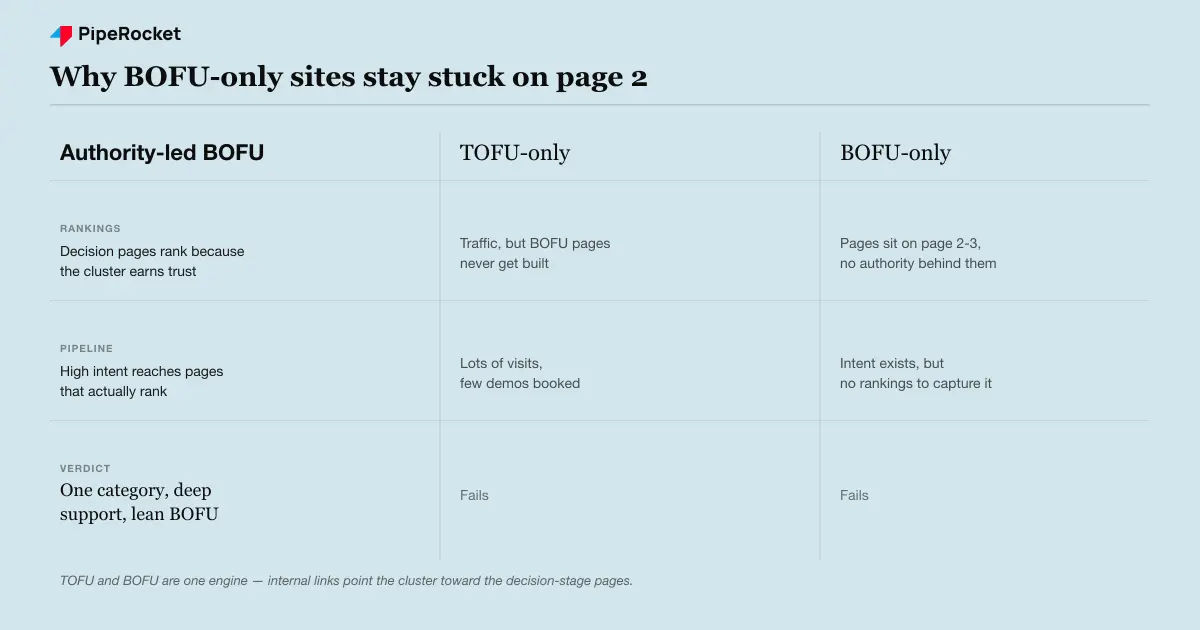
Because it’s standing alone. Everyone says TOFU is dying (AI answers informational queries, Google summarises before the click), so teams go BOFU-only and skip the supporting content entirely. Then the comparison and alternatives pages sit on page 2 to 3 with nothing behind them.
This is the core mistake, and it’s a structural one. BOFU and TOFU aren’t two separate problems. They’re one engine, and the MOFU layer between them carries the load. How to rank MOFU keywords covers that half. TOFU-heavy sites pull traffic but book few demos. BOFU-only sites have the intent but never rank, because Google has no signal that you actually know the category.
Organic search still drives 91.3% of SaaS traffic, so abandoning the supporting content that earns that visibility leaves your decision-stage pages with nothing behind them.
What I do instead is authority-led BOFU. Pick one category to dominate, not ten. Build deep supporting content around the real problems, like workflows, implementation steps, and the questions buyers actually ask, so the site earns topical credibility. Then keep the BOFU pages lean and intentional, and hold the whole thing together with internal links pointing toward the decision-stage pages.
The trade-off is real, though. Authority-led BOFU works when you have the patience to build one category properly over two or three quarters. It breaks when you need pipeline this month and try to shortcut it with ten thin pages across ten categories. That just gives Google a larger index it has less reason to crawl.
Build the Right Five Pages, Not Twenty
Most SaaS BOFU keyword lists are bloated with pages that will never earn a buyer. There are only five page types where the credit card actually comes out, and they’re the only ones worth your ranking effort:
- Use case pages: “X for [specific workflow]”
- Industry vertical pages: “X for healthcare,” “X for fintech”
- Comparison pages : “Brand A vs Brand B”
- Alternative pages: “Brand X alternatives”
- Listicles: “Best X software for [use case]”
Ignore the high-volume blog posts and vanity-traffic terms. If a competitor has these five and you don’t, you’re leaving money on the table. And if you’ve spread your effort across thirty other page types, you’ve diluted the authority that should be concentrating on these.
One thing teams get wrong constantly: comparison pages and alternative pages are not the same page with the title swapped. A comparison visitor searching “Brand A vs Brand B” is confused and choosing between two viable options, and they want you to weigh specific criteria honestly.
An alternative visitor searching “Zendesk alternatives” is already frustrated with a tool they use and looking for an escape route. One is an argument; the other is a rescue. Write them the same way and both convert worse.
Picture a compliance SaaS for fintech teams, a product with a well-defined ICP . Its “vs” page should reason through audit scope and SOC 2 readiness for a buyer deciding between two real options. Its “alternatives” page should open with the pain the incumbent tool caused, like slow evidence collection and manual screenshots, because that searcher already knows what they’re escaping.
Match the SERP Before You Write a Word
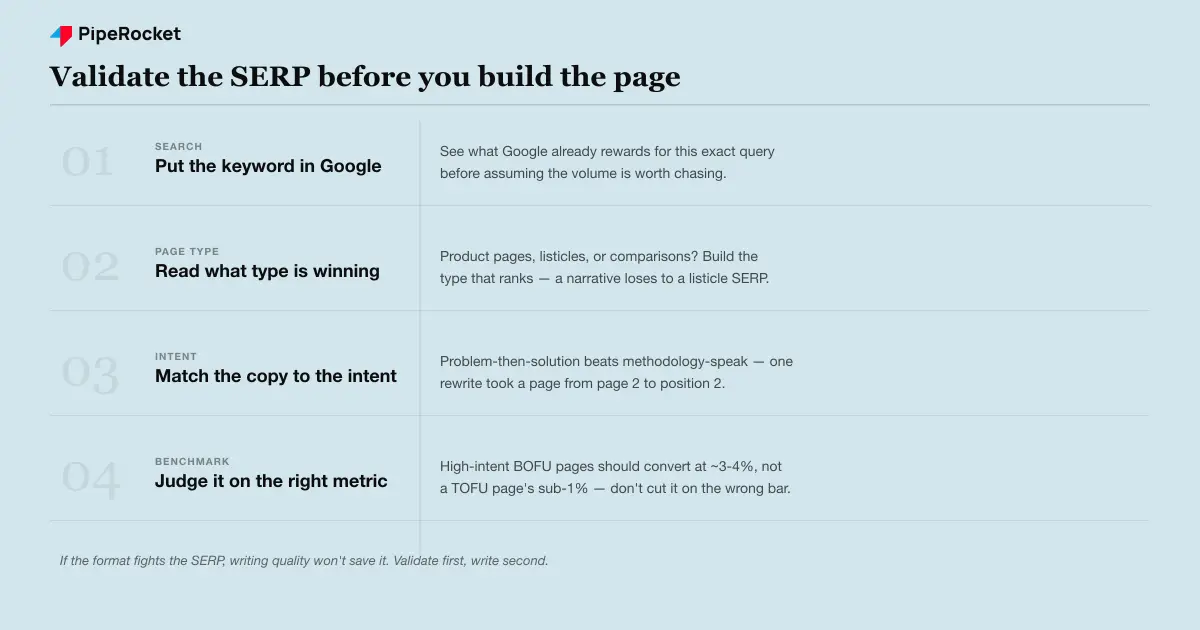
Before I build any BOFU page, I run a search validation: put the target keyword into Google and look at what’s already ranking. The SERP tells you what page type Google rewards for that query.
If the top ten results are product pages, you build a product page. If they’re listicles, a narrative essay loses no matter how good the writing is.
This is the single highest-impact lever for a stuck BOFU page, and it’s the one most teams skip. A page sitting between positions 8 and 20 is usually there because its format fights the SERP, not because it’s poorly written.
A client of ours was stuck on page 2 to 3 for a core keyword. The diagnosis wasn’t backlinks . Their page read like an academic paper, all “methodologies” and “frameworks,” while the searcher wanted a fix for a mess they were dealing with right now.
We rewrote it to a strict problem-then-solution structure, changing the first fold from “We are an X firm with Y years of experience” to “Struggling with X? Here’s how to fix it in weeks, not months.”
Within days the page went from page 2 to position 2 on page 1, with traffic up around 30%. No links bought, just copy matched to the intent behind the query.
So before you write, answer two things from the live SERP: what page type is winning, and what specific question are the top results answering. Then build to that, not to what you wish ranked.
How to Rank BOFU Pages on a Low-Authority Domain
You borrow the authority you don’t have yet. A young SaaS domain can’t out-link G2, Capterra, or a category leader, so you stop trying to win on domain strength and win on credibility signals the SERP giants are too lazy to bother with.
The move that works repeatedly: act like a neutral journalist. To rank a competitive listicle keyword against the aggregators, our team built a top-of-page comparison table of the top ten tools and pulled real pricing from each competitor’s page and G2, with a dated transparency disclaimer (“we gathered this data from [source] as of [date]; verify with the provider”).
Citing high-authority sources borrows their authority, and the honesty earns the click. That page landed a top-three ranking against G2.
The second move is to study who actually ranks, not just who you compete with for deals. Your direct business rivals tell you the persuasive sales arguments to make. But the SERP winner, often an aggregator, shows you the structure and depth Google is rewarding for that query.
Combine the sales logic of a direct competitor with the structural blueprint of whoever sits at position one.
One caution: don’t blindly copy a giant’s page structure. A category leader often ranks on brand power and decades of domain authority , not keyword strategy. Mimic the structure of a site closer to your weight class that’s punching above it. That’s a winnable blueprint.
What’s a Realistic Ranking Timeline for BOFU?
Slower than people hope, faster than TOFU. There’s no fixed number, but the pattern across the work I’ve done is consistent enough to plan around.
A well-built BOFU page on a domain with some existing authority and a supporting cluster behind it usually starts moving in weeks. A page on a brand-new domain with nothing around it can take months, or never move, if it’s standing alone.
The reason BOFU moves faster than TOFU is intent and competition. BOFU queries have lower search volume and far fewer pages chasing them, so a precisely matched page faces a thinner field. TOFU keywords are oceans of content; ranking there is a slog.
What I tell clients to expect:
- Weeks to first movement on a decision-stage page, if it sits inside a real cluster and matches the SERP
- Around month six for the compounding to kick in, when the curve bends and clicks ramp month over month
- Never, if the page is published alone with no internal links and a format that fights the SERP
The temptation is to judge a page after three weeks and rip it down. Don’t. Judge a comparison page against a comparison page’s benchmark: high-intent pages should convert at roughly 3 to 4%, while a top-of-funnel page might convert at under 1% on an asset download.
If you hold a BOFU page to the wrong benchmark, you’ll make a bad cut-or-scale call early and lose a page that was about to compound.
How PipeRocket Digital Ranks BOFU Pages for SaaS
We don’t publish decision-stage pages and hope. We pick one category to dominate, validate every keyword against the live SERP before writing, build the supporting cluster that earns the authority, then point it all at lean comparison, alternative, and pricing pages.
Most agencies execute tasks. We own the outcome: ranked pages that move pipeline, not traffic that sits in a dashboard. If you want this built properly, reach out to our team or see how our SaaS SEO service approaches the best SaaS SEO agencies conversation differently.
Frequently Asked Questions
How long does it take a SaaS BOFU page to rank?
It depends on domain authority and whether the page sits inside a supporting cluster. On a domain with some existing authority and a real cluster around it, a well-matched comparison or alternatives page usually starts moving within weeks.
On a brand-new domain with the page standing alone, it can take several months, and may never rank if the format doesn’t match what’s already on the SERP. BOFU generally moves faster than TOFU because the queries are lower-volume and less contested.
Can you rank BOFU keywords without backlinks?
Yes, more often than people assume. The fastest ranking gains I’ve seen on BOFU pages came from matching the SERP intent and format, not from buying links. One page jumped from page 2 to position 2 on a copy rewrite alone.
On a low-authority domain you borrow credibility instead of links: cite high-authority sources, pull real pricing with a dated disclaimer, and structure the page like whoever actually ranks. Links help long-term, but intent match and supporting content do the heavy lifting first.
Which BOFU pages should a SaaS company build first?
Build the five page types where buyers actually convert: use case pages, industry vertical pages, comparison (“X vs Y”) pages, alternative (“X alternatives”) pages, and listicles. These are the pages where the credit card comes out, so they earn your ranking effort before any high-volume blog post does.
Comparison and alternative pages need different writing. One weighs two real options, the other speaks to someone escaping a tool that failed them. Start with whichever maps to your easiest sales conversation.