How I Do SaaS SEO Keyword Research in 2026?
 Kamaraj Mathiarasan (Kim)
Last updated on
Kamaraj Mathiarasan (Kim)
Last updated on

If you asked me how I do keyword research, the exact steps we follow at PipeRocket Digital, this blog will be your answer. We’ve had long discussions about this within our team, and the reality is that most people start with tools when they should be starting with people.
We treat SaaS SEO keyword research not just as a standard SaaS SEO checklist, but as a way to map the entire Total Addressable Market (TAM) for a product. Whether you are a founder trying to get traction or a marketer trying to scale, I am going to walk you through the exact process we use, a process that evolved directly from managing massive accounts like Sprinto.
I will be upfront with you: it is a bit more work upfront. It takes time. But that extra effort is the difference between guessing what might work and actually dominating your category.
TL;DR
- Stop opening SEO tools first: I honestly believe this is where everyone gets it wrong. You shouldn’t start with Ahrefs or Semrush. You have to start with your internal teams, Sales, CS, Product, because they know the specific, messy words customers actually use to describe their pain, which is data a tool just won’t give you.
- Don’t just copy your competitors. If you only look at what the other guys are ranking for, you are just validating your own bias. We find that the real “gold” comes from merging that human insight from your team with the data, rather than just downloading a competitor’s keyword list and calling it a strategy.
- Group keywords into “Topics,” not just lists. A spreadsheet with two thousand rows is useless noise. We group them into topics, like “GRC Software”, so we can walk into a meeting and tell the executives, “We don’t need a random budget, we need to build exactly 60 pages to capture the market.” It turns a guessing game into a business case.
- Prioritise by business value over raw volume. A low-volume “alternative” or “integration” query from a warm buyer usually beats a big-volume awareness term. Weight bottom and middle-of-funnel intent first, then fill in the top.
- Assign one keyword per page. Map every term to a single Topic and page to avoid keyword cannibalization, where two of your own URLs fight for the same query.
Should You Be Worried About AI Search for SaaS Keyword Research?
No. Keyword research still matters for SaaS SEO because around 90% of people are still using Google . The term “keyword” is evolving into “prompt,” but the same buyer language drives both, so keep learning how to find keywords for SaaS SEO.
You are probably hearing the noise. People say “keywords are dead” and claim everything is moving to AI tools like ChatGPT or Perplexity. There is truth to that. The way people interact with the internet is changing.
But traditional search isn’t ending anytime soon. That 90% Google share is a massive chunk of the world. So while we prepare for a future of AI prompts, we still treat Keyword Research for SaaS SEO as the bedrock of how your customers find you. Later in this guide I show the one AI-search step we now add to the process.
Do Not Go the Usual SaaS Keyword Research Route: Here’s Why
Starting with a tool and your own guesses gives you a narrow, biased list: you only find the keywords you already expect. That misses most of your Total Addressable Market. Start with people first, then validate with tools.
If I asked you to sit down and do keyword research for SaaS SEO right now, you would probably follow the standard playbook we all learned. You know the one. It usually looks something like this:
- You open a notes app or Excel sheet.
- You write down the category terms you think are relevant. For example, if you are in the GRC (Governance, Risk, and Compliance) space, you write “GRC software,” “GRC tools,” and “GRC pricing”.
- You list the big competitors, like “MetricStream” or “LogicGate,” and look for “MetricStream alternatives”.
- You take that list you just brainstormed, you paste it into Google Keyword Planner, you get the search volume, and maybe you run a competitor gap analysis .
I get it. We used to do it exactly this way, too. But we realized something critical: this format does not help you scale.
When you start with just your own knowledge and a software tool, you build a very narrow view of the market. You miss the full spectrum, the Total Addressable Market (TAM). You only find the keywords you expect, so you validate your own bias. To fix this, we flipped the script entirely.
The 4 Keyword Categories Every SaaS Company Should Map
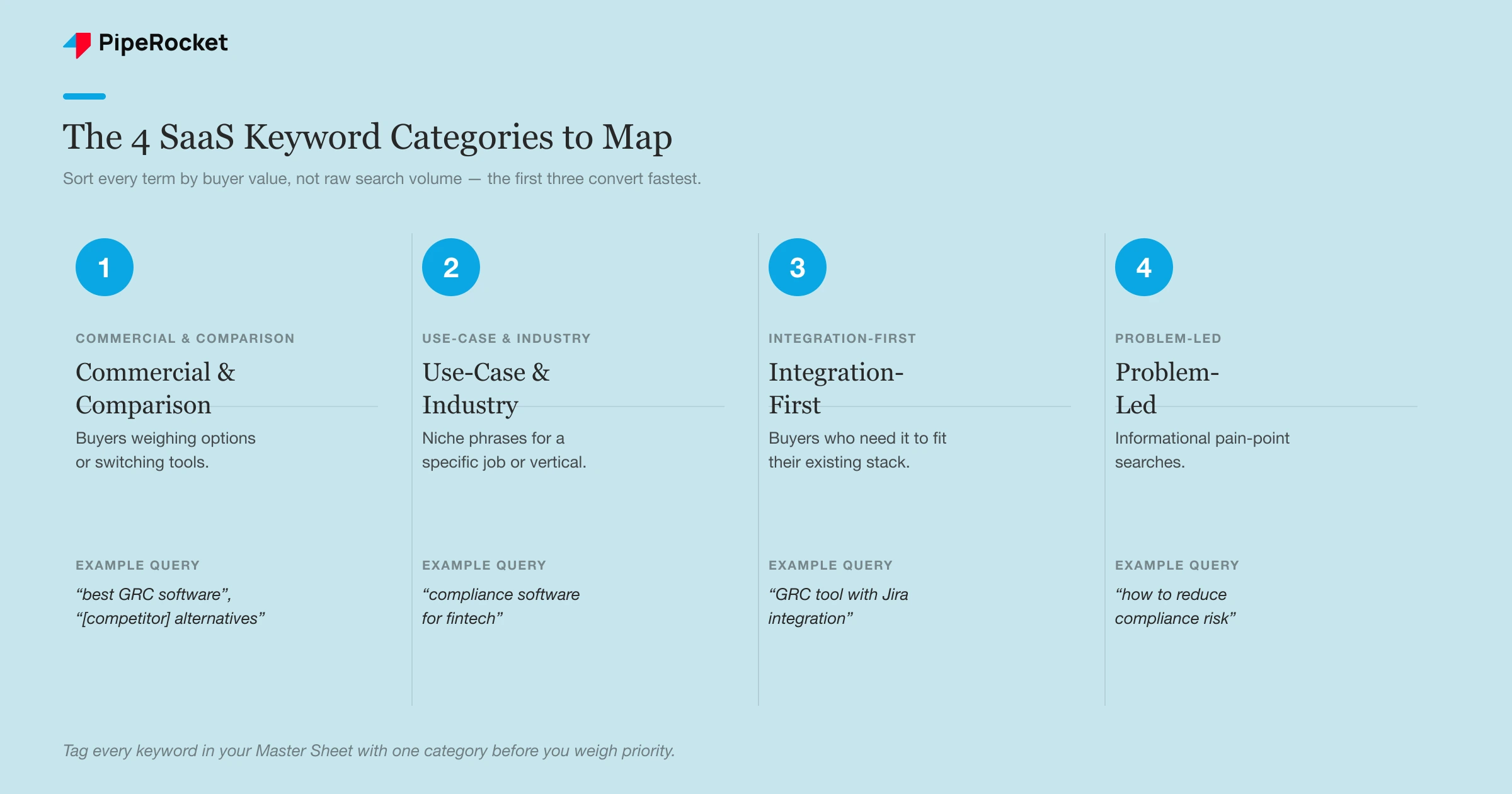
SaaS keyword research works best when you sort terms into four buyer-value categories that go beyond raw search volume. Commercial and comparison, use-case and industry, integration-first, and problem-led queries each pull a different buyer, and the first three usually convert fastest.
| Category | What it captures | Example query |
|---|---|---|
| Commercial & Comparison | Buyers weighing options or switching tools | “[Competitor] alternatives”, “best GRC software” |
| Use-Case & Industry | Niche phrases for a job or vertical | “compliance software for fintech” |
| Integration-First | Buyers who need it to work with their stack | “GRC tool with Jira integration” |
| Problem-Led | Informational pain-point searches | “how to reduce compliance risk” |
Tag every keyword in your Master Sheet with one of these categories. It stops you from over-indexing on high-volume awareness terms and helps you weight the commercial, use-case, and integration queries where warm buyers actually convert.
Step 1: Mine Your Internal Teams Before Any Tool
The biggest breakthrough I had was realizing that our internal teams held the keys to proper keyword research for SaaS SEO. This approach really clicked for me in 2023 when I was working with Sprinto.
Here’s What I Did
Instead of jumping straight into Ahrefs or Semrush like I usually did, I created a simple Excel sheet. I sent this sheet to every single team that touches the product or interacts with the customer:
- I went to the Customer Success Team because they talk to existing clients every single day.
- I went to the Sales Team because they hear the raw questions prospects ask during discovery calls.
- I went to the Product Team because they know the technical roadmap and the precise definitions of what we are building.
- I even went to the Marketing Sub-Teams: the Paid Ads team, the Events team, the Webinar team, and even the Social Media marketers.
Honestly, when I first sent these sheets out, I was skeptical. I thought, “They’re just going to send me the same keywords I already know, the stuff competitors like Vanta or Drata are already ranking for”. I was very wrong, and it was a huge surprise. You see, real users don’t search like SaaS SEO pros.
- A prospect explaining a problem to a sales rep uses layman terms (long-tail keywords ) to describe their pain.
- A Product Manager might use technical jargon.
- A Customer Success Manager knows exactly how a user phrases a troubleshooting issue.
The Result I Didn’t Expect
That collaboration gave us an extra 900+ keywords we hadn’t found on our own. It took our list from a standard 1,500 keywords to a massive 2,400. We never would have found those simply by staring at a keyword tool. So here is your first step: Before you touch a tool, collaborate with your:
- Product
- Sales
- Customer Success
- Product Marketing teams
to curate a “human” list first.
Step 2: Validate With Your Tool Stack
Once your human list is done, validate it with three tools: Google Keyword Planner for search volume, Ahrefs or Semrush for competitor gaps, and G2 or Gartner to confirm what the industry officially calls your category. Only then do you bring tools in.
We use this specific stack to make sure we aren’t missing anything.
First stop: Google Keyword Planner
We take the seed keywords and the team’s input and run them through Google Keyword Planner. We use this primarily to identify search volume, to see how many people are actually searching, and to check the location data to understand the Global vs. Country-level split.
Next stop: Ahrefs or Semrush
We look at the Competitor Analysis Tools like Ahrefs or Semrush to see what our competitors are currently ranking for and do a gap analysis. We merge these findings with our internal list.
Pro Tip:
Here’s a pro tip that many people miss: Industry Naming. You need to know what the industry officially calls your category. We browse G2 and Gartner to see how they categorize products. For example, you might think people search for “Procurement Management Software”. But you go to G2 and realize they categorize it as “Procurement Automation Software” or just “Procurement Software”. Checking these sites ensures you are aligning your keywords with the actual industry standard.
One more cheap source many people skip: Google autocomplete and the People Also Ask box. Type your seed terms into Google, note the suggestions and related questions, and drop the fresh phrasings into your Master Sheet. It costs nothing and surfaces the exact wording buyers use.
Now Create Your Keyword “Master Sheet”
Now comes the heavy lifting. We take all these inputs, the team insights, the Google Keyword Planner data, the competitor gaps, the G2 categories, and we merge them into one “Master Sheet”. I won’t lie to you, this is time-consuming. It normally takes us three to four days to close this research phase. But if you want to identify your true priority and map your Total Addressable Market , this is the only way to do it. Here is exactly how you should structure your Keyword Research Template :
| Column Name | Description | Example (GRC Context) |
| Keyword | The actual search term. | “GRC Software” |
| Search Volume | Global or Country specific. | 1,200 |
| Intent | Informational, Navigational, Transactional. | Transactional |
| Category | The main umbrella. | Governance, Risk, and Compliance |
| Sub-Category | Feature-level breakdown. | Risk Management Software |
| Topic | The grouping pillar (Crucial!). | “Overview of GRC” |
| Priority | P0 (Urgent), P1, P2. | P0 |
- You need a column for the Keyword, which is the actual search term, like “GRC Software”.
- You need the Search Volume, whether that is global or country-specific.
- You need the Intent (ToFu, MoFu, BoFu).
- You need the Category, the main umbrella term like “Governance, Risk, and Compliance”.
- You need the Sub-Category for a feature-level breakdown.
- You need a Priority column, marking things P0 for urgent, P1, or P2.
When we set that Priority, we do not just guess. We weigh keyword difficulty , CPC , and traffic potential against how close the term sits to a buying decision, then let ICP intent break ties. That informal keyword scoring is what decides whether a term is a P0 or a P2.
The Power of the “Topic” Column
I want to highlight the “Topic” column because it is vital. This column helps you group thousands of keywords into manageable clusters . For example, you might have keywords like:
- “What is GRC?”
- “GRC components”
- “GRC examples”
All of these should be mapped to a single Topic: “What is GRC” or “Overview of GRC”. This tells you that you need one complete pillar page to cover all those terms and rank higher in the SERP , rather than writing three separate, thin articles.
The rule to burn into your process: one keyword, one page. Give every primary keyword a single dedicated URL. When two of your own pages target the same term, you get keyword cannibalization, where your URLs compete against each other and split the ranking signal. The Topic column is exactly how you catch and prevent that before you write a word.
Step 3: Map Every Keyword to Intent and Funnel Stage
Tag every keyword with one intent so you build the right page for it: Informational (TOFU) for buyers understanding a problem, Navigational (MOFU) for buyers looking for a known brand, and Transactional (BOFU) for buyers ready to pick a solution.
This is where research turns into business decisions. Tag every keyword with the correct Intent.
- Informational: The user has a problem but isn’t ready to buy. They want to understand the meaning or the overview.
- Example*:* “What is GRC?” or “How to reduce risk in a company?”.
- Navigational: They already know the brand and are trying to find it.
- Example*:* “MetricStream GRC pricing” or “Sprinto compliance cost”.
- Transactional (Bottom of Funnel): They are looking for a specific solution.
- Example*:* “Compliance software”, “GRC tools”, or “GRC alternatives”.
The “40-60” Rule for BOFU
Here is a benchmark I want you to remember: Most SaaS companies with a single product will have a maximum of 40 to 60 Bottom-of-Funnel (BOFU) pages. If you try to create more than that, you are likely forcing it. This count includes your software pages, alternatives pages , comparisons, and pricing pages. For GRC, that means “GRC software,” “GRC alternatives,” “GRC automation,” etc. It rarely exceeds 60.
Step 4: Check Which Keywords Trigger AI Overviews
Remember the AI-search question we opened with? Here is the one concrete move we now add. Run your top Master Sheet terms through a live Google search and note which ones return an AI Overview or read like a prompt (“how do I…”, “best way to…”). Those are the terms where a direct, quotable answer near the top of your page wins the citation.
Flag them in a simple column, then make sure each of those pages opens with a self-contained answer an AI engine can lift. You still target the same keyword, you just format it so both Google’s ranking and its AI Overview can use it. That is how we bridge the “keyword to prompt” shift without abandoning the foundation.
Step 5: Turn the Research Into a Business Case
Use the finished sheet to pitch a finite, data-backed plan: name the total addressable content market and the exact page counts by funnel stage. That turns a random budget request into a calculated investment executives can approve.
The biggest struggle marketers face is justifying the budget. Management usually throws out a random number, like “We need 30 articles this quarter”. With this research method, you can walk into that meeting with confidence. You can say:“Based on our research, the Total Addressable Market for content in our category is 330 articles. We have the potential to capture 60 BOFU pages, 70 MOFU pages, and 200 TOFU pages”.
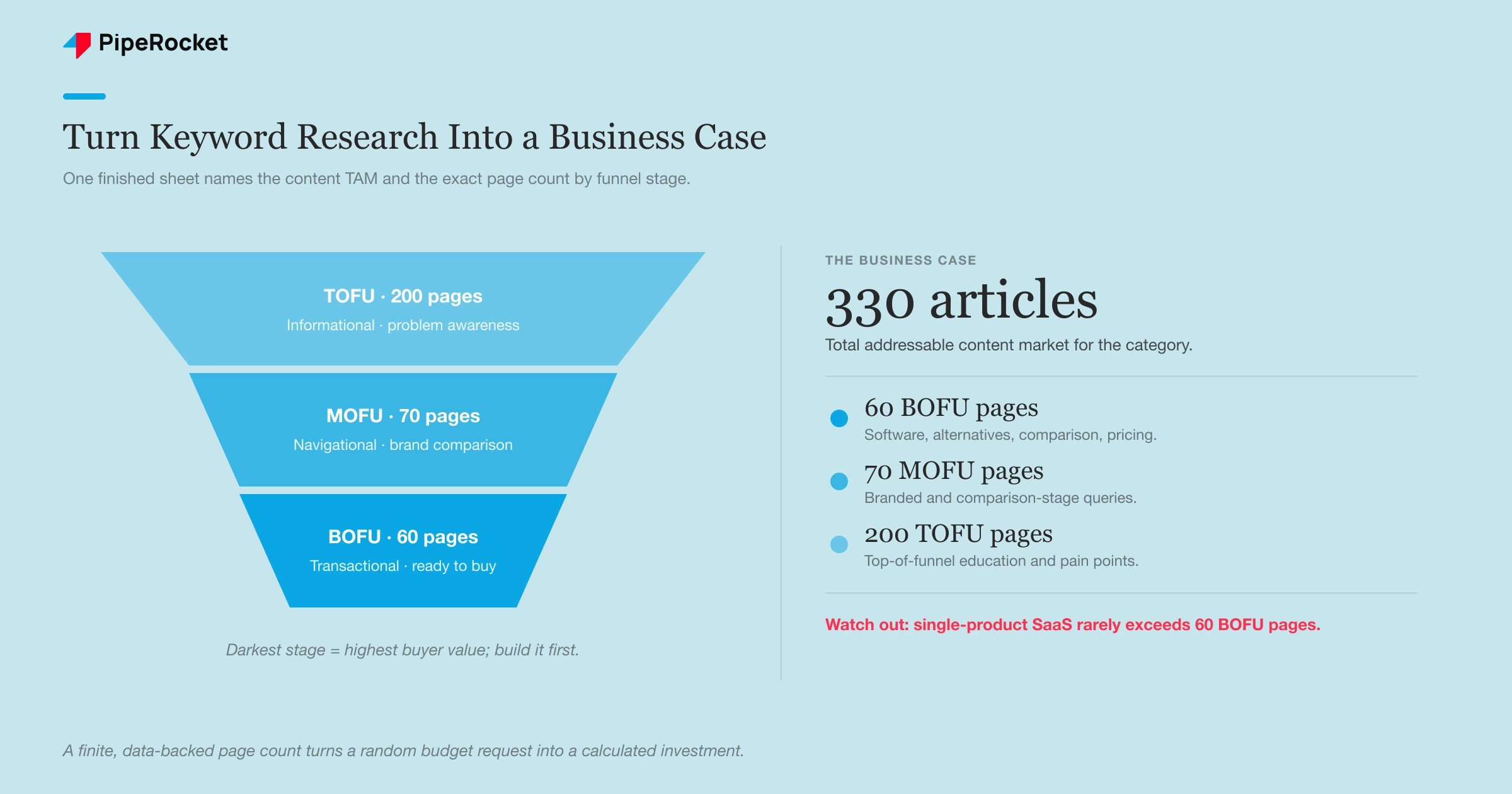
This transforms content from a random request into a calculated investment. It gives clarity to the executives on the overall budget needed, and it gives the SEO team a clear roadmap of where to start and where to end. Once that roadmap is set, run it against our SaaS SEO checklist so nothing downstream, content, on-page, or technical, slips through the cracks.
This fits inside the wider SaaS SEO 8-step framework .
Go Deeper: The SaaS Keyword Research Cluster
This guide is the hub for how we approach keyword research. Each stage below has its own deep dive:
Keyword foundations
- Types of keywords in SEO : the intent categories every keyword should be tagged against
- Search volume vs search intent : which to weight when the two pull in different directions
Prioritising and mapping
- How to prioritise SaaS keywords by funnel stage
- How to score SaaS keywords by ICP intent
- How to map keywords to the SaaS buyer journey
Ranking by funnel stage
Keeping the cluster clean
Let PipeRocket Digital Do It for You
Look, I’ll be honest with you, this methodology works, but it is a grind. If you are running a lean marketing team, you probably don’t have 40 hours to spare next week to sit in spreadsheets. That is exactly where our SaaS SEO services come in. We don’t just send you a generic Semrush export and wish you luck. We come in and execute this exact “Goldmine” process for you.
We interview your Sales and CS teams, we map your Total Addressable Market (TAM), and we hand you a fully prioritized execution roadmap. You get the strategy without the headache. Ready to stop guessing and start dominating your category? Reach out to us!
For a step-by-step version you can tick off as you go, use our free keyword research checklist .
Conclusion
Keyword research for SaaS SEO is about conversation. By starting with your internal teams, you capture the language your customers actually use. By mapping that data into a structured asset with Topics and Priorities, you stop guessing. Yes, it takes a few days to do it right. But this process allows you to see the entire battlefield of your Total Addressable Market, so you can scale effectively.
Frequently Asked Questions
1. Why can’t I just use Ahrefs or Semrush to find all my keywords?
Tools are great for validation, but they are terrible for discovery. If you rely 100% on tools, you are only seeing what your competitors have already found. By skipping the internal interviews, you miss the “unseen gold”, the specific, high-intent phrases that real buyers use on sales calls but don’t have enough volume yet to show up in a tool. You need the human input to find the gaps the tools miss.
2. Why is mapping keywords to ‘Topics’ more important than the keywords themselves?
Because a list of 2,000 keywords is just noise; a list of 330 Topics is a strategy. Grouping keywords into Topics tells you exactly how many pages you need to build. It stops you from writing ten thin, repetitive articles about “GRC” and forces you to write one complete pillar page that ranks for all of them. It turns data into a roadmap.
3. How does this method help me get budget approval from executives?
It kills the guessing game. Instead of asking for a random budget for “more blogs,” you can present a calculated business case: “The Total Addressable Market requires exactly 60 Bottom-of-Funnel pages and 70 Middle-of-Funnel pages.” Executives respect finite, data-backed goals. This research gives you the hard numbers to justify the exact investment you need.
4. Can I use ChatGPT for keyword research?
Yes, but only for brainstorming seed phrases and buyer language. It cannot verify search volume or difficulty. Still validate every term with your internal teams plus Google Keyword Planner and Ahrefs or Semrush.
5. What are the 9 types of keywords used in SEO?
The common list covers short-tail, long-tail, short-term fresh, product-defining, evergreen, and the four intent buckets (informational, navigational, commercial, transactional). We break down the full taxonomy in our guide on the types of keywords in SEO.