
How to Do a Keyword Gap Analysis vs SaaS Competitors
 Kamaraj Mathiarasan (Kim)
Last updated on
Kamaraj Mathiarasan (Kim)
Last updated on
Most keyword gap reports hand you 4,000 keywords your competitor ranks for and you don’t, sorted by volume. I delete that report. It’s the wrong thing to look at.
The gap you actually care about lives in the pages themselves. A competitor quietly built a set of pages to catch buyers at the moment they’re ready to pay, and you didn’t build them. Find those pages and you’ve basically found their pipeline.
TL;DR
- Most gap reports measure the wrong thing: They compare keyword counts, so a competitor’s top-of-funnel blog haul looks like dominance when the real gap is the money pages they built and you didn’t.
- Step 1, pull the raw gap then cut hard: Run the Content Gap or Keyword Gap report, then strip out informational, branded, and off-intent terms until a few hundred buyer-close keywords survive.
- Step 2, map each gap to a money page: Bucket every surviving keyword into the five page types (use-case, vertical, comparison, alternative, listicle) where buyers actually convert.
- Step 3, group the gaps into topics: Most gap keywords collapse into far fewer pages than the row count suggests, so plan around the pages you’re missing rather than a flat keyword list.
- Step 4, prioritise by worth over ease: Score each page by searcher intent and build the high-converting alternative and comparison gaps first, letting support content follow.
- Skipping gaps matters as much as closing them: Don’t ship the raw CSV, chase the wrong competitors, or try to close every gap, because much of it is junk traffic that won’t pay.
Why most keyword gap reports are useless
The standard gap report measures the wrong thing. It compares keyword counts, so a competitor sitting on 6,000 ranking blog keywords looks like a runaway leader. But, most of those keywords are “what is” articles that never sent them a single demo. You end up chasing volume you can’t monetise.
Despite the name, a keyword gap analysis is really a page-and-intent exercise that happens to use keyword data as the input. Two SaaS companies can have the exact same keyword gap on paper and a completely different revenue gap sitting underneath it.
One clarification before we start, because the two terms get muddled. A keyword gap analysis is keyword-level: it compares the specific keywords and pages your competitors rank for against the ones you don’t. A content gap analysis is broader, topic-and-page-level: the subjects and pages your site is missing overall, whether or not a competitor already ranks for them. This piece is the keyword-and-competitor version, but the two overlap once you group the gaps into pages in Step 3.
The competitor isn’t beating you because they have more keywords. They’re beating you because they built comparison and alternative pages for the exact moment a buyer pulls out a credit card, while you spent that quarter writing top-of-funnel posts. The gap report shows you the keywords. It quietly hides the reason they’re winning.
This piece is just the narrow execution method, how to actually run the gap analysis. The bigger question of which competitors to study, and how to read their whole strategy, lives in our guide on SaaS SEO competitor analysis . Start there if you haven’t picked your competitors yet, and see the full SaaS SEO keyword research process for how the gaps you find feed your master list.
Here, I’m assuming you already know who they are and you just want the gap.
Step 1: Pull the raw gap, then throw most of it away
Open Ahrefs or Semrush, drop in your domain plus two or three direct competitors, and run the Content Gap (Ahrefs) or Keyword Gap (Semrush) report. That part takes five minutes. The hard part is deciding what to cut.
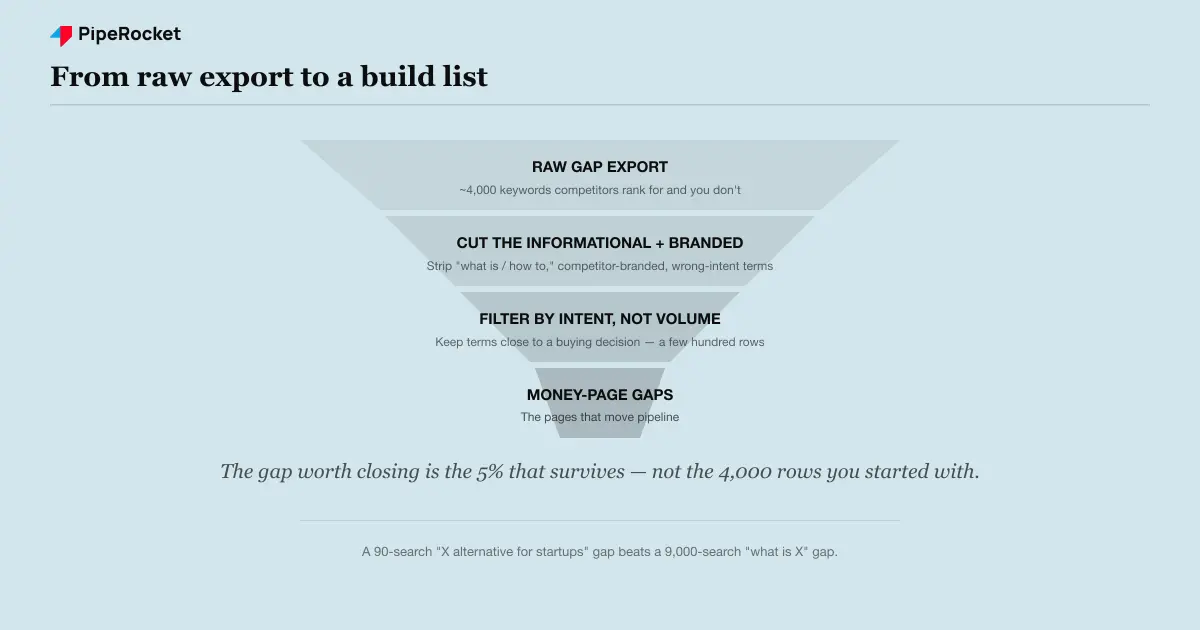
The raw export will be thousands of rows. Filter hard before you read a single one. I strip out anything that’s clearly informational (“what is,” “how does,” “guide to”), anything branded to the competitor, and anything with intent your product can’t serve.
What survives is a much shorter list, usually a few hundred terms, where the searcher is closer to a buying decision. That’s your working set. The 3,800 rows you deleted weren’t gaps worth closing. They were gaps worth ignoring.
Before you hunt the competitor’s gap, spend ten minutes auditing your own thin and underperforming pages. Some “gaps” are pages you already have that just rank badly, and updating those is faster than building from scratch.
Start with the “Missing” and “Untapped” filters
In Semrush’s Keyword Gap tool, start with two filters. “Missing” shows keywords every competitor you entered ranks for and you don’t. “Untapped” shows keywords at least one competitor ranks for and you don’t. Missing is your priority set; untapped is the wider opportunity pool.
| Filter | What it shows | When to use it |
|---|---|---|
| Missing | Keywords all listed competitors rank for and you don’t | First pass: the clearest, most contested gaps |
| Untapped | Keywords at least one competitor ranks for and you don’t | Second pass: wider opportunities to score by intent |
Ahrefs frames the same idea in its Content Gap report by letting you require that all or some competitors rank. Either way, filter first, then sort by intent, not by search volume.
Don’t let volume drive the cut
The instinct is to sort by volume and start at the top. Resist it. We’ve watched teams burn a quarter chasing a 9,000-search gap keyword, rank for it, and move zero pipeline, because the keyword brought researchers and students, not buyers.
The math is unforgiving. A 1,000-search keyword, even ranking top three, brings maybe 100 clicks; at a typical SaaS conversion rate of 2 to 4%, that’s four or five conversions.
A 90-search keyword like “Zendesk alternative for startups” might bring eight visitors a week, and most of them are evaluating a switch right now. Run that math on every gap before you sort.
Step 2: Map each gap to a money page
Bucket every surviving keyword into one of five money-page types: use-case, industry vertical, comparison, alternative, or listicle. A keyword on its own tells you almost nothing. The question is what page the competitor built to capture it, because that’s what you’ll have to build to compete. So I sort every gap into the page types where the credit card actually comes out.
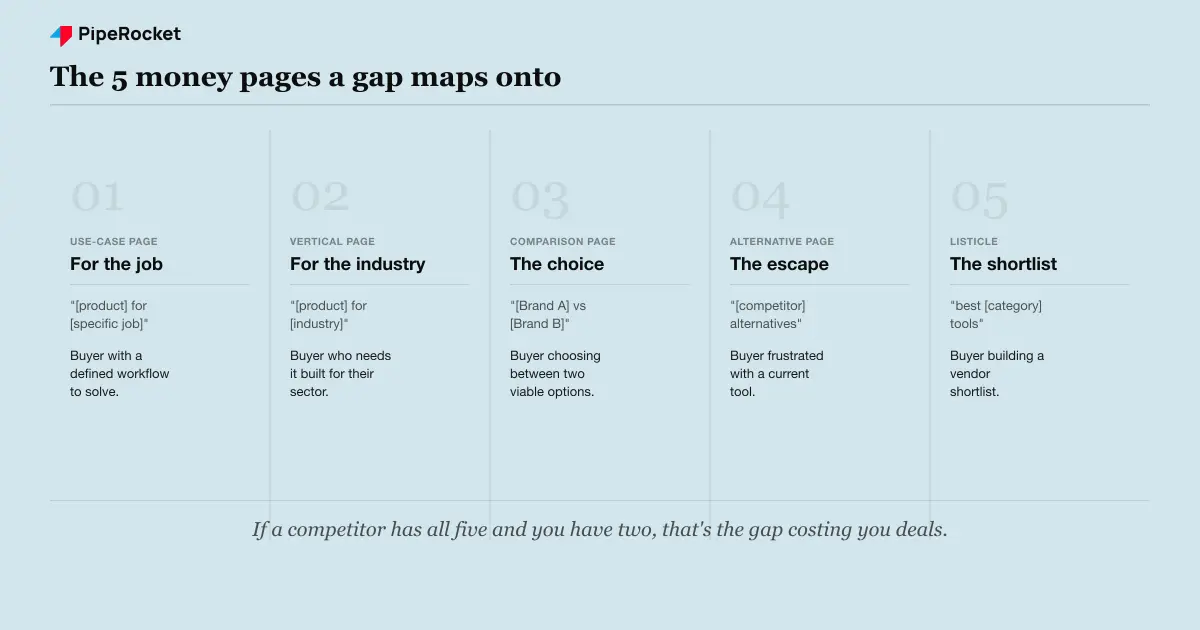
These are the pages worth caring about:
- Use-case pages: “[product] for [specific job]”
- Industry vertical pages: “[product] for [industry]”
- Comparison pages: “[Brand A] vs [Brand B]”
- Alternative pages: “[competitor] alternatives”
- Listicles: “best [category] tools”
If a competitor has all five built out and you have two, that’s the gap that’s costing you deals, not the blog keywords. Ignore the high-volume top-of-funnel pages and the vanity traffic graphs.
If a competitor ranks for a money-page keyword and you don’t, you’re leaving money on the table, and that’s the line item to fix first.
A small example: a compliance SaaS for fintech teams runs the gap report and finds the competitor ranks for “SOC 2 software for startups,” “Vanta alternatives,” and “Drata vs competitor.”
Those three aren’t three keywords to add to a blog. They’re a use-case page, an alternative page, and a comparison page that don’t exist on the client’s site yet. That’s the build list.
Step 3: Group the gaps into topics instead of a flat list
A spreadsheet of 250 gap keywords is noise. The same 250 grouped into topics is a strategy, and usually a much shorter one. Most gap keywords collapse into far fewer pages than the row count suggests.
“What is GRC,” “GRC components,” and “GRC examples” all map to one pillar page, not three thin articles. The same compression happens with money pages: “Okta alternative,” “Okta competitors,” and “Okta vs [you]” don’t need three URLs. They need one strong alternative page and one comparison page, internally linked.
Grouping does two things. It tells you the real size of the gap (“we’re missing 18 pages,” not “we’re missing 250 keywords”), a number you can actually plan and budget against. And it stops you building thin, overlapping pages that cannibalise each other.
Done right, this is also where a gap analysis hands off cleanly to keyword research and a topic plan, rather than staying a one-off audit.
Step 4: Prioritise the gap by what it’s worth over what’s easy
Score each page by the intent of the searchers it captures, not by search volume, because intent predicts pipeline. Now you have a grouped build list, but don’t work it top to bottom. A gap analysis that doesn’t end in a priority order is just a longer report.
I judge pages by the benchmark for their type, not aggregate traffic. Alternative and comparison pages carry high buying intent and should convert at roughly 3 to 4%, while a general top-of-funnel page might convert at 0.75%, often on an asset download rather than a demo.
Judge a comparison-page gap by a blog-page benchmark and you’ll deprioritise the thing that would’ve closed deals.
So the order is usually:
- Alternative and comparison gaps first: highest buying intent, fastest to pipeline.
- Use-case and vertical pages next: strong intent, tied to a specific buyer or job.
- Informational gaps last: the content that builds the topical authority those money pages need to rank.
Build the decision-stage pages first and let the support content follow.
This is the whole point of running a gap analysis the narrow way. Most agencies execute the task. They hand over the gap list and call it done.
We own the outcome, which means tying every gap to a page, every page to an intent, and every intent to the pipeline it actually moves.
Step 5: Monitor rank changes after the pages ship
Track where each new page ranks over the following weeks, because a gap analysis isn’t done when the pages publish, it’s done when they rank and convert. Use the position-tracking feature in Ahrefs or Semrush to watch your target money-page keywords.
Watching the ranks tells you two things. Which pages are climbing and deserve more internal links or a refresh, and which gaps you closed on paper but still don’t rank for, meaning the competitor’s page is stronger and the gap needs more work.
A page that ships and stalls at position 40 hasn’t closed the gap. Rank tracking is how you tell a real win from a page that just exists.
The most common one is treating the gap report as the deliverable. The export is the raw material, not the analysis. If you hand a founder a 4,000-row CSV, you’ve done the easy 5% and skipped the 95% that matters.
The second is comparing against the wrong competitors. A direct business rival and the domain that actually ranks #1 are often different. Frequently the #1 is G2 or an aggregator riding brand authority you’ll never match.
Don’t blindly chase a giant’s keyword gap. They often rank on domain power, not strategy, so their “gap” is unreachable for you. Sort out direct-versus-SERP competitors before you pick which domains to compare against.
The third is closing every gap. You don’t want to rank for everything a competitor ranks for, because a lot of their gap is junk traffic that won’t convert for your product either.
A gap analysis is as much about deciding what to skip as what to build. The teams that grow are doing fewer pages, better, against the intent that actually pays.
Gap analysis only pays off if someone keeps shipping against it, which is the part most in-house teams drop; the SaaS SEO agency shortlist covers teams that own the cadence.
How PipeRocket Digital runs gap analysis for SaaS clients
When we run a keyword gap analysis, we don’t ship the spreadsheet. We ship a prioritised build list of money pages tied to pipeline. We map every gap to a page type, score it by buyer intent, and sequence the decision-stage pages first.
If you’d rather not wrestle the export yourself, our SaaS SEO team does exactly this. Reach out to us and we’ll walk through your competitors’ gaps with you.
Frequently Asked Questions
What’s the difference between a keyword gap analysis and competitor analysis?
Competitor analysis is the broad read: who your real competitors are, how their whole SEO strategy works, what messaging and page structures they use.
A keyword gap analysis is one narrow step inside that, finding the specific keywords and pages they rank for that you don’t. You run the gap analysis after you’ve decided which competitors matter, then turn its output into a build list.
What tools do I need for a keyword gap analysis?
Ahrefs or Semrush will do it. Ahrefs calls it the Content Gap report, Semrush calls it the Keyword Gap tool. Both let you enter your domain plus several competitors and export every keyword they rank for that you don’t.
The tool is the easy part. The value is in the filtering and page-mapping you do afterward, which no tool does for you.
How many competitors should I include in a gap analysis?
Two or three direct competitors is usually the sweet spot. More than that and the overlap gets noisy, and you start pulling in keywords from companies that aren’t really competing for your buyer.
Pick your closest business rivals, plus one domain that genuinely ranks for your target money-page keywords, and ignore aggregators like G2 or Capterra unless you’re specifically studying their page structure rather than chasing their rankings.
Can ChatGPT do a keyword gap analysis?
Not the data part. ChatGPT can’t pull the ranking data that shows which keywords competitors rank for, so it can’t find the gap itself. Ahrefs or Semrush do that. ChatGPT can help once you have the filtered export, synthesizing and bucketing keywords into topic groups.
How do you perform a content gap analysis?
A content gap analysis works topic-and-page-level rather than keyword-level. You audit your existing pages, map them to the buyer journey, then find the subjects and pages your site is missing overall, whether or not a competitor ranks for them. It’s broader than the keyword-and-competitor version in this guide.

