How to Improve Topical Authority for a SaaS Brand (Without Publishing More of Everything)
 Ranjeeth Kumar
Last updated on
Ranjeeth Kumar
Last updated on
Here’s a pattern I keep seeing at SaaS companies frustrated with their SEO: they know they need topical authority, so they commission 20 more blog posts. The content goes live. Rankings don’t move. And the conclusion they land on is that topical authority takes time.
Sometimes it does. But most of the time, the real problem isn’t the timeline. It’s the sequence. They’re publishing more content on topics they’re already thin on, in formats Google already has ten versions of, with no logical build order connecting any of it. Volume without structure doesn’t build authority. It just makes a bigger index.
TL;DR
- Diagnose before you build: Most SaaS teams have topical coverage gaps they don’t know about. Audit what you actually cover before commissioning more content.
- Map topics, not keywords: Group your keyword list into topic clusters so you know how many pages you need to build, not just how many keywords exist.
- BOFU anchors the build: Start with decision-stage content and build support content outward, not the other way around.
- Internal links are the connective tissue: Topical authority doesn’t compound without links connecting related content into a coherent cluster.
- Measure signals, not just rankings: Authority shows up as rankings on subtopics you haven’t targeted, AI mentions, and impression breadth across the whole topic.
Why Most “Build Topical Authority” Advice Doesn’t Work for SaaS
The standard advice goes like this: pick a topic, publish consistently, cover every subtopic. It’s not wrong, exactly. But it’s missing the part that actually determines whether any of it works.
The Depth Problem
Most SaaS brands that stall out on topical authority have the same underlying problem: they’ve published widely across a topic but not deeply on any part of it. A company selling compliance software might have 25 posts mentioning SOC 2, but no single page that definitively answers what a compliance buyer actually needs to know.
Google reads the cluster and doesn’t find depth anywhere. So it doesn’t trust the site on that topic.
The Sequence Problem
The other failure mode is building in the wrong order. Teams start with TOFU because it gets traffic fast and leadership likes the numbers. They write definitional posts, industry roundups, and awareness pieces.
Then they wonder why their comparison pages and alternative pages aren’t ranking. The answer is usually that there’s nothing authoritative underneath them. BOFU pages don’t rank in isolation, and TOFU posts don’t convert without a destination.
Note: Publishing more content fixes neither of these problems. It usually makes the second one worse. A diagnostic and a build sequence do.
Step 1: Map Your Topic Universe Before Publishing Anything
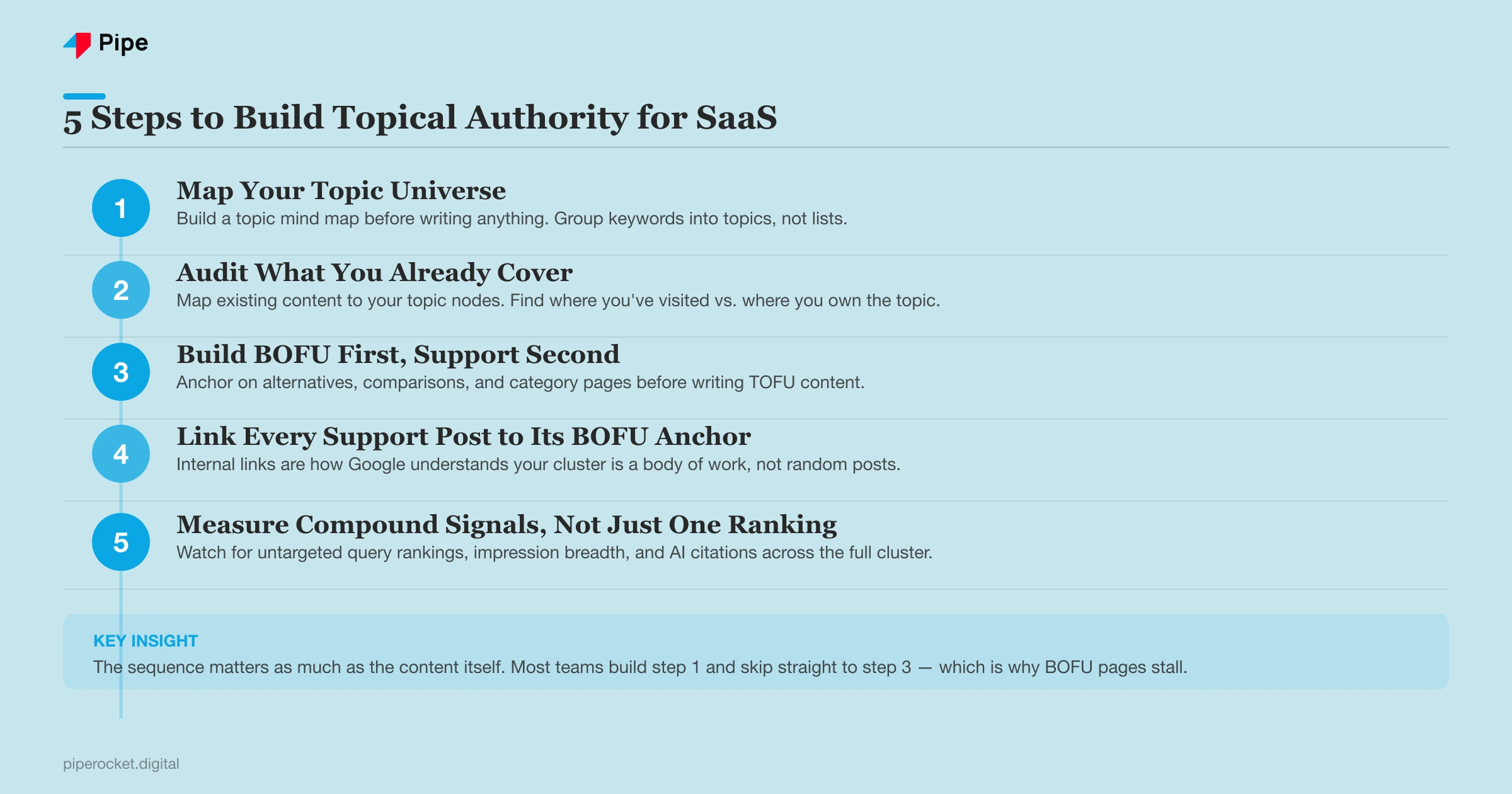
Before you write a word, you need to know the full shape of your topic. Not a keyword list, an actual topic map. The distinction matters more than most people think.
A spreadsheet of 2,000 keywords is noise. It tells you what search volume exists but nothing about how many pages you need to build. A structured set of 250 topics is a strategy. It tells you exactly how many pieces of content it takes to cover your category, and which ones belong on the same page versus separate ones.
Our team builds a topic mind map before any publishing starts. Take the core category (say, “SOC 2 compliance software”) and map every subtopic outward:
- Overview
- Trust Services Criteria
- Scope
- Audit Frequency
- Implementation for Startups
- Automation
- Process to Certification
Each cluster on the map becomes a content cluster. Each node becomes one page. Nothing outside the map gets written until the map is complete.
How to Build a Topic Mind Map
Start with your core category in the center. Then branch outward by asking: what are the distinct subtopics someone building knowledge in this area would search for?
Group those subtopics into clusters. Three to five clusters per topic is typical for a focused SaaS product. If you find yourself with ten clusters, you’re probably trying to dominate too many categories at once, which dilutes the authority you’re building in each.
Once the map exists, every keyword in your research gets assigned to a node. Keywords that don’t map anywhere either belong to a cluster you missed (add a node) or they don’t belong in this content program at all. The map keeps you deliberate.
Step 2: Audit What You Already Cover (Honestly)
If you already have content published, you need to audit it before building new pages. Not a light review. An honest one.
Pull your existing posts and map each one to a node on the topic mind map. The goal: find out whether you have genuine depth on any subtopic, or whether you’ve just visited it once with a thin post.
“Visiting” a topic means having one or two posts that mention it. Owning a topic means having a page that is the best answer to the primary question in that cluster, plus supporting content that builds around it. There’s a real difference, and Google sees it.
Watch for these signals in your audit:
- Short, thin posts on complex subtopics (a sign of thin coverage, not depth)
- Multiple posts targeting the same keyword without different intent (a cannibalization risk)
- Clusters where you have TOFU posts but no BOFU content pointing buyers toward a decision
- Topics you haven’t covered at all despite them sitting inside a cluster you’re trying to own
The result of the audit is a gap map: which nodes are well-covered, which are thin, and which are empty. That gap map, not your backlog of content ideas, should drive your next publishing quarter.
Stale organic traffic despite consistent publishing usually means a topical authority gap. The other common cause is cannibalization: two posts fighting for the same query instead of one strong page owning it.
Step 3: Build in the Right Order (BOFU First, Support Second)
Build decision-stage (BOFU) pages first, then add support content outward, not the other way around.
| Approach | What happens |
|---|---|
| TOFU-first | Traffic accumulates, but decision-stage pages lack the authority to rank |
| BOFU-first | Revenue-stage pages rank first; TOFU content compounds authority underneath them |
The instinct is to build from TOFU downward: start with educational content that gets traffic, let domain authority accumulate, then build conversion-stage pages when the site has more credibility. It sounds logical. But for SaaS brands trying to build topical authority, it’s the wrong sequence.
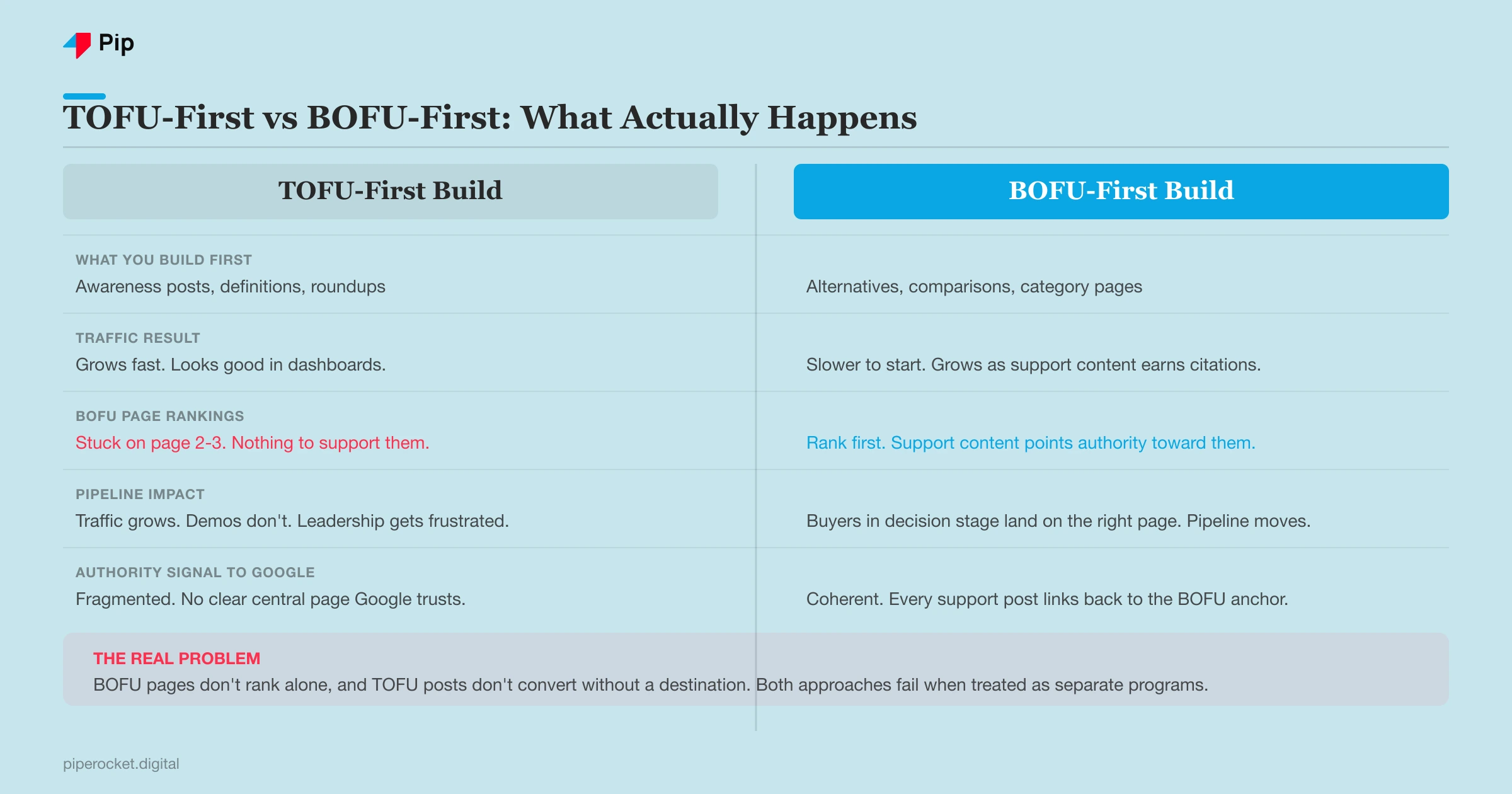
TOFU-heavy sites get traffic but few demos. BOFU-only sites have the right intent but nothing to back them up, so they sit on page two or three. Both approaches fail because they treat the two halves of a content program as separate problems instead of one engine.
What a BOFU-First Cluster Actually Looks Like
The approach our team uses is to anchor the cluster on decision-stage pages first, then build outward.
Build these pages before anything else:
- Alternatives pages (“best [competitor] alternatives”)
- Comparison pages ("[your product] vs [competitor]")
- Category pages (“best [category] software”)
- Integration and use-case pages
These pages catch buying intent. A person searching for alternatives or comparisons is already in the decision stage. If your site has nothing ranking there, you’re invisible to the buyers who are ready to convert.
Once the BOFU anchors are live, the support content (workflows, how-tos, implementation guides, definition posts) exists for a specific reason. It earns citations, warms buyers who are still researching, and passes topical authority back to the decision-stage pages through internal links.
One Category at a Time
One constraint matters here: pick ONE category to dominate before expanding to a second. Spreading authority across ten topics at once dilutes the signal in each.
- A compliance software brand building authority in SOC 2, ISO 27001, HIPAA, and GDPR simultaneously will be thin across all of them for years.
- Pick the category closest to your core buyer’s language.
- Own it completely, then expand.
Step 4: Use Internal Linking as the Authority Signal, Not an Afterthought
Internal linking is the mechanism that tells Google your cluster is a cluster, not a random collection of posts. Without it, you have individual pages. With it, you have a body of work.
| Rule | Why it matters |
|---|---|
| Every support post links to its BOFU anchor | Concentrates authority where it converts |
| Pillar links out to spokes; spokes link back | Creates bidirectional authority flow |
| Use descriptive anchor text | Tells Google what the destination page is about |
| Cap at 3-5 internal links per post | Prevents PageRank dilution |
Where teams go wrong is treating internal links as housekeeping rather than strategy. Links added in a “read more” section at the bottom, or with generic anchor text, don’t help Google understand how your cluster is structured.
Step 5: Measure Whether Your Topical Authority Is Actually Growing
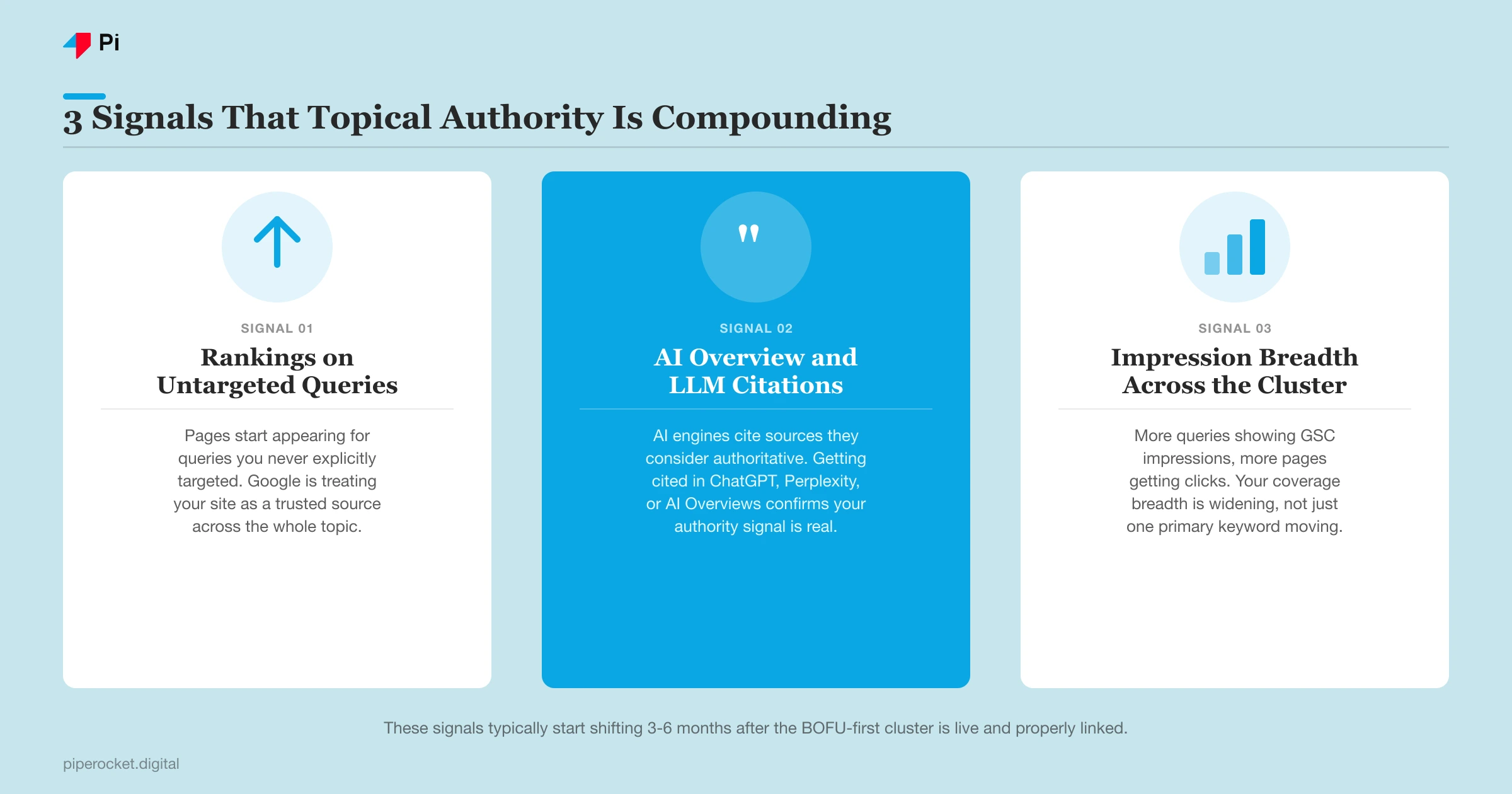
Topical authority compounds through indirect signals (untargeted subtopic rankings, impression breadth, and AI citations), not through movement on a single target keyword.
The real signals that it’s working are:
- Rankings on subtopic queries you haven’t explicitly targeted yet
- Impression growth across a cluster of queries, not just one page
- Being cited in AI-generated answers on topic-related questions
- Time-on-site improvements on cluster pages (buyers are reading more because the content is deeper and better connected)
When our team evaluates a SaaS brand’s topical authority, we score it as one of six dimensions, alongside technical SEO health, backlinks , brand signals, user intent mapping, and AI readiness. The brands that win reach “strong” across all six. They don’t max out one dimension while neglecting the others.
What to Watch in Search Console
That framing changes how you measure progress. You’re not just watching one keyword. You’re watching whether an entire topic area in Google Search Console starts moving: more queries showing impressions, more pages getting clicks, rankings appearing on question-based queries you never specifically targeted.
If you published the BOFU anchor pages, built the support cluster around them, and connected everything with internal links, those signals should start shifting within three to six months.
Note: If signals aren’t moving, the gap is almost always in coverage depth (the pages aren’t comprehensive enough to be the definitive answer) or in the linking structure (the cluster isn’t pointing authority toward the right pages).
Why PipeRocket Digital Builds Topical Authority for SaaS Brands
At PipeRocket, this is what we actually do: build topic mind maps, audit existing coverage for real gaps, and execute the BOFU-first cluster sequence. We don’t publish content and hope it compounds. We build the structure first, then fill it deliberately.
If you want your SaaS brand to own a category in search rather than just appear in it, we can help. Reach out to our team or see what a proper SaaS SEO agency engagement looks like.
Frequently Asked Questions
How long does it take to build topical authority?
For most SaaS brands starting from a thin content foundation, expect six to twelve months before topical authority compounds into visible ranking movement on the subtopics you care most about.
The first three months are usually front-loaded with infrastructure work: the topic mind map, the coverage audit, and building the BOFU anchor pages. Rankings on those anchors typically start moving in months four through six, and the wider cluster gains traction from there.
The timeline shortens if you have existing content that just needs consolidation and better internal linking.
Does topical authority help with AI Overviews and AI search?
Yes, directly. AI search engines (ChatGPT, Perplexity, Google’s AI Overviews ) cite sources they consider authoritative on a topic, and the signal they use is similar to what traditional Google uses: depth, coverage breadth, and how well the content answers the specific question.
A site with strong topical authority on, say, compliance software is more likely to be cited in an AI-generated answer about SOC 2 than a site that has one general post on the subject.
Building topical authority is one of the most durable things you can do for both traditional and AI search visibility.
How many articles do you need to have topical authority?
There’s no universal number, and chasing a count is the wrong frame. What matters is coverage completeness relative to your specific topic.
A focused SaaS product in a defined category might need several dozen core pages to cover the topic well (including BOFU pages , pillar content, and key subtopic posts). A broader category might need more.
The topic mind map tells you the number specific to your product and audience. If you build to that map with genuine depth on each node, you have topical authority. If you publish 100 thin posts that don’t cover the map systematically, you don’t.