A SaaS marketing agency owns the demand engine for a software company. Most specialise in one lane; the work itself splits into four. Go-to-market strategy: defining the ideal customer profile, positioning and messaging. Demand generation: multi-channel paid acquisition across LinkedIn, Google and Meta, measured against pipeline rather than traffic. Content and search visibility: SEO, AI-search visibility and a thought-leadership engine. Revenue operations: connecting the CRM, automating lead scoring, and keeping HubSpot or Salesforce telling the truth. Most agencies pick one of those lanes. We run all four in one retainer, which is why attribution stops being an argument between vendors.
SaaS marketing retainers span a wide range, roughly $3,000/mo for a focused single-channel programme up to $20,000–$30,000/mo for enterprise full-funnel work. Pipeline reporting starts in week four; compounding organic typically lands month four to six. PipeRocket retainers start at $3,000/mo, scope-based, with a 3-month minimum then rolling, no setup fee, no markup on ad spend, and a free audit before you commit. What that buys: strategy, SEO, paid media, content, RevOps wiring and one pipeline dashboard both channels report into. What it does not include: a percentage cut of your ad spend, or a 12-month lock-in.
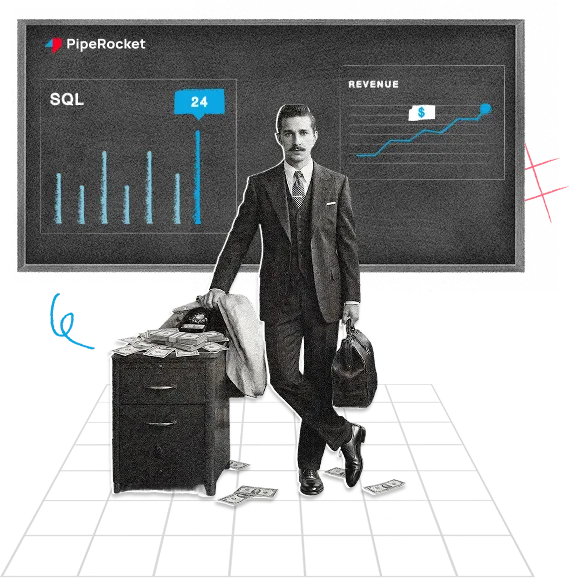
Every account is run by a senior-led pod, strategist, SEO lead, paid media lead, content strategist, with no junior handoff. 30+ team, 70+ B2B SaaS clients since 2023, 4.7/5 across 18 verified Clutch reviews, Google Partner and Meta Business Partner. Named clients include Storylane, Spendflo, HyperVerge, HyperStart, DevRev and CyberSierra. Verified results: HyperStart moved SQOs from 4 to 11 and cut cost per lead 73%; HyperVerge hit 51 MQLs in three months at 3.5x on zero extra budget; Storylane grew 2.5x in a quarter with SQLs up 25%.
Both channels report into one pipeline model. We capture the click ID on every form (GCLID from Google, plus the LinkedIn click ID) and stitch it into HubSpot or Salesforce, mapped through MQL to SQL to SQO to closed-won. Offline conversion import then pushes closed-won values back to the ad platforms so bidding optimises on revenue instead of cheap leads. Underneath sit Google Tag Manager and server-side tracking, enhanced conversions, consent-mode handling, UTM parameters and naming standards, GA4 event architecture, and lead routing and deduplication. Reporting runs in Looker Studio against a data-driven attribution model, with multi-touch attribution shown alongside it. Cost per SQL, CAC payback and pipeline contribution are the headline numbers, not sessions or form fills. On the RevOps side we also own lifecycle stages, lead scoring and routing SLAs, so marketing and sales are reading the same definition of a qualified lead.
The field splits by specialty. Kalungi and similar shops lead on fractional CMO work for early stage, Directive Consulting on pipeline-tied paid media, Grizzle and Omniscient Digital on organic content, Ironpaper on outbound and ABM. PipeRocket runs organic and paid in one retainer for post-product-market-fit B2B SaaS. Ask any shortlist for cost per SQL from a comparable account.
Yes, but the bar moved. Efficient growth replaced growth at any cost, so investors weigh net revenue retention, CAC payback inside 12 months and gross margin more heavily than raw ARR growth. Marketing is judged the same way, which is why pipeline contribution and CAC payback matter more than lead volume.
Match the agency to your bottleneck, not to its reputation. If you need positioning and a go-to-market plan, look for fractional CMO work. If the budget exists but attribution is broken, look for performance plus RevOps. Ask for cost per SQL from a comparable SaaS account, check who actually staffs the work, and avoid percentage-of-spend pricing.
A general digital marketing agency for SaaS often reuses the same playbook it runs for e-commerce or local business clients, more traffic, more leads. A dedicated SaaS digital marketing agency builds around trial-to-paid conversion, comparison and alternative pages, and CAC payback, the metrics that actually move a SaaS board.
Yes. As a B2B SaaS digital marketing agency, we work with self-serve PLG products, sales-assisted mid-market SaaS, and enterprise SaaS with longer procurement cycles. The buyer research, content, and attribution model flex to the motion, PLG, sales-led, or hybrid.
Our SaaS marketing services span SEO (topical authority, comparison/alternative pages, technical SEO), PPC (search, retargeting, account-based), and marketing ops (attribution, lifecycle, reporting). You can engage a single service or run all three as a unified programme.
First spend goes live in week 3 of the engagement. Most SaaS clients see qualified pipeline within 30–60 days once attribution and comparison-ready pages are wired in. Full topical authority and demand-generation maturity build over 6–9 months, faster for short PLG sales cycles, longer for enterprise SaaS.













































































 Research
 Content
 Design
 Optimisation
 Analysis