SaaS SEO: The Complete Guide for B2B SaaS in 2026
 Kamaraj Mathiarasan (Kim)
Last updated on
Kamaraj Mathiarasan (Kim)
Last updated on
Most SaaS teams come to me asking which SEO tactics to run. Publish more blog posts? Build more links? Chase the keywords competitors rank for? That’s the wrong first question.
SaaS SEO is a discipline with four moving parts, not a stack of tactics you switch on. The tactics only start compounding once you understand how those parts fit together.
I’ve spent 15 years on this, leading organic growth at Sprinto and Kissflow and running it across 50+ B2B SaaS brands at PipeRocket. This guide is the map of the whole discipline. The step-by-step playbook is one click away.
TL;DR
- What it is: SaaS SEO turns organic and AI search into a pipeline engine for software companies rather than just a traffic source.
- Why it’s different: Your buyer is a committee on a 30 to 90 day cycle, so you optimise for a journey rather than a single click.
- Who it’s for: It compounds only after product-market fit and a clear ICP. Before that, it scales confusion.
- What a program contains: Four parts working at once, Content, Technical, Authority, and Measurement, scored together rather than maxed one at a time.
- Why it still matters: Organic is the only channel that compounds, and AI search widened its lead over paid rather than killing it.
- How AI search changes it: Answers now appear inline and cite sources, so credibility and entity signals decide who gets quoted.
- The strategy in brief: Set pipeline goals, fix the foundation, build BOFU-first clusters, earn authority, measure pipeline. The sequenced steps live in the playbook.
What Is SaaS SEO?
SaaS SEO is the practice of optimising a software company’s web presence for organic search and the new AI search layer, turning search intent into trials, demos, and revenue while pulling customer acquisition cost down over time. It sits at the junction of SEO, content marketing, conversion rate optimisation, demand generation, and B2B SaaS go-to-market, and it applies whether you’re a seed-stage tool or one of the larger SaaS companies scaling a category.
What separates it from general content marketing is the pipeline intent behind every keyword decision. You’re not publishing to build an audience. You’re publishing to capture buyers who are actively researching a problem your product solves, then routing them toward a conversion.
How Is SaaS SEO Different From Traditional SEO?
SaaS SEO differs from traditional SEO in one decisive way: your buyer almost never converts on the first visit. A B2B SaaS purchase runs through multiple stakeholders and a 30 to 90 day evaluation cycle, so the search journey moves from problem awareness to vendor comparison long before a demo request lands in your CRM.
Traditional SEO optimises for a ranking and a click. SaaS SEO optimises for a buying committee across that entire journey.
A CMO searching “best project management software” and a developer searching “project management API integration” are often on the same buying committee . Your strategy has to reach both, at different moments, with different content. As Eli Schwartz argues in Product-Led SEO , the strongest SaaS programme is built around the product, and the keywords flow from there.
| Traditional SEO | SaaS SEO | |
|---|---|---|
| Primary goal | Rankings and traffic | Trials, demos, and pipeline |
| Who searches | A single searcher | A multi-stakeholder buying committee |
| Decision window | A single session | A 30 to 90 day evaluation cycle |
| Win condition | Position one | Organic SQLs and closed revenue |
Who SaaS SEO Is (and Isn’t) For
SaaS SEO compounds only after you have product-market fit and a clear ICP . Before that, it just scales your confusion faster. If you don’t yet know exactly who buys and why, every keyword decision downstream inherits that fuzziness, and you end up ranking for terms your real buyers never search.
That’s the honest disqualifier most agencies skip because it costs them a sale.
First-hand takeWe turn SaaS companies away from SEO more often than you’d think. If you don’t have product-market fit and a clear ICP yet, SEO will just scale your confusion faster. Fix that first, then we talk search.
That fit-first conversation is what working with a SaaS SEO consultant should feel like: honest about whether SEO is even the right bet before anyone signs. If you’re comparing independent operators, our best SaaS SEO experts roundup is a reasonable place to start.
The teams SaaS SEO works for share three traits. They know who their buyer is. They have a product that visibly solves a researched problem. And they can commit to a 9 to 12 month horizon, because that’s when organic starts outpacing paid on cost per qualified lead.
What Does a SaaS SEO Program Actually Contain?
A real SaaS SEO program is four parts working at once: Content, Technical, Authority, and Measurement. The mistake I see most often is treating it as a single lever, usually content, and pulling that one as hard as possible.
Programs that win are scored across all four dimensions at the same time, the way you’d score a product across reliability, speed, and design rather than maxing one and ignoring the rest. Get one part to “great” and leave the others at “weak,” and the great one can’t carry the program on its own.
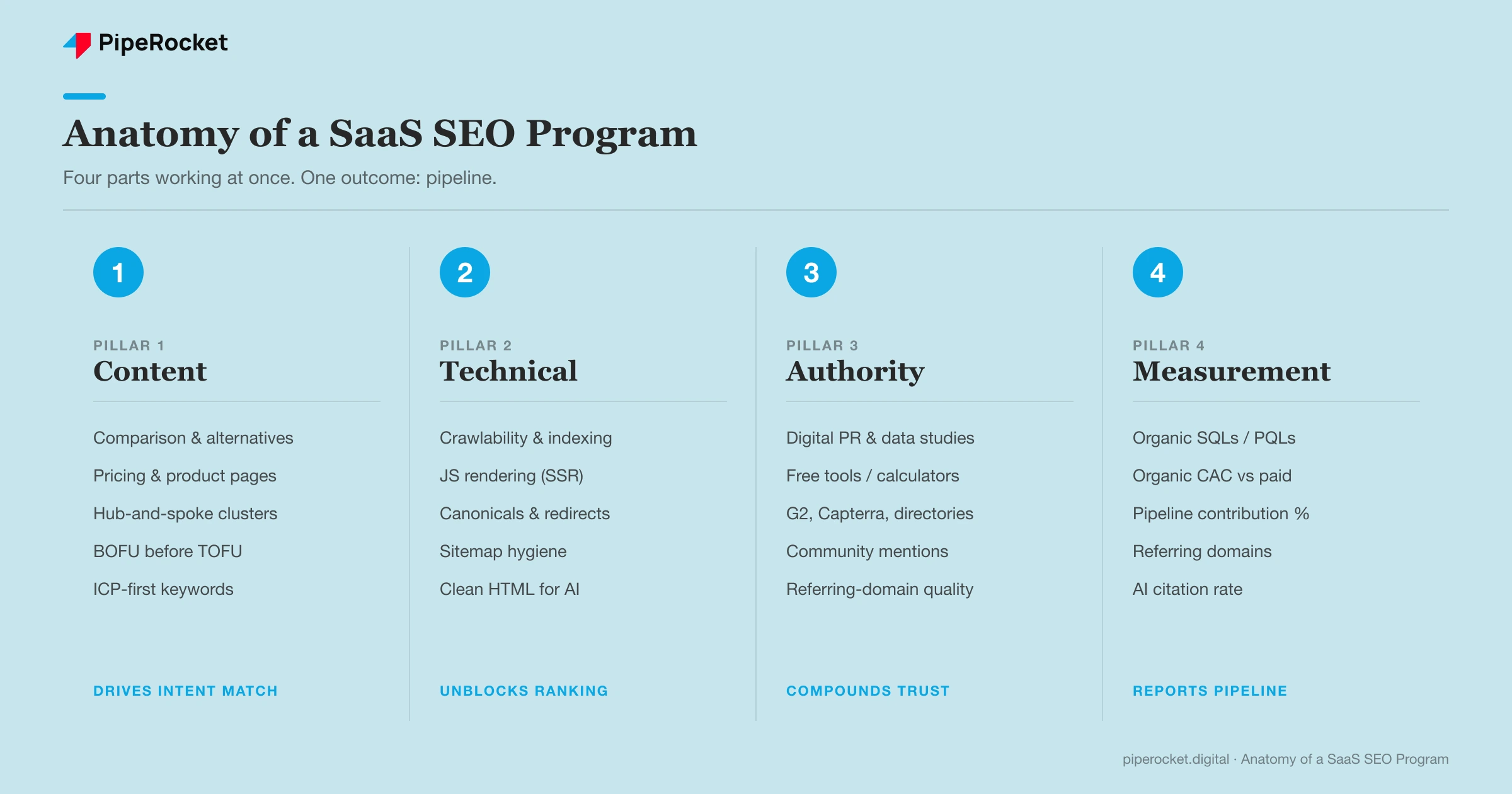
Here’s what each part is responsible for. This is the map. Each one has its own deep guide where the tactics live.
Content: BOFU-first, built in clusters
Content is where most SaaS SEO budget goes, and where most of it is wasted. The fix is to build across all three funnel tiers in a deliberate order: BOFU first (bottom-of-funnel, high-intent), then MOFU (middle-of-funnel use-case and solution pages), then TOFU (top-of-funnel educational content and free tools). Bottom-of-funnel leads because a comparison page with 300 visits at 15% conversion beats a trend article with 10,000 visits at 0.2%.
Which pages you build first comes out of competitor keyword research : pull the terms rivals already rank for, then prioritise the high-intent BOFU and MOFU keywords they win and you don’t. That single step decides where the budget goes before a word gets written.
Then you organise it as clusters. One pillar page covers the broad topic, 10 to 15 spokes cover every sub-topic, and every spoke links back to the pillar. That architecture is what signals topical authority to Google and gives AI engines a coherent body of work to cite.
On-page and commercial pages: the conversion surface
Commercial pages are where content turns into pipeline, so they get their own optimisation pass separate from blog posts. Product, feature, pricing, comparison, and integration pages carry the highest buying intent on the site, and they are the pages a buying committee opens right before a demo. On-page work here means matching each page to the exact query, keeping titles and H1s literal, and adding the proof (screenshots, specs, pricing clarity) that converts a researcher into a trial.
Technical: crawlability and indexation first
Technical SaaS SEO is narrower than people think. A SaaS site has roughly 1,000 to 2,000 pages, not the millions an e-commerce catalogue runs, so crawlability and indexation are about 90% of the job. Fix broken redirects, canonical errors, orphan pages, and JavaScript rendering issues, and Google rewards the rest.
Perfect Core Web Vitals scores matter less than the obsession around them suggests. Top-ranking pages for competitive terms rarely score above 80. Get the page crawlable and indexable, keep the experience clean, and move on.
Authority: earned through systems
Authority comes from a portfolio of sources, not a single tactic. Digital PR and original research earn links at scale. Free tools and calculators get embedded and shared. Integration and partner directories drop contextual links from high-authority domains in your exact category. Community presence on Reddit, Quora, and LinkedIn earns the brand mentions that AI engines disproportionately cite.
Watch referring-domain quality, not raw count. One link from a respected SaaS publication beats fifty from low-authority directories.
Measurement: pipeline over sessions
Measurement is the part that decides whether the other three get funded next year. The program is judged on organic-attributed pipeline, SQLs, and CAC, not on sessions or rankings. More on the specific metrics below, because this is where most programs quietly fail.
Why Does SEO Still Matter for B2B SaaS in the AI Era?
Organic search is the only acquisition channel that compounds, and AI search widened its lead rather than ending it. Paid ads stop the moment you pause the budget. Content built in month one is still generating demos in month eighteen at zero incremental cost per visit.
The data is blunt on this. We analysed 53 B2B SaaS brands over eight months. Organic didn’t just hold its ground against AI engines, it widened the gap on every metric that matters:
| Metric | Organic search | AI engines |
|---|---|---|
| Share of total traffic | 91.3% | 8.7% |
| Visitor-to-lead conversion | 0.92% | 0.26% |
| Absolute leads generated | 37x more | baseline |
Organic drove roughly 11 times more traffic than every AI engine put together, and converted at nearly 3.5 times the AI rate. Those numbers come from PipeRocket Digital’s State of SEO in the AI World 2026 report .
The economics show up in client work too. Spendflo credits us with 5X organic traffic over eight months and a 25% lift in organic leads. CyberSierra went from 6 to 338 keywords in top-10 positions , a 279% organic traffic increase. Neither came from chasing volume. Both came from ICP-mapped content built to convert.
For most SaaS companies, organic CAC crosses below paid CAC somewhere between months 9 and 14, then keeps falling as the content library grows. Paid can never replicate that curve.
How SaaS SEO Works in the AI Search Era (GEO, AEO, LLMO)
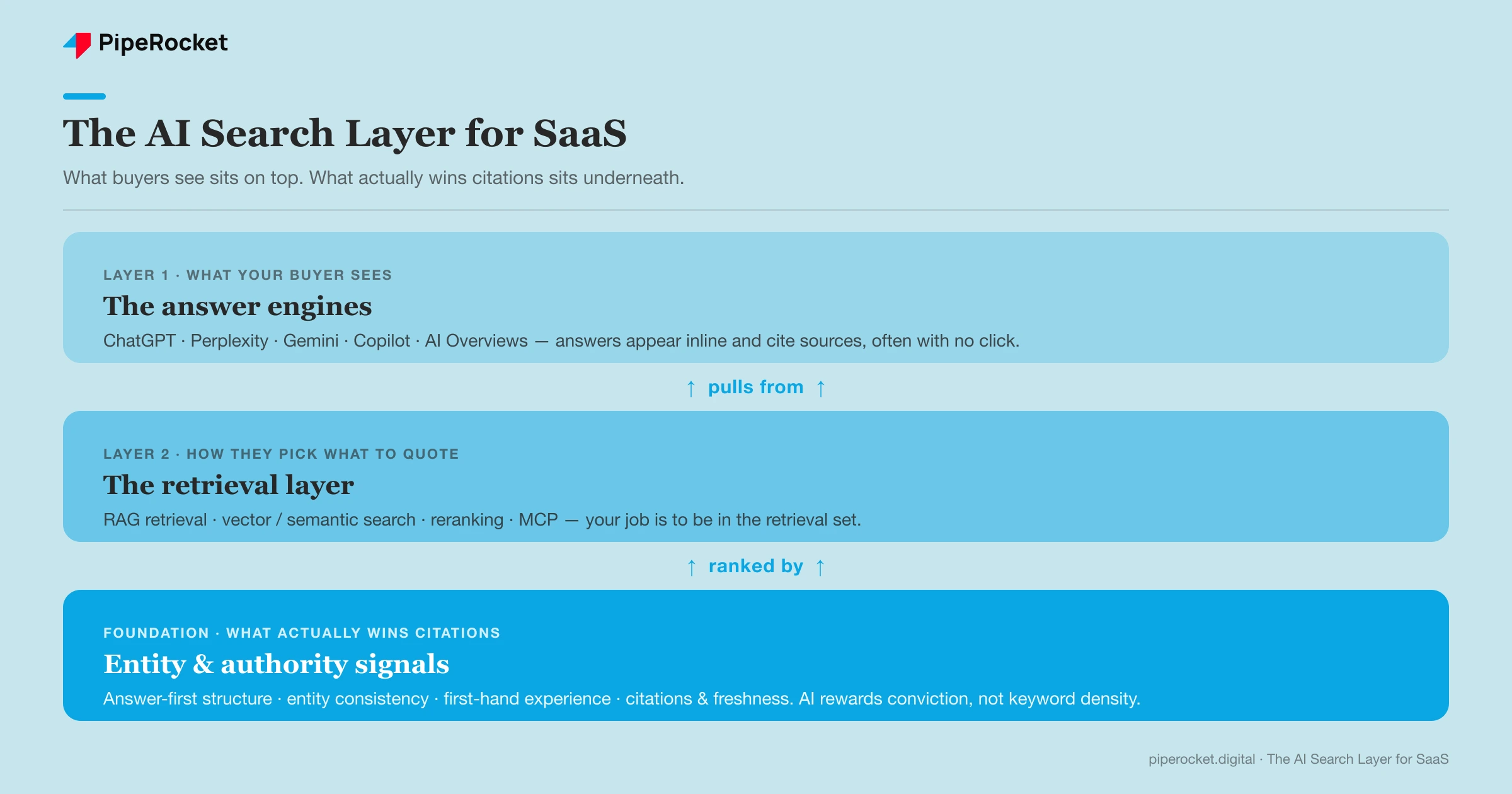
SaaS SEO now works by getting your content retrieved and cited by AI answer engines that resolve a query inline, not just ranked on a page of links. Search no longer ends at a SERP . ChatGPT, Perplexity, Google Gemini, Microsoft Copilot, and Google AI Overviews now answer questions inline and cite their sources, often without the user clicking through.
This is mainstream. At Google I/O 2026, the company reported AI Overviews at roughly 2.5 billion monthly users and its conversational AI Mode at around 1 billion, so most of your buyers already meet an AI-generated answer before a blue link.
Generative Engine Optimisation, Answer Engine Optimisation, and Large Language Model Optimisation are three names for adapting to that shift. For SaaS, it changes who gets discovered and why. Teams hiring this out rather than building it in-house can start with our best SaaS LLMO agencies roundup.
What AI engines actually reward
AI engines reward conviction over keyword density. First-hand experience is becoming a ranking signal in its own right. The web is saturated with generic information, and AI systems are increasingly weighting practitioner-led, founder-led explanations over anonymous content.
Google’s June 2026 spam update reinforced this by targeting scaled AI-generated content, so mass-produced articles now carry real downside. Real examples and real decisions beat abstract definitions, and depth in one category beats thin coverage across ten.
Three things move citation odds for SaaS:
- Answer-first structure: every major heading is a question your buyer types, with the answer in the first two sentences.
- Entity disambiguation: your brand name, logo, and description stay identical across G2, Capterra, Clutch, LinkedIn, Crunchbase, and Wikidata, so the Knowledge Graph resolves you as one node.
- Brand mentions on the surfaces AI engines lean on: we’ve watched Google’s AI return a named shortlist of agencies for a buyer query, with the citation pulled straight from a Reddit thread.
Microsoft Copilot is the clearest proof that quality beats volume here. It sends just 3.1% of AI traffic but the highest lead-to-SQL rate of any AI platform, because its users arrive from inside enterprise work tools.
The retrieval layer underneath (RAG, vectors, MCP)
Beneath the visible answer engines is an infrastructure layer that decides who gets quoted. Most AI engines answer through retrieval-augmented generation : a retrieval step pulls candidate documents from a corpus, then the model writes an answer grounded in them. Your job is to be in that retrieval set.
Vector embeddings are how the retrieval step judges relevance, clustering content by meaning rather than exact keywords, which is why “semantic SEO” stopped being a metaphor. Model Context Protocol, an emerging open standard for how AI agents reach external data, is starting to make clean, structured product data directly queryable by agents.
You don’t need to build vector databases. You need to publish content that’s clean, structured, and entity-consistent so a retrieval step can lift it cleanly, because that’s what the infrastructure rewards.
Google’s own 2026 guidance on optimising for AI features backs this up:
- It is still SEO. Showing up in AI Overviews and AI Mode needs no special measures: an llms.txt file or dedicated AI schema is not required.
- llms.txt is optional. Publishing one as low-cost insurance for the crawlers that read it is fine, but treat it as optional rather than a ranking prerequisite. The fundamentals, crawlable pages, clear entities, and genuine expertise, are what carry over.
The SaaS SEO Strategy in Brief, and Where the Full Playbook Lives
The SaaS SEO strategy is five moves in a fixed order: set pipeline goals, define your buyer personas , fix the technical foundation, build BOFU-first content in clusters, then earn authority and measure against pipeline. It’s short to state and long to execute. In order:
- Set pipeline-tied goals, and define your buyer personas, before opening a keyword tool
- Fix the technical foundation before publishing
- Build BOFU content first, then work upward in clusters
- Earn authority through systems, not one-off campaigns
- Measure everything against pipeline, not pageviews
The sequence is the point. Most teams start in the middle and wonder why nothing compounds.
How long it takes and what it costs
Budget for a 9 to 12 month horizon before organic outpaces paid on cost per qualified lead. First ranking movements land in 30 to 90 days on low-difficulty BOFU keywords, first organic demos in 3 to 6 months, and predictable recurring pipeline around months 9 to 12. Cost tracks scope: a focused BOFU-first program runs lighter than a full-cluster build across all three funnel tiers. The timeline moves with your starting domain authority and publishing cadence.
The full step-by-step version, with the order to run each step, B2B examples, and the “what not to do” at every stage, lives in our complete 8-step SaaS SEO strategy framework . Treat this guide as the map and that one as the route. For the specific signals Google weighs at each step, see our Google ranking factors for SaaS breakdown.
How Do You Measure SaaS SEO?
You measure SaaS SEO by pipeline contribution, not vanity metrics. Rankings and raw traffic tell you a page exists; they don’t tell you whether it sent a qualified buyer to sales. The shift is to stop chasing traffic and start chasing signals: who visited, which pages, how often, and what that predicts about pipeline.
| Vanity metric | Why it misleads | Replace with |
|---|---|---|
| Raw organic traffic | Doesn’t filter for ICP match | Organic SQLs and PQLs |
| Keyword rankings | Position one for a zero-intent term is zero pipeline | Pipeline-generating keywords ranked |
| Domain authority | Not a Google ranking factor | Referring domain quality |
| AI traffic volume | Doesn’t reflect citation strength | Share of Model Response, AI Citation Rate |
| First-touch attribution | Undercounts SEO across long cycles | Multi-touch or pipeline-influenced attribution |
One caution on the AI column. The current crop of AI-visibility and share-of-model tracking tools is immature, directional at best, so treat those numbers as estimates rather than precise measurement in 2026. If your SEO fundamentals are strong, you’re likely already showing up in AI answers.
The SaaS SEO Tool Stack
The 2026 stack is more crowded than the 2020 version, but the core stays small. A working program needs six things: a keyword and competitor platform, a crawler, an analytics and reporting layer, an on-page aid, an AI-visibility tracker, and an intent-data signal.
| Category | Tools |
|---|---|
| Keyword and competitor intelligence | Ahrefs, Semrush, Moz, AlsoAsked, AnswerThePublic |
| Site crawlers and technical audits | Screaming Frog, Sitebulb, Lumar, Botify |
| Analytics and pipeline reporting | Google Search Console, GA4, Looker Studio, HubSpot, Salesforce |
| On-page content optimisation | Clearscope, Surfer SEO, Frase, MarketMuse |
| AI visibility and citation tracking | Ahrefs Brand Radar, Semrush AI Visibility Toolkit, Profound, Otterly |
| Intent data | 6sense, Bombora, Clearbit, ZoomInfo, RB2B |
The AI-visibility row moves fastest of the six; our best AI visibility tools roundup tracks which ones are worth the subscription right now.
Weighing the two directly? See our neutral MarketMuse vs Clearscope breakdown.
You don’t need all of these. Most teams thrive with Ahrefs or Semrush, plus Screaming Frog, GSC, GA4, one AI-visibility tool, and one intent-data signal. The rest earn their place only when scale demands them.
Why Choose PipeRocket Digital for SaaS SEO?
If the board is asking what organic search contributed to pipeline last quarter, that’s the problem we were built to solve. PipeRocket Digital is a SaaS SEO agency that reports on pipeline, not rankings. Before a keyword tool opens, we:
- Go inside your sales calls and map your ICP
- Identify the buying triggers that move a prospect to sales
- Measure every page against SQLs, PQLs, and pipeline contribution
If you’d rather evaluate options first, compare the best SaaS SEO agencies , then talk to us when you want pipeline on the agenda.
Frequently Asked Questions
What is SaaS SEO and how is it different from regular SEO?
SaaS SEO is the practice of optimising a software company’s site for organic and AI search to generate trials, demos, and pipeline. The difference from regular SEO is the buyer. A B2B SaaS purchase runs through a buying committee over a 30 to 90 day cycle, so you optimise for a multi-stakeholder journey rather than a single click, and you measure success in organic SQLs and pipeline rather than rankings and sessions.
Does SaaS SEO still work now that AI Overviews and ChatGPT answer questions directly?
Yes, and the gap has widened in organic’s favour. Across 53 B2B SaaS clients, organic converted visitors to leads at 0.92% versus AI traffic’s 0.26% and drove 37 times more absolute leads. AI search changes the shape of the work, adding GEO , AEO , entity clarity, and community-led citation, but not the underlying economics. Organic remains the channel with the best lead quality and the only compounding cost curve.
How long does SaaS SEO take to show results for a B2B SaaS company?
First ranking movements happen in 30 to 90 days for low-difficulty BOFU keywords. First organic demos usually appear in your CRM within 3 to 6 months. Predictable recurring pipeline tends to arrive around months 9 to 12, with the full compounding effect at 12 to 24 months. The timeline depends heavily on your starting domain authority and publishing cadence.
What SEO metrics should B2B SaaS marketers track?
Track pipeline metrics over vanity metrics: organic SQLs and PQLs, pipeline-generating keywords ranked, referring-domain quality, and organic CAC. Add Share of Model Response and AI Citation Rate for AI visibility, and use multi-touch attribution to credit SEO across the long buying cycle.