
200+ AI SEO Statistics (Updated October 2026)
 Kamaraj Mathiarasan (Kim)
Last updated on
Kamaraj Mathiarasan (Kim)
Last updated on
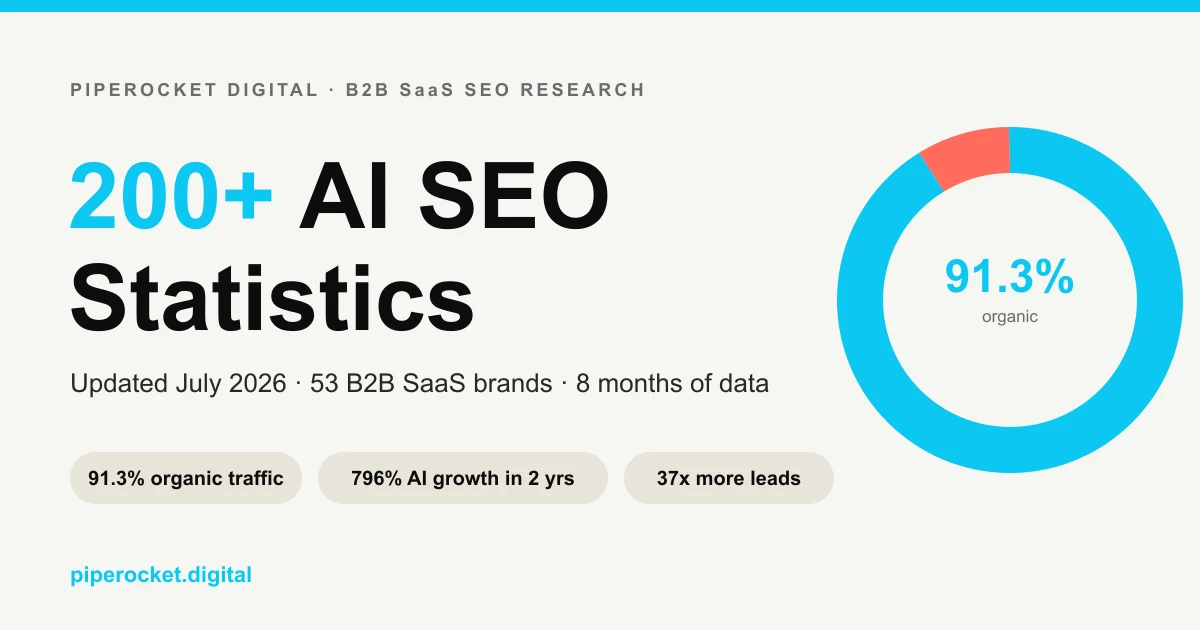
Here is the headline from our own data: across 53 B2B SaaS brands we tracked for 8 months, organic search still drove 91.3% of all traffic and 37x more leads than every AI engine combined, yet AI referral traffic is growing fast and converting a very different kind of buyer. If you run marketing for a B2B SaaS company, you have heard the two loud takes: “AI is killing organic search,” or “AI is just a distraction.” Both are wrong, and most people repeating either one are working off vibes, not data.
So we dug in. We pulled real analytics and CRM data from those 53 brands and compared organic search against AI referral traffic across traffic, leads, conversions, and pipeline. No estimates. No surveys. Just what we saw in the numbers.
Every statistic in the first six sections comes directly from that dataset. The industry statistics in the later sections are sourced separately, with links to the original research.
Key Takeaways
- Of all traffic analyzed across 53 B2B SaaS brands, 91.3% came from organic search and only 8.7% from AI engines.
- Organic generated 37x more leads than AI, and converted visitors at 3.5x higher rates.
- AI traffic skews harder toward BoFu: 44% of AI sessions were bottom-of-funnel vs. 41% for organic.
- Only 11.8% of AI-referred sessions carried brand intent, vs. 28.1% for organic.
- ChatGPT drove 65.8% of all AI referral traffic. Microsoft Copilot delivered the highest Lead-to-SQL rate at 35%.
- In cybersecurity SaaS, organic leads closed at 81% Lead-to-SQL vs. just 20% for AI-referred leads.
- Homepage conversions grew 6–9% MoM for 6 consecutive months, a signal of AI-driven discovery flowing into branded organic searches.
- The dark funnel hides an estimated 57–73% of the B2B buying journey from standard attribution tools.
- AI referral traffic grew 796% in two years (January 2024 to December 2025), far outpacing organic search, though it still accounts for only about 0.18% of total web sessions.
- 99.2% of all AI Overview keywords are informational in intent, so AI Overviews dominate research queries far more than commercial ones.
- AI-referred visitors can convert at a dramatically higher rate than organic, with one 12-million-visit analysis finding 14.2% versus 2.8%, roughly 5x.
- Only 30% of brands stay visible from one AI answer to the next, and just 20% across five consecutive runs, making AI visibility far less stable than organic rankings.
AI vs. Organic Traffic Volume Statistics for B2B SaaS in 2026
These figures reflect the share of traffic across the 53 B2B SaaS brands we analyzed over 8 months, not industry-wide estimates.
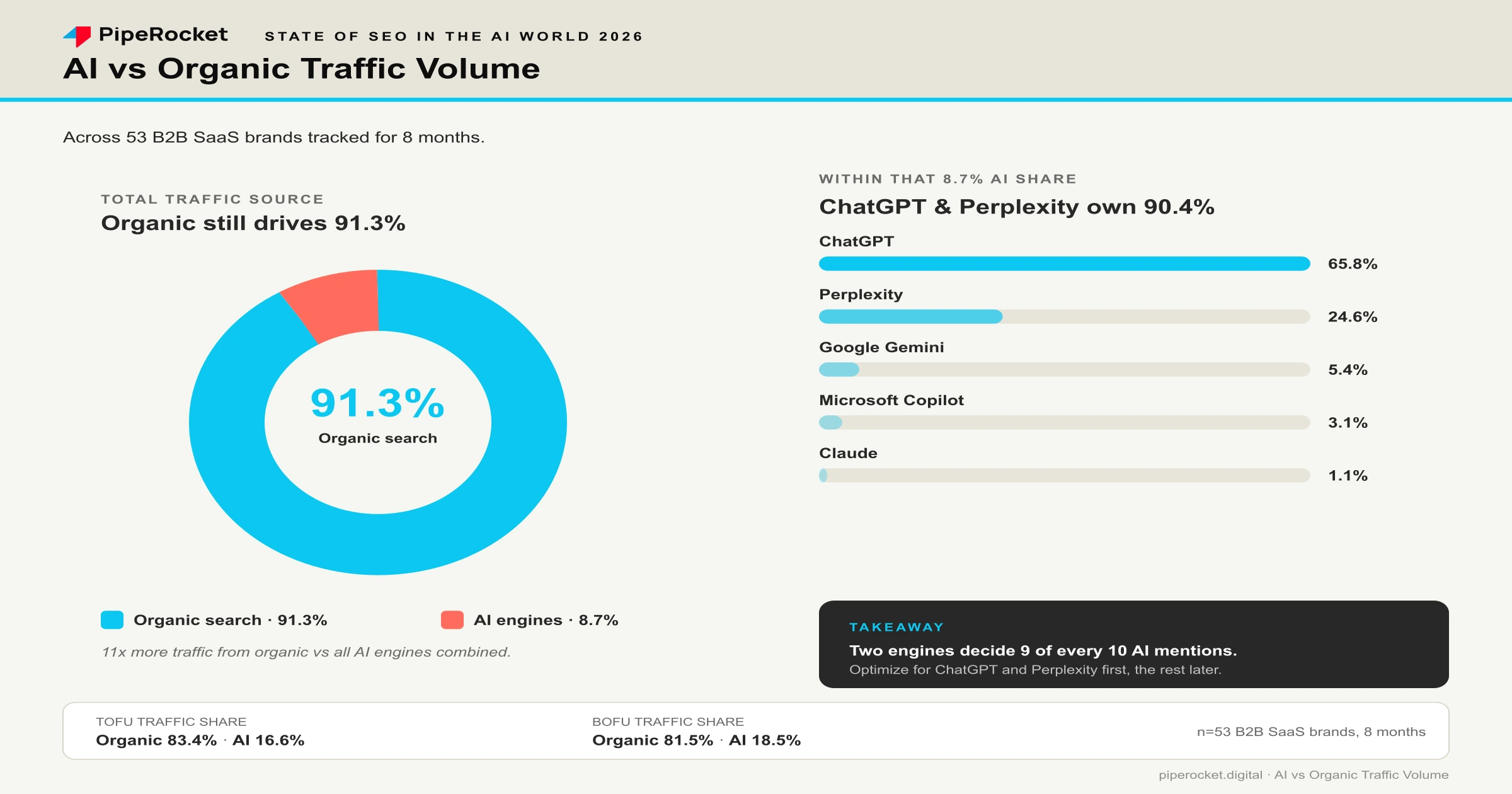
- Of all traffic analyzed across 53 B2B SaaS brands, 91.3% came from organic search and 8.7% from AI engines combined.
- Organic search drove 11x more traffic than all AI engines combined across the brands studied.
- Of the AI referral traffic analyzed, ChatGPT accounted for 65.8%, by far the dominant AI referral source.
- Perplexity was the second-largest AI referrer, accounting for 24.6% of all AI-sourced traffic.
- ChatGPT and Perplexity combined accounted for 90.4% of all AI referral traffic to B2B SaaS sites.
- Google Gemini contributed 5.4% of AI referral traffic, Microsoft Copilot 3.1%, and Claude just 1.1%.
- Not a single vertical in the dataset showed AI traffic surpassing organic in absolute visit volume.
- Of all Top-of-Funnel traffic recorded, 83.4% came from organic search and 16.6% from AI engines.
- Of all Bottom-of-Funnel traffic recorded, 81.5% came from organic search and 18.5% from AI engines.
- In Customer Support SaaS, organic accounted for 87% of all traffic, the highest organic dominance of any vertical studied.
- Homepage conversions grew 6–9% month-over-month for 6 consecutive months, consistent with AI-driven discovery feeding into branded organic searches.
AI vs. Organic Lead Generation and Pipeline Conversion Statistics for B2B SaaS
These figures compare how organic and AI-referred visitors converted across the funnel, from first visit, to lead, to Sales Qualified Lead, across the 53 brands in our dataset.
- Organic search visitors converted to leads at 0.92%, nearly 3.5x higher than AI-referred visitors at 0.26%.
- Across the dataset, organic generated 37x more leads in absolute terms than all AI referral sources combined.
- Organic leads converted to Sales Qualified Leads at 33.3%, compared to 28.6% for AI-sourced leads.
- Among AI platforms, Microsoft Copilot produced the highest Lead-to-SQL rate at 35%, ahead of ChatGPT (30%), Perplexity (25%), Gemini (20%), and Claude (15%).
- Copilot’s Lead-to-SQL rate of 35% was 133% higher than Claude’s 15%, despite both platforms sending comparable volumes of raw traffic.
- There was a 20-percentage-point spread in Lead-to-SQL rates across the five AI platforms tracked (35% Copilot to 15% Claude).
Engagement and On-Site Behaviour: Organic Search vs. AI Referral Traffic in B2B SaaS
Once visitors landed on site, organic and AI-referred users behaved very differently. These metrics reflect average on-site behaviour across the full dataset.
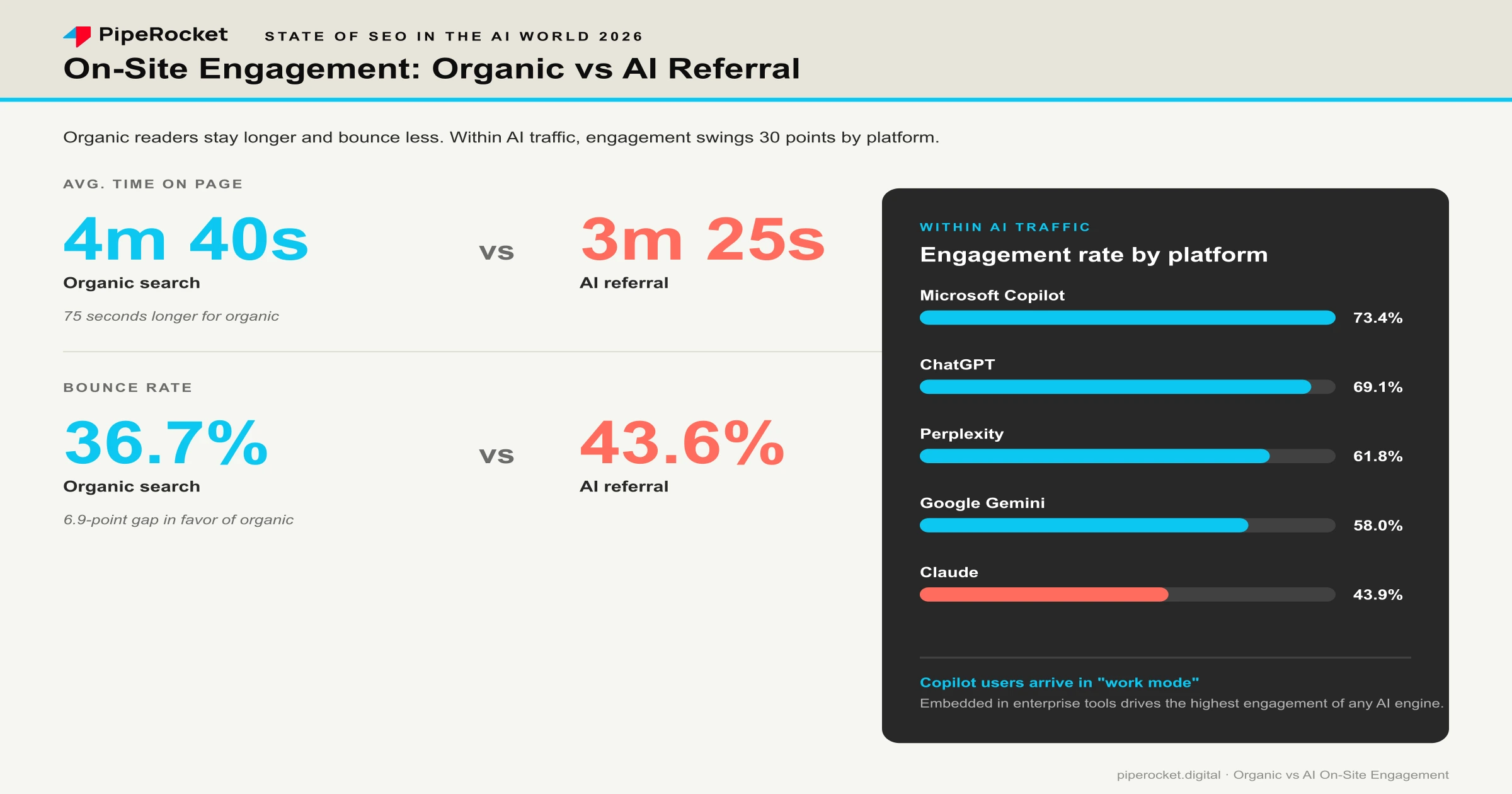
- Organic visitors spent an average of 4 minutes and 40 seconds on page, 75 seconds longer than AI-referred visitors (3m 25s).
- AI-referred visitors were 27% less engaged by time-on-page than organic visitors across the dataset.
- The bounce rate for organic traffic was 36.7%, vs. 43.6% for AI-referred traffic, a 6.9-point gap.
- Among AI platforms, Copilot-referred users had the highest engagement rate at 73.4%, followed by ChatGPT (69.1%), Perplexity (61.8%), Gemini (58.0%), and Claude (43.9%).
- There was a 29.5-percentage-point spread in engagement rates across the five AI platforms (73.4% Copilot vs. 43.9% Claude).
- Copilot’s higher engagement is attributed to its embedding inside enterprise productivity tools. Users arrive already in active “work mode.”
Funnel Stage and Search Intent Distribution: AI Traffic vs. Organic in B2B SaaS
These figures show how the funnel composition and brand intent differed between organic and AI-referred sessions across the full dataset.
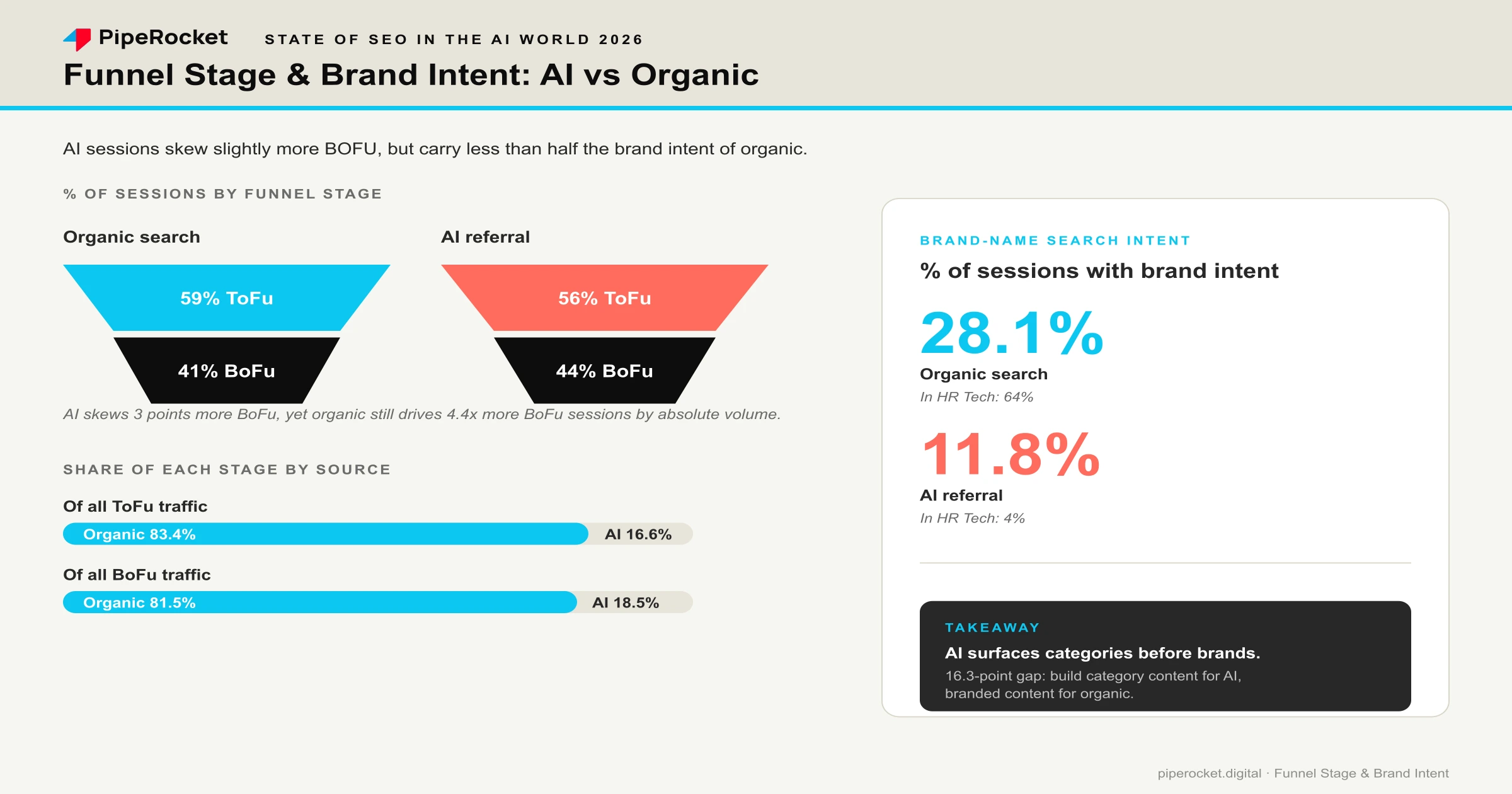
- Of all organic sessions analyzed, 59% were Top-of-Funnel and 41% were Bottom-of-Funnel.
- Of all AI-referred sessions analyzed, 56% were Top-of-Funnel and 44% were Bottom-of-Funnel, a proportionally stronger BoFu skew than organic.
- Despite AI’s higher BoFu share, organic still drove 4.4x more BoFu traffic in absolute volume than AI across the dataset.
- 28.1% of organic sessions carried brand-name search intent. Only 11.8% of AI-referred sessions did, a 16.3-point gap.
- 88.2% of AI-referred sessions were non-branded, vs. 71.9% for organic, confirming AI surfaces categories before brands.
- In HRTech, 64% of organic sessions included branded queries, vs. just 4% of AI-referred sessions, a 60-point brand-intent gap.
Lead-to-SQL Conversion Rates by SaaS Vertical: Organic Search vs. AI Referral
Organic and AI traffic behaved very differently depending on the SaaS vertical, particularly where trust, compliance, or risk played a major role in the buying decision.
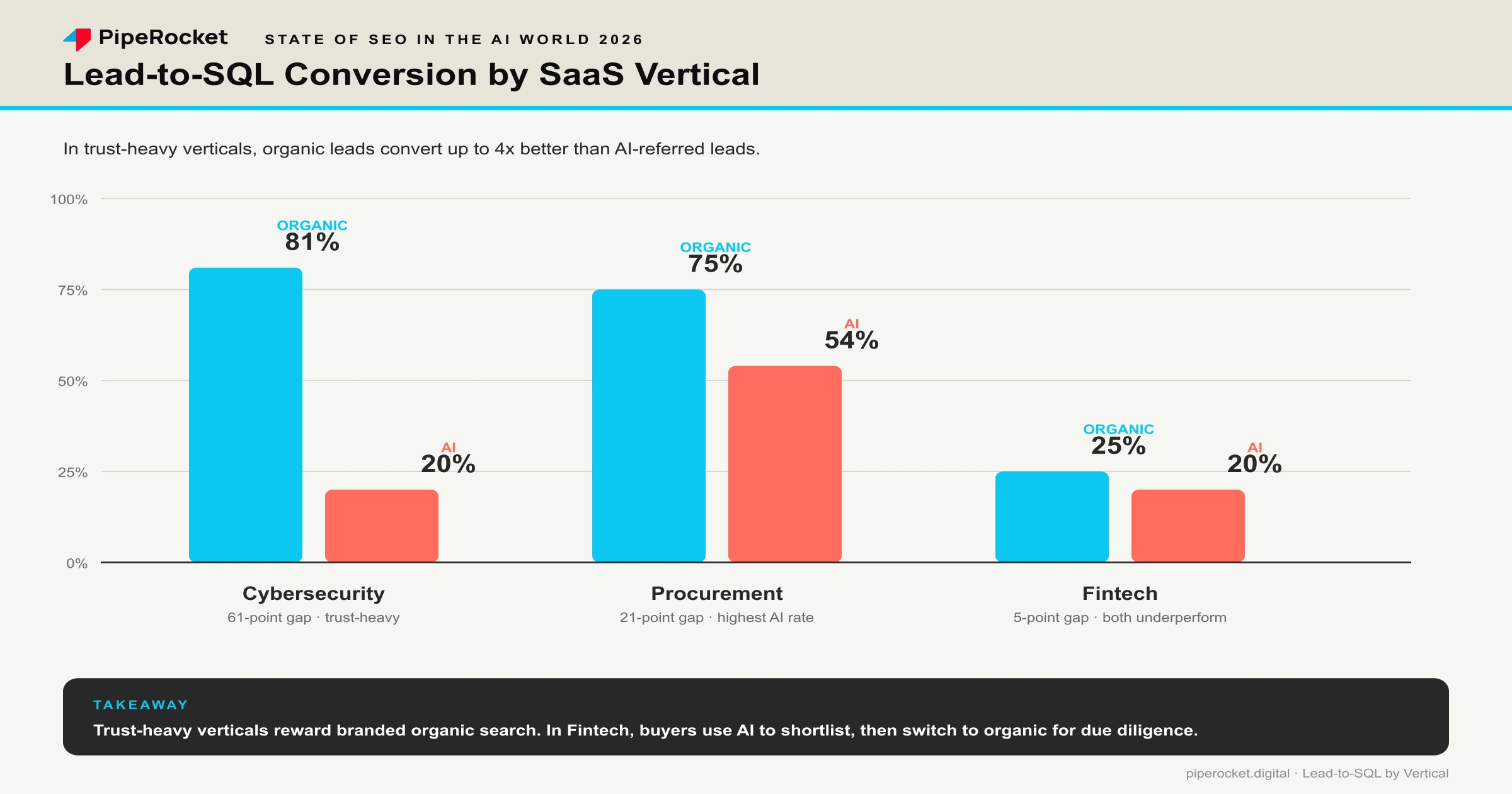
- In Cybersecurity SaaS, organic leads converted to SQLs at 81%. AI-referred leads converted at just 20%, a 61-point gap driven by trust requirements.
- In Procurement SaaS, organic leads converted at 75% Lead-to-SQL, while AI-referred leads converted at 54%, the highest AI conversion rate of any vertical studied.
- In Fintech SaaS, both channels underperformed: organic at 25% Lead-to-SQL and AI at 20%, reflecting a high-scrutiny due diligence buying process.
- In Customer Support SaaS, organic held 87% of all traffic. Buyers in established categories appear to bypass AI and search directly for known vendors.
- In HRTech, 64% of organic traffic was branded vs. only 4% of AI traffic, AI functions almost entirely as a top-of-funnel discovery tool in this vertical.
- In Fintech, buyers appear to use AI to shortlist vendors, then switch to organic search for compliance and security verification before converting.
AI Platform Performance Statistics: ChatGPT, Perplexity, Copilot, Gemini and Claude for B2B SaaS
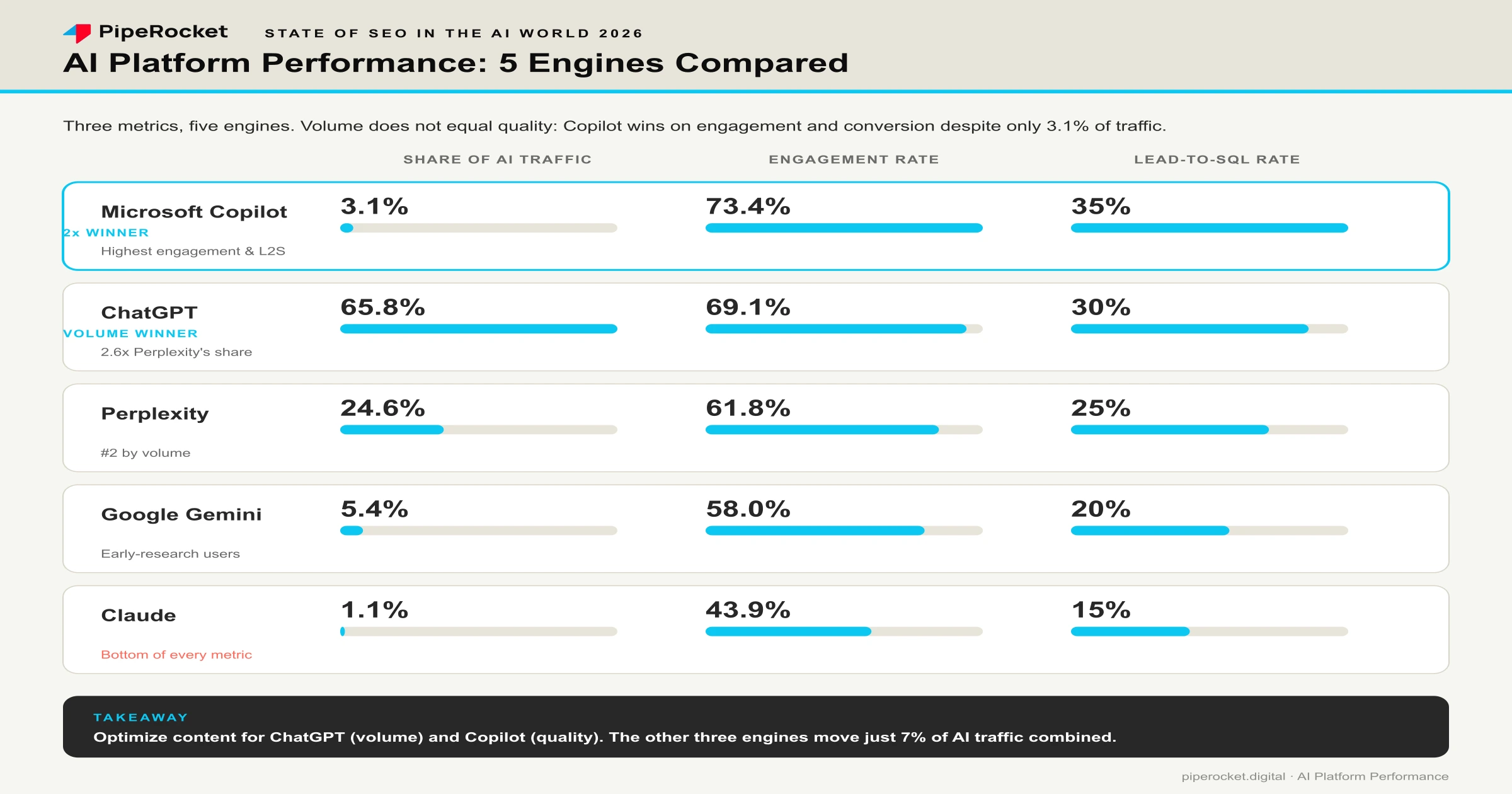
Across the five AI platforms tracked, traffic volume, on-site engagement, and pipeline conversion varied significantly.
| AI platform | Share of AI traffic | Engagement rate | Lead-to-SQL rate |
|---|---|---|---|
| Microsoft Copilot | 3.1% | 73.4% | 35.0% |
| ChatGPT | 65.8% | 69.1% | 30.0% |
| Perplexity | 24.6% | 61.8% | 25.0% |
| Gemini | 5.4% | 58.0% | 20.0% |
| Claude | 1.1% | 43.9% | 15.0% |
- ChatGPT drove 65.8% of all AI referral traffic, more than 2.6x Perplexity’s share and over 60x Copilot’s share.
- Despite contributing only 3.1% of AI traffic, Copilot delivered the highest Lead-to-SQL rate (35%) and highest engagement rate (73.4%) of any AI platform.
- Claude contributed only 1.1% of AI referral traffic and had the lowest engagement (43.9%) and Lead-to-SQL rate (15%) of all platforms tracked.
- Gemini’s 20% Lead-to-SQL rate matched Fintech organic performance, suggesting Gemini-referred users were in early, exploratory research phases.
AI Search Adoption and Usage Statistics
The statistics above come from our own dataset. The sections that follow draw on the wider body of third-party research published across 2025 and 2026, with every figure linked to its original source. AI search is being adopted fast, but it is layering on top of traditional search rather than replacing it, and B2B software buyers are moving faster than the general population.
- 44% of US adults now report using ChatGPT as of early 2026, up from 34% in 2025 and 18% in 2023. (Pew Research Center, June 2026 )
- 28% of employed US adults use ChatGPT for work, up from just 8% in early 2023. (Pew Research Center, June 2025 )
- 51% of B2B software buyers now start their research with an AI chatbot more often than with Google, up from 29% in April 2025. (G2 Research, April 2026 )
- 71% of B2B buyers rely on AI chatbots for software research, up from 60% just seven months earlier. (G2 Research, April 2026 )
- 69% of B2B buyers chose a different vendor than they originally planned based on AI chatbot guidance, and 33% bought from a vendor they had not previously known existed. (G2 Research, April 2026 )
- 97% of B2B buyers say AI chatbots have meaningfully changed their research habits, and 53% now find AI research more productive than traditional search. (G2 Research, April 2026 )
- 94% of B2B buyers report using AI at some point during a purchase process. (Forrester, 2026 )
- ChatGPT’s share of worldwide AI web traffic fell from 86.7% to below 65% in roughly a year as Gemini climbed past 20%, a redistribution of usage rather than a decline in AI overall. (Similarweb, 2026 )
- Generative AI platforms referred 226.8 million US visitors to third-party sites in January 2026. (Similarweb 2026 Generative AI Visibility Index )
What Makes Content Get Cited by AI: LLM Ranking Factors
The signals that earn AI citations are not the same as classic SEO ranking factors. Brand presence beats raw link metrics, freshness matters, and several widely-hyped tactics do nothing.
- Branded web mentions correlate with AI visibility about 3x more strongly than backlinks (0.664 vs. 0.218), across a study of 75,000 brands. (Ahrefs, August 2025 )
- YouTube mentions show the single strongest correlation with AI visibility (around 0.737), outranking every other factor tested across ChatGPT, AI Mode, and AI Overviews. (Ahrefs, December 2025 )
- Domain Rating correlates only 0.27 to 0.33, and backlink count only about 0.19 with AI visibility, confirming raw link metrics are secondary to brand mentions. (Ahrefs, December 2025 )
- 76.4% of ChatGPT’s top 1,000 cited pages were updated within the last 30 days. (Ahrefs, October 2025 )
- Only 30% of brands stay visible from one AI answer to the next, and just 20% across five consecutive runs, so AI citation is far less stable than organic rankings. (AirOps, 2026 )
- Pages not updated quarterly are over 3x more likely to lose AI citations than recently refreshed pages. (AirOps, 2026 )
- ChatGPT’s cited pages skew far fresher than Google’s organic results, with direct citations averaging 458 days newer than what ranks organically. (Ahrefs, 2026 )
- 44.2% of all ChatGPT citations pull from the first 30% of a page, with the middle 40% contributing 31.1% and the final third only 24.7%. (Ahrefs, 2026 )
- Cited content shows an entity density of about 20.6%, three to four times higher than standard prose, so AI favors content dense with named people, brands, and products. (Ahrefs, 2026 )
- Schema markup showed no causal lift in AI citations across 1,885 pages that added JSON-LD versus 4,000 control pages; all changes fell within statistical noise. (Ahrefs, via Search Engine Land, 2026 )
- llms.txt showed no measurable effect on how often a domain is cited by LLMs in a 300,000-domain analysis. (SE Ranking, November 2025 )
Top Cited Domains and Content Formats in AI Answers
AI engines pull from a narrow, predictable set of domains and formats. Knowing which ones tells you where to build presence.
- Wikipedia is the single largest source in ChatGPT’s top 1,000 cited pages at 29.7%, followed by homepages and landing pages (23.8%) and educational pages (19.4%). (Ahrefs, October 2025 )
- Only 32.3% of ChatGPT’s top-cited content types are ones marketers can directly influence; the remaining 67.7% are formats like Wikipedia and organizational homepages. (Ahrefs, October 2025 )
- 28.3% of ChatGPT’s top-cited pages have zero organic Google keyword rankings, confirming AI citation and classic SEO ranking are increasingly separate games. (Ahrefs, October 2025 )
- Reddit is the most-cited domain in Perplexity and Google AI Mode , and second only to Wikipedia in ChatGPT, based on over 1 million citations analyzed. (Otterly.AI, February 2026 )
- Community platforms (Reddit and Quora) account for 52.5% of citations versus 47.5% for brand domains. (Otterly.AI, February 2026 )
- Brand-domain citation rates vary sharply by platform: Google AI Overviews cite brand domains 59.8% of the time, ChatGPT 44.7%, and Perplexity only 28.9%. (Otterly.AI, February 2026 )
- “Best of” listicles account for 43.83% of ChatGPT citations across software, agency, and product categories, the dominant format for commercial queries. (Ahrefs, 2026 )
- ChatGPT averages 15 sources per response versus Gemini’s 3, based on 126 million US AI search prompts, so ChatGPT casts a far wider citation net. (Semrush 2026 AI Visibility Index )
AI Bot, Crawler, and Agent Statistics
If AI engines cannot crawl your pages, none of the citation factors matter. Crawler behavior is shifting quickly, and most of it exists to harvest training data rather than send traffic.
- GPTBot’s share of crawler traffic grew from 2.2% to 7.7% in a year (up 305%), moving to the third most active crawler, while Googlebot reached 50% of all crawler traffic. (Cloudflare, July 2025 )
- PerplexityBot ’s request volume grew 157,490% year over year, the fastest-growing crawler tracked, though from a small base. (Cloudflare, July 2025 )
- Only 14% of the top 10,000 domains have any robots.txt directive targeting AI bots, so most publishers have not made an explicit access decision either way. (Cloudflare, July 2025 )
- Anthropic’s ClaudeBot crawls 23,951 pages for every referral it sends back, versus GPTBot at 1,276 to 1 and Google at roughly 5 to 1, showing most AI crawling harvests training data and returns almost no traffic. (Cloudflare Radar, 2026 )
- llms.txt files reached 36,120 known instances by May 2026, an 8.8x jump in a year, yet AI crawlers almost never fetch them. (ppc.land, 2026 )
- Google has confirmed it does not support llms.txt and has no plans to, with John Mueller comparing it to the ignored meta-keywords tag. (via Digital Applied, 2026 )
Google AI Overview and Zero-Click Statistics
AI Overviews are expanding into commercial territory and compressing click-through rates, but being cited inside one is a measurable advantage.
- AI Overviews appeared in 6.49% of US queries in January 2025, peaked near 24.61% in July, then settled to 15.69% by November 2025 after Google recalibrated the feature. (Semrush, December 2025 )
- AI Overview coverage grew 58% year over year, reaching roughly 48% of tracked queries by March 2026. (BrightEdge via Search Engine Journal, March 2026 )
- AI Overview presence in B2B technology queries climbed from 36% to 82% in twelve months, one of the steepest increases of any industry tracked. (BrightEdge via Search Engine Journal, March 2026 )
- US Google searches ended without a click 68.01% of the time in early 2026, up from 60.45% in 2024. (SparkToro via Search Engine Land, 2026 )
- Organic CTR for queries with an AI Overview fell to 1.3% in December 2025 before recovering to 2.4% by February 2026, based on 2.43 billion organic impressions across 53 brands. (Seer Interactive, April 2026 )
- Brands cited inside an AI Overview earn 120% more organic clicks per impression than brands not cited on the same page (2.07% vs. 0.94% CTR on informational queries). (Seer Interactive, April 2026 )
- Comparison queries trigger an AI Overview 95.4% of the time, question queries 85.9%, review queries 86.3%, and “best of” queries 81.3%, versus just 27.3% for single-word queries. (Seer Interactive, April 2026 )
- Commercial-intent AI Overview queries rose from 8.15% to 18.57% and transactional queries from 1.98% to 13.94% in a year, as AI Overviews move deeper into purchase-intent searches. (Semrush, December 2025 )
- Healthcare has the highest AI Overview trigger rate at 88%, followed by Education at 83% and B2B Tech at 82%. (BrightEdge via Search Engine Journal, March 2026 )
AEO and GEO Statistics: How B2B Buyers Use AI in the Purchase Journey
Beyond our proprietary dataset, here is what broader industry research tells us about AI’s role in B2B buying behaviour and how to optimize for AI citation and visibility. If you would rather partner than build this in-house, our roundup of the best AEO agencies for AI visibility tracking and reporting applies these same signals to real vendors.
- 89% of B2B buyers now use generative AI at some point in their buying process. (source: Forrester Buyers’ Journey Survey, 2024 )
- B2B buyers spend just 17% of their total purchase journey meeting with potential suppliers, most evaluation happens independently. (source: Gartner )
- 92% of B2B buyers start with at least one vendor already in mind, and 41% have a single preferred vendor selected before formal evaluation begins.
- 95% of the time, the winning vendor is already on the buyer’s Day One shortlist, before a single sales conversation takes place.
- Adding statistics and data points to content increases AI visibility by 22%. Including direct quotations boosts it by 37%.
- Pages with proper schema markup are 30–40% more likely to be cited in AI-generated answers.
- GEO optimization techniques can boost AI content visibility by up to 40% through statistics inclusion, structured formatting, and comprehensive topic coverage.
- Content with clear, verifiable data points earns roughly 30–40% more visibility in LLM -generated answers than purely qualitative content.
- Brand search volume, not backlinks , is the strongest predictor of AI citations, with a 0.334 correlation to LLM visibility.
- Establishing entity presence across 4+ third-party platforms increases AI citation likelihood by 2.8x.
- Only 11% of domains are cited by both ChatGPT and Perplexity, platform-specific GEO optimization is essential, not optional.
- Brands in the top quartile for web mentions receive over 10x more citations in AI Overviews than those in the second quartile.
- AI referral traffic grew 527% year-over-year between January and May 2025, yet most analytics platforms still misattribute it as direct traffic.
- The dark funnel hides an estimated 57–73% of the B2B buying journey from attribution tools.
- When AI Overviews appear in Google results, organic CTR drops from 1.41% to 0.64%, a 54.6% decline.
- Only 38% of AI citations now come from top-10 organic results, down from 76% in mid-2025.
- Across all industries, YouTube (~23.3%), Wikipedia (~18.4%), and Google.com (~16.4%) are the three most cited domains in AI Overviews.
- 38% of Americans now use AI tools like ChatGPT and Perplexity as their primary search interface as of 2026.
- Listicle and comparison formats are selected for AI citation approximately 2.5x more often than narrative content, comparative listicles win 32.5% of all AI citations.
- Nearly half of SEO experts (48.6%) identified Digital PR as the most effective link-building tactic for 2025.
- The overlap between top Google results and AI-cited sources has dropped from 70% to below 20% as of late 2025.
- Organic search is projected to remain the #1 B2B pipeline channel through at least 2028, but brands winning AI citation will hold a decisive share-of-voice advantage in the discovery phase.
- AI platforms generated over 1.1 billion referral visits in June 2025, up 357% year-over-year.
- Despite this growth, AI platforms drive an average of only 1% of overall web traffic across 10 major industries, organic search still dominates in absolute volume.
- From September to November 2025, ChatGPT referrals increased 52% year-over-year, while Gemini referral traffic grew 388% in the same period.
- Analysis of 12 million website visits found AI search traffic converts at 14.2% compared to Google organic’s 2.8%, roughly 5x higher.
- Gartner predicts traditional search volume will drop 25% by 2026 as AI agents replace Google for product research among B2B buyers.
- Gartner also projects that 90% of B2B purchases will be agent-driven by 2028, making AI visibility a prerequisite for pipeline, not just awareness.
- Nearly half of B2B buyers now use AI platforms like ChatGPT and Claude for vendor research, according to HG Insights’ 2025 buyer behavior analysis.
- When an LLM surfaces a vendor a B2B buyer had not previously considered, 51% go directly to that vendor’s website, making AI citation a new top-of-funnel acquisition channel.
- The GEO market was valued at approximately $848 million in 2025 and is projected to reach $33.7 billion by 2034, a 50.5% CAGR .
- AI search traffic across SaaS brands is growing at an average of 41% month-over-month, while organic grows at roughly 2–3% MoM, but organic still leads in absolute conversion volume.
- Between 40% and 60% of cited sources change month-to-month across Google AI Mode and ChatGPT, making AI citation far less stable than organic rankings.
- 44.2% of all LLM citations come from the first 30% of a page, your intro and opening paragraphs are your highest-leverage section for AI visibility.
- Commercial intent prompts are much more likely to trigger a web search in ChatGPT (53.5%) compared to informational queries (18.7%), making BoFu content critical for AI citations.
- ChatGPT only cites 15% of the pages it retrieves, 85% of sources retrieved during a search session are never cited in the final response.
- Sites with over 32,000 referring domains are 3.5x more likely to be cited by ChatGPT than sites with up to 200 referring domains.
- The zero-click rate on Google exceeded 65% in Q1 2026, up from 58.5% in late 2025. On mobile, it reaches 77%.
- AI Overviews now trigger on 30%+ of Google queries in 2026, up from just 13% in March 2025, and when they appear, organic CTR drops by 61%.
AI SEO Statistics for B2B SaaS and Technology
These figures come from Conductor’s 2026 AEO /GEO benchmarks for the Information Technology sector, the vertical closest to most B2B SaaS SEO programs.
- AI Overviews appear on 11.4% of page-one Google queries in the IT industry, rising to 19.4% for technology hardware and 10.8% for software and services. (Conductor, April 2026 )
- AI referral traffic accounts for 2.80% of all website visits in IT, and 3.37% in software and services, one of the higher shares of any sector tracked. (Conductor, April 2026 )
- ChatGPT drives 88.5% of AI referral traffic in the IT sector, with Perplexity around 5%. (Conductor, April 2026 )
- In software and services, the most AI-cited domains are google.com (6.54%), microsoft.com (5.08%), and sap.com (3.44%). (Conductor, April 2026 )
- Microsoft holds a 19.73% AI-citation share in technology hardware, the single largest brand share in that subindustry. (Conductor, April 2026 )
AI Search Statistics for Fintech and Financial Services
Financial-services buyers lean on AI to research, yet AI referral volume stays small while trust-heavy queries still favor known brands. If you market a fintech product, our fintech marketing team applies these signals directly.
- ChatGPT drives 89.7% of all AI referral traffic to the Financials sector. (Conductor, April 2026 )
- AI referral traffic is just 0.48% of total site traffic in Financials, rising to 0.61% for financial services specifically. (Conductor, April 2026 )
- NerdWallet holds a 10.14% AI-citation share in financial services, more than any single bank. (Conductor, April 2026 )
- 25.79% of financial-services queries trigger a Google AI Overview, rising to 27.3% for financial services and 26.2% for banking. (Conductor, April 2026 )
AI Search Statistics for HealthTech and Healthcare
Healthcare has the highest AI Overview exposure of any industry, and consumers now bring health questions to ChatGPT at massive scale. HealthTech marketing has to account for both, whether you run it in-house or vet it against our best HealthTech marketing agencies roundup.
- More than 40 million people ask ChatGPT healthcare questions every day, and 1 in 4 of its 800 million weekly users sends a health prompt each week. (OpenAI, January 2026 )
- 3 in 5 US adults used AI for health questions in the past three months, with 55% examining symptoms and 48% understanding medical terms. (OpenAI via Healthcare Dive, January 2026 )
- AI Overviews appear on 48.7% of first-page healthcare queries, the highest AIO exposure of any industry Conductor tracked. (Conductor, April 2026 )
- ChatGPT drives 83.8% of AI referral traffic to healthcare sites, followed by Perplexity (7.8%), Copilot (4.7%), and Gemini (2.8%). (Conductor, April 2026 )
- Roughly 7 in 10 health-related ChatGPT conversations happen outside typical clinical hours. (OpenAI, January 2026 )
AI Search Statistics for Cybersecurity
Cybersecurity is where AI-search invisibility is most brutal: most vendors simply do not get cited. Our cybersecurity marketing team treats AI citation as a category-defense problem, and it’s worth the same scrutiny whichever cybersecurity marketing agency you’re evaluating.
- 73% of cybersecurity vendors tested received zero ChatGPT citations when buyers asked for category recommendations, across 250 buyer-intent prompts on six AI platforms. (GrackerAI, February 2026 )
- 48% of ChatGPT’s cybersecurity citations come from Wikipedia and about 11% from Reddit, not analyst reports or vendor sites. (GrackerAI, February 2026 )
- AI-referred traffic delivers 4.4x more value per visitor than organic for cyber vendors, and only 2 to 7 domains are cited per AI response. (GrackerAI, February 2026 )
- Cross-platform AI visibility averages just 41 out of 100 for cyber vendors. CrowdStrike leads EDR at 87 and Palo Alto Networks leads network security at 83. (GrackerAI, 2026 )
AI Search Statistics for LegalTech
Legal teams went from cautious to committed on generative AI in a single year, which reshapes how LegalTech buyers evaluate tools. See our LegalTech marketing approach for context, or compare it against our best LegalTech marketing agencies roundup if you’re vetting outside help.
- 87% of general counsel now report generative-AI use in their legal teams, up from 44% a year earlier. (FTI Consulting and Relativity, March 2026 )
- The top legal GenAI use cases are summarization (83%), clause identification (63%), and transcription (53%). (FTI and Relativity, March 2026 )
- 53% of legal departments now have a formal AI or technology roadmap, more than double the prior year’s 25%. (FTI and Relativity, March 2026 )
AI Search Statistics for MarTech
MarTech teams are adopting AI agents faster than they are adapting content for AI search, leaving a visible readiness gap. Our MarTech marketing team closes it — if you’re shortlisting outside help instead, our best MarTech marketing agencies roundup is a good starting point.
- 90.3% of marketing organizations use AI agents somewhere in their stack, but only 23.3% have moved them into full production. (Scott Brinker, Martech for 2026 )
- 63% of marketing leaders recognize buyers have shifted to AI assistants, yet only 14% have adapted their content strategy. (Incubeta via Martech for 2026 )
- 53% of consumers distrust AI-powered search results, even as 70% say they would welcome AI agents helping them shop. (Incubeta, 2026 )
AI Search Statistics for Manufacturing and Industrial
Industrial and manufacturing sites see the highest AI referral share of any vertical here, and analysts often out-rank the manufacturers themselves in AI answers.
- AI referral traffic is 1.25% of all traffic in Industrials, rising to 1.62% for Transportation and 1.50% for Capital Goods. (Conductor, April 2026 )
- ChatGPT drives 87.5% of AI referral traffic in Industrials, with Perplexity at 5.1%. (Conductor, April 2026 )
- AI Overviews appear on 18.8% of Industrials queries, rising to 23.2% for commercial and professional services. (Conductor, April 2026 )
- Deloitte captures 9.78% of AI-citation share in Industrials, more than most individual manufacturers. (Conductor, April 2026 )
AI Search Statistics for eCommerce and Retail
Retail is where AI-referred traffic flipped from a curiosity into a revenue channel, converting better than traditional search.
- AI-referred traffic to US retail sites rose 393% year over year in Q1 2026, with March alone up 269%. (Adobe via TechCrunch, April 2026 )
- In March 2026, AI-referred shoppers converted 42% better than non-AI traffic, a reversal from converting 38% worse a year earlier. (Adobe, April 2026 )
- Revenue per visit from AI referrals ran 37% above non-AI traffic, and those shoppers spent 48% more time on-site and viewed 13% more pages. (Adobe, April 2026 )
- AI agents drove 20% of all global online retail orders in the 2025 holiday season, worth $262 billion. (Salesforce, 2025 holiday data )
- Retailers that deployed AI shopper agents saw 6.2% sales growth versus 3.9% for those that did not, a 59% relative lift. (Salesforce, 2025 )
AI Platform Usage and Adoption Statistics (2026)
These are the raw adoption numbers behind the shift: how many people now use each AI assistant, and how fast enterprise usage is compounding.
- ChatGPT reached 900 million weekly active users in February 2026, up from 800 million in October 2025. (OpenAI via TechCrunch, February 2026 )
- ChatGPT now has 50 million paying subscribers. (OpenAI via TechCrunch, February 2026 )
- Google’s Gemini app grew from 400 million monthly active users in 2025 to 750 million in February 2026 and past 900 million by Google I/O in May 2026. (Google via TechCrunch, February 2026 )
- Perplexity grew from 2 million monthly active users in March 2023 to 34 million by March 2026. (Business of Apps, 2026 )
- Microsoft 365 Copilot passed 20 million paid enterprise seats, up 33% quarter over quarter, with queries per user up nearly 20%. (Microsoft FY26 Q3 earnings, April 2026 )
- Accenture alone deployed Microsoft 365 Copilot to more than 740,000 seats. (Microsoft, April 2026 )
- ChatGPT web visits grew 84% and mobile app users about 156% between September 2024 and March 2026. (Similarweb, May 2026 )
- Gemini web traffic expanded roughly 9x and app users surged over 1,100% in that same window. (Similarweb, May 2026 )
- Claude web visits climbed about 770% and its app user base roughly tripled in early 2026. (Similarweb, May 2026 )
- Anthropic’s share of the enterprise LLM API market rose to 40% in 2025, up from 12% in 2023, while OpenAI’s fell to 27%. (Menlo Ventures, 2025 )
- Enterprise generative-AI spend tripled from $11.5 billion in 2024 to $37 billion in 2025. (Menlo Ventures, 2025 )
AI Referral Traffic Statistics (2026)
AI referral traffic is still small in absolute terms, but it is growing fast and its citation behaviour is starting to concentrate around a few sources.
- Total AI referral visits across the web grew more than 3x between September 2024 and September 2025. (Similarweb, May 2026 )
- Generative AI referral traffic grew 796% in two years (January 2024 to December 2025) across 2.3 billion sessions, far outpacing organic search, though it still made up only 0.18% of total sessions. (WebFX, 2026 )
- After ChatGPT began surfacing clickable brand links on May 7, 2026, tracked referral traffic jumped 157.7% week over week and homepage referrals surged 354.7%. (Similarweb, May 2026 )
- The share of ChatGPT answers containing citations rose from 0.6% in January 2025 to 2.8% in August 2025. (Similarweb, May 2026 )
- In ChatGPT answers, Wikipedia is the most-cited source at 6.2% of citations, followed by Reddit (5.2%) and OpenAI’s own domains (3.2%). (Similarweb, May 2026 )
AI Crawler and Bot Statistics (2026)
If AI crawlers cannot reach your pages, none of the citation factors matter. Crawler activity now outweighs human traffic, and most of it never sends a visitor back.
- Bots now generate 57.5% of HTML web traffic versus 42.5% for humans, the first time automated requests have exceeded human traffic. (Cloudflare Radar, June 2026 )
- AI crawlers made up 20.3% of verified bot traffic in May 2026, and adding AI-search bots (6.5%) brings total AI-bot activity to about 26.7%. (Cloudflare Radar, May 2026 )
- Training crawls were 52.3% of all AI crawler requests, while only 2.6% were real-time user-action fetches. (Cloudflare Radar, June 2026 )
- ByteDance’s Bytespider nearly doubled to 10.25% of AI-bot traffic in May 2026, the fourth most active AI crawler. (Cloudflare Radar, May 2026 )
- 72.8% of AI crawler fetches in the first half of 2026 were HTML, while images were just 5.3%. (Cloudflare Radar, 2026 )
- The 403 Forbidden rate served to AI crawlers more than doubled year over year, from 3.63% in Q2 2025 to 8.56% in Q2 2026. (TechnologyChecker.io, July 2026 )
- 79% of top news sites block AI training bots via robots.txt, though only 14% block all AI crawlers. (BuzzStream via TechnologyChecker.io, 2026 )
- By one analysis of Cloudflare Radar data, Anthropic’s Claude crawled about 4,580 pages for every referral it sent back, versus OpenAI at 848 to 1, Perplexity at 186 to 1, and Google at roughly 5 to 1. (Cloudflare Radar via SEOmator, 2026 )
GEO and AEO Market Size Statistics (2026)
Generative Engine Optimization has gone from a niche term to a budgeted line item, and the market projections reflect it. If you want a partner, see our AEO and GEO agency .
- One estimate puts the global GEO market at $1.09 billion in 2026, growing to $17.1 billion by 2034, a 40.6% CAGR. (Dimension Market Research, February 2026 )
- The US GEO market alone is projected at $365.4 million in 2026, reaching $6.36 billion by 2034, a 42.9% CAGR. (Dimension Market Research, February 2026 )
- 56% of CMOs made a significant or high AEO/GEO investment in 2025, and 73% now rate their programs advanced. (Conductor State of AEO/GEO, 2026 )
- Only 23% of marketers invest in GEO measurement, and 16% are still unfamiliar with GEO or AEO as disciplines. (Conductor Benchmarks, 2026 )
- 86.4% of marketers now use AI tools, and about 30% report decreased organic traffic as buyers shift to AI search. (HubSpot 2026 State of Marketing )
B2B Buyer Behaviour and AI Statistics (2026)
Beyond our own dataset, broader 2026 research shows how deeply AI is now woven into the B2B purchase journey.
- 55% of B2B buyers compare vendors directly inside AI tools, and 47% build an internal business case before contacting a vendor. (Forrester via Machine Relations, March 2026 )
- A typical B2B buying decision now involves 13 internal stakeholders and 9 external influencers. (Machine Relations, March 2026 )
- B2B companies report 10 to 40% website-traffic declines over the past year as AI answer engines absorb research queries. (Machine Relations, March 2026 )
- 65.3% of ChatGPT’s top-cited B2B pages come from high-authority domains (Domain Rating 80+), and 88% of Google AI Mode citations do not appear in the top-10 organic results. (Machine Relations, March 2026 )
- 89% of B2B purchases in 2025 included AI features in the product itself, and 58% of buyers engaged sales reps earlier to clarify AI details. (6sense 2025 Buyer Experience Report )
- The average B2B buying cycle compressed from about 11 months in 2024 to 10 months in 2025. (6sense, November 2025 )
- 95% of professionals who use AI at work do so at least weekly and 69% daily, rising to 86% daily use among Gen Z professionals. (TrustRadius 2026 )
- 94% of B2B buyers who use AI in research call it helpful or very helpful, and Gen Z trusts AI-generated content at nearly twice the rate of older buyers. (TrustRadius 2026 )
Latest AI Overview Statistics (2026)
The most recent studies quantify how far AI Overviews have spread and how sharply they compress clicks, with effects that vary widely by query type.
- In Germany, AI Overviews cost an estimated 265 million organic clicks per month, a 6.6% average click loss across all keywords analyzed. (SISTRIX, February 2026 )
- When an AI Overview appears in that dataset, position-one CTR falls from 27% to 11%, and overall organic CTR on the page falls from 57% to 33%. (SISTRIX, February 2026 )
- Specialized health portals lose more than 30% of clicks to AI Overviews, versus just 1.07% for recipe sites and near-zero for transactional queries. (SISTRIX, February 2026 )
- AI Overviews trigger for 74% of problem-solving queries and 69% of specific-question queries, but only 3.37% of topic-research queries and 0% of navigational queries. (Authoritas )
- AIOs appeared on 29.9% of tracked keywords but only 11.5% of total search volume, and non-brand keywords trigger them at 33.3% versus 19.6% for brand terms. (Authoritas )
- 99.2% of all AI Overview keywords are informational in intent, with commercial (5.8%) and transactional (4.0%) queries making up under 10% combined, across a 300,000-keyword study. (Ahrefs, 2024 )
- AI Overview expansion pushes content down a median 220 pixels on desktop, and on mobile it pushes both previously visible organic results off-screen. (Authoritas )
- 58% of US adults ran at least one Google search that triggered an AI summary in March 2025. (Pew Research Center, July 2025 )
- Users click a traditional organic result in just 8% of searches when an AI summary appears, versus 15% without one, and only 1% click a link inside the summary. (Pew Research Center, July 2025 )
- 26% of search sessions with an AI Overview end without any further action, versus 16% of sessions without one. (Pew Research Center, July 2025 )
- Google’s AI Overviews now reach about 2.5 billion monthly users. (Google I/O, May 2026 )
AI Mode and Zero-Click Statistics (2026)
Google AI Mode scaled to a billion users fast, but Overviews still drive most zero-click behaviour, and clicks to the open web keep falling.
- Google AI Mode surpassed 1 billion monthly users one year after launch, with query volume more than doubling every quarter. (Google I/O, May 2026 )
- Even so, AI Mode was just 0.34% of all US Google searches between January and April 2026, so AI Overviews remain the dominant zero-click driver. (SparkToro via Search Engine Land, June 2026 )
- US Google searches that send a click to the open web fell from 374 per 1,000 in 2024 to 276 per 1,000 in early 2026, a 26% decline. (SparkToro, June 2026 )
- The share of searches producing any click fell 9.51 points between 2024 and 2026, a 22.9% relative decline. (SparkToro, June 2026 )
- 60% of B2B searches now end without a click, and B2B software CTRs have fallen up to 30% since AI summaries launched. (Bain and Company, March 2025 )
- 80% of consumers now rely on AI-generated results for at least 40% of their searches. (Bain and Company, 2025 )
AI Overview CTR Impact Statistics (2026)
The largest recent studies put hard numbers on how AI Overviews reshape click-through rates, and being cited inside one is now a measurable advantage.
- AI Overviews correlate with a 58% drop in position-one desktop CTR as of December 2025, up from a 34.5% drop in April 2025, with the effect fading down-page (50.8% at position 2, 38.8% at position 4, 19.4% at position 10). (Ahrefs, February 2026 )
- Position-one desktop CTR for AIO-triggering keywords fell from 7.3% to 1.6% between December 2023 and December 2025. (Ahrefs, February 2026 )
- A 700,000-keyword study found a 15.49% average CTR decline when AIOs appear, though branded queries gained 18.68% while non-branded lost 19.98%. (Amsive, 2026 )
- Publishers see a 47.5% CTR drop on desktop and 37.7% on mobile when an AI Overview is present. (Authoritas via Press Gazette, 2025 )
- Brands cited inside an AI Overview see 35% higher organic CTR (0.70% versus 0.52%) and 91% higher paid CTR. (Seer Interactive, November 2025 )
- Non-cited AIO queries lost 65.2% of organic and 78.4% of paid CTR year over year, versus a smaller 49.4% and 53.9% loss for cited queries. (Seer Interactive, November 2025 )
- A link surfaced inside an AI Overview gets 22% higher CTR than a classic position-one result, plus a 340% lift in impressions. (SISTRIX, February 2026 )
What the Data Means for Your B2B SaaS Strategy in 2026
AI is not replacing organic search. It is acting as an untracked discovery layer that ultimately fuels branded organic searches. The brands that win in 2026 will be those that protect their organic foundation while surgically optimizing for AI citation.
- Double down on core SEO. Organic is still the primary engine of predictable pipeline. Do not divert core SEO budget to LLM optimization prematurely.
- Optimize BoFu pages for AI. Surgically optimize high-intent, feature-comparison, and bottom-of-funnel pages for LLM crawlers using clear HTML tables, “X vs Y” headings, and FAQ sections.
- Target the right AI platforms. Prioritize ChatGPT for general visibility. Build specific strategies for Microsoft Copilot and Gemini to capture high-intent enterprise buyers in “work mode.”
- Close the attribution gap. Add a “How did you hear about us?” field to your demo forms. AI’s true impact on pipeline is being significantly underreported by standard attribution tools.
Stats in the first six sections are sourced from PipeRocket Digital’s proprietary 8-month analysis of 53 B2B SaaS brands. Stats in the later sections are drawn from third-party industry research published in 2025 and 2026, with individual sources linked inline.

