
What Is an AI Overview? Google's AI Answers, Explained for SaaS
 Sabari Rohith
Last updated on
Sabari Rohith
Last updated on
An AI Overview is the AI-generated answer Google displays at the top of search results, written by its Gemini models from multiple web sources, with citation links to the pages it drew from. It sits above the organic listings, answering the searcher before they ever see your blue link.
TL;DR
- An AI Overview is Google’s AI-written answer box that appears above organic results, citing the web pages it pulled from.
- It runs on Gemini models combined with Google’s index, so it grounds answers in live pages rather than pure model memory.
- Getting cited in an AI Overview is a different game from ranking, because Google often pulls sources from outside the top positions.
- For SaaS, the real risk is informational queries losing clicks while high-intent commercial queries stay largely untouched.
- Clear, extractable answers near the top of a page give Google something it can quote, which is what citation depends on.
What Is an AI Overview?
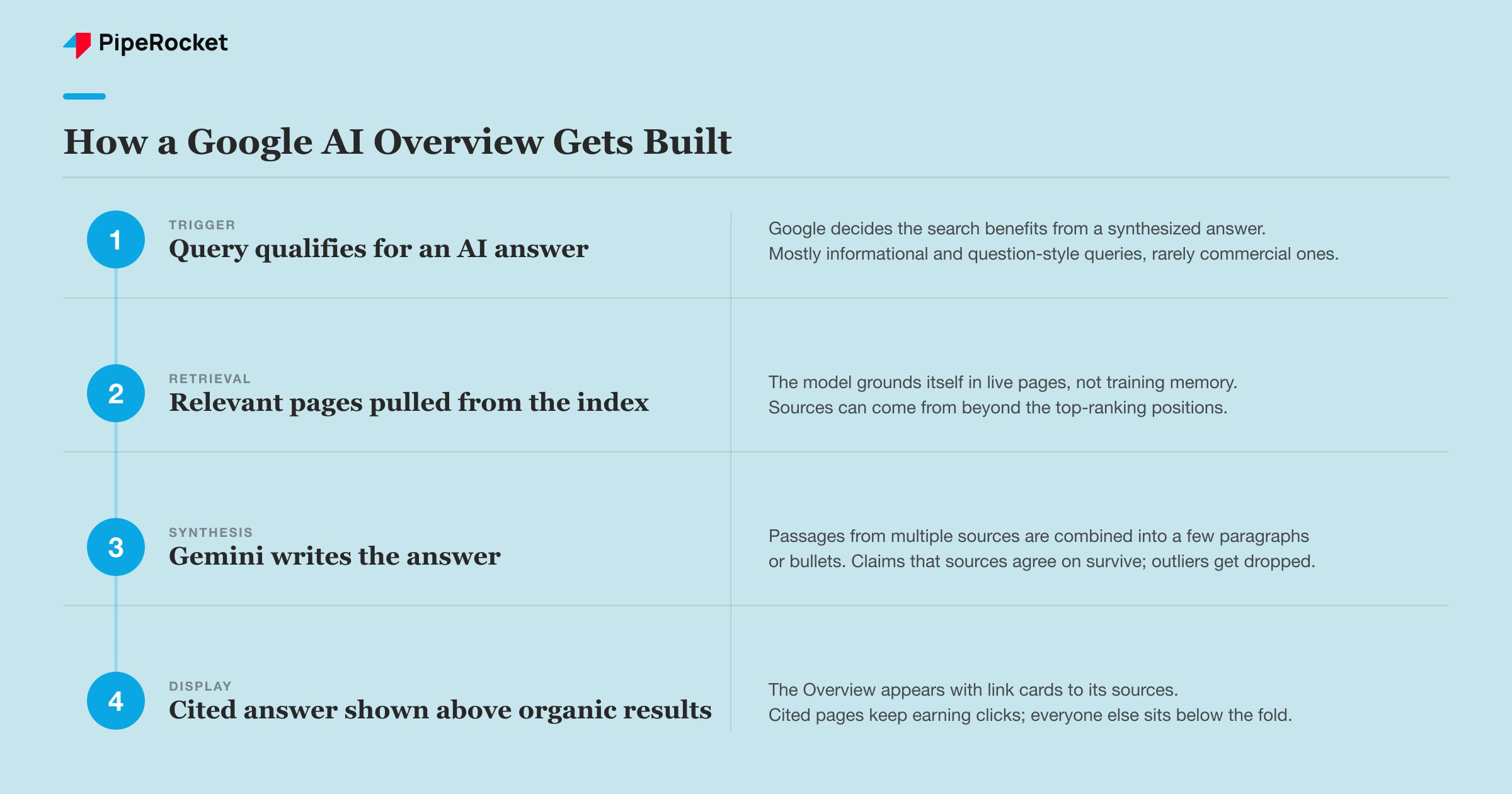
An AI Overview is Google’s generative answer feature, launched broadly in 2024 out of the Search Generative Experience experiment. When Google decides a query benefits from a synthesized answer, Gemini reads relevant pages from the index and writes a summary, with links to the sources it used.
Most SaaS teams read this as “AI is replacing the SERP .” That’s the wrong frame. An AI Overview is built on top of the same index your SEO already feeds. It rewards the same things, with one twist: your content now has to be quotable, not just rankable.
Here’s what actually makes up the feature:
- The generated answer: A few paragraphs or bullets written by Gemini, synthesized from multiple pages rather than copied from one.
- Source citations: Link cards next to or inside the answer, pointing to the pages Google grounded the response in.
- Query triggers: Google shows Overviews mostly on informational and question-style queries, and far less on high-intent commercial ones.
- Grounding in the index: The model retrieves live pages before writing, so it isn’t answering from training memory alone.
- Follow-up handling: With AI Mode, searchers can keep asking follow-ups, turning one search into a conversation.
Consider a SaaS selling contract management software. A search for “what is contract lifecycle management” now gets a full AI answer first. If that SaaS’s glossary page is a cited source, it still wins the buyers who want depth. If not, it’s invisible on its own category’s defining question.
The practical takeaway: an AI Overview moves the competition from “who ranks first” to “who gets quoted.” Those overlap heavily, but they’re not the same contest.
How Do AI Overviews Choose Their Sources?
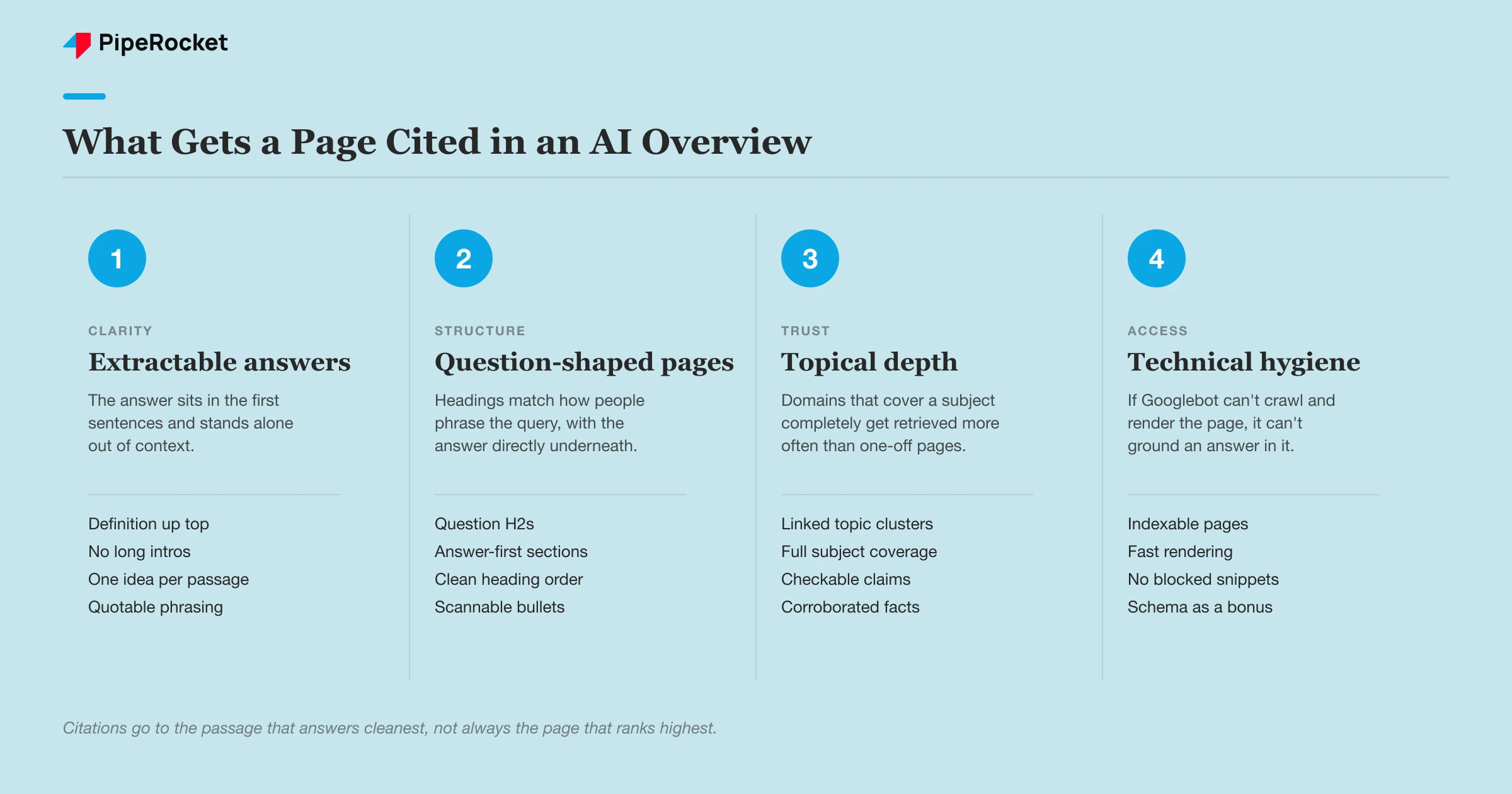
Google picks AI Overview sources through retrieval, not raw rankings. The model pulls a set of relevant pages from the index, then cites the ones whose passages best support the answer it’s writing. Ranking well helps you get retrieved, but the citation goes to the passage that answers cleanest.
This is why pages from position 8, or even page two, keep getting cited. The position-1 page might bury its answer under a long intro. The position-8 page states it plainly in the first 60 words. Gemini quotes the plain one.
What the model appears to favor:
- Direct, extractable passages: A clear definition or answer near the top of a section, written so it stands alone out of context.
- Question-shaped structure: Headings that match how people phrase the query, with the answer immediately under them.
- Corroboration across sources: Claims that multiple credible pages agree on get synthesized; outlier claims tend to get dropped.
- Topical depth on the domain: Sites with real topical authority on a subject show up as sources more consistently than one-off pages.
Schema markup helps Google parse your page, but it won’t rescue a buried answer. We’ve found the structure of the prose itself matters far more than any markup layer you add on top.
Fast Fact: Organic search drives 91.3% of SaaS traffic — AI-referred visits account for less than 9%.
Also read: how to rank on ChatGPT in 2026
How Do AI Overviews Affect SaaS Traffic?
The honest answer: they cut clicks on informational queries and barely touch high-intent ones. When Google answers “what is churn rate” in the Overview, fewer people click through to the glossary page that used to collect that traffic. Top-of-funnel impressions hold steady while clicks slide.
But look at where SaaS revenue actually comes from. Queries like “best contract management software” or “Ironclad vs Docusign CLM” are commercial. Google shows Overviews on these less often, and when it does, buyers still click through to compare options. Nobody picks a $30k vendor from a three-sentence AI summary.
So the damage is uneven:
- TOFU definitional content: Hit hardest. Expect lower click-through even when you rank or get cited.
- MOFU how-to content: Partially hit. Overviews summarize steps, but readers doing the task still open the full guide.
- BOFU comparison and pricing pages: Largely protected, because the decision needs more than a summary.
I’d go further: a click lost on “what is X” was rarely a pipeline click anyway. Watch whether your money pages keep converting, not the raw traffic number. Our research on AI search statistics shows organic search still drives the overwhelming share of SaaS leads.
Fast Fact: Organic search drives 37x more SaaS leads than AI search tools, yet most teams treat them as equal channels.
How Do You Get Cited in an AI Overview?
You get cited by being the clearest answer Google can retrieve, on a domain it already trusts for the topic. There’s no submission process and no separate index. The work is SEO plus answer-first writing.
The discipline of structuring content for AI answers has its own names now: GEO (generative engine optimization ) and AEO (answer engine optimization). Strip the acronyms away and the core moves are:
- Answer first, context after: Open each section with the direct answer in one or two sentences, then expand. Gemini quotes openings, not conclusions.
- One question per heading: Match headings to real query phrasing so retrieval connects your passage to the search.
- Build the cluster: Cover the topic completely across linked pages, because domains with depth get retrieved more often.
- Keep facts checkable: Specific, verifiable claims survive synthesis; vague marketing copy gets paraphrased away without a citation.
- Stay indexable: If Googlebot can’t render or crawl the page, it can’t ground an answer in it. Technical hygiene still gates everything.
A warning from experience: this works for informational and how-to content. For branded queries, it can backfire. If your docs answer “how to cancel [your product]” too extractably, the Overview will happily surface that to churning users. Decide page by page what you want quoted.
This is the same foundation a good SaaS SEO agency builds anyway, which is exactly the point. Citation-worthiness is rankability plus clarity.
Also read: best AI SEO agencies , best AEO agencies , and best GEO agencies
Should SaaS Teams Optimize for AI Overviews or Ignore Them?
Optimize, but don’t reorganize your strategy around them. AI Overviews are a presentation layer on top of search, and the inputs are the ones you already control. Treating them as a separate channel with a separate budget is how teams end up paying twice for the same work.
What I’d actually change this quarter:
- Restructure your glossary and TOFU pages: Put the direct answer in the first two sentences of every section. This is cheap and it’s where Overviews fire most.
- Track citations, not just rankings: Check which of your pages appear as Overview sources for your priority queries, and watch CTR by query type in Search Console.
- Double down on BOFU: Shift the effort saved on definitional traffic into comparison and alternatives pages , where clicks still convert.
Here’s the trade-off nobody states plainly. Answer-first writing makes pages more quotable but can make them feel blunter, and some writers resist it. It’s worth it for informational content. For narrative thought-leadership pieces, forcing the format flattens what made them persuasive, so leave those alone.
One more thing: don’t panic-buy “AI visibility” tools before you’ve fixed structure. A dashboard telling you you’re not cited doesn’t fix the page that buries its answer in paragraph six. Fix the pages first, measure second.
Frequently Asked Questions
1. What’s the difference between an AI Overview and AI Mode?
An AI Overview is the AI answer block that appears within a normal search results page, above the organic listings. AI Mode is a separate, fully conversational tab in Google Search where the entire experience is the AI answer and follow-up questions, with no traditional result list underneath. Overviews reach everyone by default, while AI Mode is opt-in behavior. For SaaS teams, the same answer-first structure earns citations in both, so you don’t need separate playbooks.
2. How do I know if AI Overviews are costing me traffic?
Compare impressions against clicks for your informational queries in Google Search Console. The signature pattern is impressions holding steady or rising while CTR drops, on question-style queries where you still rank well. Spot-check those queries manually to confirm an Overview appears and see whether you’re cited in it. If your BOFU pages show the same CTR decline, the cause is probably something else, because Overviews rarely fire on commercial queries.
3. Can you opt out of AI Overviews without leaving Google entirely?
Not cleanly. The nosnippet and max-snippet directives limit what Google can quote from your page, which keeps you out of Overview answers, but they also gut your regular snippets and can hurt normal organic CTR
. There’s no setting that says “rank me but don’t summarize me.” For most SaaS sites, opting out costs more visibility than the Overview takes, so the better move is deciding which pages should be quotable and structuring accordingly.
The Bottom Line
The teams winning AI Overview citations aren’t running a new playbook, they’re running the old one with sharper writing. Restructure your informational pages to answer first, then put the reclaimed effort into the commercial pages Overviews can’t replace.
If you want help getting cited in AI Overviews, get in touch , work with an AI SEO agency for SaaS , or see how the best SaaS SEO agencies are handling AI search.