
What Is Search Intent? A Practical Guide for SaaS Teams
 Kamaraj Mathiarasan (Kim)
Last updated on
Kamaraj Mathiarasan (Kim)
Last updated on
Search intent is the underlying goal a person has when they type a query into Google. Two people can search similar phrases and want completely different things. If your page doesn’t match what the searcher wants, it won’t rank, and if it somehow does rank, it won’t convert.
TL;DR
- Search intent is what the user is actually trying to accomplish with a query, not just what words they typed.
- Google categorises intent into four types: informational, navigational, commercial, and transactional.
- Mismatching intent is one of the most common reasons a well-written page fails to rank for the right keyword.
- The same topic can carry different intent depending on phrasing. “CRM software” and “best CRM for SaaS startups” are different intents.
- Matching intent correctly tells you what content format to build, not just what topic to cover.
What Is Search Intent?
Search intent is the reason behind a search. It’s not the keyword. It’s the job the searcher is trying to get done. Google’s entire relevance model is built around matching intent, which is why pages that ignore it rarely rank no matter how well they’re optimised on every other dimension.
Here’s where most SaaS teams get this wrong. They research keywords, find volume, and start writing, treating intent as something to sprinkle in afterward. But intent determines the content format before you write a word.
“What is churn rate” wants a definition. “How to reduce SaaS churn” wants a process. “Best churn reduction tools” wants a comparison. Three different pages, not one page with three sections.
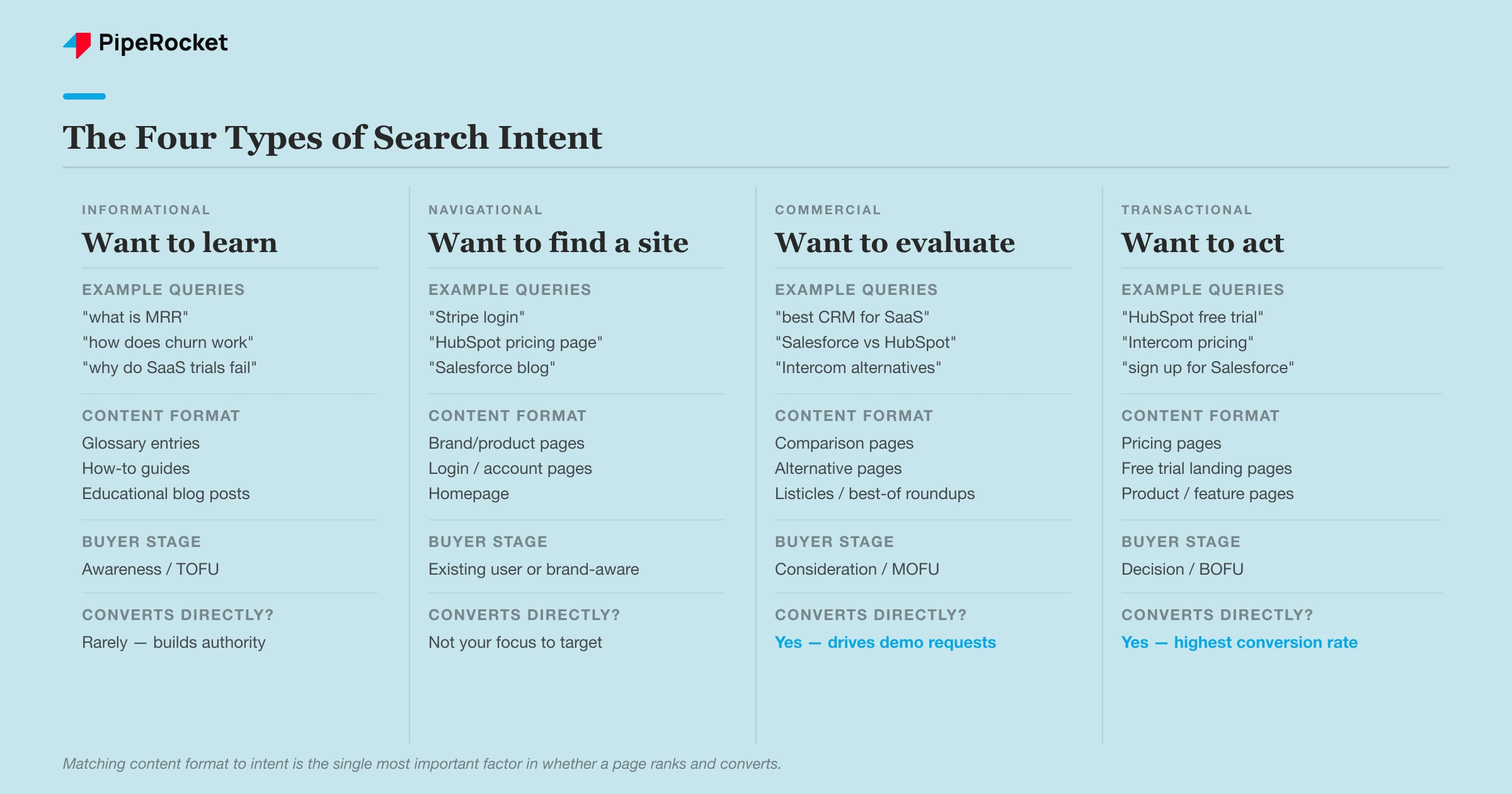
- Informational intent : The searcher wants to learn. “What is MRR,” “how does SaaS billing work.” Best matched with educational content like glossary entries and how-to guides.
- Navigational intent: The searcher wants a specific site or page. “Stripe login,” “HubSpot blog.” Usually your own brand searches or a competitor’s. No content strategy needed here.
- Commercial intent : The searcher is researching before a decision. “Best CRM for SaaS,” “Intercom alternatives.” Best matched with comparison pages , listicles, and alternative pages.
- Transactional intent : The searcher is ready to act. “Buy Salesforce,” “Intercom free trial.” Best matched with product pages, pricing pages, and conversion-focused landing pages .
Consider a SaaS built for legal operations teams. The keyword “contract management” is mostly informational. “Contract management software comparison” is commercial. Building an informational blog post to rank for the second query is a mismatch Google penalises by ranking a comparison page ahead of yours.
Before you write anything, look at the top three ranking pages for your target keyword. The format they share is Google telling you what intent it detected. Match that format first.
Fast Fact: Organic search drives 91.3% of SaaS traffic — AI-referred visits account for less than 9%.
Also read: how to map keywords to the SaaS buyer journey
Why Does Intent Mismatch Kill Rankings?
You can have the best-written, most technically sound page in your category and still fail to rank if the format doesn’t match intent. This is the part even experienced teams misapply, because intent mismatch is invisible until you look at the SERP .
Google uses click behaviour to validate its ranking decisions. If users click your result and immediately bounce back to search, Google reads that as a signal your page didn’t satisfy the intent. It moves your ranking down. A page with lower technical quality but higher intent match consistently outranks it.
- Wrong content format: A definition article ranking for a “best X” query. Google users want a comparison, so the definition page bounces them back.
- Wrong funnel stage: An awareness post trying to rank for a decision-stage query. The reader is ready to evaluate, and your page explains concepts they already understand.
- Wrong audience: A technical deep-dive ranking for a query that attracts non-technical buyers. The page is correct for one audience and useless for the one searching.
- Over-optimised for a keyword, not the intent: Repeating the exact keyword phrase signals relevance to a term, but if the structure doesn’t reflect what the searcher wants to do, rankings plateau.
Here’s the real trade-off: intent matching often means writing less, not more. A transactional page for “SaaS expense software free trial” should be short, conversion-focused, and fast. Adding a 3,000-word guide to please a word count actively hurts intent match for transactional queries.
Fast Fact: Organic search converts SaaS visitors at 0.92% — more than 3x the rate of AI-driven traffic at 0.26%.
Also read: how leading B2B SEO agencies align content format to search intent at scale
How Do You Identify the Intent Behind a Keyword?
The fastest and most reliable method is to search the keyword yourself and read the SERP. Google has already done the intent analysis for you. The format of the top three results tells you what Google has determined the intent to be.
If the top three are all listicles, the intent is commercial. If they’re all how-to guides, it’s informational. If a product pricing page ranks first, it’s transactional. Disagreeing with Google’s intent read on a given keyword is a losing bet, at least until you’ve built enough authority to challenge it.
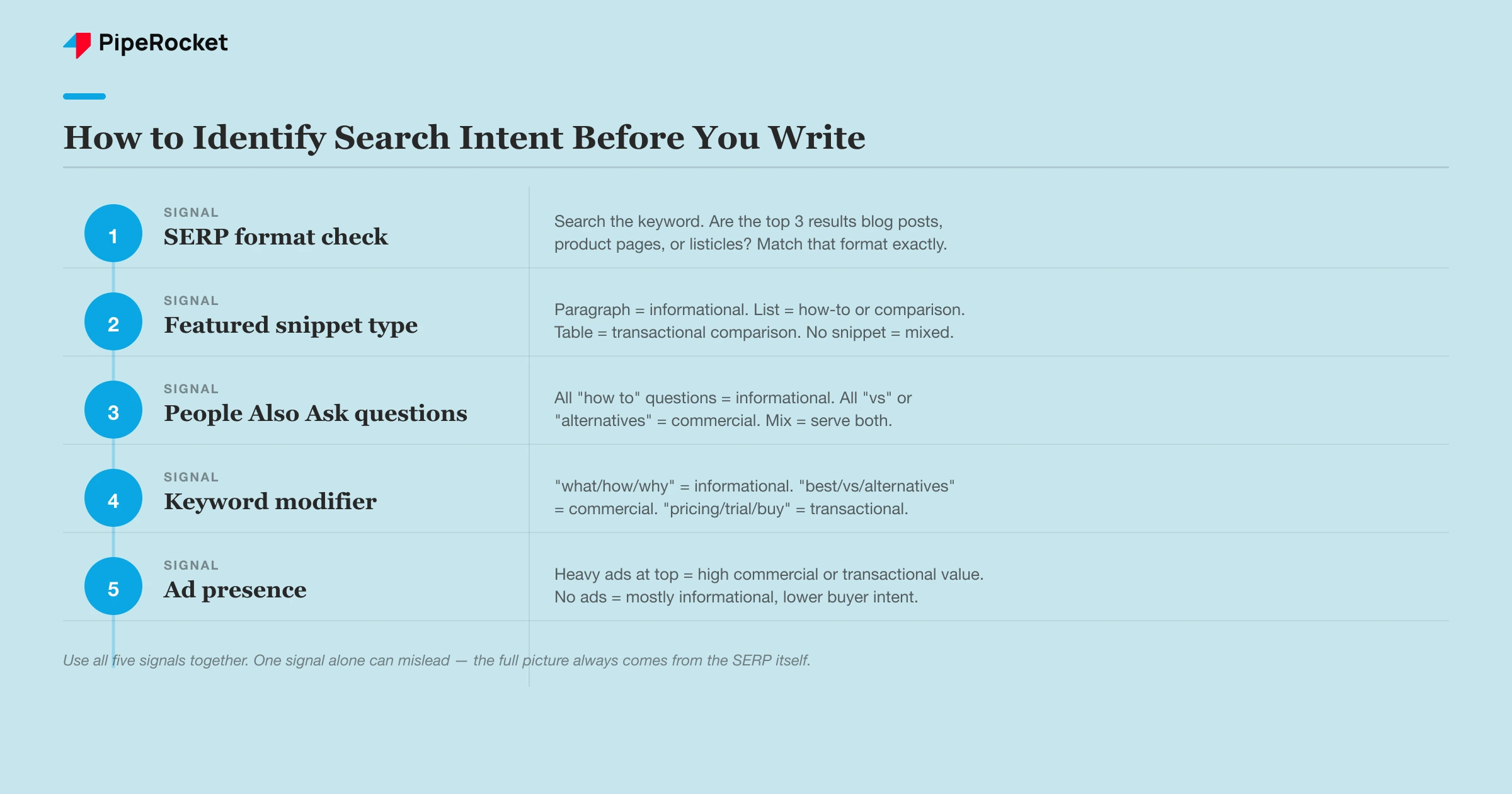
- SERP format check: Look at the top three to five results. Are they blog posts, product pages, comparison guides, or definitions? Match that format.
- Featured snippet type: A paragraph snippet signals informational intent. A list snippet usually signals a how-to or comparison. A table snippet signals transactional comparison intent.
- People Also Ask questions: The PAA box shows adjacent queries. All “how to” questions point to informational intent. All “vs” or “alternatives” questions point to commercial.
- Keyword phrasing signals: Questions (“how to,” “what is”) signal informational. “Best,” “top,” “vs” signal commercial. “Buy,” “pricing,” “free trial” signal transactional.
- Modifier analysis: The same seed keyword with different modifiers carries different intent. “CRM” is informational, “CRM for SaaS” is commercial, “CRM pricing” is transactional.
A compliance SaaS targeting “SOC 2 audit” would find mostly informational results: explainers, checklists, educational guides. But “SOC 2 audit software” shifts to commercial intent. They need separate pages for each, not one page trying to serve both audiences.
How Does Search Intent Connect to SaaS Content Strategy?
Intent is the architecture behind a SaaS content strategy . Without it, you end up with a blog full of informational posts that rank well and never convert, or product pages targeting queries nobody close to buying actually searches.
If you’re wondering why your traffic grows while pipeline stays flat, intent mismatch is usually the answer. The content attracts the top of the funnel, but the commercial and transactional queries that capture ready buyers are either missing or poorly executed.
- Informational content builds topical authority : Blog posts, glossary entries, and how-to guides establish your domain’s credibility in a topic area. They help your commercial pages rank.
- Commercial content captures active evaluators: Comparison pages, alternative pages, and listicles intercept buyers ready to choose. These drive demo requests and trial signups.
- Transactional content converts: Pricing pages, landing pages, and free trial pages serve the buyer who already wants to act. Their job is conversion, not education.
- Intent mapping prevents keyword cannibalization : Assigning each intent tier to specific page types stops two pages competing for the same query.
- Pillar pages bridge intent stages: A well-structured pillar page can serve commercial intent while linking to informational spokes and transactional product pages.
Audit your existing content by intent. Group every page into informational, commercial, or transactional. Then look at where your target keywords sit. The gaps between your content map and your keyword intent map are your production priorities.
Start with the commercial and transactional gaps. Those pages sit closest to revenue and usually pay back fastest.
Also read: how to build topic clusters that rank a SaaS site
Frequently Asked Questions
1. Can the same keyword have more than one intent?
Yes, and Google handles it by blending content formats in the SERP. A keyword like “SaaS pricing models” might surface a mix of educational blog posts and commercial comparison pages because Google detects mixed intent. In these cases, look at which format dominates the top three results and build primarily for that intent, while acknowledging the secondary intent in the content itself.
2. How often does search intent change for an established keyword?
Intent can shift as markets evolve, new products emerge, or searcher behaviour changes. A query that was primarily informational three years ago may now attract commercial searchers as the category matures. Check the SERP for your core keywords every six months. If the format of the top results has shifted from how-to guides to comparison pages, your content strategy needs to catch up.
3. Should I target high-intent or low-intent keywords first for a new SaaS site?
For a new site with low domain authority , start with informational keywords. They’re less competitive, help you build topical authority, and create the ranking foundation that makes commercial keywords achievable later. Targeting transactional keywords with zero domain authority on a brand-new site is frustrating. You’ll be outranked by established players for months while generating no traffic. Build the authority base first, then move down the funnel.
The Bottom Line
Search intent is the question you answer before any other SEO decision. Get it right and everything downstream falls into place. Get it wrong and even perfect content won’t rank. Want a content strategy built around intent? Get in touch or see how our SaaS SEO services approach it.