
What Is A/B Testing? A Practical Guide for SaaS Teams
 Sabari Rohith
Last updated on
Sabari Rohith
Last updated on
A/B testing is a method of comparing two versions of a page, email, or ad by splitting your traffic between them and measuring which one drives more of the action you care about. For SaaS teams, it replaces opinion-driven debates about landing pages and copy with actual user behavior.
TL;DR
- A/B testing splits traffic between two versions of something and measures which one converts better, so decisions come from data instead of opinions.
- Most SaaS teams don’t have enough traffic to test small changes, so they should test big swings like headlines and offers.
- Calling a winner early is the most common failure; tests need a pre-set sample size and a full business cycle.
- Landing pages, pricing pages, and onboarding flows are where A/B tests pay off most for SaaS.
- A test that “loses” still teaches you something about your buyers, which is more than an untested redesign ever does.
What Is A/B Testing?
A/B testing (also called split testing) shows version A of a page to half your visitors and version B to the other half, then compares conversion rates between the two. The version that drives more signups wins. Random assignment makes it trustworthy, since the difference comes from the change itself.
Here’s where most SaaS teams go wrong. They hear “A/B testing” and start testing button colors and font sizes. With the traffic a typical B2B SaaS site gets, those tests will run for months and tell you nothing. Small changes need huge sample sizes to detect. Big changes don’t.
- Variant: Each version in the test. A is usually your current page (the control), B is the challenger with one deliberate change.
- Conversion goal: The single action you’re measuring, like trial signups or demo bookings. Pick one before the test starts, not after.
- Random split: Visitors get assigned to A or B by chance, which removes bias from traffic source or timing.
- Statistical significance: The math that tells you the difference is real and not just noise. Without it, you’re reading tea leaves.
- Test duration: How long the test runs. It should cover at least one full business cycle, since weekday and weekend visitors behave differently.
Consider a contract management SaaS whose landing page headline describes features (“AI-powered clause detection”). The B variant leads with the outcome (“Review contracts in minutes, not days”). Splitting traffic between the two for a few weeks settles a debate the team could have argued about forever.
In practice, A/B testing is the engine inside CRO . CRO decides what’s worth changing. A/B testing proves whether the change worked.
How Does an A/B Test Actually Work?
An A/B test works in a fixed sequence: form a hypothesis, build the variant, split traffic randomly, then measure until you hit a pre-calculated sample size. The order matters. Skip the hypothesis and you’re testing random ideas. Skip the sample size calculation and you’re calling winners on noise.
The hypothesis is the part everyone rushes. A good one names the problem, the change, and the expected effect: “Visitors bounce because the form asks for 9 fields. Cutting it to 4 will lift demo requests.” Now the test teaches you something even if it loses.
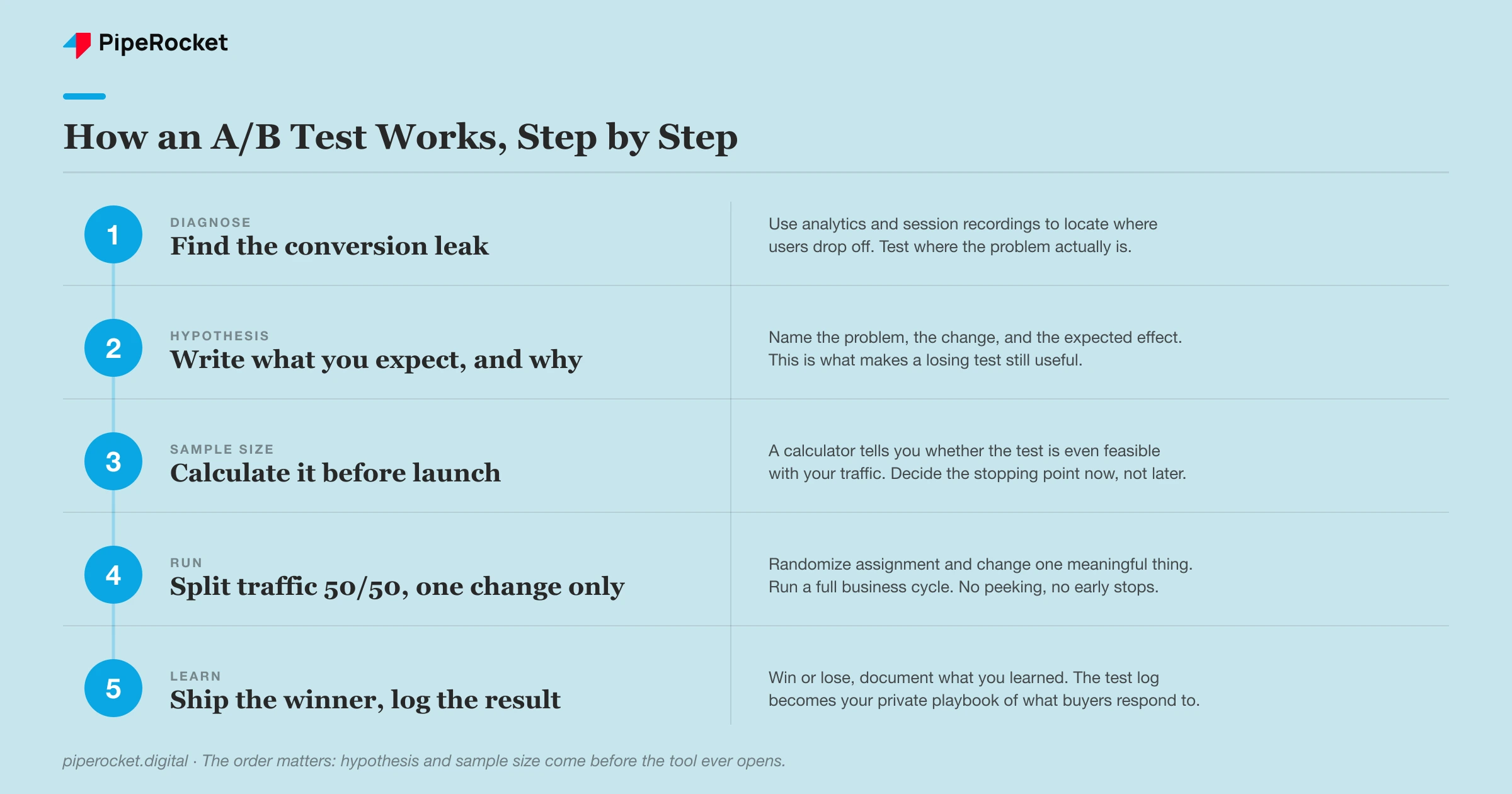
How to Run an A/B Test Step by Step
- Find the leak: Use analytics and session recordings to locate where users drop off. Test where the problem is, not where it’s easiest.
- Write the hypothesis: State what you’re changing, why, and what you expect to happen. This is what makes a losing test useful.
- Calculate sample size first: Use a sample size calculator before launching. It tells you whether the test is even feasible with your traffic.
- Build one variant: Change one meaningful thing. If you change the headline and the form together, you won’t know which one moved the number.
- Split traffic 50/50: Let your testing tool randomize assignment. Never compare this month’s page against last month’s.
- Run the full duration: Hit your sample size and cover at least one complete week. Stopping early because B looks good is the classic mistake.
- Document the result: Win or lose, log what you learned. A test log is the cheapest research asset a SaaS team can build.
A payroll SaaS for restaurants might notice trials stalling at the pricing page. Instead of redesigning everything, they test one variable: showing per-location pricing against per-employee pricing. One clean variable, one clear answer.
Do You Have Enough Traffic to A/B Test?
Probably less than you think, and this is the question to answer before anything else. A reliable A/B test typically needs hundreds of conversions per variant, not hundreds of visitors. On a page with a handful of demo requests a month, a test could take half a year to finish.
This is the honest trade-off nobody selling testing tools mentions. A/B testing gives you certainty, but it fails when conversion volume is low, because the test never finishes or finishes with a false read. On low-volume pages, user interviews and session recordings will teach you more.
- Check conversions, not sessions: Sample size depends on how many people complete your goal. Traffic alone tells you nothing.
- Test bigger swings on low traffic: A radical page change might be detectable with your volume. A button tweak never will be.
- Pool similar pages: Testing a template change across 40 feature pages gets you to significance far faster than one page alone.
- Go upstream if needed: Ad copy and email subject lines often have more volume than landing pages, so test there first.
Fast Fact: Most failed SaaS A/B tests don’t fail on strategy, they fail on volume. The test was never capable of detecting the effect in the first place.
Paid traffic changes this math. If you’re driving Google Ads traffic to dedicated landing pages, you control the volume and the audience, which makes those pages the best testing ground most SaaS teams have.
Also read: how to write Google Ads copy for SaaS
What Should SaaS Teams Test First?
Start where the money is: paid landing pages, the pricing page, and the signup flow. These pages sit closest to revenue and have clear conversion goals. A 20% lift on a demo page is worth more than a 20% lift on a blog post, every time.
My take: most SaaS teams test in exactly the wrong order. They start with the homepage because it’s visible internally, when the homepage serves so many audiences that test results are muddy. A dedicated landing page with one job and one ICP gives you clean answers.
- Headlines and value props: The highest-impact test on any page. Outcome-led against feature-led framing is the classic first test.
- Form length and fields: Every field you remove changes both volume and lead quality. Test it instead of guessing the balance.
- Pricing page structure: Plan order and annual-versus-monthly defaults move real revenue. Few teams ever test them.
- CTA framing: “Start free trial” against “Book a demo” is a business model question disguised as a button test.
- Social proof placement: Logos and review scores near the form often shift conversions more than copy edits do.
Fast Fact: The pages SaaS teams are most nervous to test, like pricing, are usually the ones where a winning variant pays for the entire testing program.
If you’re already paying for clicks, untested landing pages are the expensive habit. This is exactly the loop SaaS PPC work should close: ad, page, and test running as one system.
Also read: how to optimize SaaS landing pages
What Are the Most Common A/B Testing Mistakes?
The most common mistake is ending the test the moment one variant pulls ahead. Early leads flip constantly; a variant “winning” on day three is usually noise. You set the sample size before launch and you don’t peek-and-stop. Period.
The second mistake is quieter: testing without a hypothesis. If you can’t say why B should beat A, a win teaches you nothing you can reuse, and a loss feels like wasted time instead of a finding.
- Peeking and stopping early: Checking daily and stopping at the first significant result inflates false positives badly. Decide duration upfront.
- Testing trivial changes: Button colors and image swaps rarely produce detectable effects at SaaS traffic levels. Test things buyers actually weigh.
- Changing multiple things at once: A redesign tested as a single variant can win without telling you which element did the work.
- Ignoring segments blindly: A flat overall result can hide a variant that wins on mobile and loses on desktop. Check major segments after the test.
- Forgetting the follow-through: A winning variant that never ships is the most common quiet failure in SaaS testing programs.
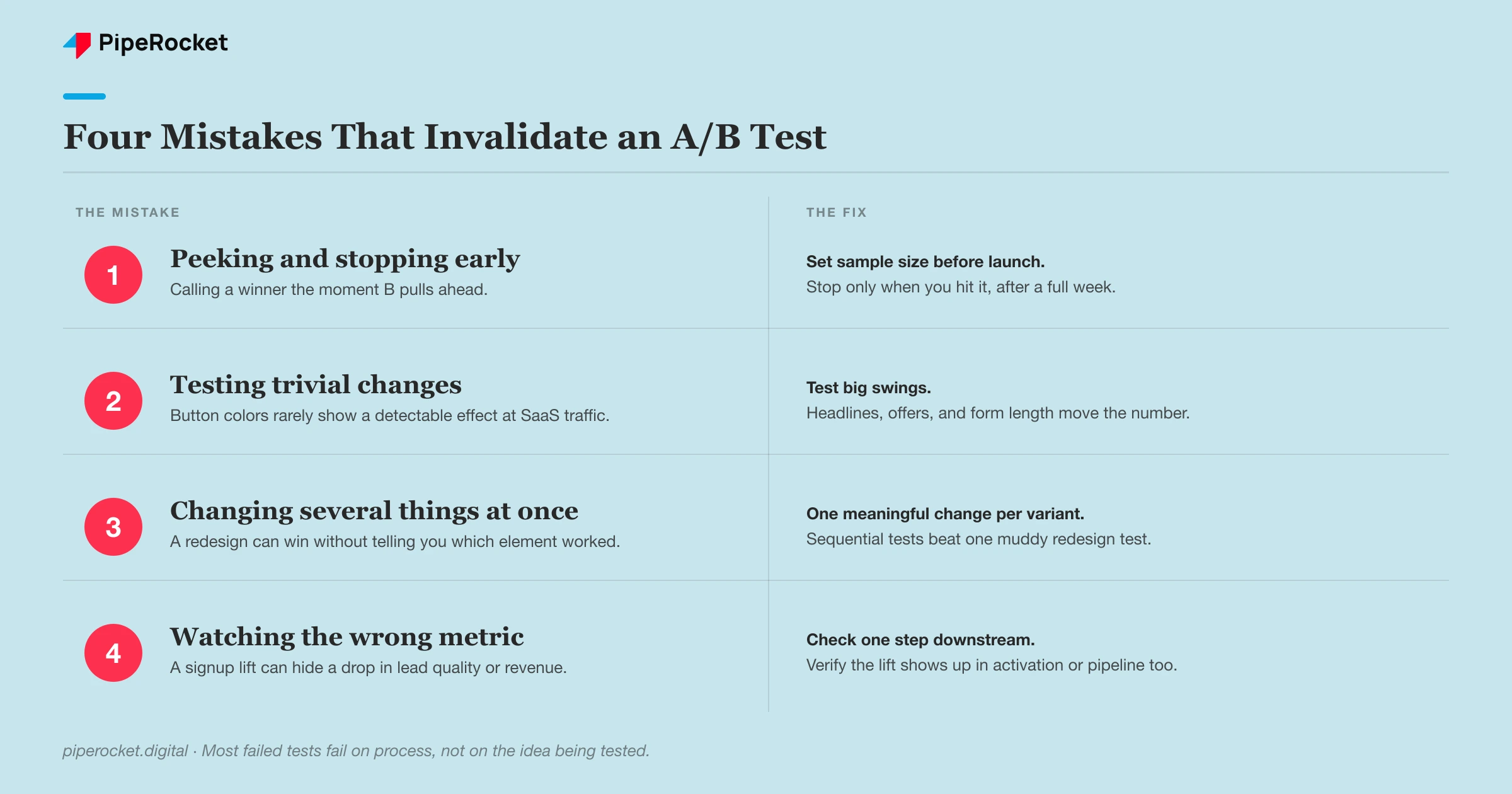
One warning from experience: a variant that lifts signups can hurt revenue. Imagine an analytics SaaS that removes the company-size field from its trial form. Signups jump, but sales now spends hours qualifying leads the form used to filter.
Always check the metric one step downstream of the one you tested.
Frequently Asked Questions
1. How long should an A/B test run?
Until it reaches the sample size you calculated before launch, and for at least one full business cycle, which for most B2B SaaS means two to four weeks minimum. Running shorter than a week skews results because weekday and weekend visitors behave differently. Running past six to eight weeks introduces its own problems, since cookies expire and returning visitors can see both variants. If your traffic can’t reach significance inside roughly eight weeks, test a bigger change or a higher-traffic page instead.
2. What’s the difference between A/B testing and multivariate testing?
A/B testing compares two (or a few) complete versions of a page, while multivariate testing changes several elements at once and measures how combinations perform, like three headlines crossed with two hero images. Multivariate sounds more efficient but needs far more traffic, because the visitors get spread across every combination. For nearly every SaaS site, sequential A/B tests are the right call. Multivariate only makes sense on pages with very high volume, like a free tool or a consumer-scale signup flow.
3. How do I know if my A/B test result is trustworthy?
Check three things before acting on it. First, the test reached the sample size you set before launch, not a significance flag that appeared mid-test. Second, the result held across the full duration rather than spiking in week one and fading. Third, the lift shows up in the downstream metric too, so a signup lift should eventually appear in activated accounts or pipeline. If a result fails any of these, rerun the test before rolling the change out everywhere.
The Bottom Line
A/B testing only pays off when you test big changes on pages with real conversion volume, and let every test finish. Build the habit of writing hypotheses and logging results, and within a year you’ll have a private playbook of what your buyers respond to.
Want that loop built into your paid program? Get in touch or see how the best SaaS PPC agencies wire testing into every campaign.