
What Is a Transactional Keyword? A SaaS Guide
 Kamaraj Mathiarasan (Kim)
Last updated on
Kamaraj Mathiarasan (Kim)
Last updated on
A transactional keyword is a search query from someone ready to take action, whether that’s buying, signing up, or checking pricing. They’ve made their decision, or they’re one step away. For SaaS, these are the lowest-volume but highest-converting queries you can rank for.
TL;DR
- A transactional keyword signals a searcher ready to act, like “HubSpot pricing” or “Notion free trial.”
- They sit at the very bottom of the funnel, past comparison and into decision.
- Volume is low, but conversion intent is the highest of any keyword type.
- The matching pages are pricing pages, signup pages, and conversion-focused landing pages , not blog posts.
- Most transactional searches are branded, so capturing non-branded transactional terms is a real competitive edge.
What Is a Transactional Keyword?
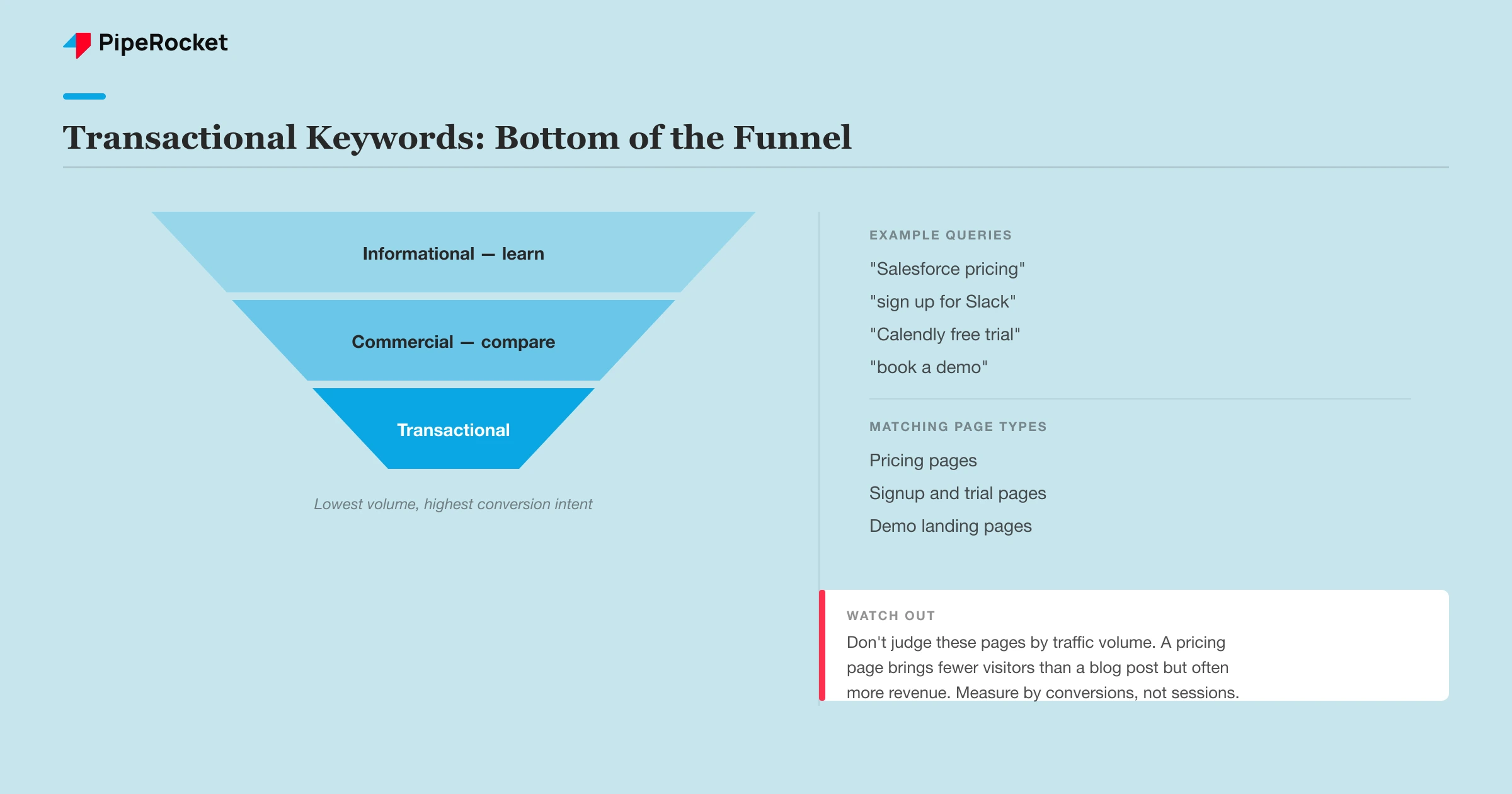
A transactional keyword is a query where the searcher intends to do something right now. They want to buy, start a trial, request a demo, or see what a tool costs. “Salesforce pricing,” “sign up for Slack,” and “Calendly free trial” are all transactional.
This is the end of the intent spectrum . Informational searchers want to learn. Commercial searchers are comparing. Transactional searchers have mostly decided and want to act. The closer a query sits to the transaction, the higher it converts and the lower its volume tends to be.
- Pricing queries: “[Product] pricing” or “[Product] cost.” The searcher is evaluating affordability before committing. A clear pricing page matches this.
- Trial and signup queries: “[Product] free trial,” “sign up for [Product].” The searcher wants to start using the tool now.
- Demo queries: “[Product] demo,” “book a demo [category].” Common in B2B SaaS where the sale runs through sales-assisted motion.
- Purchase queries: “Buy [Product],” “[Product] subscription.” Less common in SaaS than ecommerce, but present for self-serve tools.
- Coupon and deal queries: “[Product] discount,” “[Product] promo code.” High intent, though often a margin trade-off.
Consider a SaaS selling invoicing software to freelancers. “How to invoice clients” is informational. “Best invoicing software for freelancers” is commercial. “FreshBooks pricing” is transactional. That last searcher is comparing cost before clicking buy, and the page that serves them needs to remove friction, not educate.
The practical takeaway: a transactional page has one job, and that’s conversion. Stuffing it with educational content actively hurts, because the reader is past learning and ready to act.
Fast Fact: Organic search converts SaaS visitors at 0.92% — more than 3x the rate of AI-driven traffic at 0.26%.
Also read: how to rank BOFU keywords for SaaS
How Do You Identify a Transactional Keyword?
The signal is action language. If the query includes words like “pricing,” “buy,” “trial,” “signup,” “demo,” or “discount,” the searcher wants to act, not learn. The SERP confirms it: transactional queries surface product pages, pricing pages, and signup flows rather than blog content.
Branded transactional queries are the most common, since people searching “Stripe pricing” already know they want Stripe. The harder and more valuable target is non-branded transactional intent, where the searcher knows the category but hasn’t locked in a brand.
- Action modifiers: “Pricing,” “cost,” “buy,” “free trial,” “signup,” “demo,” “discount” all signal transactional intent.
- SERP format: Product pages, pricing pages, and signup flows ranking at the top confirm the intent.
- Heavy ads: Transactional queries are the most monetised, so expect ads above and below the organic results.
- Branded vs non-branded: “[Brand] pricing” is branded and easy. “[Category] pricing” is non-branded, harder, and far more valuable to capture.
A scheduling SaaS would find “Calendly pricing” dominated by Calendly’s own pages. But “appointment scheduling software pricing” is a non-branded transactional query where a strong pricing page and some authority can win real, ready-to-buy traffic.
Why Do Transactional Keywords Matter Despite Low Volume?
Transactional keywords matter because they convert at the highest rate of any keyword type. The searcher has done the learning and the comparing. All that’s left is the decision, and your page is in front of them at exactly that moment.
The honest limitation is volume. Far fewer people search “expense software pricing” than “what is expense management.” So transactional keywords won’t drive large traffic numbers. What they drive is conversions, which is the metric that actually matters.
- Highest conversion rate: These searchers are ready to act, so the percentage who convert dwarfs informational traffic.
- Direct revenue line: Transactional pages tie cleanly to signups and revenue, making them the easiest SEO work to justify.
- Branded capture: Ranking your own pricing and signup pages protects branded transactional traffic from competitor ads and comparison sites.
- Non-branded opportunity: Winning non-branded transactional queries intercepts buyers before they’ve committed to a competitor.
A warning worth stating: don’t judge transactional keywords by traffic volume. A page ranking for “[category] pricing” might bring a fraction of the visitors a blog post does, while producing more revenue. Measuring it by sessions instead of conversions leads teams to under-invest in their highest-value pages.
Fast Fact: Organic search drives 91.3% of SaaS traffic — AI-referred visits account for less than 9%.
Also read: how to write SaaS alternatives pages that convert
What Content Should You Build for Transactional Keywords?
Transactional keywords need pages built for conversion, not education. The reader is ready to act, so your job is to remove friction and make the next step obvious. Speed, clarity, and a single strong call to action matter more than depth.
Match the page to the query. A pricing query needs a clean pricing page. A trial query needs a fast path to signup. A demo query needs a short form and a clear value statement. Every extra paragraph between the reader and the action is a chance to lose them.
- Pricing pages: Transparent, scannable, and honest. Show tiers, name what’s included, and answer the obvious objections without burying the numbers.
- Signup and trial pages: Minimal friction, fast load, one clear action. Cut every field and link that isn’t essential to starting.
- Demo landing pages: A short form, a crisp value statement, and proof. Make the booking action the focus of the page.
- Self-serve checkout: For product-led tools, a frictionless path from page to active account.
The trade-off to respect: transactional pages should stay lean. It’s tempting to add educational content to “help” the reader or feed SEO, but that dilutes the conversion focus. Keep the learning on your informational and commercial pages, and let the transactional page do its one job.
How Do Transactional Keywords Fit the Full Funnel?
Transactional keywords are the last step in a journey that starts much earlier. A buyer rarely searches “expense software pricing” cold. They searched informational queries to understand the problem, commercial queries to compare options, and only then a transactional query to act. Each stage feeds the next.
This is why transactional pages don’t work in isolation. Their ability to rank depends on the authority your informational and commercial content has already built. A pricing page on a domain with no topical depth struggles to rank for non-branded transactional terms, no matter how well it converts.
- Informational feeds the top: Educational content pulls in future buyers and builds the authority your transactional pages borrow from.
- Commercial feeds the middle: Comparison and alternative pages move evaluators toward a decision, warming them for the transactional moment.
- Transactional captures the end: Pricing and signup pages convert the buyer who’s ready, closing a loop the earlier content opened.
- Internal links carry authority: Linking from informational and commercial pages to your transactional pages passes the trust that helps them rank.
A SaaS that treats these as one connected system, rather than three separate content types, sees its transactional pages rank for non-branded terms that an isolated pricing page never could. The funnel works because the stages reinforce each other.
Also read: how to build topic clusters that rank a SaaS site
Frequently Asked Questions
1. What’s the difference between a transactional and a commercial keyword?
A commercial keyword signals comparison and research, like “best CRM for startups” or “Notion vs Asana.” A transactional keyword signals readiness to act, like “Notion pricing” or “Asana free trial.” The commercial searcher is still choosing between options, while the transactional searcher has mostly chosen and wants to buy, sign up, or see cost. Commercial keywords feed comparison content, while transactional keywords feed pricing and signup pages.
2. Can a blog post rank for a transactional keyword?
Rarely, and you usually don’t want it to. Transactional queries surface product, pricing, and signup pages because that’s what the searcher wants. A blog post ranking for “[product] pricing” would frustrate a ready-to-buy visitor and convert poorly. If a blog post is outranking your pricing page for a transactional query, that’s a sign of keyword cannibalization , and you should fix the internal linking so the conversion page wins.
3. How do I capture non-branded transactional traffic?
Build a strong, well-optimised pricing or signup page targeting the category term, like “project management software pricing,” and support it with internal links and topical authority . Non-branded transactional queries are competitive, so the page needs both conversion-focused design and the domain authority to rank. This is where informational and commercial content pay off, since they build the authority that lets your transactional pages compete for non-branded terms.
The Bottom Line
Transactional keywords are low-volume and high-stakes, because they reach the buyer at the moment of decision. Build lean, conversion-focused pages and measure them by conversions, not traffic. Want help turning bottom-funnel searches into signups? Get in touch or see how our SaaS SEO services approach it.