
What Is an Informational Keyword? Guide for SaaS Marketers
 Kamaraj Mathiarasan (Kim)
Last updated on
Kamaraj Mathiarasan (Kim)
Last updated on
An informational keyword is a search query where the user’s primary goal is to understand something, not to buy, compare, or find a specific site. They’re the most common type of keyword on the web, and they’re widely misused by SaaS teams who expect informational content to generate pipeline directly.
TL;DR
- Informational keywords are queries where the searcher wants to learn, not act, like “what is MRR” or “what causes high churn.”
- They’re the highest-volume category of keywords and usually the easiest to rank for on a newer domain.
- Informational content builds topical authority and feeds future commercial rankings, but rarely drives direct conversions.
- The mistake most teams make is measuring informational content by pipeline instead of by the authority it creates.
- Not all informational keywords are worth targeting. The ones that attract your ICP early are the ones worth building.
What Is an Informational Keyword?
An informational keyword is a search query where the user wants an answer, an explanation, or a how-to, not a product page. The intent behind it is learning. “What is customer lifetime value,” “how to calculate churn rate,” and “why do SaaS companies lose customers” are all informational.
Google classifies these queries differently from commercial or transactional ones and ranks different content formats for them. When you search an informational keyword, the results are almost always blog posts, glossary entries, educational guides, or explainer videos, not pricing pages or product demos.
- Definitional queries: “What is X” format. The searcher wants a clear explanation of a concept. Glossary entries and educational blog posts match this intent.
- How-to queries: “How to do X” or “how does X work.” The searcher wants a process or method. Step-by-step guides match this intent.
- Why queries: “Why does X happen” or “why is X important.” The searcher is building context or diagnosing a problem. Analytical content fits here.
- Concept comparisons (not products): “Difference between MRR and ARR ,” “SEO vs SEM .” The searcher is learning the territory, not evaluating vendors.
- Research queries: “SaaS churn benchmarks,” “average CAC for B2B SaaS.” The searcher is gathering data to inform a decision, but isn’t ready to make one yet.
Consider an onboarding SaaS built for mid-market HR teams. A query like “what is employee onboarding” is informational. The searcher is probably an HR manager learning the concept, not a procurement lead ready to evaluate software. That’s a very different audience from someone searching “best onboarding software for remote teams.”
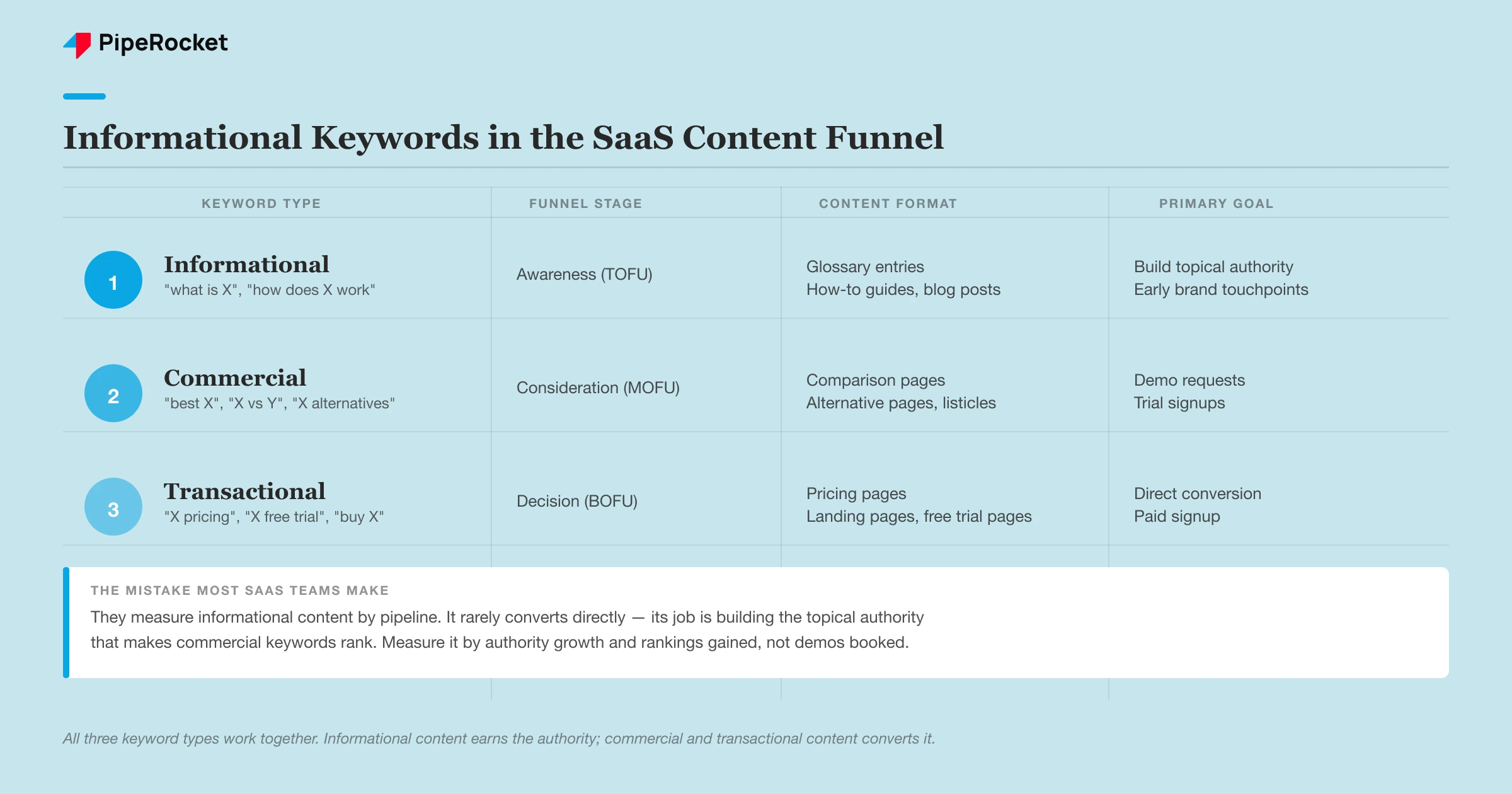
Both queries are worth targeting, but for different reasons and with different content. Informational content rarely converts directly. Its job is to pull your ICP in early, build trust, and create the authority that makes your commercial and transactional pages rank later.
Fast Fact: Organic search drives 91.3% of SaaS traffic — AI-referred visits account for less than 9%.
Also read: how to do SaaS SEO keyword research the right way
Why Do Informational Keywords Matter for SaaS SEO?
The common argument against informational content is that it attracts people who’ll never buy. That’s true, and it’s also missing the point. Informational keywords matter for two structural reasons that have nothing to do with direct conversion.
First, they build topical authority . Google rewards sites that cover a topic area in real depth across multiple pages. A SaaS with deep, well-linked content on every concept in its category earns more authority for its commercial keywords than a site with only product pages and a few thin posts.
Second, they reach your ICP at the start of their journey. Someone searching “what is keyword difficulty ” today might be searching “best SEO tools for SaaS” in four months. Informational content creates early brand touchpoints that matter in a long B2B buying cycle.
- Topical authority building: Covering the full breadth of your category’s informational keywords signals expertise to Google and helps your commercial pages rank.
- Early funnel reach: Informational searchers are often future buyers. Capturing them before they’re ready influences the commercial decision later.
- Internal linking foundation: Informational posts and glossary entries create natural links to your commercial and transactional pages, passing authority where it matters.
- Featured snippet opportunities: Definitional and how-to queries frequently trigger featured snippets, putting your brand in front of searchers before they click.
- Lower competition: Informational keywords are generally easier to rank for than commercial ones. For a new domain, they’re the entry point into organic search.
Not every informational keyword is worth targeting. A SaaS that sells expense management software doesn’t need to rank for “what is a balance sheet.” The ones worth targeting are the concepts your specific ICP searches while they’re still learning, directly adjacent to the problem your product solves.
Fast Fact: Users from organic search spend an average of 4 minutes 40 seconds on SaaS pages, nearly a full minute longer than AI-referred visitors.
How Do You Choose Which Informational Keywords to Target?
The selection filter for informational keywords is ICP proximity. The closer a concept is to the problem your product solves, the more likely the person searching it eventually needs your product.
A revenue intelligence SaaS should build informational content around forecasting, pipeline coverage, and revenue operations concepts. These are the topics their buyers think about. Building content around general business topics like leadership or productivity reaches a much broader and far less targeted audience.
- ICP language mapping: List the concepts your ideal customers discuss in sales calls, reviews, and support tickets. Those concepts become your informational keyword targets.
- Search volume vs. relevance: A lower-volume keyword your exact ICP searches is more valuable than a high-volume term that draws a broad, unqualified crowd.
- Keyword difficulty: Informational keywords vary in difficulty. “What is churn” is easier than “what is product-led growth ,” which faces competition from high-authority domains.
- Gap analysis: Check which informational keywords your competitors rank for that you don’t. These represent authority gaps worth filling.
- Supporting commercial intent: The best informational keywords link naturally to your commercial pages, serving the user and your funnel at once.
A legal operations SaaS targeting enterprise procurement teams should build content around contract lifecycle management, redline review, and approval workflows. These are the concepts their buyers deal with daily. The content that doesn’t convert to pipeline still contributes to the cluster authority that helps their commercial pages rank.
Also read: how to prioritise SaaS keywords by funnel stage
What Content Format Works Best for Informational Keywords?
Format matching is as important as keyword selection. An informational keyword targeted with the wrong content format won’t rank even if the content itself is excellent.
The right format depends on the type of informational query. Definitional queries are best served by glossary entries: concise, structured, with a clear definition upfront. How-to queries need step-by-step guides with clear action items. “Why” queries and analytical topics need longer posts that build a genuine perspective.
- Glossary entries for definitional queries: Short, clear, structured. Answer the “what” directly in the first paragraph, then add depth. Google often pulls glossary-style openings as featured snippets.
- How-to guides for process queries: Step-by-step structure with clear steps. Each step should explain the action and the reason, not just what to do.
- Analytical posts for “why” queries: These need a real point of view. A post on “why SaaS churn spikes in Q1” that lists generic reasons loses to one that takes a specific, defensible position.
- Data roundups for research queries: “SaaS churn benchmarks 2026” attracts searchers looking for numbers. A well-organised compilation of real data with clear sourcing ranks reliably.
Here’s the trade-off. Glossary entries are fast to produce and good for covering broad informational territory. Long-form analytical posts take more time but earn more backlinks and authority. A good SaaS content programme runs both: the glossary provides breadth, the analytical posts provide depth.
Frequently Asked Questions
1. Should I put a CTA on an informational page?
Yes, but it needs to match where the reader is. A hard “book a demo” CTA at the end of a definitional glossary entry usually performs poorly because the reader isn’t there yet. A softer CTA, like “see how SaaS teams use this” linking to a case study, performs better. The best informational CTAs move the reader one step further down the funnel, not all the way to a conversion in one jump.
2. How do I know if an informational keyword is attracting my ICP?
Check the related queries and PAA boxes for the keyword in Google Search Console. If the surrounding questions are about the problem your product solves, you’re in the right neighbourhood. If the surrounding queries come from a completely different audience, such as students or job seekers, the keyword is probably too broad to drive meaningful ICP traffic regardless of volume.
3. Can informational content rank for commercial keywords over time?
Sometimes, but it’s usually a sign of something going wrong rather than right. If your informational blog post is outranking your comparison page for a commercial query, that’s keyword cannibalization , and it’s costing you conversions. The informational post is stealing clicks that should go to a page designed to convert. Fix it by restructuring internal links to signal which page should own the commercial query, and consider consolidating thin content.
The Bottom Line
Informational keywords are an investment in authority, not a shortcut to pipeline. Build them around your ICP’s vocabulary, then measure them by the authority they create. Want a content strategy that supports pipeline growth? Get in touch or see how our SaaS SEO services approach the full funnel.