How to Prioritize SaaS Keywords by Funnel Stage
 Kamaraj Mathiarasan (Kim)
Last updated on
Kamaraj Mathiarasan (Kim)
Last updated on
You’ve got a spreadsheet with a few hundred keywords, each tagged TOFU, MOFU, or BOFU. The mapping is done. Now someone has to decide what gets written in week one, and that decision is where most SaaS content plans quietly fall apart.
The order you build in matters more than the list itself. Two teams with the identical keyword set will get completely different pipeline results based purely on sequence.
Here’s how I decide what to ship first, and why almost every SaaS site I touch starts at the bottom of the funnel.
TL;DR
- Why sequence at all: the same funnel-mapped keyword list produces wildly different pipeline depending on what you build first, so order is a deliberate decision in its own right.
- Start at the bottom: BOFU pages sit closest to the buying decision, so building them first puts revenue-shaped content live while authority is still compounding.
- Capacity caps the bottom: the 40-60 rule means BOFU runs out fast, so you sequence the finite high-intent pages first, then move up the funnel.
- ROI sets the order inside a stage: rank keywords by intent and conversion math ahead of search volume, so a 90-search comparison term beats a 9,000-search definition.
- Sequencing traps: building TOFU-first, treating every BOFU page as equal priority, and ignoring how long pages take to rank are the three mistakes that stall plans.
Why Build Order Decides Your Pipeline
Most teams treat prioritization as a sorting problem. They’ve already split keywords into TOFU, MOFU, and BOFU buckets , so they assume the work is done and start writing whatever’s at the top of the sheet. That’s usually the highest-volume term, which is almost always a top-of-funnel definition.
Once you’ve done the keyword research and mapping , you know what each keyword is. That still says nothing about what to build first. Those are two different jobs, and conflating them is why content calendars fill up with awareness blogs while the pages that close deals never get written.
Sequencing is where the actual strategy lives. A buyer searching “best GRC platform for fintech” is reaching for a credit card, while a buyer searching “what is GRC” might be a student.
Publish for the student in month one because the term has more volume, and you’ve spent a quarter building traffic that doesn’t convert while a competitor built the comparison page that wins the deal.
So the question I actually ask isn’t “which keywords are most important?” It’s “which keywords, built in which order, get us revenue-shaped pages live fastest while the slow stuff compounds in the background?” That reframe changes everything about how the list gets sequenced.
Why High Volume at the Top Is a Trap
The volume on TOFU terms is real, and it’s seductive. A definition keyword might pull 9,000 searches a month while a comparison keyword pulls 90. On a spreadsheet sorted by volume, the definition wins every time, and that’s exactly the trap.
Run the math instead. A 9,000-search keyword ranking top three might bring a few hundred clicks, and at a top-of-funnel conversion rate well under 1%, that’s almost no pipeline.
The 90-search comparison term can convert at three to four percent, so the high-volume term brings traffic while the comparison term brings an actual demo.
Why I Start at the Bottom of the Funnel
I build BOFU first on almost every new SaaS site . Not because BOFU is “better” content, but because it’s the content sitting closest to the money, and getting it live early means you’re capturing demand while the rest of the plan is still warming up.
The standard advice runs the other way: build awareness first, then nurture people down the funnel. It’s wrong for most early-stage SaaS, because you don’t control the timeline on awareness content.
TOFU takes months to rank and even longer to tie to revenue. BOFU pages catch people who’ve already decided they need a solution and are choosing between vendors right now.
What 3 to 15 Opportunities Looked Like
We grew one B2B SaaS client from 3 sales opportunities to 15 in two quarters, no budget increase and no extra content. The shift was purely about what we prioritized.
We stopped chasing high-volume terms and started building for the queries someone types when they already have the problem. Many of those pages got 5 to 10 visitors a week, but almost every visitor was a decision-maker.
That’s the whole argument for bottom-up sequencing. One high-intent visitor on a comparison page is worth more than a thousand on a definition post.
Start at the bottom and your earliest pages are the ones most likely to turn into pipeline, so the program pays for itself before the slow TOFU layer has even ranked.
The detail of how those pages actually climb the SERP lives in our guide on ranking BOFU keywords for SaaS .
When BOFU-First Breaks
BOFU-first isn’t a universal law, and I’ll say where it breaks. If your category is so new that nobody’s searching comparison or alternative terms yet, there’s no bottom-of-funnel demand to capture, and forcing BOFU pages onto a category that doesn’t exist yet is a waste.
In that situation you’re in genuine demand-creation territory, and TOFU has to come first to teach the market the category exists. But that’s rare. Most SaaS companies operate in categories with established competitors, real comparison searches, and buyers actively shopping, which is exactly where building the bottom first wins.
Why Capacity Caps Your BOFU Layer Fast
Here’s the part that makes sequencing tractable: you can’t build BOFU forever, because there isn’t that much of it. Most single-product SaaS companies max out at roughly 40 to 60 bottom-of-funnel pages.
Try to force more than that and you’re stretching thin pages out of intent that doesn’t exist.
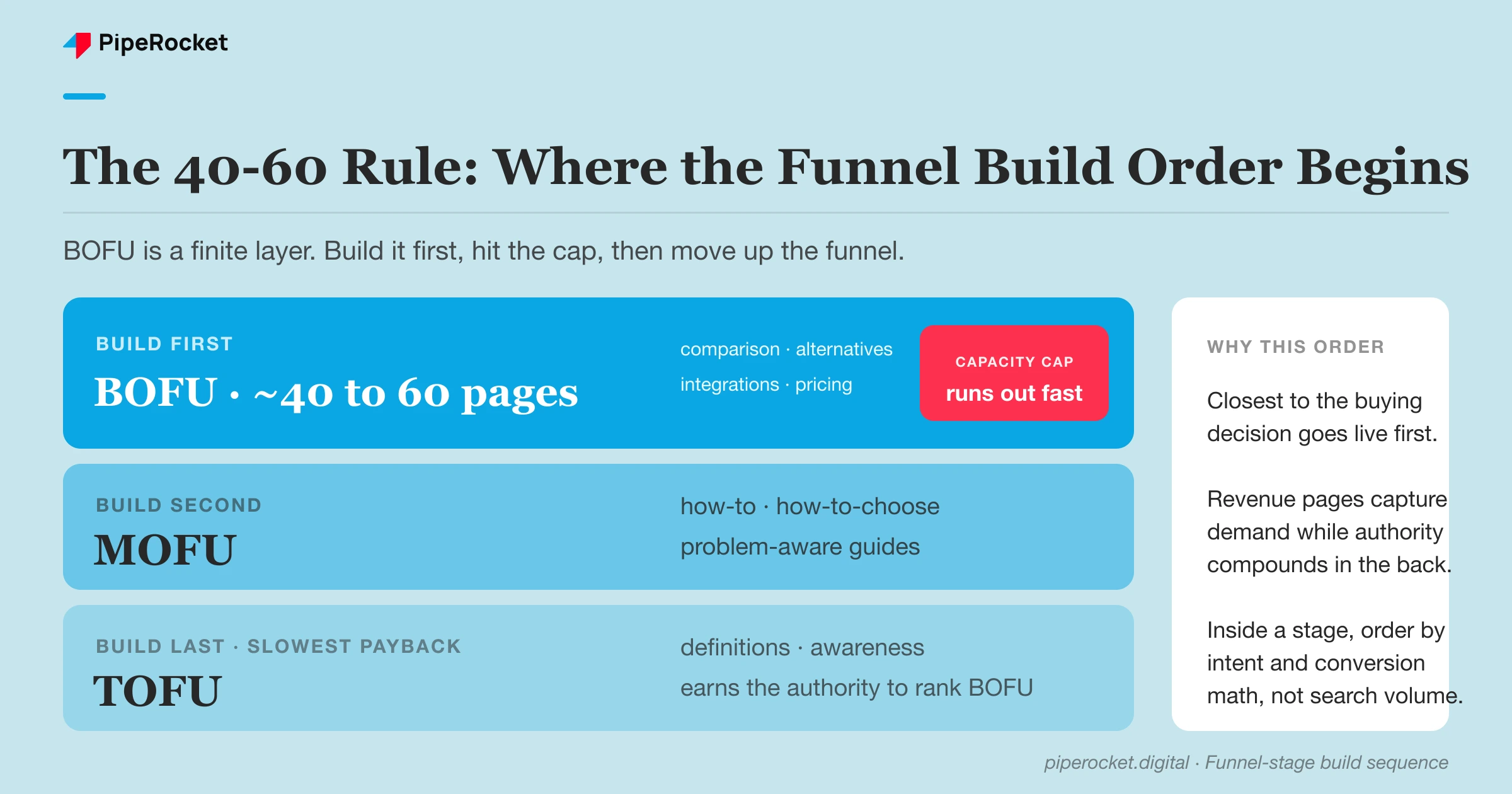
That cap is what makes the sequence finite and orderly instead of overwhelming. Your BOFU layer isn’t a bottomless list you could spend two years on; it’s a defined set of pages you can scope and ship in a quarter or two. The BOFU build covers a handful of page types:
- A comparison page for each real competitor
- Alternative pages for the tools your buyers are escaping
- Integration pages
- The pricing page
Once those are live, you’ve covered the high-intent demand and it’s time to move up.
The 40-60 rule earns its keep as a sequencing tool, because it tells you when the bottom of the funnel is done.
The moment your BOFU set is built and indexed, the next priority shifts to MOFU: the “how to” and comparison-adjacent terms that warm up buyers who aren’t quite ready for a decision page yet.
The mistake I see is teams who never hit the cap because they were never counting. They keep generating BOFU-ish ideas indefinitely, building page 60, then 70, then 90, each one thinner than the last.
Write a comparison page for a “competitor” nobody’s actually evaluating you against, and you’ve blown past the cap into demand that isn’t there.
What to Build After You Hit the Cap
Once BOFU is built, MOFU is the next layer, and the same intent-first logic applies inside it. Prioritize the MOFU terms closest to a buying decision: implementation guides, “how to choose” articles, and the problem-aware searches that sit one step before someone starts comparing vendors.
TOFU comes last in the build order, but not because it doesn’t matter. It earns the topical authority that makes the BOFU pages rank, so it’s essential to the engine.
It’s just the slowest-paying layer, so it belongs at the back of the queue where its long timeline doesn’t block the revenue pages. There’s more on assembling these layers into a connected system in our guide to building topic clusters .
How ROI Decides the Order Inside a Stage
Sequencing by stage gets you most of the way, but within a stage you still have to choose what goes first, and that’s where conversion math beats search volume every time. Two BOFU pages aren’t equal priority just because they’re both BOFU.
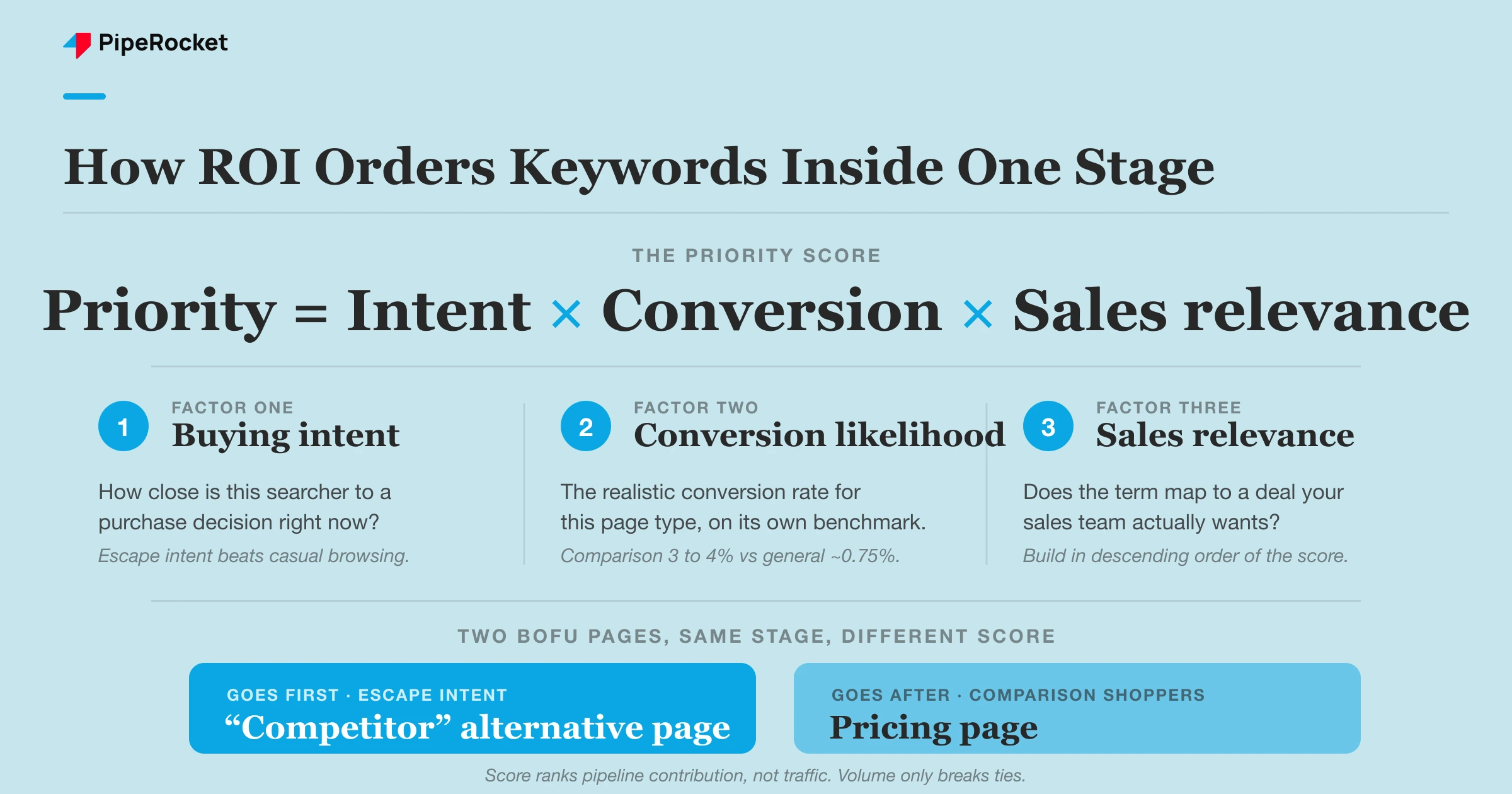
Rank the keywords inside a stage by likely pipeline contribution, not by traffic. The way I think about it is to score each candidate on three things and let that set the queue:
- Buying intent: how close is this searcher to a purchase decision?
- Conversion likelihood: what’s the realistic conversion rate for this page type?
- Sales relevance: does this term map to a deal your sales team actually wants?
A page’s value is intent times conversion likelihood times how badly sales wants that kind of lead, and you build in descending order of that score.
This is the same logic behind scoring SaaS keywords by ICP intent , which goes deeper on weighting terms by how well they match your ideal buyer.
I report conversion by page type, not aggregate traffic, and hold each type to its own benchmark. A comparison or alternative page should convert at three to four percent because the intent is high.
A general top-of-funnel page often sits around 0.75 percent, frequently on an asset download rather than a demo. Judge a blog post by a comparison page’s benchmark and you’ll make bad sequencing calls.
| Page type | Typical conversion | When it leads |
|---|---|---|
| Comparison / alternative pages | 3 to 4% | Highest intent, so they go first inside the stage |
| Pricing / BOFU pages | High intent, no fixed benchmark stated | Strong, but escape-intent pages still lead them |
| General top-of-funnel pages | Around 0.75% | Last in the build order, usually on an asset download |
Take a compliance SaaS for fintech teams. Their “[competitor] alternative” page and their “SOC 2 automation pricing” page both sit in BOFU, but the alternative page catches someone actively leaving a tool that failed them, while the pricing page catches comparison shoppers.
The alternative page goes first because escape-intent converts faster, even if it has lower search volume.
Volume Still Matters, Just Not First
None of this means search volume is useless. Between two keywords with identical intent and conversion potential, the higher-volume one wins.
The point is sequence: intent and conversion math set the order, and volume breaks ties inside it. We get into where the two genuinely trade off in our breakdown of search volume versus search intent .
Common Sequencing Mistakes That Stall a Plan
Three mistakes wreck more SaaS content sequences than anything else, and all three come from prioritizing the wrong thing at the wrong time.
-
Building TOFU-first because it’s easier to justify to leadership. Awareness content gets more traffic, the charts go up and to the right, and everyone feels productive. Six months later traffic has tripled and pipeline hasn’t moved, because you built for people who weren’t buying while ignoring the ones who were.
-
Treating every BOFU page as equal priority. Teams build their BOFU set in whatever order the keywords appear in the sheet, instead of leading with the pages that map to the deals sales wants most. Your “[biggest competitor] alternative” page and your page for a tool nobody compares you to are both BOFU, but only one belongs in week one.
-
Ignoring how long pages take to rank when you sequence. BOFU pages on a young domain don’t rank overnight; they need supporting content and internal links behind them. Sequence as though everything ranks instantly, and you’ll build a pricing page in isolation, watch it sit on page three, and conclude BOFU “doesn’t work” when the real problem was that you built the pricing page before the content that was supposed to hold it up.
The fix for all three is the same: sequence by where revenue actually comes from, and build the finite high-intent layer first. The slow-ranking authority content still has to start early, precisely because it pays off late.
Get the order right and the same keyword list that produced traffic for one team produces pipeline for you.
Sequencing is where most plans quietly stall, and the SaaS SEO agency shortlist covers teams that hold the order under pressure.
How PipeRocket Digital Sequences SaaS Keyword Plans
When we take on a SaaS site, we don’t write the keyword list in spreadsheet order. We scope the finite BOFU layer first, sequence those pages by the deals your sales team wants, then build the MOFU and TOFU layers that earn the authority to rank them.
Most agencies execute a content calendar . We own the outcome, which is pipeline. If you want your keyword plan sequenced for revenue, our SaaS SEO team does exactly this, and you can talk to us here .
Frequently Asked Questions
Should I build TOFU or BOFU content first for SaaS SEO?
Build BOFU first for almost every established SaaS category. Bottom-of-funnel pages catch buyers who are already comparing vendors and ready to convert, so getting them live early means your content starts producing pipeline while slower-ranking TOFU content compounds in the background.
The exception is brand-new categories with no existing comparison searches, where you have to create awareness first because there’s no bottom-of-funnel demand to capture yet.
How many BOFU keywords should a SaaS company target?
Most single-product SaaS companies max out at roughly 40 to 60 bottom-of-funnel pages, covering software pages, comparisons, alternatives, integrations, and pricing. That’s a practical ceiling, not a target to force.
If you find yourself building comparison pages for competitors nobody actually evaluates you against, you’ve passed the point where real buying intent exists and you’re manufacturing thin pages. Once the genuine BOFU set is built, move up to MOFU.
Does search volume matter when prioritizing keywords by funnel stage?
It matters, but as a tiebreaker, not the primary sort. Intent and conversion likelihood decide the order: a low-volume comparison term that converts at three to four percent beats a high-volume definition term that converts at under one percent.
Use volume to choose between two keywords that have equal intent and similar conversion potential. Leading with volume is the most common reason SaaS content programs grow traffic without growing pipeline.