How to Score SaaS Keywords by ICP Intent (Not Volume)
 Kamaraj Mathiarasan (Kim)
Last updated on
Kamaraj Mathiarasan (Kim)
Last updated on
You already have the keyword list. Maybe it’s 400 rows from Ahrefs, maybe it’s the messy human list your sales team gave you.
The question now isn’t “is this a keyword,” it’s “does the person typing this look anything like someone we can actually sell to.” Here’s the scoring system we run to answer that, one keyword at a time.
TL;DR
- Why volume scores fail: Difficulty and volume rate the keyword’s SEO odds while staying silent on whether the searcher owns a problem you solve, so they keep greenlighting traffic that never converts.
- Score problem ownership: The first and heaviest signal is whether the searcher personally owns the pain your product fixes rather than sitting vaguely “in your category.”
- Score buying power and fit: Rate whether the searcher’s company size and role match the people who actually sign your contracts.
- Score the buying trigger: Rate how close the search sits to a real trigger event, the moment something broke and they need a fix now.
- Weight and set a kill threshold: Weight the three signals, total them out of a fixed number, and draw a hard line below which a keyword is dead no matter how good the volume looks.
- Score a real list and cut: Run every keyword through the same columns, sort by score, and make build decisions on the number instead of the gut.
- The traffic traps: High-volume keywords that pass every SEO filter and fail every ICP signal are the ones that quietly burn your quarter.
Why Difficulty and Volume Scores Keep Letting You Down
Most keyword scoring models rate the wrong thing. You open a tool, you get Keyword Difficulty, search volume, maybe a CPC, and you build a priority score out of those three. The problem is every one of those numbers describes the keyword’s SEO odds. None of them describe the human typing it.
Most teams score keywords on how winnable they are. That’s backwards, because a keyword you can win easily and a buyer who can pay you are two completely different things.
We’ve watched teams rank top-three for high-volume terms and move zero pipeline, because the searchers were mostly students and job seekers who were never going to buy.
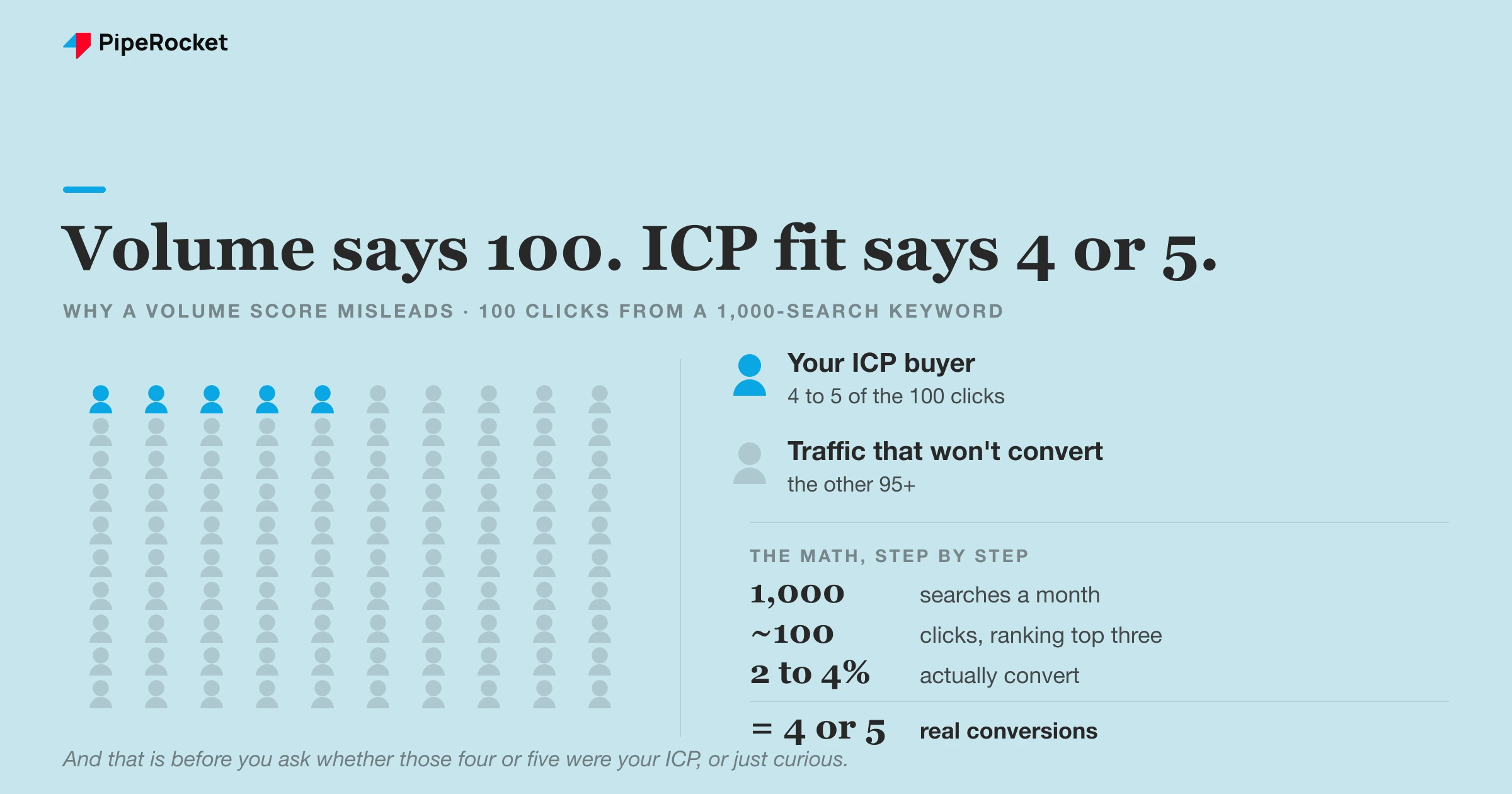
A 1,000-search keyword ranking top three might bring 100 clicks, and at a typical SaaS conversion rate of 2 to 4%, that’s four or five conversions. Now ask: were any of those four people your ICP? If you scored the keyword on volume, you never asked.
That’s the gap this rubric closes. You score each keyword on ICP fit, then you let volume break ties, not lead the decision. If you want the deeper case for that ordering, we made it in our piece on search volume versus search intent .
Step 1: Score Whether the Searcher Owns the Problem
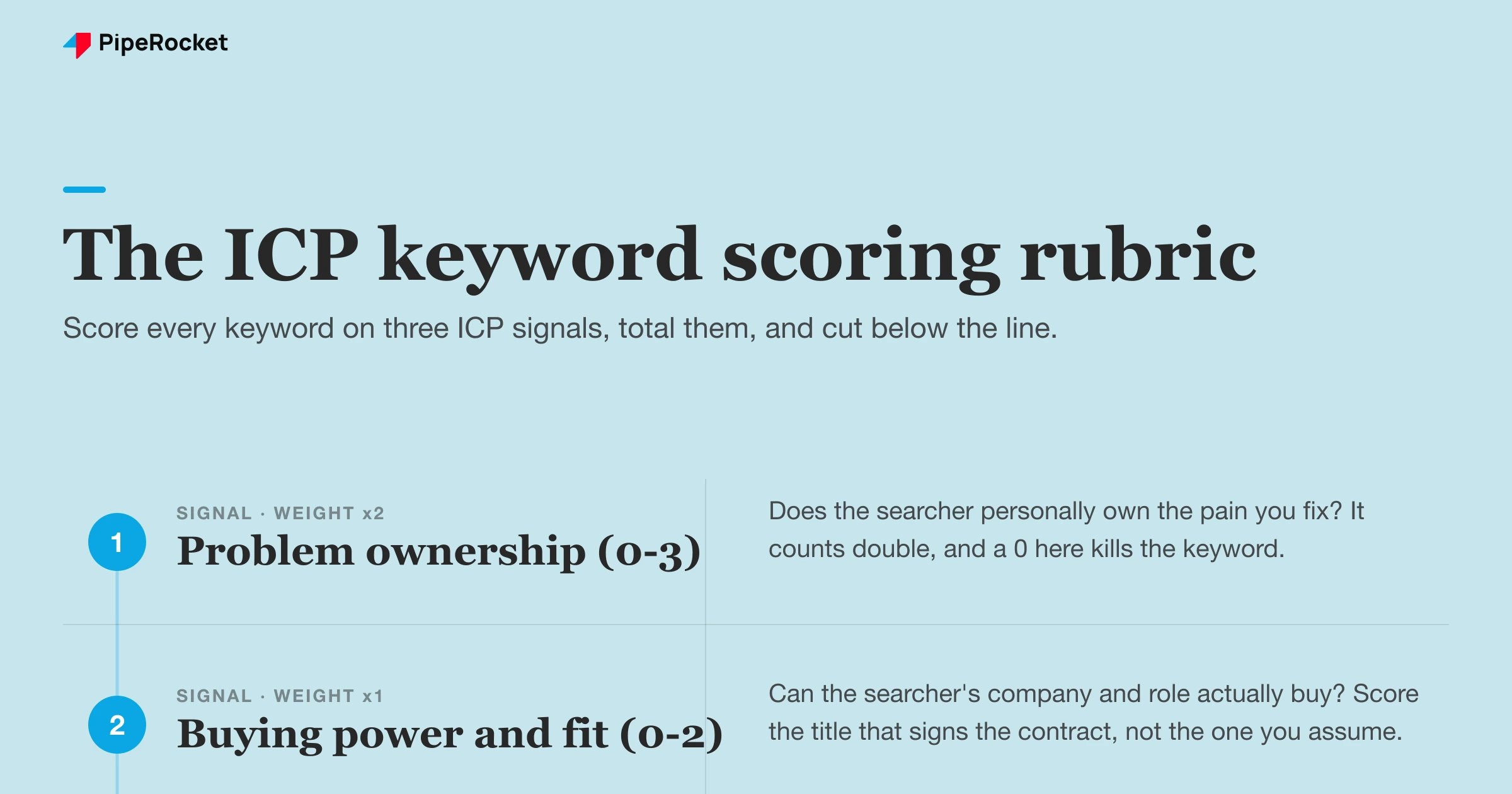
The heaviest signal is problem ownership. Before anything else, ask: does the person typing this query personally own the pain our product removes? Not “are they in our category,” but “is this their problem to fix.” Score it 0 to 3.
This signal does most of the work, so it carries the most weight. A query like “SOC 2 compliance automation” is owned by someone with the compliance fire on their desk. A query like “what is SOC 2” might be owned by an intern writing a summary for their boss. Same category, completely different person.
We learned how much this matters by changing one question. On an enterprise client we stopped asking “what gets the most searches” and started asking “what does someone search when they already have this problem and need a solution now.”
Most of those queries had very low volume. But the searchers were decision-makers, and a page getting five or ten visitors a week was almost all qualified. That client went from a handful of sales opportunities to several times that in two quarters, no budget increase, no extra content.
Here’s how to score the signal:
- 3: The searcher clearly owns the exact problem you solve and is looking for a fix.
- 2: They own a related problem and your product is a plausible answer.
- 1: They’re researching the category but ownership is unclear.
- 0: They’re adjacent at best, learning, comparing careers, or writing about it.
If a keyword scores 0 here, it almost doesn’t matter what the rest of the row says.
Step 2: Score Buying Power and ICP Fit
The second signal is whether the searcher’s company can actually buy from you. A keyword can be owned by someone with the real problem who still sits completely outside your ICP, wrong company size, wrong vertical, wrong budget. Score this 0 to 2.
This is where SaaS teams leak the most effort. You map keywords beautifully, you rank, and the leads that show up are freelancers and SMBs when you sell to mid-market security teams. The keyword wasn’t wrong about the problem. It was wrong about the wallet.
Take a compliance SaaS built for fintech teams of 200-plus. “Free compliance checklist” owns a real problem and pulls real volume. But it pulls solo founders and three-person startups who’ll never reach your floor price.
Same problem, wrong buyer. That keyword scores high on Step 1 and a flat 0 here, which is exactly the signal you want the rubric to catch.
So when you score fit, score it against the title that signs, not the title you assume. The same precision matters when you map keywords to the buyer’s journey later.
Score it like this:
- 2: The query implies your exact company size, vertical, or role.
- 1: Fit is plausible but the query is generic across segments.
- 0: The query skews toward people outside your ICP (free, students, SMB when you’re enterprise).
Step 3: Score the Buying Trigger
The third signal is the trigger. How close does this search sit to the moment something actually broke? Someone searching because a deadline, an audit, an outage, or a failed tool just landed on their desk is worth far more than someone idly reading. Score it 0 to 2.
Trigger language is specific and a little urgent. “Vanta alternative” carries a trigger, someone’s unhappy with a tool right now. “Zendesk migration” carries a trigger. “What is helpdesk software” carries none. The first two searchers have a reason to act this month. The third might act next year, or never. Trigger fit decays the moment your positioning moves, so re-score it whenever your ICP shifts.
This is the signal that separates a comparison or alternative keyword from a definitional one. We’ve seen the pattern hold across accounts: when SEO keeps ranking the old version of a company after it repositions, traffic looks healthy while the wrong people land, because the trigger-heavy keywords were never rebuilt around the new ICP.
Score the trigger:
- 2: Clear trigger language (alternative, migration, replace, pricing, deadline-driven).
- 1: Implied or soft trigger.
- 0: Purely informational, no reason to act now.
Step 4: Weight the Signals and Set Your Kill Threshold
Now make the three signals into one number. They aren’t equal, so don’t average them. Problem ownership predicts pipeline harder than the others, so it gets the most room, and the trigger and fit signals fill in around it.
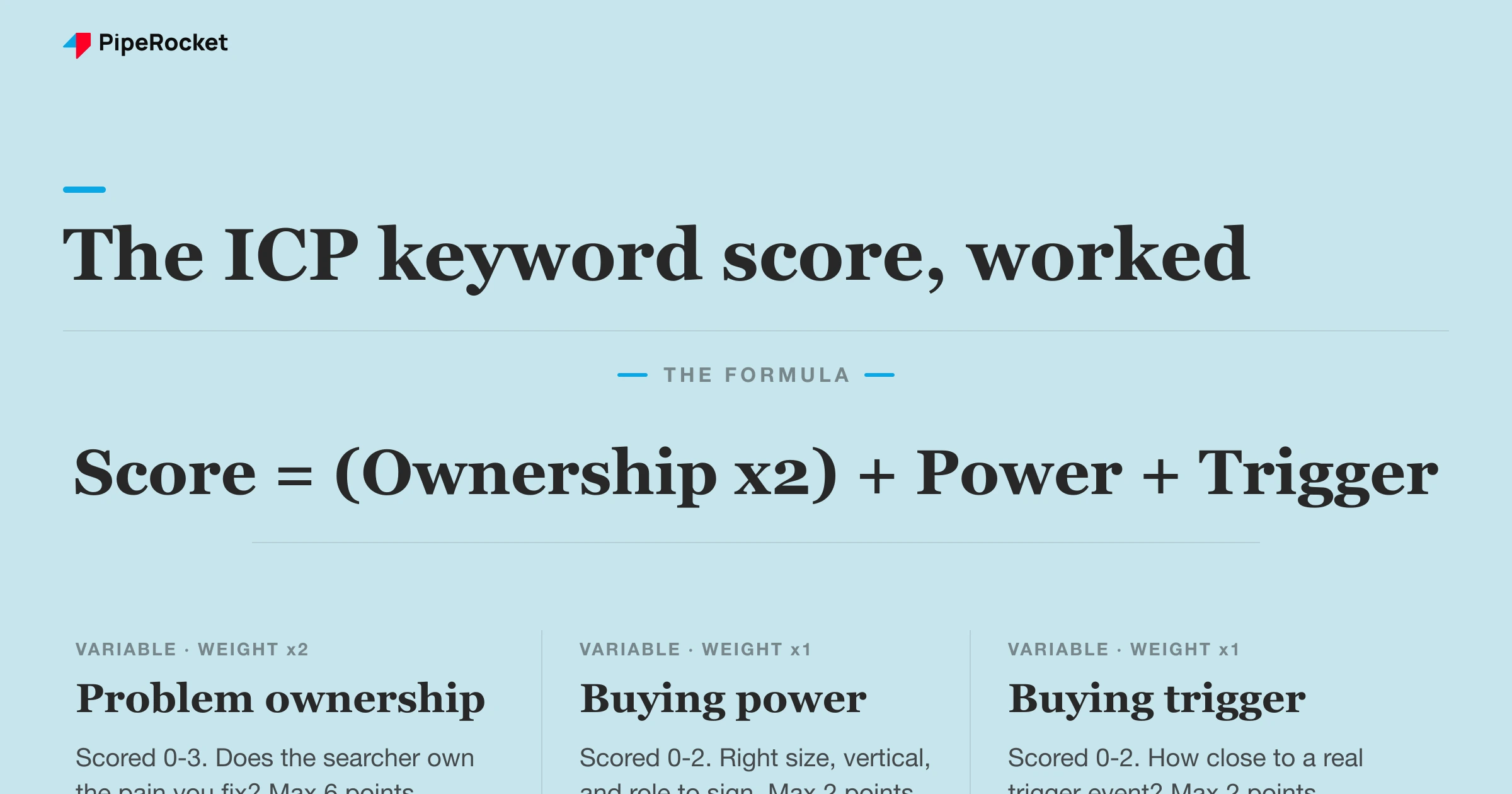
Here’s the weighting we run. Problem ownership stays on its 0 to 3 scale and counts double. Buying power and trigger stay 0 to 2 each and count once. That gives you a clean total out of 10:
- Problem ownership (0-3) x 2 = up to 6
- Buying power and fit (0-2) = up to 2
- Buying trigger (0-2) = up to 2
The kill threshold matters more than the weighting. Below a 5 out of 10, a keyword is dead to you, no exceptions, no “but the volume is amazing.” We hold this line hard because the whole point is to stop chasing traffic and start chasing buying signals. A keyword that scores 4 with 8,000 searches a month is still a 4.
There’s one override worth keeping. If problem ownership scores 0, kill the keyword regardless of total, because a 6 built entirely on fit and trigger with nobody owning the problem is a number lying to you. Ownership is the gate; the rest is refinement.
Step 5: Score a Real List and Cut on the Number
Put the scoring into your keyword sheet and make it a column, not a vibe. The sheet we use already has Keyword, Volume, and Intent columns; the ICP score lives right next to them and becomes the sort key. This turns “which 30 should we write” from an argument into a sort.
Take a real slice. Say a compliance SaaS for fintech is scoring these four:
| Keyword | Ownership | Fit | Trigger | Score |
|---|---|---|---|---|
| soc 2 compliance software | 3 | 2 | 1 | 9 |
| vanta alternative | 3 | 2 | 2 | 10 |
| what is soc 2 | 1 | 1 | 0 | 3 |
| free compliance checklist | 2 | 0 | 1 | 5 |
The “vanta alternative” and “soc 2 compliance software” rows are obvious builds. “What is soc 2” dies at a 3 even if it has ten times the volume.
The checklist sits right on the line at 5, and that’s where volume finally earns a vote: if it’s huge and cheap to produce, it can be a supporting asset, but it never jumps the queue ahead of a 9.
Sort the whole list by score, descending. Build top-down. The keywords clustered at 8 to 10 are your money pages and your BOFU set , the ones worth real effort.
Everything from 5 to 7 is a maybe, sequenced by capacity. Below 5 doesn’t enter the plan. If you want the full sequencing logic once the list is scored, we laid it out in how to prioritize SaaS keywords by funnel stage .
The Traffic-Trap Keywords That Pass Volume and Fail ICP
A traffic trap is a keyword that scores beautifully on every SEO metric and zero on every ICP signal. High volume, low difficulty, healthy CPC , and a searcher who will never, ever buy. These are the ones that wreck a quarter, because they look like wins right up until the pipeline report lands.
The tell is always the same: the keyword describes a topic in your category but not a person in your market. The query patterns that pull volume and pull the wrong human:
- “What is [category]”
- “[category] examples”
- “[category] template”
- “free [thing]”
They feel productive because traffic climbs. We’ve seen SaaS teams scale exactly this kind of content and watch sessions rise while demos stay flat, which is the clearest sign you don’t have a traffic problem, you have an audience problem.
Spot the trap before it reaches the plan by running the ownership question first, not the volume column. If you can’t name the specific person who’d type the query with the problem on their desk, the volume is irrelevant.
We treat SEO as a way to chase buying signals rather than raw sessions, so a keyword that can’t name its buyer doesn’t get built no matter how the tool scores it.
It’s a boring discipline to hold to, but it’s the part that actually protects your pipeline. For the broader vocabulary behind these signals, our breakdown of the types of keywords in SEO and the full SaaS keyword research process both feed this rubric.
Scoring this strictly means turning down keywords that look good in a tool, which is easier with an outside partner holding the line; the SaaS SEO agency shortlist covers teams that do.
How PipeRocket Digital Scores Keywords by ICP Intent
We don’t build SaaS content off a volume export. For every client we score the keyword list against the ICP first, problem ownership, buying power, and trigger, then let volume break ties.
That’s how a page with five qualified visitors a week beats a page with five thousand of the wrong ones. If you want this run on your own list, our SaaS SEO team does exactly this, and you can talk to us here .
Frequently Asked Questions
How do I score a keyword for ICP fit if I don’t have a clear ICP yet?
Start by writing down the single role that owns the problem your product solves and the company size that can afford you. You can score the three signals against even a rough definition and still cut the obvious mismatches. The rubric gets sharper as your ICP firms up, but it works on day one because problem ownership and buying power are the two things you can usually answer even before your positioning is final.
Should search volume ever override the ICP score?
Only as a tiebreaker between keywords that already cleared the kill threshold. If two keywords both score a 7, build the higher-volume one first. Volume never rescues a keyword below your threshold, because a high-volume term that fails the ICP signals just delivers more of the wrong traffic. The order is fit first, volume second, every time.
How is this different from mapping keywords to the buyer’s journey?
Stage mapping decides which stage a keyword belongs to, awareness, consideration, or decision. ICP scoring decides whether the searcher is even your buyer in the first place. A keyword can map cleanly to the decision stage and still fail the ICP test if the person making that decision sits outside your market. Score for ICP fit first to decide what’s worth keeping, then map the survivors to stages to decide how to write them.