
How to Map Keywords to the SaaS Buyer Journey
 Kamaraj Mathiarasan (Kim)
Last updated on
Kamaraj Mathiarasan (Kim)
Last updated on
Every keyword is a moment in someone’s head. The person searching “what is SOC 2” and the person searching “Vanta vs Drata pricing” want completely different things, and the second one is closer to paying you.
Most SaaS teams build one big keyword list and treat every line the same, then wonder why traffic climbs and pipeline sits still. You don’t fix that with more keywords. You fix it by sorting the ones you already have by where the buyer actually is, and here’s exactly how I do that.
TL;DR
- The mistake costing you pipeline: Treating every keyword as one bucket means you build awareness content for buyers who were ready to compare tools, and decision pages for people who’ve never heard of the category.
- The three stages and what each query sounds like: Awareness asks “do I have a problem,” consideration asks “what kinds of solutions exist,” decision asks “which specific tool do I buy,” and each maps to ToFu, MoFu, and BoFu.
- How to read intent from the words: The verb, the modifier, and whether a brand name shows up tell you the stage faster than search volume ever will.
- Mapping to the buying committee: A developer and a CMO search the same product in different languages, so one keyword usually belongs to a single role rather than the whole account.
- Tagging your list so it’s usable: Add a stage column to your keyword sheet and a page-type, because an unstaged list stays data instead of becoming a plan.
- Where teams get it wrong: Over-weighting awareness volume, forcing a decision query onto a blog post, and ignoring that the same word can mean two stages depending on who typed it.
Why One Keyword List Is Quietly Killing Your Content
Plenty of teams treat a keyword list like a to-do list. You pull 2,000 keywords from Ahrefs, sort by volume, and start writing top to bottom. That gives you a pile of unsorted intent rather than a strategy.
The problem is that a flat list hides the only thing that matters, which is what the searcher is trying to do. A buyer searching “employee onboarding checklist” is curious. A buyer searching “BambooHR alternatives” is shopping. Write the same kind of page for both and you’ll satisfy neither.
I’ve watched teams burn a whole quarter on this. They publish 30 awareness blogs because those keywords have the biggest numbers, traffic doubles, and the founder is happy until the sales team points out that none of it converted. The content was good. It was just aimed at people who weren’t buying yet.
When you map keywords to the buyer journey first, the list reorganizes itself around a real question: at each stage, what does this person need to see to move one step closer? That’s a different exercise from “which keyword has 5,400 searches.”
It’s the difference between keyword research as a volume hunt and keyword research as audience mapping . The volume still matters. It just stops being the thing you sort by.
The Three Stages, and What Each One Actually Sounds Like
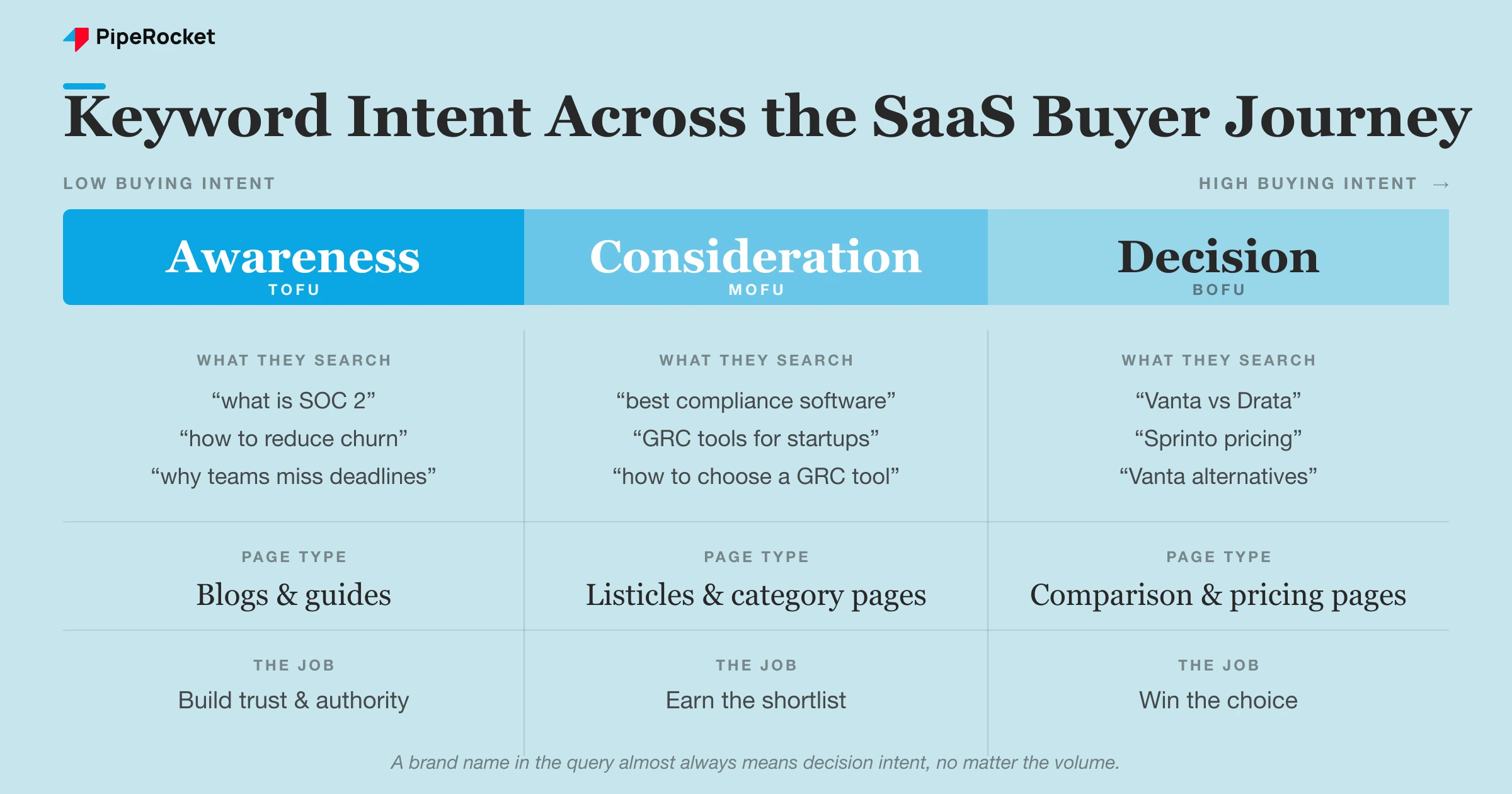
Map every keyword to one of three buyer-journey stages: awareness, consideration, or decision. These line up cleanly with the funnel terms most SaaS teams already use, so awareness is your ToFu, consideration is MoFu, and decision is BoFu.
Awareness: they have a problem but no solution in mind
At the awareness stage the searcher knows something hurts but hasn’t named the fix. They type questions: “why is my team missing deadlines,” “what is SOC 2 compliance,” “how to reduce customer churn.” There’s no product category in the query, often no commercial intent at all.
These keywords carry the highest volume and the lowest buying signal, which is exactly why they’re so easy to over-invest in. Awareness content earns trust and topical authority , and it warms people up. What it doesn’t do is fill next quarter’s pipeline. Treat it as a credibility play, not a lead play.
One thing worth knowing: across the 53 B2B SaaS brands we analysed over 8 months, only 11.8% of AI-referred sessions carried brand-name intent versus 28.1% of organic, which tells you most early-stage discovery happens before anyone knows your name.
Consideration: they know solutions exist and want to compare types
Now the searcher has a category. They’re searching “best compliance automation software,” “GRC tools for startups,” “alternatives to manual SOC 2 audits.” The query names a kind of solution but not a winner. They’re building a shortlist.
This is where most buying actually starts to take shape, and it’s the stage SaaS teams under-serve most. The searcher wants orientation: what types of tools solve this, what should I look for, who’s in the running.
Listicles, category pages, and “how to choose” guides live here. The intent is warmer than awareness but not yet locked onto a vendor.
Decision: they’re choosing between named options
At the decision stage the query gets specific and often carries a brand. “Vanta vs Drata,” “Sprinto pricing,” “Vanta alternatives,” “is Drata worth it.” These are low-volume, high-intent searches, and they’re where the credit card comes out.
A page might get 40 visitors a month and still be your best-converting URL on the site. Decision keywords are the heart of ranking BoFu keywords for SaaS , and they deserve their own dedicated pages (comparison and pricing among them), not a paragraph buried in a blog.
How to Read Intent Straight From the Words
You can tell a keyword’s stage from three signals inside the query itself, faster than any tool’s intent label. Look at the verb, the modifier, and whether a brand name appears.
The verb tells you the mental mode:
- “What is,” “how to,” “why does” signal learning (awareness)
- “Best,” “top,” “compare,” “vs” signal evaluating (consideration)
- “Pricing,” “demo,” “alternatives,” “review” signal choosing (decision)
The modifier narrows the audience. “GRC software” is a category; “GRC software for fintech startups under 50 people” is a decision-stage query wearing a category’s clothes, because only someone deep in the buying process qualifies their search that precisely.
The brand name is the clearest tell of all. The moment a searcher types your name or a competitor’s, they’ve left awareness behind. Branded intent is decision intent almost every time.
The data backs this up: in that same 8-month study, AI sessions skewed harder toward bottom-of-funnel than organic (44% versus 41%), and the queries that converted were the specific, named ones, not the broad category terms.
One warning. Intent labels from tools are a starting point, not gospel. Ahrefs will tag “CRM software” as commercial, but a student writing a paper and a VP of Sales scoping vendors both type it.
The word alone can’t always resolve who’s behind it, which is the exact problem the ICP intent scoring rubric is built to solve. Read the query, then sanity-check it against who your buyer actually is.
Map the Keyword to the Person Who Searches It
Here’s the layer most stage-mapping skips: the same product is searched by different roles in different languages, and a single keyword usually belongs to one of them.
Our team learned this the hard way running paid for SaaS clients. We stopped opening the keyword tool first and instead grilled product and sales on who actually makes the call. A CTO and a CEO searching the same tool care about opposite things.
The CTO searches “does it integrate with our stack” and “SOC 2 compliant”; the CEO searches “ROI” and “team productivity.” Same product, two buyers, two query languages.
In B2B SaaS the buyer is rarely one person. A compliance platform gets researched by a security engineer who searches “automated evidence collection,” a CFO who searches “cost of SOC 2 audit,” and a CEO who just wants to know if the deal closes faster.
Map each keyword to the role most likely to type it, and you’ll see that your “consideration” bucket is really three smaller buckets, one per stakeholder.
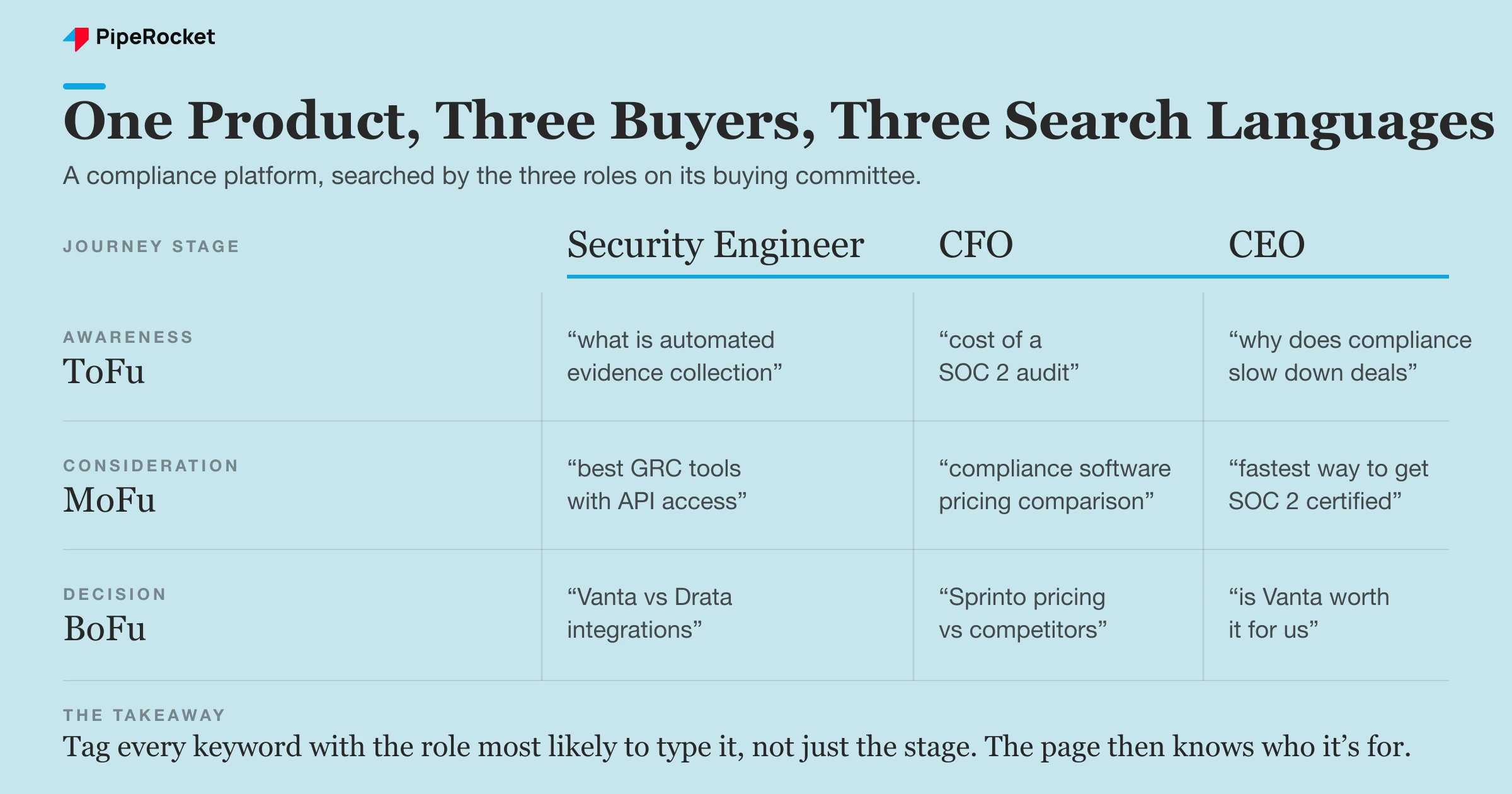
This is why ICP belongs in the mapping exercise, not after it. A keyword that’s perfect for the engineer is noise to the CEO.
When you tag a keyword, tag the persona alongside the stage. It changes what the page has to say, and it stops you from writing one generic page that tries to speak to everyone and lands with no one.
Build the Map: Tag Your List So It’s Actually Usable
A keyword list with no stage column is data. A keyword list with a stage column is a plan. The mapping only pays off when it lives in your sheet, so here’s the structure I use.
Take your master keyword sheet and add three columns next to each keyword:
- Stage: Awareness / Consideration / Decision
- Persona: which role types this (engineer, CFO, CEO, end user)
- Page type: the format that matches the intent (blog, listicle, comparison, pricing, alternative)
The page-type column is the one teams forget, and it’s the one that prevents the most damage. A decision-stage keyword needs a comparison or alternative page, never a blog post, because the SERP for “Vanta vs Drata” is full of comparison pages and Google won’t rank your narrative essay there no matter how good it is.
Comparison and alternative pages aren’t even the same format. A comparison-page visitor is weighing two viable options, while an alternative-page visitor is escaping a tool that failed them, so they need different writing.
Once every row has a stage, a persona, and a page type, the list tells you how to build. Group the rows by topic and you’ll see how many pages each stage needs. That grouping is the bridge into building topic clusters , where the staged keywords become a connected structure instead of scattered posts.
What this map deliberately doesn’t tell you is the order to build in, or which keyword to write first. That’s a sequencing question, and it lives in how to prioritize SaaS keywords by funnel stage , because mapping and prioritizing are two different jobs.
Where SaaS Teams Get Journey-Mapping Wrong
Most teams map keywords to stages and still get it wrong, in three specific ways I see over and over.
Over-weighting awareness
The first is over-weighting awareness because the volume is intoxicating. Awareness keywords have the biggest numbers, so they dominate the plan, and the team ends up with a library of “what is” articles and almost no decision pages. Everyone says ToFu is dying anyway since AI now answers informational queries before the click.
The honest read is subtler: awareness and decision content fail when you treat them as separate problems instead of one engine. Awareness builds the authority that makes your decision pages rank, so you need both, just not in the ratio volume tempts you into.
Lean too far toward awareness and you get traffic with no demos; lean BoFu-only and your comparison pages sit on page 2 with nothing supporting them.
Format-intent mismatch
The second mistake is format-intent mismatch. The keyword is mapped to “decision” correctly, but the team writes a 2,000-word blog post for it instead of a comparison page. The stage was right and the format fought it.
If the top 10 results for a query are all comparison pages and you publish an essay, you lose regardless of writing quality. Map the stage, then match the format to what the SERP already rewards.
Assuming a keyword has a fixed stage
The third is the quiet one: assuming a keyword has a fixed stage. “CRM software” is consideration for a buyer comparing tools and awareness for someone who just heard the term. The word doesn’t carry the stage on its own. The person does.
When a keyword feels like it sits in two stages at once, that’s usually a signal that two different personas are searching it, and you may need two pages, or a single page with sections that serve both.
This same tension shows up when you’re choosing search volume versus search intent , where the highest-volume version of a term and the highest-intent version are often two separate queries.
Mapping well takes someone who has seen several SaaS funnels, and the SaaS SEO agency shortlist covers teams with that range.
How PipeRocket Digital Maps Keywords to Pipeline
We don’t sort keywords by volume and hope the right people show up. We map every keyword to a buyer-journey stage and the specific role likely to search it, then match each one to the page type that actually ranks for that intent.
Awareness content earns the authority, consideration content builds the shortlist, and decision pages do the converting, held together so they reinforce each other instead of competing. If you want this built around your real buyers, we’re open for a call , and you can see the full approach on our SaaS SEO agency page.
Frequently Asked Questions
What are the three stages of the SaaS buyer journey?
The three stages are awareness, consideration, and decision, which map directly onto the ToFu, MoFu, and BoFu funnel terms. In awareness the buyer knows they have a problem but hasn’t named a solution. In consideration they know solution types exist and are building a shortlist. In decision they’re comparing specific named vendors and close to buying.
Each stage produces a different kind of search query, so a keyword almost always belongs to exactly one of them.
How do I know if a keyword is top, middle, or bottom of funnel?
Read the words in the query before you trust any tool’s label. Verbs like “what is” and “how to” signal awareness; “best,” “compare,” and “vs” signal consideration; “pricing,” “demo,” and “alternatives” signal decision.
The strongest single tell is a brand name, because the moment a searcher types your name or a competitor’s, they’ve moved to the decision stage. A specific modifier like an industry or company size also pushes a query down-funnel, since only a serious buyer searches that precisely.
Should I create content for every stage of the buyer journey?
Yes, but not in equal amounts and not in the order volume suggests. You need awareness content to build the topical authority that makes your decision pages rank, and you need decision pages because that’s where conversions happen.
The mistake is over-investing in awareness because it has the biggest search numbers, which leaves you with traffic and no pipeline. Treat awareness and decision content as one connected engine rather than separate projects, and weight your effort toward the stages closest to a buying decision.

