Search Volume vs Search Intent: How to Choose for SaaS
 Kamaraj Mathiarasan (Kim)
Last updated on
Kamaraj Mathiarasan (Kim)
Last updated on
Every SaaS keyword list forces the same fight. One column says a keyword gets 4,000 searches a month. Another column says the people typing it have no reason to buy. You can only build so many pages, so you have to pick a side.
Here’s how we actually make that call, keyword by keyword, instead of letting the bigger number win by default.
TL;DR
- Why the debate is fake most of the time: For the vast majority of SaaS keywords the answer is intent, and volume only earns a vote once intent is already a yes.
- Let the SERP settle it: The fastest way to break the tie is to search the keyword yourself and see what page type Google already rewards.
- Run the volume math before you argue: A high-volume keyword’s real conversion count is usually smaller than it looks, so do the arithmetic before you defend it.
- When volume genuinely wins: Volume earns the slot once the searcher already has buying intent and you simply want more of them, so lean on it to scale reach among searchers who are already ready to buy.
- When intent has to override: A near-zero-volume keyword beats a popular one whenever the rare searcher is a decision-maker with a problem they need solved now.
- How to decide on one keyword: Score intent first as a gate, then use volume only to rank the keywords that already passed.
- The mistake worth naming: Running your whole list on volume hides the damage, because the traffic chart looks like success long after the pipeline has stopped.
The Volume vs Intent Debate Is Mostly Fake
For most SaaS keywords, this isn’t a real trade-off. Intent wins, and it isn’t close. The debate only feels balanced because volume is the number your tool shows you first and intent is the thing you have to think about.
Most teams treat volume and intent as two equal inputs and average them into a priority score. That’s wrong, because a keyword nobody who can buy is searching for is worthless at any volume, while a keyword one perfect buyer searches for can be worth a quarter of pipeline. You can’t average a multiplier of zero.
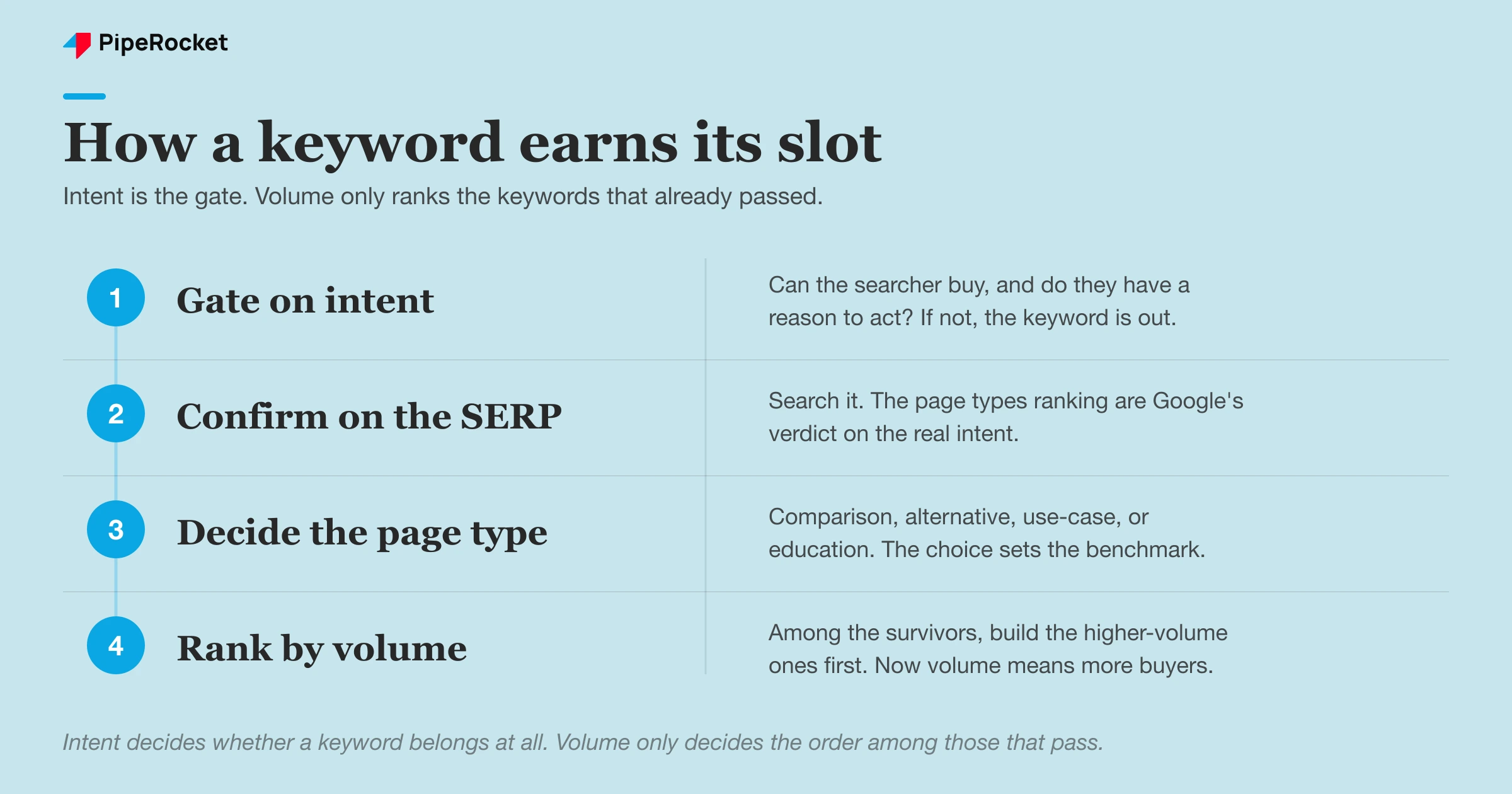
So the real question isn’t “which matters more in general.” It’s narrower than that. Intent decides whether a keyword belongs on your list at all, and volume only decides where it ranks among the keywords that already passed the intent test.
We’ve watched teams rank top-three for big terms and move zero pipeline, because the searchers were mostly students and job seekers who were a year away from a credit card.
This is the same ordering we use when we score keywords by ICP intent : intent gates, volume ranks. The rest of this piece is about the cases where that order gets genuinely hard to call.
Stop Arguing and Search the Keyword Yourself
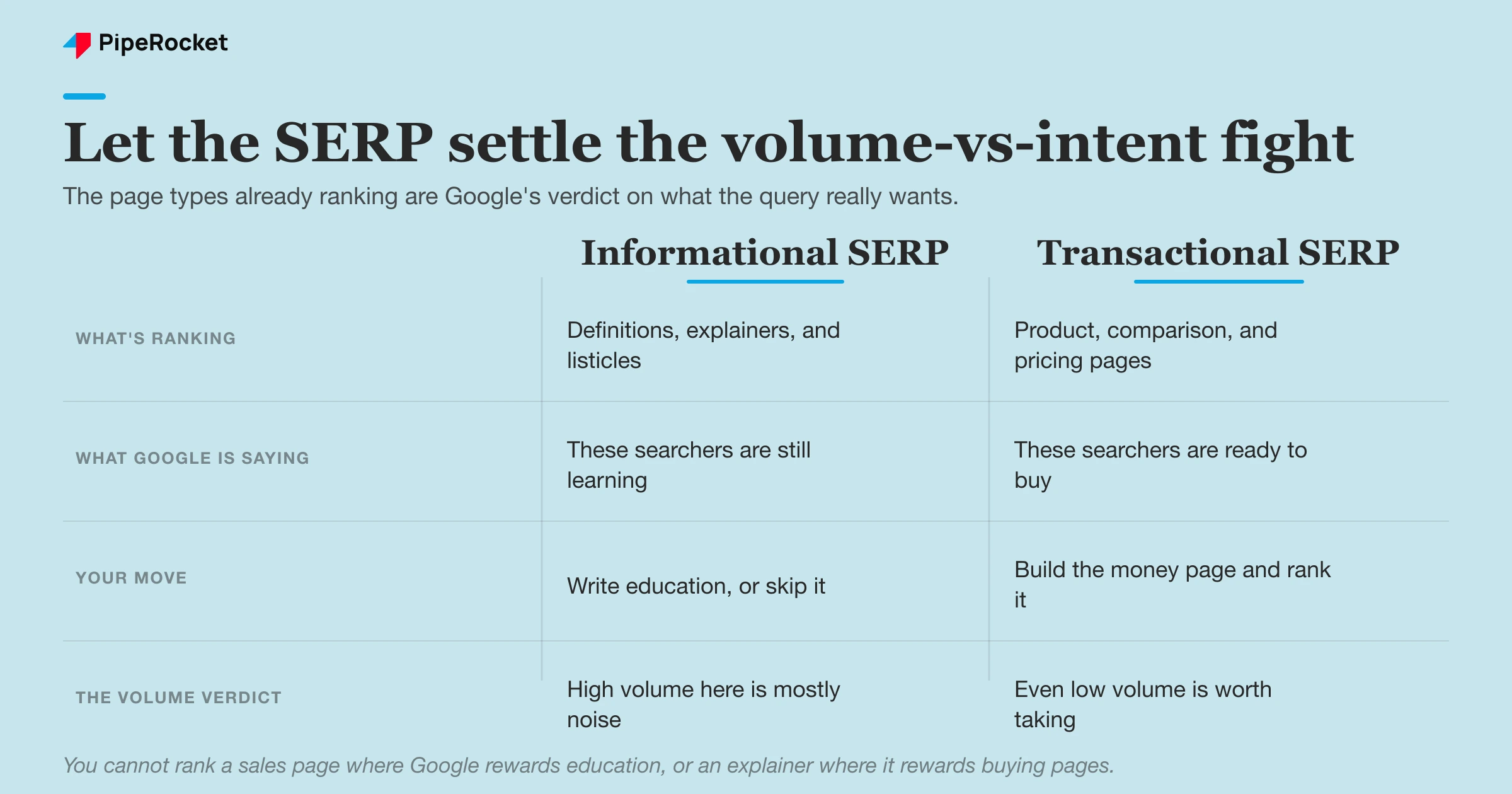
When volume and intent point in opposite directions, the quickest way to settle it is to put the keyword into Google and read the first page. The SERP is Google’s verdict on what intent that query actually carries, and it overrides whatever your gut or your tool says.
This is the check we run before building any page. If you search a keyword and the top ten results are all “what is X” blog posts, Google has decided that query is informational, and a hard-sell product page won’t rank there no matter how high the volume looks.
If the top ten are product and comparison pages , the query carries buying intent and a blog post will get buried.
The page type that already ranks tells you the intent, and the intent tells you whether the volume is reachable for the kind of page you’d actually want to build.
The SERP can flip a keyword you’d have skipped
Sometimes the SERP rescues a low-volume keyword you’d have cut on the number. A query like “[tool] for HIPAA compliance” might show 90 searches a month. That looks like nothing next to “best project management software.”
But search it, and if the first page is full of vendor product pages and comparison content, Google is telling you those 90 searchers are buyers in a regulated vertical who pulled out their credit card.
The low volume isn’t a weakness here, it’s a filter that’s already removed everyone who can’t buy. That’s a slot worth taking, and the volume number alone would have talked you out of it.
The SERP also kills high-volume keywords you wanted to win
The reverse happens just as often. A keyword with great volume can turn out to be a trap once you read the page.
Search “marketing automation ” and you’ll find definitions, Wikipedia-style explainers, and listicles aimed at people learning the category. None of that converts, and you can’t bolt a demo CTA onto a definition and expect it to rank.
So even with the volume staring at you, the SERP says this is a top-of-funnel education query, and you either write it as education and accept it won’t drive pipeline directly, or you skip it. Either way, the page type ranking there made the call for you before you wrote a word.
Do the Volume Math Before You Defend It
Before anyone argues for a high-volume keyword, run the arithmetic on what that volume is actually worth. The number almost always shrinks once you push it through a funnel, and a lot of “we have to rank for this” keywords don’t survive the math.
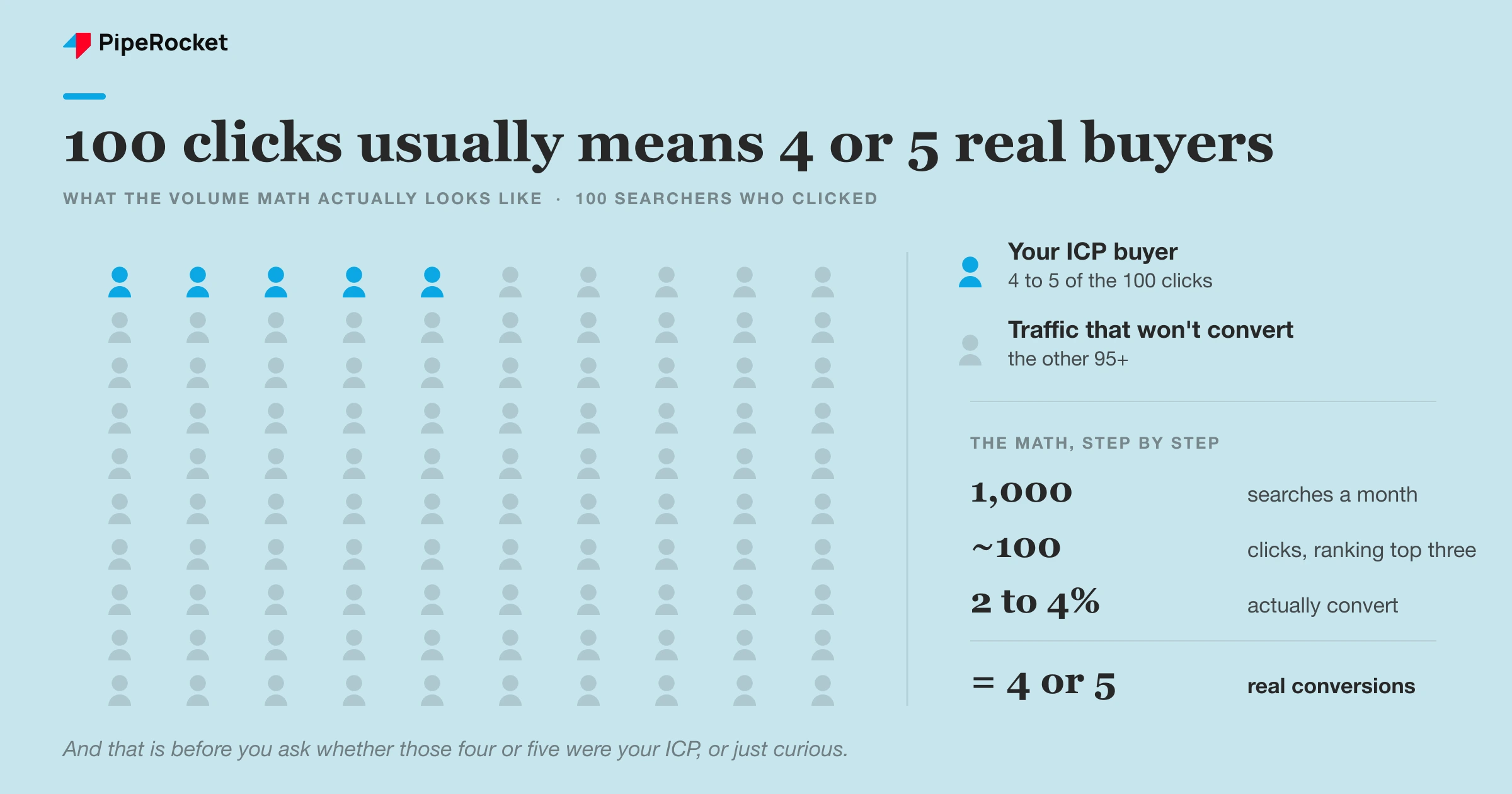
Take a keyword with 1,000 searches a month. Ranking top three, you might capture 100 clicks. At a typical SaaS conversion rate of 2 to 4%, that’s four or five conversions, and that’s before you ask whether any of those four people were your ICP or just curious.
A keyword that looked like a thousand opportunities is really four or five, and the wrong four or five if the intent is soft. Run that math and the volume stops being intimidating.
This is also where reporting honesty matters, because the same keyword performs completely differently depending on the page you build for it. We hold each page type to its own benchmark instead of one blended number:
- High-intent pages like alternatives and comparisons should convert around 3 to 4%
- General top-of-funnel pages often convert closer to 0.75%, and usually on an asset download rather than a demo
Judge a top-of-funnel blog post by a comparison page’s benchmark and you’ll make bad calls in both directions, cutting pages that were doing their actual job and scaling pages that never could. The volume math only means something once you’ve decided what page the keyword becomes and which benchmark it answers to.
When Search Volume Actually Wins
Volume genuinely wins in one specific situation: the searcher already has buying intent, and you simply want more people exactly like them. Volume is a multiplier on intent that already exists. It is never a substitute for intent that doesn’t.
Here’s the whole call in one view:
| The decision | Volume wins the slot | Intent overrides volume |
|---|---|---|
| The searcher | Already a qualified buyer, you just want more like them | A rare decision-maker with an active problem |
| What volume is doing | Multiplying intent that already exists | Nothing on its own; one real buyer beats thousands who can’t sign |
| Typical query | High-intent terms at scale, like “[category] software comparison” | Near-zero-volume problem queries, like “migrate off [legacy tool] without downtime” |
| Where it shows up | Broad comparison and category terms with budget behind them | Enterprise and high-ACV SaaS: migration, compliance, a tool that just failed |
Picture two comparison keywords that both pass the intent test. “[Your category] software comparison” gets 2,000 searches a month and “[niche tool] vs [niche tool]” gets 120. Both are high-intent, both pull people choosing between real options with a budget.
Here, and only here, volume is the right tiebreaker, so you build the 2,000-search page first because it’s the same qualified buyer at fifteen times the scale. That’s volume doing its honest job, ranking two keywords that already earned their place.
The trap is using volume to justify a keyword that failed the intent test, telling yourself the traffic will “build awareness.” A deliberate top-of-funnel page is fine, but a high-volume informational keyword is only a pipeline keyword if the people searching it can buy. If they can’t, the volume is just a louder version of zero.
When Search Intent Has to Override Volume
Intent overrides volume whenever the rare searcher is worth more than the crowd. In enterprise and high-ACV SaaS this is the norm, not the exception, because one decision-maker with an active problem is worth more than thousands of random visitors who’ll never sign anything.
A client that traded volume for buyers
We grew one client from 3 sales opportunities to 15 in two quarters, with no budget increase and no extra content. All we changed was which keywords we chased:
- Before: we targeted high-volume bottom-of-funnel keywords and published traffic-focused content. Traffic grew, pipeline didn’t, and the leads weren’t qualified.
- After: we asked “what does someone search when they already have a problem and need a solution now,” things like implementation problems and scaling bottlenecks. Most had near-zero volume, but a page might get 5 to 10 visitors a week and almost all of them were decision-makers.
If your traffic is growing but pipeline isn’t, you may not have a traffic problem at all, you have an audience problem.
This is where the standard tools fail you, because Keyword Difficulty and volume describe the keyword’s SEO odds and say nothing about the human typing it. A query like “migrate off [legacy tool] without downtime” might show almost no volume, yet the person typing it is mid-crisis and ready to switch vendors this month.
For the mechanics of building these, our guide on ranking BOFU keywords covers the page side. The point here is the judgment call: low volume plus high intent beats high volume plus soft intent almost every time in B2B SaaS.
How to Make the Call on a Single Keyword
Put it together and the decision is a sequence, not a balancing act. You don’t weigh volume against intent. You check intent first, and only the keywords that pass get measured on volume.
For any one keyword, here’s the order we run:
- Gate on intent first. Could the person typing this be someone you can sell to, and do they have a reason to act? If no, the keyword is out, and the volume never gets a vote.
- Confirm it on the SERP. Search the keyword and read the page types ranking. If they match the kind of page you’d build to convert this searcher, the intent is real and confirmed by what Google already rewards.
- Decide the page type. A passing keyword becomes a specific page, comparison, alternative, use-case, or a deliberate education piece, and that choice sets the conversion benchmark you’ll judge it by.
- Now rank by volume. Among the keywords that passed, build the higher-volume ones first, because at that point volume is finally measuring more of the right person instead of more of anyone.
The mistake almost every team makes is starting at the bottom of that list, sorting by volume on day one and reverse-engineering a reason the traffic matters. Run it the other way and the hard cases stop being hard.
If you want the full picture of where each passing keyword sits in the buyer’s path, we lay that out in our guide to mapping keywords to the SaaS buyer journey . The build order once they’re mapped is covered in how to prioritize keywords by funnel stage .
A Mistake Worth Naming
The most expensive version of this plays out across your whole list, not on one keyword. You run the entire list on volume, never notice, and volume reporting keeps looking like success right up until someone asks where the pipeline is.
A compliance SaaS for fintech teams can rank page-one for a dozen high-volume category terms and still close nothing, because every one of those terms is owned by analysts and students rather than buyers. The dashboard says the program is working. Sales says they’ve never heard of a single one of those visitors.
That gap is the whole problem, and it stays invisible as long as you measure traffic instead of qualified pipeline. If you understand the difference between the types of keywords and gate on intent before you ever sort by volume, which is exactly how we run SaaS keyword research , the gap never opens in the first place.
How PipeRocket Digital Makes This Call
We don’t pick keywords off a volume sort. We gate every keyword on whether the searcher is someone you can sell to, confirm it against the live SERP, and only then let volume decide the build order among the survivors.
It’s slower than exporting a list and sorting by the biggest number, and it’s the reason our clients’ rankings turn into pipeline instead of a traffic chart nobody acts on.
If you want this run properly on your keyword list, our SaaS SEO team does exactly this, and you can reach out here .
Frequently Asked Questions
Is search volume or search intent more important for SaaS SEO?
Intent is more important for almost every SaaS keyword. Volume tells you how many people search a term, but intent tells you whether those people can become customers, and a keyword with no buyer intent is worthless no matter how high its volume is.
The right way to use both is to treat intent as a gate that a keyword must pass, then use volume only to prioritize among the keywords that already passed. Volume becomes a tiebreaker, not the deciding factor.
How do I find the search intent of a keyword?
The most reliable method is to search the keyword in Google and read what’s on the first page. The page types that rank are Google’s own verdict on the intent, so if the results are definitions and explainers the intent is informational, and if they’re product and pricing pages the intent is transactional.
This matters because you can’t rank a sales page where Google is rewarding education, or an explainer where it’s rewarding buying pages. The SERP settles the intent question faster and more accurately than any label in a keyword tool.
When should I target low-volume keywords?
Target low-volume keywords when the few people searching them are high-intent buyers, which is common in enterprise and high-ACV SaaS. A keyword that gets 50 searches a month from decision-makers with an active problem is worth more than one that gets 5,000 searches from people who’ll never buy.
We’ve grown a client’s sales opportunities from 3 to 15 in two quarters by targeting exactly these low-volume, high-intent problem queries instead of popular category terms. The test is simple: if the rare searcher is your buyer with a reason to act now, the low volume is a feature, not a flaw.