Types of Keywords in SEO (with SaaS Examples)
 Kamaraj Mathiarasan (Kim)
Last updated on
Kamaraj Mathiarasan (Kim)
Last updated on
A buyer searching “what is a CRM” and a buyer searching “Salesforce vs HubSpot pricing” are not in the same conversation. They’re not even in the same year of the buying cycle.
Most SaaS teams treat both as “keywords” and write the same kind of content for both, which is why their traffic grows and their pipeline doesn’t. Sorting keywords by what the searcher actually wants is the first real decision in SEO, and almost everyone skips it.
TL;DR
- Sort by what the searcher wants first: The taxonomy exists to tell you what a buyer wants and how close they are to paying, so volume is the wrong place to start classifying.
- Intent is the first and most important lens: Every query is informational, navigational, commercial, or transactional, and each one maps to a different kind of page you have to build.
- Length is really a proxy for specificity: Head terms bring volume and almost no buyers, while specific long-tail queries are where qualified SaaS pipeline actually lives.
- Funnel stage ties the lenses together: Keywords move from ToFu awareness to BoFu decision, and BoFu is finite (roughly 40 to 60 pages) while ToFu is nearly infinite.
- Role is a fourth lens for SaaS keywords: Primary, secondary/LSI, branded, and geo-targeted keywords describe the job a term does on a page, and they shape on-page optimization once intent, length, and funnel stage set the target.
- Classify in a structured sheet, then group by topic: Score each keyword across intent, length, funnel stage, and role in columns, then cluster into pillars so 2,000 keywords become 250 topics with a build count.
- Misreading the type breaks strategies more than missing keywords: Chasing head-term volume, mismatching page type to keyword type, and format mismatches all stall conversions even when you rank.
Why “What Is a Keyword Type” Is the Wrong First Question
A keyword type is shorthand for what the searcher wants and how close they are to buying, so the useful first question is why the taxonomy exists, not what it lists. Get that wrong and every downstream decision (page format, CTA, internal links) is wrong too.
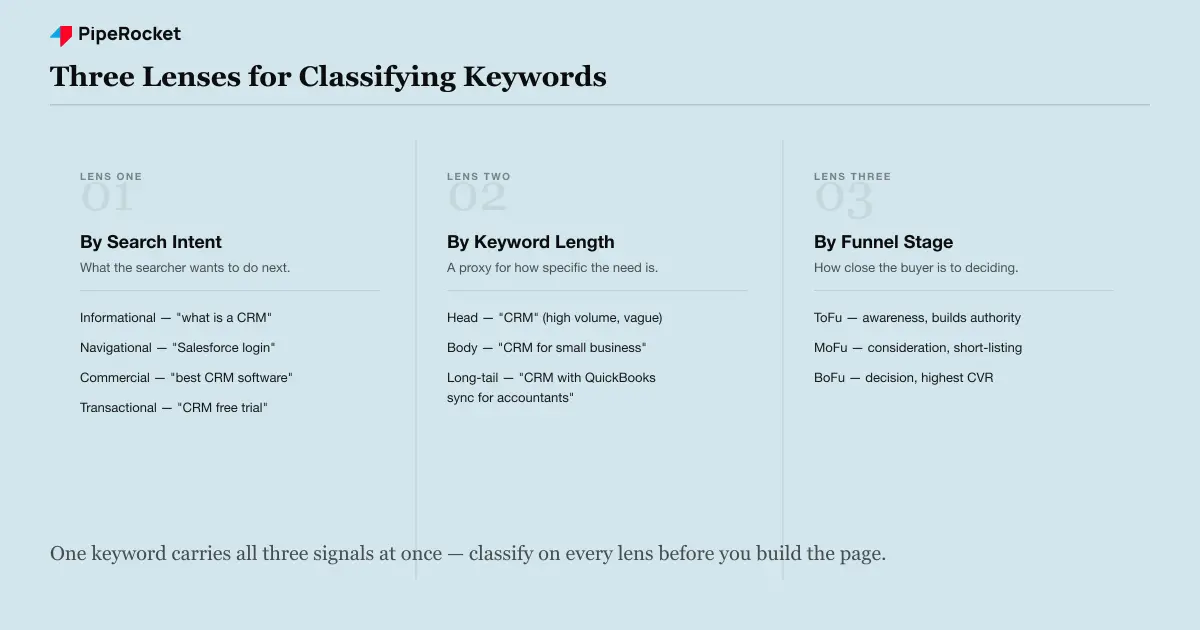
Most guides hand you a flat list: informational, navigational, commercial, transactional. That list is correct and almost useless on its own, because it only sorts by one dimension. The same keyword carries a length signal and a funnel-stage signal at the same time, and those change what you build.
Classifying keywords by volume is the default move, and it’s backwards. Tools sort by search volume because that’s the number they can measure. But volume tells you how many people search, not whether any of them will ever pay you.
In SaaS, those are wildly different questions: our own data shows organic search converts visitors at 0.92%, more than 3x the 0.26% we see from AI-driven traffic.
I learned to do keyword research by starting with people, not tools . Tools are for validation, not discovery.
Lean 100% on Ahrefs or Semrush and you only ever see the keywords your competitors already found. The richest keyword types surface from talking to Sales and Customer Success, because real buyers don’t search like SEO pros.
The Searcher Decides the Type, Not the Word
A keyword has no fixed type until you know who’s typing it. “Slack” is a navigational keyword for someone who already uses it and wants the login page. The same word is commercial for someone weighing it against Microsoft Teams, and it’s nearly transactional for someone searching “Slack enterprise pricing.”
This matters because you can’t classify a spreadsheet of keywords mechanically. You classify by reading the query the way the searcher meant it, and sometimes by checking what Google already ranks, since the SERP is Google’s own verdict on the dominant intent behind that word.
The practical move: when a keyword feels ambiguous, search it. If the top 10 results are all blog posts explaining a concept, it’s informational, and a product page won’t rank there however much you want it to.
The Four Types by Search Intent
Every query falls into one of four intent buckets: informational, navigational, commercial, or transactional. Intent is the most important lens because each bucket maps to a different kind of page and a different stage of the SaaS buying decision.
1. Informational: the searcher wants to learn something. “What is single sign-on,” “how does SOC 2 work,” “employee onboarding best practices.” They’re not buying today. The right page is a guide or explainer, and the goal is trust and topical authority , not a hard demo pitch.
2. Navigational: the searcher wants a specific page or brand. “Zendesk login,” “Notion pricing page,” “Asana help center.” They already know where they’re going. You mostly capture these for your own brand, defending your name so the right page shows up first.
3. Commercial: the searcher is comparing options before they buy. “Best project management software,” “Zendesk vs Freshdesk,” “Calendly alternatives.” This is where most B2B SaaS pipeline lives, and the right page is a comparison, alternative, or category listicle.
4. Transactional: the searcher is ready to act. “Buy [tool] subscription,” “[tool] free trial,” “schedule [tool] demo.” The right page is a product or pricing page with a single clear CTA, because friction here costs you a closeable deal.
The trade-off worth naming: informational keywords give you reach and authority, but they convert at a fraction of a percent, so building your whole program on them gets you traffic and no demos. Commercial and transactional keywords convert far better but are limited in number, which is exactly why you need the next lens.
The Three Types by Keyword Length
The three length types are head terms, mid-tail (body) keywords, and long-tail keywords, running broad to specific. Length is really a proxy for specificity, and specificity is a proxy for intent: the longer and more specific the query, the closer the searcher usually is to knowing exactly what they need.
1. Head Terms Get the Searches and Almost None of the Buyers
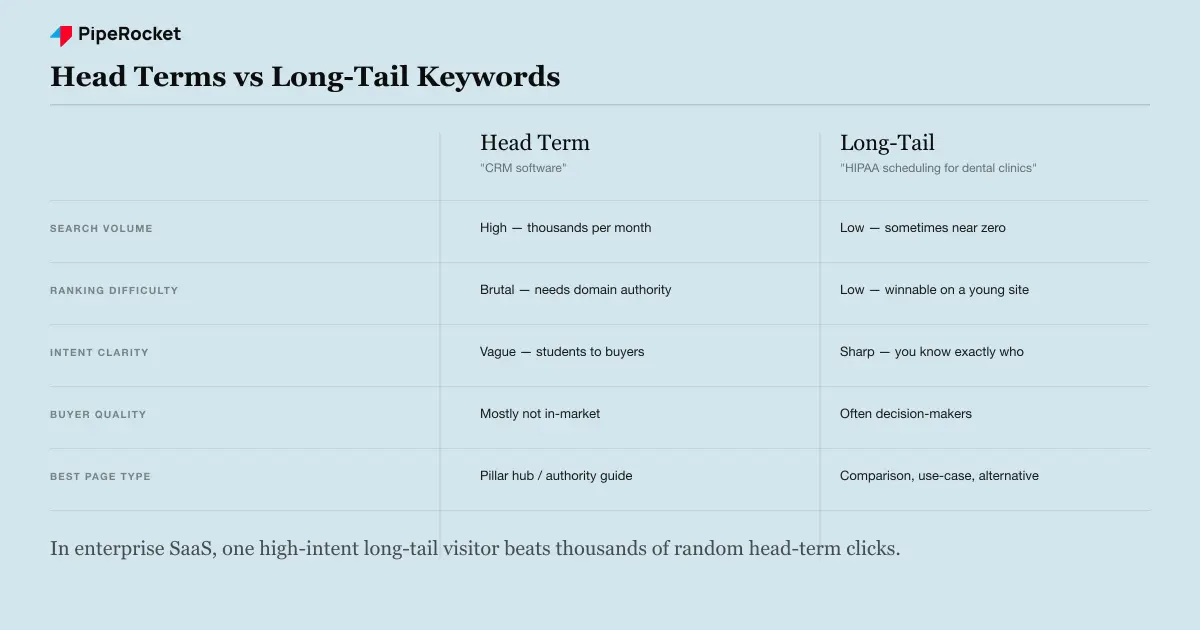
A head term is the broad, one-or-two-word query: “CRM,” “project management,” “cybersecurity software.” Huge volume, brutal difficulty, and intent so vague you can’t tell a student from a buyer. Everyone wants to rank for them, which is why almost no one new can.
The volume trap is real. A 1,000-search head term, even ranking top three, might bring ~100 clicks; at a typical SaaS conversion rate of 2 to 4%, that’s four or five conversions.
Run that math before you commit a quarter to chasing a head term, because high volume with wrong intent loses to low volume with buying intent every time.
Head terms still matter for brand authority and as the hub of a topic cluster. Just don’t expect them to carry pipeline on their own, and don’t let their search volume seduce you into building your strategy around them.
2. Mid-Tail (Body) Keywords Sit in the Middle
Mid-tail keywords, also called body keywords, are moderate-length, moderate-volume, moderate-intent queries: “CRM for small business,” “best CRM software.” They’re more specific than a head term but broader than a true long-tail phrase. Useful, but not where I’d start on a low-authority site, since head-term difficulty still bleeds into them.
3. Long-Tail Keywords Are Where SaaS Pipeline Actually Lives
A long-tail keyword is the specific, multi-word query: “HIPAA-compliant appointment scheduling for dental clinics,” “CRM that integrates with QuickBooks for accountants.” Lower volume, far lower difficulty, and intent so clear you know exactly who’s searching and why.
We grew a client from 3 sales opportunities to 15 in two quarters by shifting from high-volume terms to exactly these: implementation problems and operational bottlenecks. Most had near-zero search volume, but the searchers were decision-makers.
A page might get only 5 to 10 visitors a week, almost all highly qualified. In enterprise SaaS, one high-intent visitor is worth more than thousands of random clicks.
The lesson sits underneath the whole length lens: if traffic is growing but pipeline isn’t, what you usually have is an audience problem, and rarely a traffic problem.
The Three Types by Funnel Stage
Funnel stage maps keywords to where the buyer is in their decision, and it’s the lens that ties the other two together. A compliance SaaS for fintech teams sees the same person move through all three stages over months, and each stage needs its own keyword type and its own page.
1. ToFu (top of funnel): awareness. The buyer has a problem but doesn’t know the solution category yet. “How to reduce employee turnover,” “what is data observability.” These are mostly informational, mostly head and body terms, and they build authority rather than pipeline.
2. MoFu (middle of funnel): consideration. The buyer knows the category and is comparing approaches. “Best data observability tools,” “data observability vs monitoring.” These are commercial, often long-tail, and they’re where buyers start short-listing.
3. BoFu (bottom of funnel): decision. The buyer is choosing a vendor. “Monte Carlo vs Datadog,” “Datadog pricing,” “Datadog alternatives.” Commercial and transactional, almost always long-tail, and the highest-converting keywords you’ll ever target.
Most teams ignore a structural reality here: a single-product SaaS company has a maximum of roughly 40 to 60 BoFu pages , like software pages, alternatives, comparisons, and pricing. Try to force more and you’re stretching. That ceiling tells you how to balance your keyword portfolio, because BoFu is finite and ToFu is nearly infinite.
The cluster I build runs decision-first: What Is → How To → Tools → Alternatives → Pricing → Conversion, with the BoFu nodes built first and everything linking toward them.
Most teams build the opposite direction and wonder why their well-ranked ToFu content sends no demos. You can see the same staged logic applied to ads in how to run Google Ads for SaaS , where the funnel order changes which keywords you bid on first.
Keywords by Role in Your Content Strategy
A fourth lens sorts keywords by the job they do on a page: primary, secondary/LSI, branded, and geo-targeted. Intent, length, and funnel stage decide which keyword to target; role decides how you actually use it once you’re writing the page.
1. Primary keywords: the single main term a page is built to rank for, matched to the title, H1, and URL. One page targets one primary keyword, like “seo keywords for saas” on a SaaS keyword-strategy page. Everything else on the page supports it.
2. Secondary / LSI keywords : the related terms and phrases that give a page semantic depth. Despite the name, “LSI keywords” aren’t a real Google ranking factor; they’re simply the related and semantic terms (“customer relationship management,” “sales pipeline,” “contact management” around a CRM page) that naturally show up when you cover a topic fully. Using them helps you rank for dozens of variations of the main query, not because Google rewards the terms themselves, but because they signal you’ve actually covered the subject.
3. Branded keywords: queries that include a company or product name, like “Salesforce pricing” or “Notion templates.” You defend your own branded keywords first, then target competitor branded terms through comparison and alternative pages where it’s fair to do so.
4. Geo-targeted keywords: queries with a location, like “CRM software for UK accountants” or “onboarding software Australia.” They matter for SaaS with region-specific compliance, pricing, or data-residency angles, and they narrow a broad term into a qualified, lower-competition one.
For SaaS specifically, the role lens is where on-page optimization happens: one primary term per page, secondary and LSI keywords to cover the topic fully, and branded or geo variants captured on the pages built for them.
Here is how the four lenses line up as a single taxonomy:
| Lens | Keyword types | What it tells you |
|---|---|---|
| Search intent | Informational, navigational, commercial, transactional | What the searcher wants to do next |
| Length | Short-tail (head), mid-tail (body), long-tail | How specific the query is, a proxy for buyer intent |
| Funnel stage | ToFu, MoFu, BoFu | Where the buyer is in the decision |
| Content role | Primary, secondary/LSI, branded, geo-targeted | The job the keyword does on the page |
How to Classify a Keyword List Without Losing Your Mind
The mistake is trying to apply all three lenses to 2,000 keywords in one pass. Don’t. Classify in a structured sheet, one column per dimension, then group, because a flat list of 2,000 keywords is noise, while 250 grouped topics is a strategy.
My keyword research master sheet has a column for each signal you’ve now met:
- Keyword: the query itself
- Search Volume: for context, never as the deciding factor
- Intent: informational / navigational / commercial / transactional
- Length type: head / body / long-tail
- Funnel stage: ToFu / MoFu / BoFu
- Role: primary / secondary-LSI / branded / geo-targeted, for on-page use
- Topic: the pillar this keyword groups under (the crucial column)
- Priority: P0 / P1 / P2 based on intent and fit rather than volume
The Topic column is what turns classification into a plan. “What is GRC,” “GRC components,” and “GRC examples” all map to one pillar page, not three thin articles, and grouping by topic tells you how many pages to actually build.
Done properly, this takes three to four days, but it maps your full addressable market and turns content from a random ask (“write 30 articles this quarter”) into a business case: the market is 250 articles, 60 BoFu, 70 MoFu, 200 ToFu. That’s the difference between a keyword list and a strategy.
Where Keyword Types Quietly Break SaaS Strategies
The most expensive mistakes come from misreading the keyword type and building the wrong page for it, and rarely from missing keywords. Three patterns show up again and again.
Chasing Head-Term Volume on a Low-Authority Domain
Chasing broad head terms before you have the authority to rank for them burns a quarter and returns nothing. You spend it on “project management software,” never crack page two, and the comparison keywords you could have owned go to a competitor. High difficulty plus vague intent is the worst combination in SEO.
Mismatching Page Type to Keyword Type
Building the wrong page format for a keyword’s real intent stalls conversions even when you rank. A comparison-page visitor (“Brand A vs Brand B”) is choosing between two viable options, while an alternative-page visitor (“Brand A alternatives”) is already frustrated and looking for an escape. Same category, but a different keyword type that needs a different page.
Building the Wrong Format for the Query
Ignoring the format a keyword’s intent demands wastes your best traffic. Build a hard-sell product page for an informational query and it won’t rank, because Google already decided that keyword wants a guide. A thin blog post for a transactional query wastes the highest-intent traffic you’ll ever get. The type tells you the format.
How PipeRocket Digital Uses Keyword Types
We don’t classify keywords to fill a spreadsheet. We classify them to tie every page to the actual sales pipeline . That means scoring keywords by intent and ICP fit, not volume, and building BoFu and MoFu pages first so the program returns pipeline early instead of just traffic.
If your keyword list is long but your demos are flat, that’s usually a classification problem we can fix. You can see how we approach it on our SaaS SEO service page, compare options among the best SaaS SEO agencies, or just talk to our team .
Frequently Asked Questions
What are the four types of keywords used in SEO?
The four types by intent are informational (learn, “what is a CRM”), navigational (find a brand, “Salesforce login”), commercial (compare before buying, “best CRM software”), and transactional (ready to act, “Salesforce free trial”). Most SaaS pipeline comes from commercial and transactional keywords, even though informational ones have the most volume.
What are three keywords?
The three keyword types by length are short-tail (head terms like “CRM”), mid-tail (body terms like “CRM for small business”), and long-tail (specific multi-word queries). They run broad to specific, high volume to low volume, and vague intent to clear buyer intent.
What’s the difference between short-tail and long-tail keywords?
Short-tail keywords (also called head terms) are broad one or two-word queries like “CRM,” with high search volume, very high difficulty, and vague intent that mixes students, researchers, and buyers. Long-tail keywords are specific multi-word queries like “CRM for accounting firms with QuickBooks integration,” with lower volume, lower difficulty, and intent so clear you know exactly who’s searching.
In B2B SaaS, long-tail keywords usually drive far more qualified pipeline because the searchers are closer to a buying decision, even though each one brings less traffic.
How do I know which type of keyword to target for my SaaS?
Start with intent and funnel stage, not volume. If you’re on a low-authority domain, prioritize commercial and transactional long-tail keywords at the bottom of the funnel (comparison, alternative, and pricing queries), because they convert highest and are easier to rank.
Use informational top-of-funnel keywords to build topical authority once your BoFu pages have traction. The fastest check for any single keyword is to search it: whatever format Google already ranks tells you the page type you need to build.