How to Rank a New SaaS Site With Low Domain Authority
 Sabari Rohith
Last updated on
Sabari Rohith
Last updated on
Your site is live. You’ve published a few blog posts. You open Google Search Console and it’s blank. Zero clicks, zero impressions, nothing. The natural reaction is to blame the domain authority. “We’re too new. We need more links. We need to wait.”
That’s the wrong diagnosis. Low domain authority is a constraint, not the cause. Most new SaaS sites don’t rank because they’re targeting keywords established domains already own. What fixes it is competing in a bracket your site can actually win right now, with a plan that builds authority as a by-product of the work.
Here’s what that plan looks like.
TL;DR
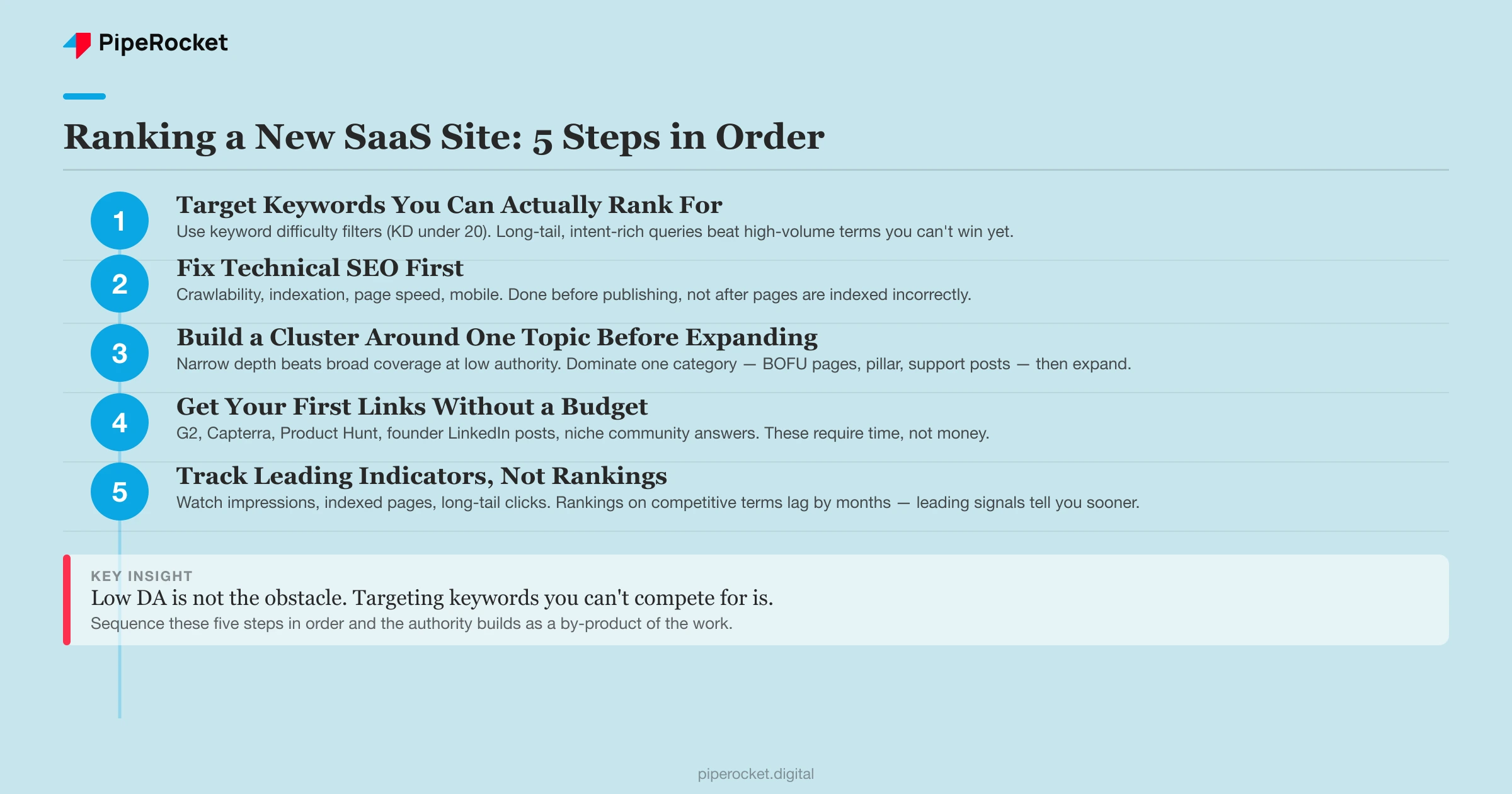
- Step 1: Target rankable keywords: Use keyword difficulty filters to find low-competition, high-intent queries your site can compete for today.
- Step 2: Fix technical SEO first: Crawlability, indexation, speed, and mobile need to be clean before content goes live.
- Step 3: Build a tight cluster: Dominate one narrow topic with 6 to 8 connected posts before touching anything adjacent.
- Step 4: Earn your first links: Product directories, founder LinkedIn, niche community answers. No budget required.
- Step 5: Track leading indicators: Impressions and long-tail clicks tell you whether it’s working months before rankings on competitive terms do.
Step 1: Target Keywords You Can Actually Rank For
The single biggest mistake we see on new SaaS sites is aiming at the wrong targets. A team launches, runs a keyword research session, and picks the highest-volume terms in their category: “HR software,” “payroll automation,” “compliance management.” Then wonders why nothing moves six months later.
Here’s the math. Take a keyword with 1,000 monthly searches. Even ranking in the top three, you might pull around 100 clicks. Industry estimates put typical SaaS conversion rates at 2–4%, which means four or five actual conversions from that traffic. That’s not nothing.
But it requires your page to outrank domain-authority-60 competitors who’ve been building content in that category for years. A new site at DA 10 is not going to do that.
The fix is to stop competing in the wrong bracket entirely.
How to Find Keywords You Can Actually Win
Open Ahrefs or Semrush and filter for keyword difficulty under 20. You’re looking for:
- Long-tail, specific, intent-rich queries (“compliance automation for fintech startups” not “compliance software”)
- Use-case variations with a vertical (“HR software for construction companies”)
- Integration keywords (“project management tool that integrates with Slack”)
- People Also Ask questions, which often have no DA-gated competitors in the top results
For each keyword, check who ranks on page one. If every result is from a DA 50-plus domain, skip it for now. Come back in 12 months when you’ve built authority in the niche.
What “Rankable” Actually Looks Like
A rankable keyword for a new site has three things: specific intent, low competition, and a genuine connection to what your product solves. Those aren’t consolation-prize keywords. They’re where your first conversions come from, because the people searching them already know what they want.
The volume trap is real. Ranking top three for a niche query with 200 monthly searches can produce more qualified pipeline than sitting on page four for a 5,000-search term. Don’t let low volume talk you out of a keyword that the right buyer is actually searching.
Step 2: Fix Technical SEO Before You Publish Content
A technically broken site wastes every other effort. You can write perfect content and earn links from quality sites, and if Google can’t crawl or index your pages properly, none of it lands.
For a new SaaS site, the technical checklist is short. You don’t need log file analysis or JavaScript rendering audits at this stage. You need four things working:
- Crawlability: is your robots.txt blocking anything it shouldn’t? Is the sitemap submitted in Google Search Console?
- Indexability: check the “Pages” report in Search Console for “Crawled but not indexed” and “Discovered but not indexed.” If those numbers are climbing early, you have a quality or crawl-budget issue to address.
- Page speed : core web vitals don’t need to be perfect, but they can’t be broken. A page that takes eight seconds to load on mobile is losing rankings it could otherwise hold.
- Mobile usability: SaaS buyers research on mobile more than most teams assume. Fix any mobile usability errors flagged in Search Console before they compound.
One warning worth flagging: if you’re launching with a staging site that was indexed before the real domain, the wrong version of your pages can end up indexed. That takes weeks to reverse. Check canonical tags and make sure Search Console is pointing at the right property from day one.
Step 3: Build a Cluster Around One Topic Before You Expand
Here’s the pattern we see constantly with new SaaS sites. A team publishes 40 blog posts across 15 different topics in the first year and wonders why nothing ranks. Google looks at the site and sees a thin, scattered presence: a little bit of content on everything and deep expertise in nothing.
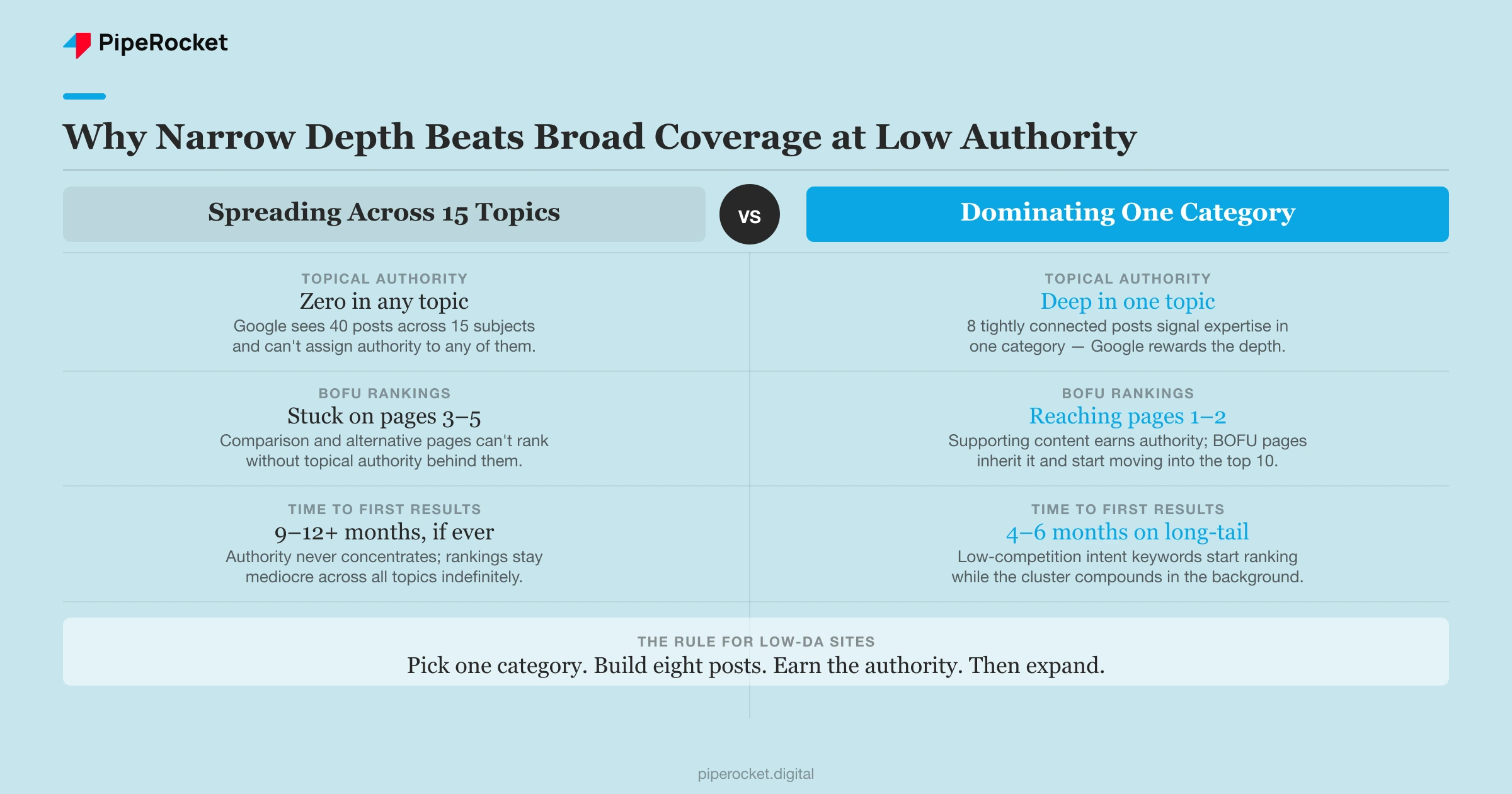
Topical authority doesn’t work that way. Google’s understanding of a site’s expertise is built through connected, deep coverage of a specific domain. A site with 8 tightly connected posts on one narrow topic signals expertise in that category far faster than 40 posts spread across 15.
The mechanism matters. BOFU pages (your comparison pages , alternative pages, pricing pages) are the ones that actually convert. But they don’t rank in isolation. BOFU pages without topical authority behind them sit on page three regardless of how good the content is.
And TOFU content without BOFU pages to convert the traffic gets you sessions, not pipeline. The only approach that works for a low-authority site is what we’d call authority-led BOFU: pick one narrow category, build the supporting content that earns topical credibility, then let the BOFU pages inherit it.
| Approach | What happens |
|---|---|
| TOFU-first | Traffic grows but BOFU pages lack authority to rank, so conversions stay flat |
| BOFU-first | Decision-stage pages rank first, TOFU content builds authority underneath them |
Pick One Category. Just One.
If you’re a compliance SaaS for fintech teams, don’t try to rank for compliance, fintech, GRC, and risk management all at once. Pick the most specific version of what you do (“fintech compliance automation”) and own that before you touch anything adjacent.
The cluster for that category might look like this:
- One pillar page: “Fintech Compliance Automation: What It Is and How It Works”
- Two BOFU pages: “[Competitor] vs [Your Product]” and “Best Fintech Compliance Software”
- Two use-case pages: one for payments, one for lending
- Two or three supporting posts addressing the ICP ’s real pain points (“How to Prepare for a SOC 2 Audit as a Fintech Startup”)
Every page links to every other page in the cluster. Internal links are free and they work from day one. Use them intentionally.
What Goes Into a Cluster That Ranks
Build BOFU first. Most teams start with awareness content because it gets more traffic and is easier to pitch to leadership. But if you’re optimising for pipeline and you have limited publishing capacity, decision-stage pages (alternatives, comparisons, pricing) convert better and signal to Google what category you’re competing in.
Build those first, then fill in the supporting content around them.
Once the cluster is live, hold the line. Don’t expand to a new topic until the first cluster shows real traction: impressions climbing, a few long-tail pages hitting page two or three. That’s the signal that topical authority is starting to accumulate.
Step 4: Get Your First Links Without a Budget
A new SaaS site at zero links isn’t helpless. Three channels reliably produce quality first links without a content-marketing budget or an agency-run outreach programme.
Product Directories
G2, Capterra, Product Hunt, Crunchbase, and the relevant directory in your vertical. Every one of these is a link and a trust signal. They’re also where your early buyers go to research, so you want to be there regardless of the SEO benefit. Set up complete profiles, collect a few reviews. These directories have real domain authority and the links carry weight.
Founder LinkedIn Posts
A founder explaining a real problem they solved for a customer (with the product URL in the post) gets shared, saved, and often picks up nofollow brand mentions across blogs and newsletters. Nofollow links still build entity recognition.
And if the post picks up traction, someone writes about it and links to the site properly. This isn’t a scalable link-building strategy, but it works well in the first three to six months while you’re building the content cluster.
Niche Community Contributions
One detailed, genuinely useful answer on a relevant Reddit thread or Slack community (with your site linked where relevant) earns a link and qualified referral traffic. The key word is “genuinely useful.”
A low-effort plug reads as spam and gets removed. A 300-word answer to a specific technical question that happens to mention the product at the end reads as helpful and stays.
What to avoid early on: guest posting farms, reciprocal link exchanges, and high-volume DR-10 links from generic directories. In bulk, these dilute your link profile and can make it harder to earn trust from quality sites later. Build slowly with links that make contextual sense.
Step 5: Track Leading Indicators, Not Rankings
A new SaaS site won’t rank on page one for anything competitive in the first 90 days. Checking keyword rankings daily in that window is a morale killer and it doesn’t tell you whether the work is paying off. The right question is whether the right signals are moving.
Here’s what to watch instead:
| Metric | What it tells you |
|---|---|
| Impressions in Google Search Console | Google is finding and indexing your content and starting to match it to queries. This is the first real signal, even before clicks arrive |
| Indexed pages | Should grow cleanly as you publish; if you publish 10 pages and only six are indexed, there’s a crawl or quality issue to diagnose |
| Long-tail clicks | Your first organic clicks will almost always come from long-tail queries, not the primary keyword. That is evidence the cluster is working |
| Clicks on BOFU pages | When comparison and alternative pages start picking up any clicks, that’s a real signal; a few BOFU clicks are worth more than hundreds on an informational post |
The compounding effect is real, but it arrives late. The curve is flat for the first three to four months and then turns sharply. Most teams quit just before the inflection point.
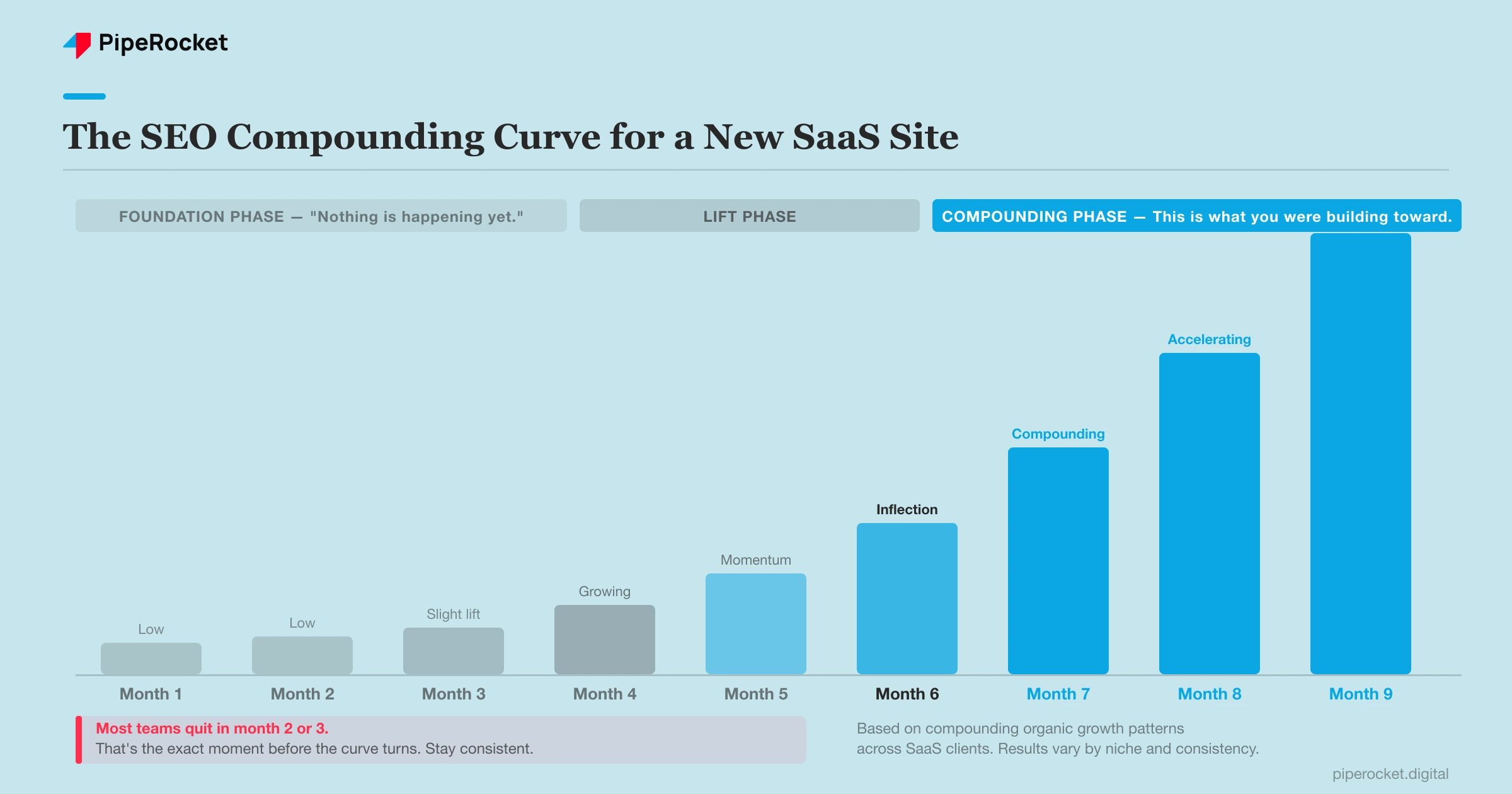
The teams that stay in it are watching leading indicators, not rankings. They can see impressions climbing in months two and three and they know the work is landing. The teams that quit are staring at a rank tracker showing page eight and concluding the strategy isn’t working.
The teams that make it through are the ones who can see real progress in their leading indicators before rankings move, and use that signal to stay consistent.
The Biggest Mistake New SaaS Sites Make
If there’s one pattern that reliably kills early-stage SaaS SEO , it’s trying to do everything at once. Technical fixes, content, link building, social, PR: all running simultaneously, all at low intensity, all producing thin results.
The sites that break through make a different choice. They pick one category, build it deeply, and expand from a position of strength. They’re not spreading effort across 10 bets. They’re concentrating it on one and refusing to dilute it until that one is working.
Tip: Before any of this starts, there’s a more fundamental question. Without product-market fit and a clear picture of who your buyer is, SEO just scales your confusion faster. If you’re not sure who you’re selling to, every keyword decision is a guess and every piece of content lands slightly off. Get clarity on the ICP first. Then the keyword targeting makes sense, the cluster writes itself, and the authority builds in the right direction.
Low domain authority is a starting point you can move from. Targeting the wrong category is a compounding error that takes years to undo.
How PipeRocket Digital Helps New SaaS Sites Rank
We build the sequenced plan for early-stage SaaS sites: keyword targeting, technical foundation, and cluster architecture calibrated for sites that can’t yet play the generic SEO playbook. If you’re starting from zero, get in touch or see how we work on our SaaS SEO agency page .
Frequently Asked Questions
How long does it take for a new SaaS website to rank on Google?
For low-competition, long-tail keywords, a new SaaS site can start seeing rankings in four to six months with consistent content and a tight cluster structure. For competitive, high-volume keywords in established categories, realistically expect 12 to 18 months, and only after you’ve built genuine topical authority in the niche first.
The compounding effect is real. It just arrives later than most teams expect, which is why the leading indicators matter so much in the early months.
Can a new website rank without backlinks?
For very specific, low-competition queries, yes. A new site with strong on-page optimisation and clear topical focus can rank without external links, especially on People Also Ask queries and long-tail phrases with low domain-authority competition.
But for anything in a contested category, you’ll need at least a handful of quality links from relevant sources. Start with product directories like G2 and Capterra, then layer in genuine community contributions and founder content. You don’t need a formal link-building programme in the first six months, but you do need links from real, contextually relevant sources.
What is a good domain authority for a new SaaS site?
A brand-new site will typically sit at DR 1–10 for the first three to six months regardless of content quality. A DR of 20–30 after 12 months of consistent publishing and link earning is a solid benchmark for a SaaS site in a competitive space.
The more important number isn’t the DA itself. It’s whether the specific pages you’re trying to rank are competing against pages with similar authority. A DR 15 site can absolutely rank on page one if the competition for that specific keyword is also sitting at DR 15 to 25.