
What Is GEO (Generative Engine Optimization)? A SaaS Guide
 Ranjeeth Kumar
Last updated on
Ranjeeth Kumar
Last updated on
GEO (generative engine optimization ) is the practice of making your brand and content more likely to be cited and recommended inside AI-generated answers from engines like ChatGPT, Perplexity, and Google’s AI Overviews. Where SEO earns you a ranking, GEO earns you a mention in the answer itself.
TL;DR
- GEO is about getting your brand cited inside AI-generated answers, while SEO is about ranking your pages in a list of links.
- AI engines pull from sources they can parse and trust, so clear structure and third-party mentions matter more than keyword placement.
- GEO and SEO share most of the same foundation, and good GEO work almost always starts with good SEO work.
- AI-referred traffic is still a small slice of SaaS visits, so GEO should complement organic search, never replace it.
- The brands that win GEO are the ones already named in listicles, reviews, and comparisons across the web.
What Is GEO (Generative Engine Optimization)?
GEO is the discipline of shaping your content and your brand’s footprint so generative AI engines pick you when they assemble an answer. When someone asks ChatGPT “what’s the best CRM for a 10-person sales team,” GEO is the work that decides whether your product gets named.
Here’s where most teams get it wrong. They treat GEO as a brand-new channel with brand-new rules, something to spin up alongside SEO. In practice, the engines lean heavily on the same signals search always has. GEO is less a new discipline and more SEO with a different scoreboard.
- Citations over rankings: The unit of success is being named or linked inside the answer, since there’s no position two in a single paragraph.
- Engines, plural: ChatGPT, Perplexity, Gemini, Claude, and AI Overviews each retrieve and cite differently, so visibility varies engine to engine.
- Third-party proof: Engines cross-reference what others say about you, so reviews, listicles, and comparison posts feed your citability.
- Parseable content: Clear headings, direct definitions, and structured data make your pages easy for an LLM to lift and quote.
- Brand entity strength: The more consistently the web describes who you are and what you do, the more confidently an engine recommends you.
Consider a contract management SaaS for legal teams. Its product pages rank fine, but it appears in zero “best contract management software” listicles. When an engine assembles a recommendation, it has nothing external to corroborate the brand, so it names competitors instead. That gap is a GEO problem.
The practical takeaway: your own site is only half of GEO. The other half lives on pages you don’t control.
How Is GEO Different From SEO and AEO?
GEO targets AI-generated answers, SEO targets ranked lists of links, and AEO (answer engine optimization) targets direct-answer surfaces like featured snippets. The three overlap heavily, and the industry hasn’t fully settled the labels, but the core distinction is what surface you’re optimising for.
| SEO | AEO | GEO | |
|---|---|---|---|
| Target surface | Ranked organic results | Snippets, People Also Ask , voice answers | AI-generated answers and chat responses |
| Unit of success | Position on the page | Owning the answer box | Being cited or recommended in the answer |
| Core lever | Relevance, links, technical health | Direct, extractable answer formatting | Brand mentions, structure, source trust |
| Click behaviour | User clicks a result | Often zero-click | Often zero-click, sometimes a citation click |
My honest take after watching teams chase all three: don’t build three separate strategies. The page that ranks in Google is usually the same page Perplexity cites. It answers the question in the first two sentences and sits on a trusted domain with clean structure.
Where GEO genuinely diverges is the off-site layer. SEO treats a third-party listicle as a nice backlink . GEO treats it as core infrastructure, because engines synthesise recommendations from exactly those pages. That shift in weighting is the real difference, and it changes where you spend effort.
Also read: the best GEO agencies for SaaS and B2B teams
How Do AI Engines Pick Which Brands to Cite?
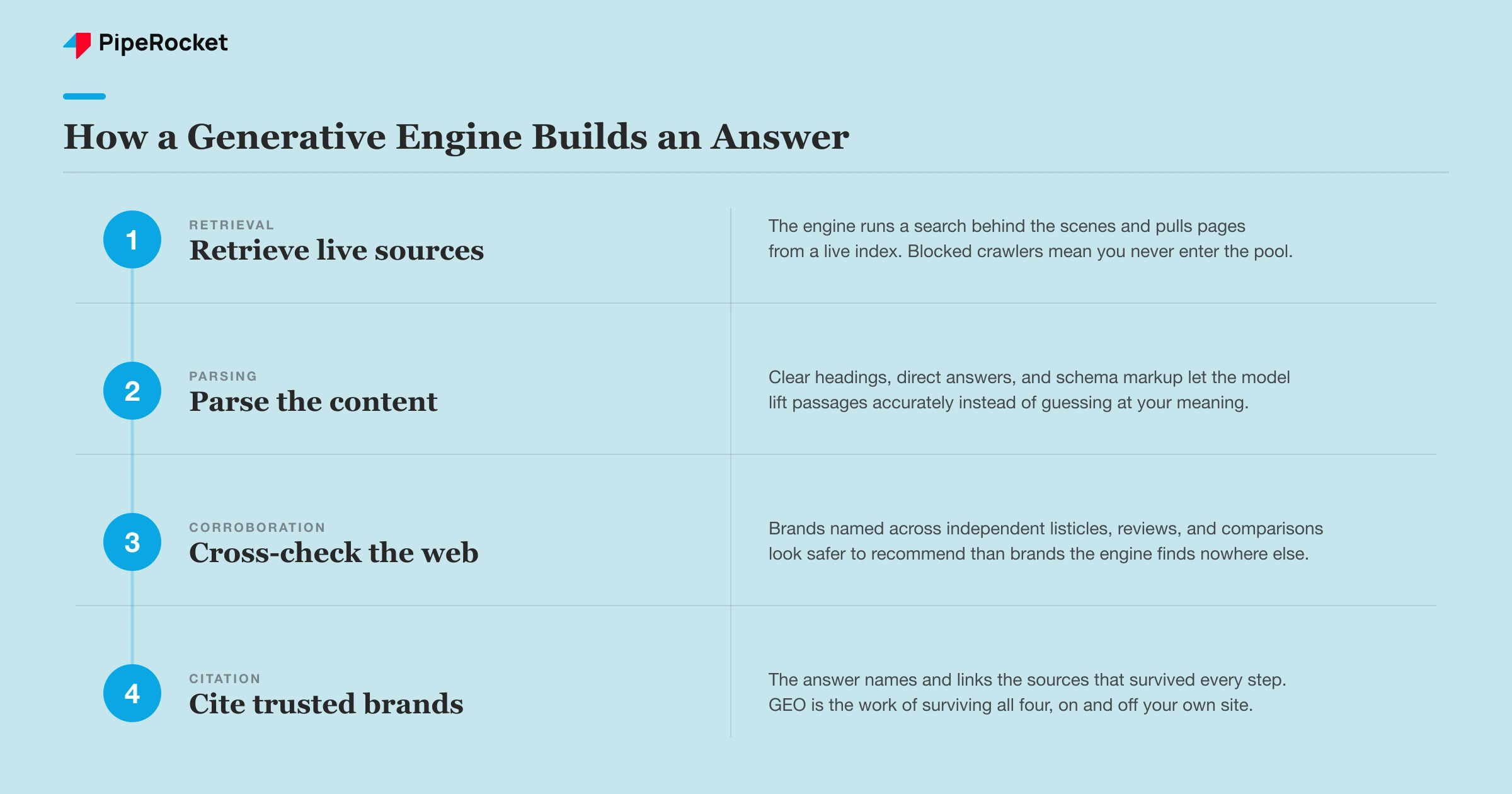
Engines cite sources they can retrieve and parse, then corroborate against the rest of the web. Most engines run a retrieval step before answering, pulling live pages from a search index and grounding the response in them. Surface in that retrieval and read cleanly, and you’re a citation candidate.
So, what makes one candidate beat another? A few patterns show up consistently:
- Direct answers up front: Pages that define or answer in the opening lines get quoted, since the engine can lift the passage without reconstruction.
- Consensus across sources: A brand named in five independent comparison posts looks safer to recommend than one named in zero.
- Recognisable structure: Proper heading hierarchy, tables, and schema markup help the engine map your page accurately.
- Source-level trust: Established domains with real topical depth get retrieved more often, which is why topical authority carries straight into GEO.
- Crawl access: If your robots.txt blocks AI crawlers, some engines simply can’t use you, whatever the content quality.
Imagine a payroll SaaS for startups that publishes a genuinely thorough pricing comparison. The page answers the cost question in its first paragraph and uses a clean table. Perplexity starts citing it for payroll cost queries within weeks, while the brand’s prettier but vaguer homepage never appears.
Resist the urge to chase tricks here. Stuffing pages with “statistics” or fake quotes to game engines is the new keyword stuffing, and it ages just as badly. Being widely referenced and easy to quote is the durable play.
Fast Fact: Organic search drives 91.3% of SaaS traffic — AI-referred visits account for less than 9%.
Should SaaS Teams Invest in GEO Right Now?
Yes, but with proportion. GEO deserves a slice of your effort, not a rebuild of your strategy. The buzz around AI search has convinced some teams to gut their SEO program and go all-in on GEO. The traffic data doesn’t support that move, and we’d argue against it every time.
The case for starting now is positioning, since buyers increasingly ask engines for shortlists before they ever search. The case against over-rotating is volume. AI-referred visits remain a small fraction of what organic search sends, and they convert worse too.
Fast Fact: Organic search converts SaaS visitors at 0.92% — more than 3x the rate of AI-driven traffic at 0.26%.
There’s a real trade-off to weigh. Showing up in AI answers builds brand awareness even without a click, but it fails as a strategy when your buyers still research through traditional search and review sites. It’s worth prioritising if your buyers are early AI adopters, like developers or technical founders.
A heads up on measurement: GEO attribution is messy. A founder might see your product named by ChatGPT, then visit directly a week later. Your analytics calls that direct traffic. Track AI referrals across engines, but accept the picture stays fuzzy.
We’ve compiled the actual numbers on AI search behaviour, citation patterns, and traffic share if you want to pressure-test the investment case before committing budget.
Also read: 200+ AI SEO statistics for SaaS teams
How Do You Start Doing GEO Without Wrecking Your SEO?
Start by fixing the overlap, because around 80% of GEO work is SEO work you should be doing anyway. Strong organic foundations feed the retrieval systems engines depend on, so nothing about GEO asks you to abandon search.
The Starting Sequence
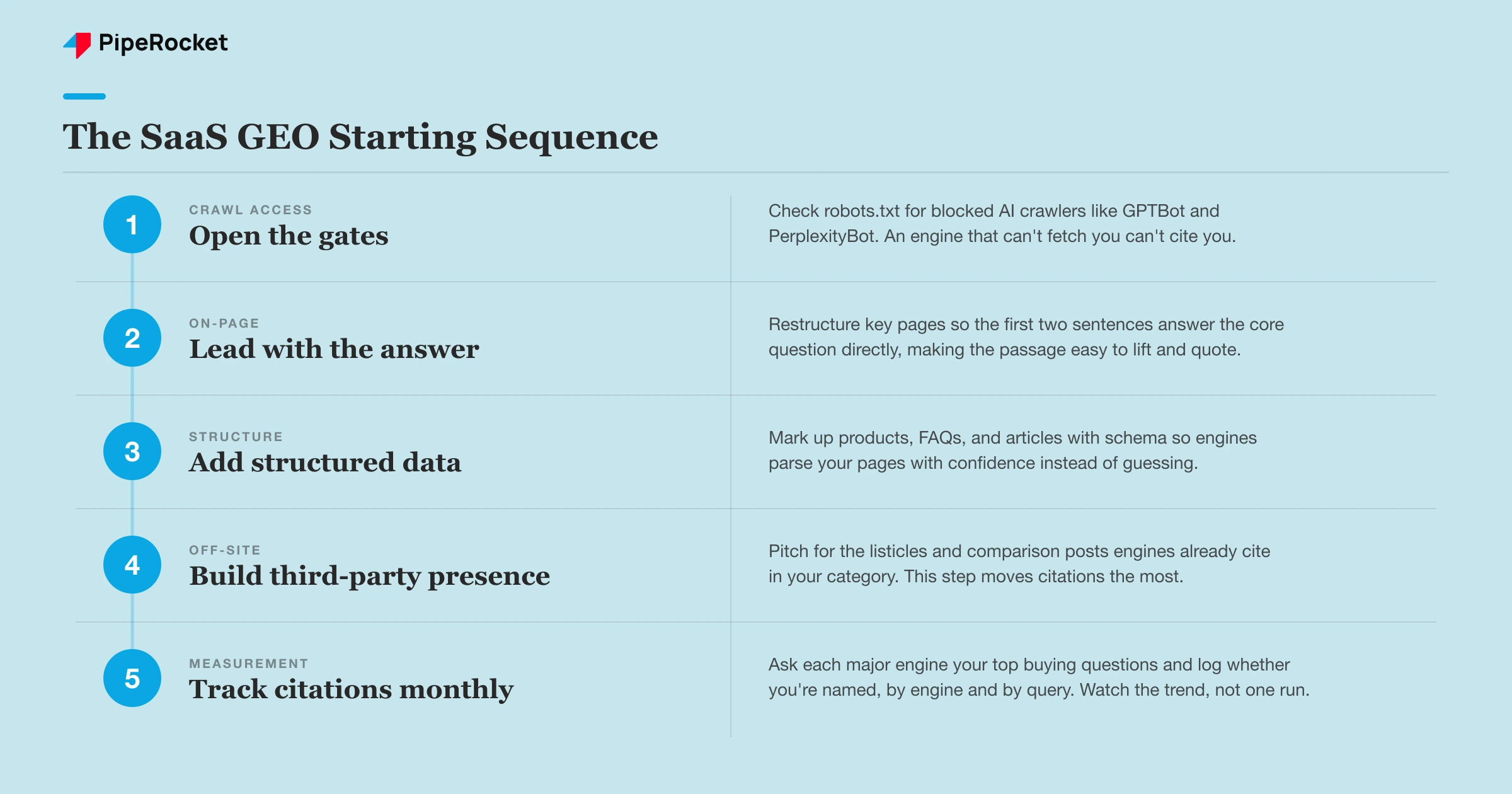
Run these in order, since each step feeds the next:
- Open crawl access: Check robots.txt for blocked AI crawlers (GPTBot, PerplexityBot , ClaudeBot), because blocked engines can’t cite you at all.
- Lead with the answer: Restructure key pages so the first two sentences directly answer the page’s core question, making passages liftable.
- Add structured data: Mark up products, FAQs, and articles with schema so engines parse your pages with confidence.
- Build third-party presence: Pitch for inclusion in the listicles and comparison posts engines actually cite in your category.
- Track citations monthly: Ask the major engines your category’s buying questions and log whether you’re named, by engine and by query.
The third-party step is the one most teams skip, and it’s the one that moves citations the most. Getting named in respected category roundups does more for AI visibility than another round of on-page tweaks. The best AI SEO agencies treat digital PR as the centre of GEO work.
One warning from experience: don’t create separate “AI-optimized” versions of existing pages. You’ll split your authority across duplicate URLs and confuse both Google and the engines. Improve the page you have. Our SaaS SEO services cover GEO as part of the same engagement.
Frequently Asked Questions
1. How do I measure whether GEO is working?
Run a monthly citation audit: ask ChatGPT, Perplexity, Gemini, and Google’s AI mode your category’s top 20 buying questions and record whether your brand appears, in what position, and with what sentiment. Pair that with AI referral traffic in your analytics, segmented by source. Expect noisy data, since answers vary between sessions and engines update constantly. A rising citation rate across two to three months is the signal that matters, not any single query result.
2. Will GEO replace SEO for SaaS companies?
Not on any timeline worth planning for. Organic search still drives the overwhelming majority of SaaS traffic and converts at several times the rate of AI-referred visits. The two also share most of their underlying work, so “replacing” SEO with GEO mostly means doing the same things while ignoring your biggest channel. The smarter frame is that GEO extends your search program to new surfaces. Teams that keep both running compound the same effort twice.
3. Does blocking AI crawlers protect my content or just hurt my visibility?
For most SaaS marketing sites, blocking hurts more than it protects. Your public marketing pages exist to be found and referenced, and blocking GPTBot or PerplexityBot removes you from answers your competitors will happily fill. Blocking can make sense for proprietary data, gated research, or paywalled content where being quoted destroys the value. Decide page by page rather than blocking site-wide, and revisit the decision as engines change how they credit sources.
The Bottom Line
GEO rewards the brands the web already talks about, so start with the off-site work. Pick your top 20 buying questions, check who the engines name today, and close the gap. Want it built for you? Get in touch , work with a GEO agency for SaaS , or see how the best SaaS SEO agencies do it.