GEO and AEO for SaaS: How to Win AI Search With One Playbook
 Vignesh Sampath
Last updated on
Vignesh Sampath
Last updated on
A buyer searched “SaaS SEO agency in USA” a few months back. Google didn’t hand them ten blue links. The AI answer named a short list of agencies, and ours was on it. The citation came straight from a Reddit thread, not our homepage. That’s the moment AI search stops being a theory you read about. AI engines now name brands and pull their reasons from wherever they trust, and the work that puts you on that list is the same work that wins Google’s AI Overview.
TL;DR
- GEO and AEO are one job in two outfits: GEO gets you cited inside ChatGPT and Perplexity, AEO gets you extracted into Google’s AI Overviews, but most of the work is shared.
- One playbook wins both surfaces: Four moves (extractable structure, off-site authority, entity clarity, and first-party data) feed LLM citations and AI Overviews at the same time.
- They only split in two places: Heavy schema skews toward AEO, off-site brand mentions skew toward GEO. Everything else overlaps.
- Measure it as a directional trend: AI-visibility tracking is directional in 2026, so pair it with pipeline and never report a precise number.
- Most wasted time comes from splitting it up: Running GEO and AEO as two projects, or bolting AI SEO onto your SEO instead of building on it, burns the most hours.
GEO and AEO Are the Same Job in Different Clothes
GEO and AEO point at two different surfaces, but they run on one engine. GEO is how you get named inside a generative answer. AEO is how you get pulled into Google’s answer box. Most teams now build two separate plans for them, and that’s where the waste starts.
Here’s the part that matters for your roadmap. The credibility signals that win one surface are the signals that win the other. Clear structure, answer-first writing, first-party data, and brand mentions across third-party sites show up in both. AI engines surface a category before they surface a brand, so well-structured, non-branded content is what gets pulled into the answer, no matter which engine is asking.
What people mean by GEO and AEO
GEO (generative engine optimization) is getting your SaaS cited or recommended inside generative engines like ChatGPT, Perplexity, Gemini, and Claude. The engine writes a synthesized answer, and you want your name inside it.
AEO (answer engine optimization) is getting your content lifted into Google’s AI Overviews, featured snippets, and voice results. The engine extracts an answer from a page, and you want it extracted from yours.
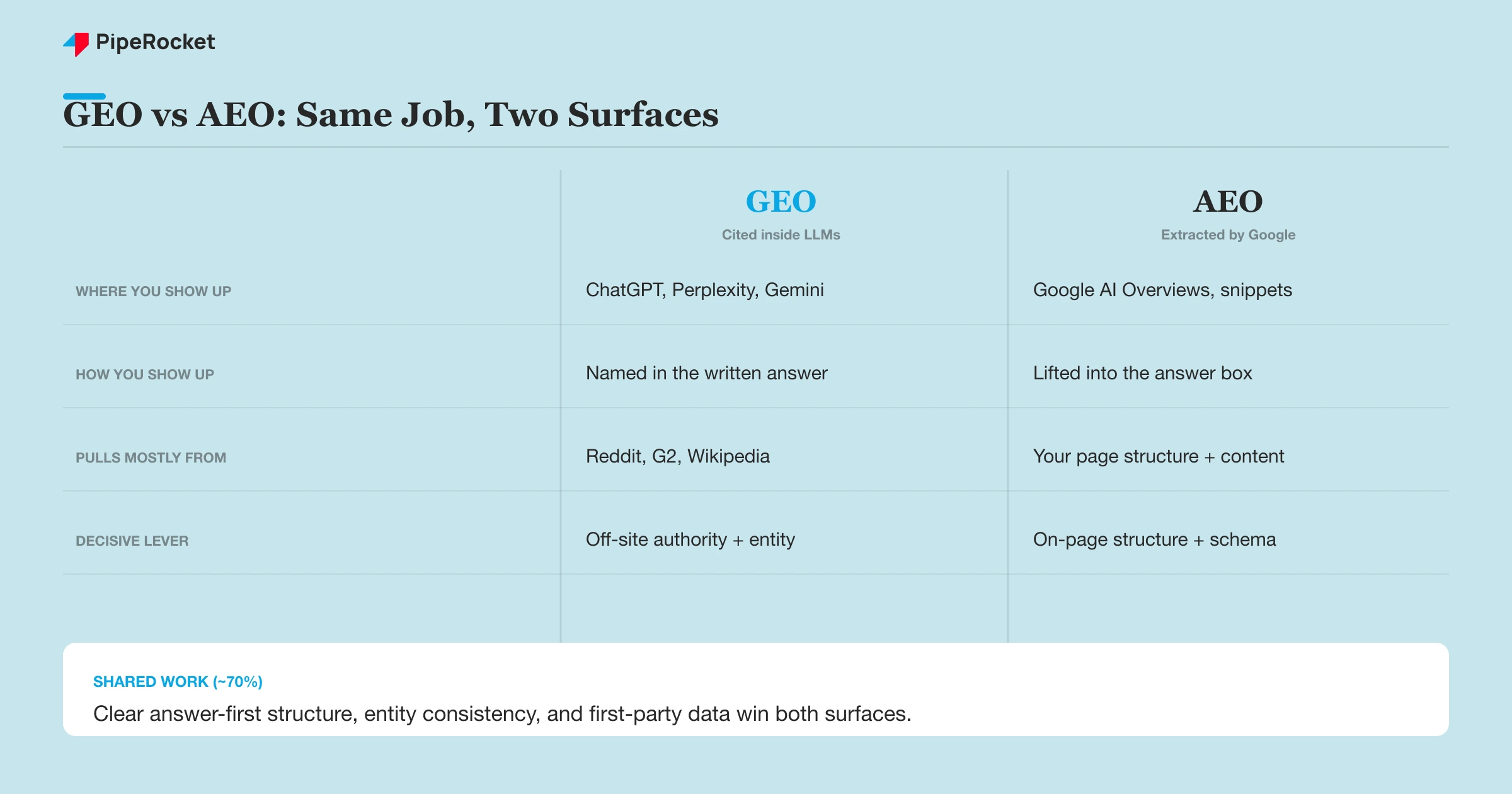
| GEO | AEO | |
|---|---|---|
| Where you show up | ChatGPT, Perplexity, Gemini, Claude | Google AI Overviews, featured snippets, voice |
| How you show up | Named in a synthesized answer | Extracted into the answer box |
| Pulls mostly from | Off-site sources it trusts (Reddit, G2, Wikipedia) | Your page’s structure and content |
| Decisive lever | Off-site authority + entity clarity | On-page structure + schema |
| Shared work | Credibility, clear structure, entity consistency, first-party data | The same four |
Why splitting them into two playbooks is a waste
Look at the overlap. When most of GEO and AEO is the same work, two separate roadmaps mean you do that shared work twice, fund it twice, and report it twice. You’ve split a budget that should compound.
AI didn’t change the fundamentals of this. It changed what gets rewarded. Rankings stopped being the finish line and traffic stopped being the full story, but the foundations (clear answers, real authority, a clean entity) still decide who gets surfaced. Treat GEO and AEO as one practice, AI SEO , and you build that foundation once.
The AI SEO Playbook: The Work That Wins Both Surfaces
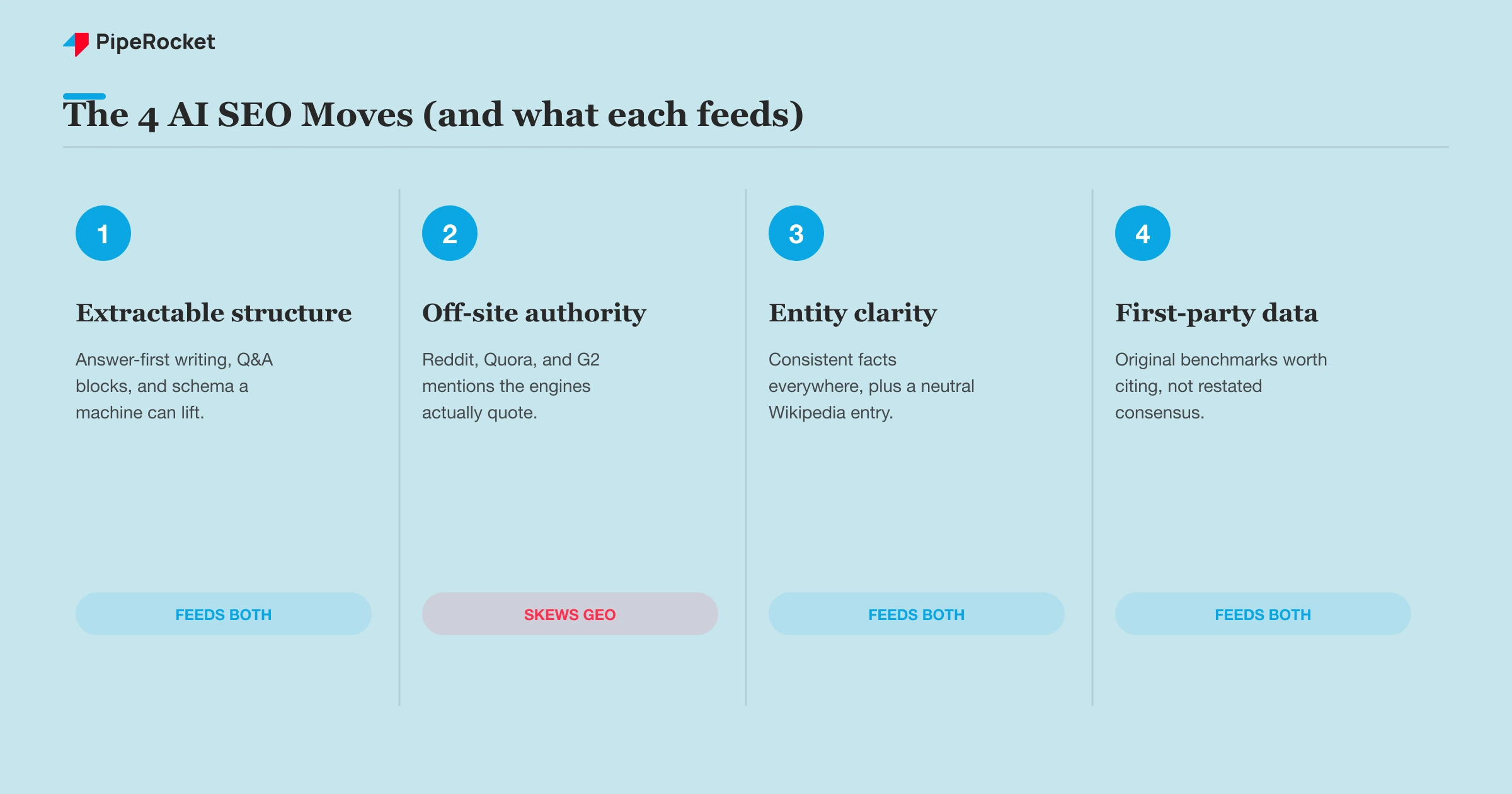
Four moves get you into AI answers, and each one feeds both surfaces at once. This is the whole job. You’re not running a GEO checklist and an AEO checklist side by side, you’re doing four things well and letting them pay off across every engine.
Structure every page so a machine can lift the answer
Answer the question in the first two sentences of any section, then support it. Google’s AI Overviews extract clean answer blocks, and LLMs quote text they can isolate cleanly, so a buried answer helps neither.
Give both engines something easy to grab:
- A direct one or two sentence answer at the top of each section
- Question-shaped headings that match how buyers actually ask
- Lists and tables for anything comparative
- FAQ, Article, and Product schema so machines read the structure as well as the words
This single habit is the most underrated move in AI SEO. It serves AEO extraction directly, and it hands LLMs the quotable chunks they pull into a synthesized answer.
Off-site authority is where citations get decided
You won’t get cited inside ChatGPT by polishing your own pages alone. The engines pull their reasons from the places they trust, and most of those places aren’t your website. Remember the agency that got named from a Reddit thread? The engine found it exactly where it always looks: third-party discussion, not the agency’s own site.
So show up there:
- Answer real founder questions on Reddit and Quora, with substance, not pitches
- Earn real reviews on G2 and Clutch with named client outcomes
- Get mentioned in comparison content the engine can quote
If you’re not present on Reddit, Quora, or G2, you’re invisible to the surface you’re chasing. On-site-only work can’t fix that. Our Reddit & Quora checklist for SEO and AEO is a free starting point for systematizing that presence instead of doing it ad hoc.
Lock your entity so both engines trust who you are
Make your name, category, and core facts consistent everywhere they appear. AI engines build a picture of who you are from across the web, and a messy entity (different descriptions, conflicting facts) makes you a risky thing to cite.
Getting a client cited by AI through Wikipedia
The strongest entity move we run is getting a client listed on Wikipedia, and not for the backlink . It’s for the credibility. In our experience, Wikipedia shows up constantly in AI citations for competitive B2B queries, so a neutral, fully-cited entry earns trust the engines respect.
I won’t pretend it’s easy. We failed three or four times before one stuck, because everything has to be neutral and fact-based with no promotional language. Done right, client pages started appearing in GPT and Perplexity citations within weeks.
Publish first-party data worth quoting
Original data is the cleanest way to get cited. AI engines reward content with something to say, and first-hand experience is quietly becoming a ranking signal, because the engines are looking for conviction, not another restatement of the consensus.
Picture a compliance SaaS for fintech teams. Instead of another generic explainer, they publish a benchmark drawn from their own customer base, structure it answer-first, and back it with a couple of honest Reddit answers and a real G2 profile.
That single body of work is exactly the kind that gets extracted into an AI Overview and named in Perplexity for “best compliance tool” queries. One effort, both surfaces.
The Two Places GEO and AEO Actually Diverge
There are exactly two points where the surface changes what you do. Everywhere else, the playbook above covers both. Knowing these two lets you tilt your effort when you’re short on time.
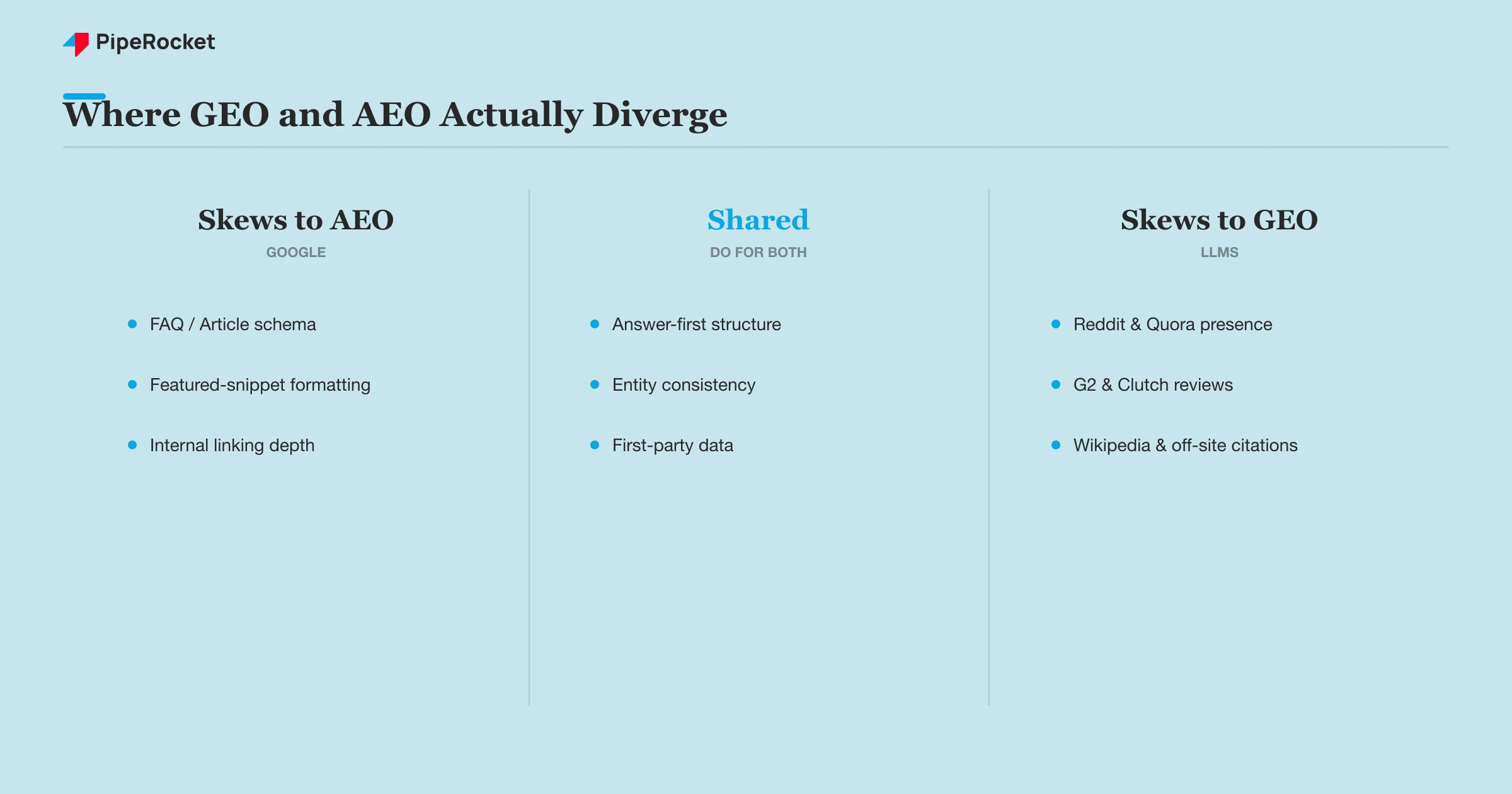
Heavy schema and snippet formatting skews toward AEO. Google reads structured data to build its answer box, while the LLMs lean less on it. Off-site brand mentions and citations skew toward GEO, because the generative engines pull from third-party sources far more than Google does for a featured snippet.
| Skews to AEO (Google) | Shared (do for both) | Skews to GEO (LLMs) |
|---|---|---|
| FAQ/Article schema | Answer-first structure | Reddit and Quora presence |
| Featured-snippet formatting | Entity consistency | G2 and Clutch reviews |
| Internal linking depth | First-party data | Wikipedia and off-site citations |
If you have to choose what to start with, choose by where your buyers actually ask their questions. A category your buyers research inside ChatGPT rewards the GEO tilt first. A category where they still Google “how to do X” rewards the AEO tilt.
How to Measure AI Visibility Without Fooling Yourself
AI-visibility tracking is directional in 2026, so treat every number as an estimate. The tools sample a handful of prompts, results swing between sessions, and nobody has a clean, repeatable read on share-of-answer yet.
The blunt truth, as our SEO lead puts it: “Most LLM SEO tracking tools right now? Pure guesswork.” That doesn’t mean skip measurement, it means hold the numbers loosely and watch the trend instead of the decimal.
What’s worth tracking now
Track whether you appear or get cited in AI answers for the queries that actually drive your pipeline. Split it into:
- Branded prompts (does the engine describe you correctly?)
- Non-branded, category prompts (does it name you for “best tool for X”?)
- Citation source (where is the engine pulling your mention from?)
That last one tells you which off-site work is paying off, which is more useful than any single visibility score.
Why the numbers are soft
The same prompt returns different answers across sessions, models update without notice, and most tools can’t see inside the engine’s retrieval. So a tracking dashboard gives you a direction, not a fact.
Warning: don’t put a precise AI-visibility percentage in a board deck. Report it as a range and a trend, pair it with organic-attributed pipeline, and you’ll keep your credibility when someone checks the number next quarter.
The AI SEO Mistakes That Waste the Most Time
The expensive errors all come from treating AI search as a new, separate thing instead of an extension of the SEO you already run. Three show up most often.
Running GEO and AEO as two separate projects
This is the costliest one, and it’s the whole reason for this article. Two roadmaps, two budgets, two reporting lines, for work that’s largely identical. You don’t get better results, you get duplicated effort and a split focus. Build one AI SEO program and let the shared work compound.
Chasing AI citations with zero off-site presence
Plenty of teams optimize their own pages obsessively, then wonder why ChatGPT never names them. The generative engines pull from Reddit, G2, and Wikipedia, so on-site-only work is invisible to the exact surface they’re chasing. If you want to be cited off-site, you have to exist off-site first.
Bolting AI SEO on instead of building it on your SEO
The credibility, structure, and authority that win AI search are the same foundations that win rankings. Teams that treat AI SEO as a separate bolt-on end up rebuilding what they already had. Start from your existing SEO, sharpen the structure and the off-site authority, and you’re most of the way there.
How PipeRocket Digital Does AI SEO for SaaS
We build AI search visibility into the SEO retainer rather than selling it as a separate line item. That means entity work, off-site citations on the platforms AI trusts, and answer-first structure on the pages that matter, all tied back to pipeline instead of a visibility score. If your SaaS isn’t getting named in AI answers, take a look at our AI SEO services , or just talk to our team and we’ll tell you straight where the gaps are.
Frequently Asked Questions
Is GEO the same as AEO?
Not technically, but in practice you treat them as one job. GEO (generative engine optimization ) is about getting cited inside generative engines like ChatGPT and Perplexity, while AEO (answer engine optimization) is about getting extracted into Google’s AI Overviews and featured snippets. They target different surfaces, but the underlying work (clear structure, off-site authority, entity consistency, first-party data) is mostly shared. So the smart move is to run one AI SEO playbook rather than two competing ones, whether you run it in-house or with an AI SEO consultant . For a deeper breakdown of each split, see our comparisons of GEO vs SEO and AEO vs GEO .
How do I get my SaaS mentioned in ChatGPT?
Show up in the sources ChatGPT trusts and pulls from. That means real, substantive answers on Reddit and Quora, genuine reviews on G2 and Clutch, a consistent entity across the web, and content with original data worth quoting. Generative engines name categories before brands, so well-structured, non-branded content that answers buying questions is what gets you surfaced. Polishing only your own pages won’t do it, because the engine looks off-site for who to cite.
Does AI SEO replace traditional SEO?
No, it builds on it. AI changed what gets rewarded, not the fundamentals, so the same credibility signals that win rankings (clear structure, real authority, a clean entity) are what win AI answers too. Teams that treat AI SEO as a separate discipline usually end up rebuilding the SEO foundation they already had. The better approach is to extend your existing SEO with off-site authority work and answer-first structure.