
What Is AEO (Answer Engine Optimization)? A SaaS Guide
 Omar Sheriff
Last updated on
Omar Sheriff
Last updated on
AEO (Answer Engine Optimization ) is the practice of structuring content so search engines and AI assistants can extract it as the direct answer to a question. Instead of competing for a click, you’re competing to be the passage an AI Overview , a featured snippet, or a chatbot pulls and shows.
TL;DR
- AEO means formatting content so answer engines can lift a specific passage from your page as the direct answer to a question.
- It’s different from GEO, which is about being cited or recommended inside AI-generated responses rather than being the extracted answer itself.
- Answer engines reward clear question-shaped headings followed by short, self-contained answers, not long winding explanations.
- For SaaS, AEO protects visibility on informational queries where users increasingly get answers without clicking anything.
- You measure it by tracking which questions your pages get extracted for, not by raw traffic alone.
What Is AEO (Answer Engine Optimization)?
AEO is optimization for the systems that answer questions directly: featured snippets, People Also Ask boxes, voice assistants, AI Overviews, and chat-based tools. The goal is for one of these engines to read your page, find a passage that answers the question cleanly, and show that passage to the user.
The mechanics are simple to state and hard to execute. Answer engines look for a question, then a tight answer right under it. If your page buries the answer in paragraph four of a 300-word intro, the engine picks someone else’s page.
- Extraction, not ranking: AEO targets the moment an engine pulls a passage from your page. You can rank #3 and still win the answer box.
- Question-shaped structure: Headings phrased as real questions, with the direct answer in the first sentence below, are what engines extract most reliably.
- Self-contained passages: Each answer should make sense on its own, because the engine shows it without the rest of your page.
- Entity clarity: Engines need to know exactly what your page is about. Consistent naming and schema markup remove the guesswork.
- Zero-click reality: Many answer placements never send a visitor. The win is visibility and brand recall, with the click as a bonus.
Consider a SaaS that sells expense management for mid-market finance teams. A buyer asks “what is expense report automation” in Google or ChatGPT. If that SaaS wrote a clean 40-word definition under that exact question heading, the engine can lift it. If not, a competitor gets the placement.
Here’s the contrarian bit: most teams treat AEO as a new discipline that replaces SEO . It doesn’t. It sits on top of it. A page with no authority behind it won’t get extracted no matter how clean the formatting is. The engines still pick answers from pages they already trust.
Fast Fact: Organic search drives 91.3% of SaaS traffic — AI-referred visits account for less than 9%.
Also read: the latest AI search statistics for SaaS
How Is AEO Different From GEO and Traditional SEO?
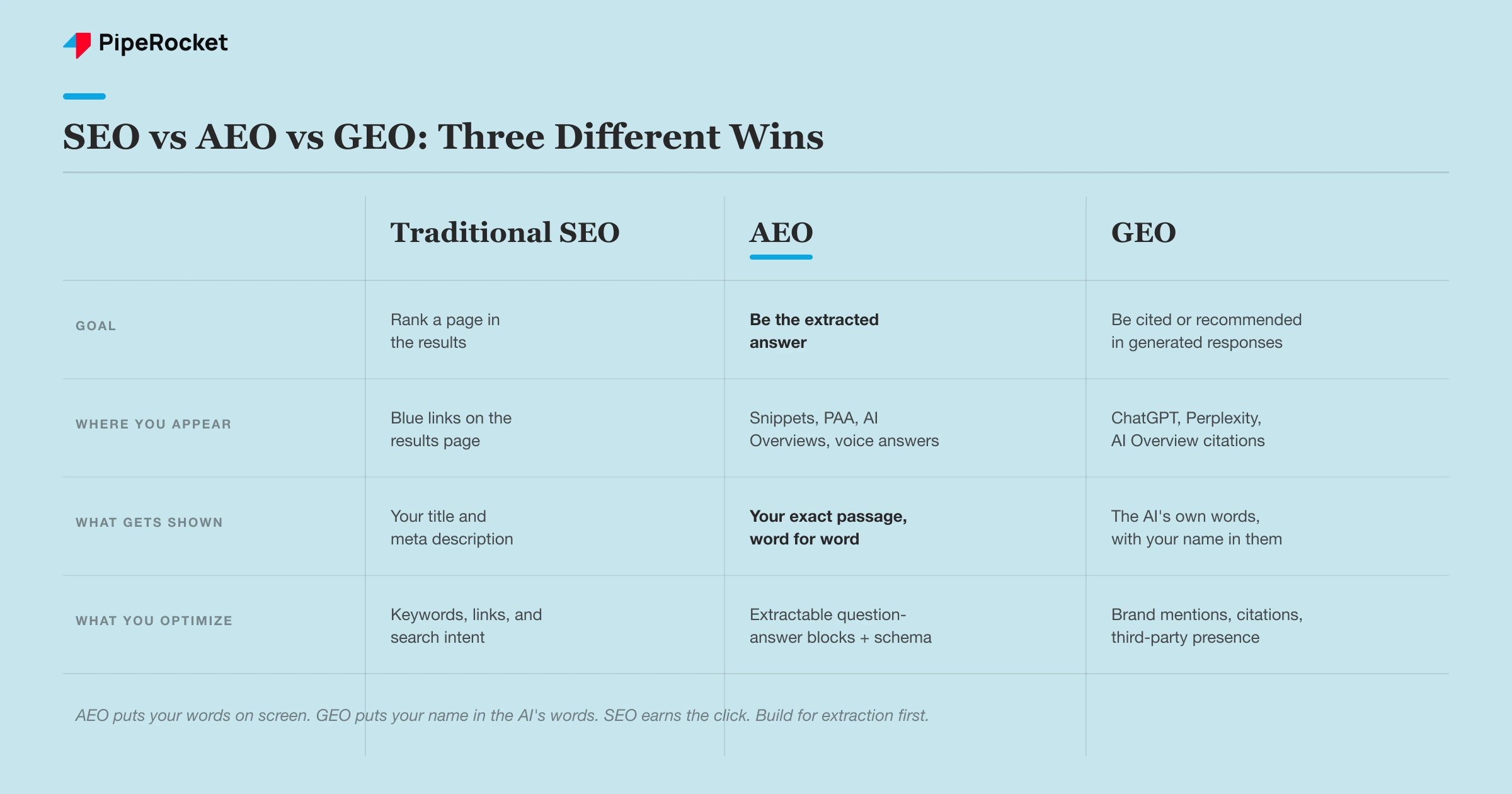
AEO is about being the extracted answer. GEO is about being cited or recommended inside a generated response. Traditional SEO is about earning the ranked blue link. Three different outcomes, and they need different work.
People mix up AEO and GEO constantly. When Google shows a snippet quoting your definition word for word, that’s AEO. When ChatGPT writes its own answer and recommends your product in it, that’s GEO. AEO is your words on screen. GEO is your name in someone else’s words.
| Traditional SEO | AEO | GEO | |
|---|---|---|---|
| Goal | Rank a page in results | Be the extracted answer | Be cited or recommended in generated responses |
| Where you appear | Blue links | Snippets, PAA, AI Overviews, voice answers | ChatGPT, Perplexity, AI Overview citations |
| What gets shown | Your title and meta description | Your exact passage | The AI’s words, with you mentioned |
| Optimize for | Keywords, links, intent | Extractable question-answer blocks | Brand mentions, citations, third-party presence |
The overlap is real, though. A well-structured page helps all three. The page that wins a featured snippet is often the same page an LLM retrieves and cites. So the smart move is to build pages that work for extraction first, because that structure also feeds generation.
My opinion: SaaS teams should do AEO before chasing GEO. AEO improvements live on pages you control and show results in weeks through snippet tracking. GEO depends partly on third-party mentions you don’t control, and it’s harder to attribute. Win the extractions first.
Also read: how to rank on ChatGPT
How Do Answer Engines Pick the Answer They Show?
Answer engines pick the passage that most directly and completely answers the question, from a page they already trust on the topic. Both halves matter. A perfect passage on an untrusted page loses to a decent passage on a trusted one.
Under the hood, the engine matches the user’s question against passages, not whole pages. Google’s passage-level systems and the retrieval step behind LLM answers both work this way. They score chunks of text for how well each chunk resolves the query on its own.
- Directness: The answer appears in the first sentence after the question, not after a wind-up. Engines penalize throat-clearing.
- Completeness in small space: Roughly 40 to 60 words that fully resolve the question score best for snippet extraction.
- Format match: Definition questions want a paragraph. “How to” questions want steps. “Best X” questions want a list. Match the shape the engine expects.
- Page trust: Topical authority and links still decide which pages are in the candidate pool at all.
Picture a compliance automation SaaS with the best explanation of SOC 2 evidence collection on the internet, written as one flowing 800-word essay. The engine can’t lift anything from it. A weaker competitor with a question heading and a crisp four-sentence answer gets shown instead.
This is the trade-off worth naming. Writing for extraction gives you answer placements, but it can flatten your voice if you apply it everywhere. It’s worth it on informational pages built to capture questions. On BOFU comparison pages , persuasion still beats extractability, so don’t sterilize those.
Fast Fact: Organic search drives 37x more SaaS leads than AI search tools, yet most teams treat them as equal channels.
How Do You Optimize a SaaS Page for AEO?
Start with the questions, not the page. Pull the real questions your buyers ask from People Also Ask and from your own sales and support conversations. Then give each question its own heading and answer it immediately underneath.
Step-by-Step Optimization
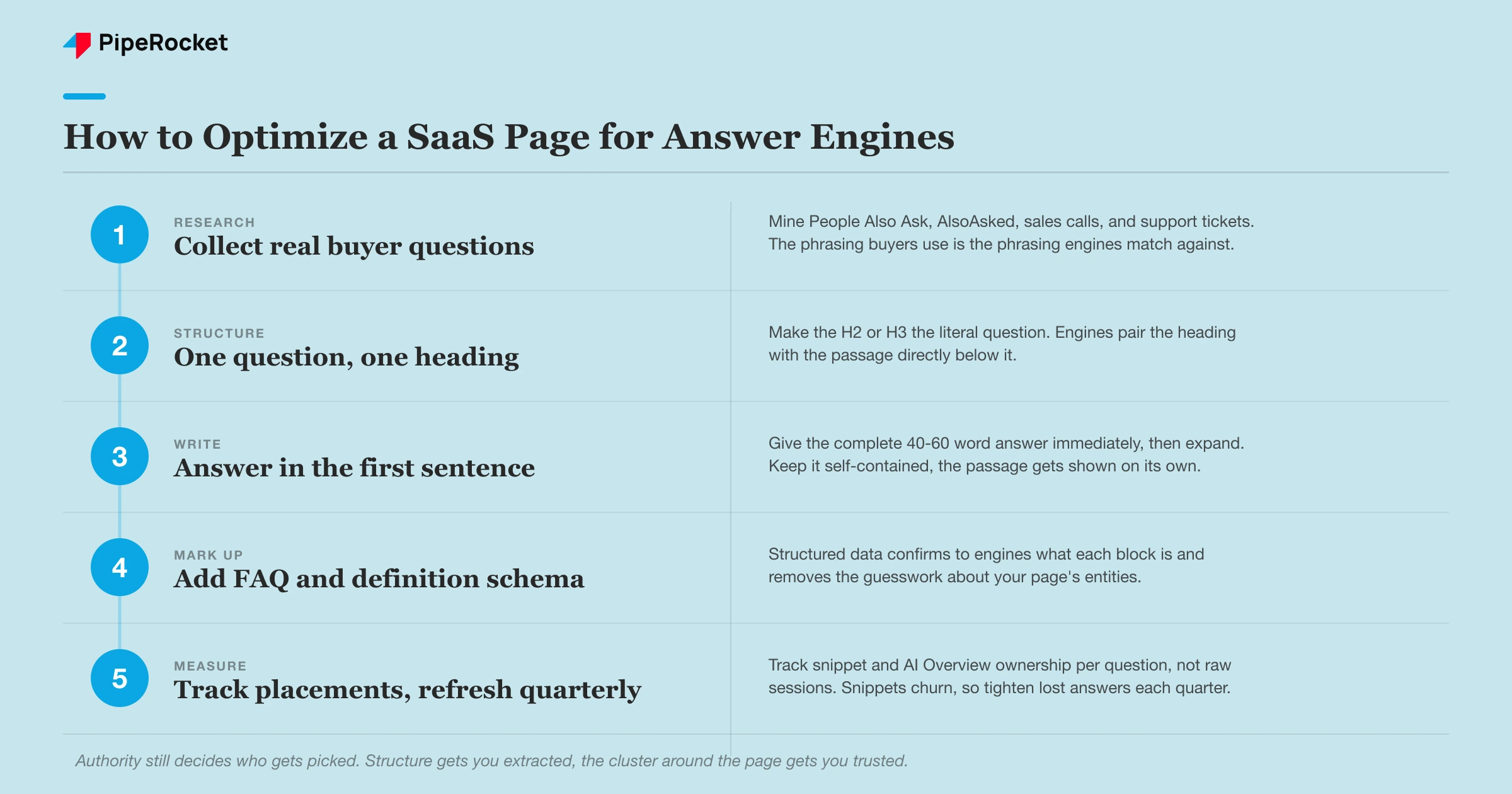
- Collect real questions: Mine People Also Ask, AlsoAsked, and your own sales call notes. The phrasing buyers actually use is the phrasing engines match against.
- One question, one heading: Make the H2 or H3 the literal question. Engines pair the heading with the passage below it.
- Answer in the first sentence: Give the complete short answer immediately, then expand. Never make the engine dig for it.
- Keep answers self-contained: No “as mentioned above” references. The passage gets shown alone, so it has to stand alone.
- Add schema: FAQ and definition markup through structured data confirms to engines what each block is.
- Cover the cluster: One optimized page rarely wins alone. Surrounding pages on the same subject build the trust that gets you into the candidate pool.
- Refresh on a schedule: Snippets churn. Re-check your placements quarterly and tighten answers that lost their spot.
A word of caution from doing this work: don’t turn every page into an FAQ farm. We’ve seen teams bolt 15 thin question blocks onto a page and wonder why nothing got extracted. Engines pick pages that genuinely cover the subject, and thin blocks read as thin to them too.
This works best for informational and definition-style queries. For high-competition commercial queries, the answer box often doesn’t exist at all, because Google shows ads and product grids instead. Spend your AEO effort where answer surfaces actually appear, and check the live SERP before optimizing.
Also read: the best AEO agencies for SaaS
How Do You Measure Whether AEO Is Working?
You measure AEO by tracking answer placements, not just traffic. For each target question, check whether the SERP shows an answer surface and whether your page owns it. Rank trackers like Semrush and Ahrefs flag SERP-feature ownership per keyword, which makes this trackable at scale.
Traffic alone will mislead you here. A page can win a snippet and lose clicks, because the user got the answer without visiting. If you judge that page by sessions, you’ll kill content that’s doing exactly its job.
- Placement share: Of your target questions, what percentage show an answer surface, and how many of those does your page own?
- Impression growth at stable position: Rising impressions in Search Console while average position holds often means you’ve picked up answer surfaces.
- Branded search lift: Users who see your answer come back later and search your name. Watch branded query volume alongside placements.
- Assisted conversions: Zero-click visibility shows up later in the funnel, so track whether organic-influenced pipeline grows over the quarter.
We track this for our own glossary, and the pattern is consistent. Placement wins show up two to three weeks before any traffic movement, and some of the best placements never move traffic at all. They move brand recall, which you only see in branded search trends.
So, set expectations with whoever reads your reports. AEO success looks like visibility share going up. If leadership only accepts session growth, the program gets cut right when it’s working. The best SaaS SEO agencies now report answer placements as a standard metric for this exact reason.
Frequently Asked Questions
1. Should a SaaS team prioritize AEO or GEO first?
AEO first, in most cases. AEO work happens entirely on pages you control, and you can verify results within weeks by checking snippet and PAA ownership for your target questions. GEO depends heavily on third-party citations and brand mentions across the web, which take longer to build and are harder to attribute. The good news is the structured, well-covered pages you build for AEO also make strong retrieval sources for GEO, so the work compounds.
2. When does AEO not make sense for a keyword?
When the SERP doesn’t show an answer surface. Many commercial and transactional queries return ads, product grids, and comparison listicles with no snippet or AI Overview at all. Optimizing those pages for extraction wastes effort and can weaken the persuasive copy that converts. Check the live SERP for each target query first. If there’s no featured snippet, PAA, or AI Overview present, treat it as a normal SEO and conversion play instead.
3. How do I know if a snippet I won is actually helping the business?
Look past the page’s own sessions. Compare branded search volume and direct traffic trends in the weeks after winning the placement, since users who get your answer often return by searching your name. In Search Console, rising impressions with steady or falling clicks on that query is the zero-click signature, which confirms you hold the surface. Then check whether organic-assisted pipeline for that topic cluster grows over the following quarter.
The Bottom Line
AEO is the cheapest visibility upgrade for most SaaS sites, because it mostly means restructuring pages you already have. Pick your 20 highest-value buyer questions, answer each one under its own heading, and track placement ownership. Want this done properly? Get in touch or work with an AEO agency for SaaS .