
What Is Keyword Difficulty? A SaaS SEO Guide
 Kamaraj Mathiarasan (Kim)
Last updated on
Kamaraj Mathiarasan (Kim)
Last updated on
Keyword difficulty is a score, usually from 0 to 100, that estimates how hard it would be to rank on page one for a term. SEO tools calculate it mainly from the backlink strength of the pages already ranking. Treating it as a verdict is where most teams go wrong.
TL;DR
- Keyword difficulty is a 0 to 100 score estimating how hard it is to rank for a term, based mostly on competitors’ backlinks .
- Different tools calculate it differently, so an Ahrefs score and a Semrush score for the same keyword won’t match.
- The number ignores your domain authority, content quality, and search intent, which all change your real odds.
- Low difficulty plus high relevance to your buyer is the sweet spot, not just low difficulty alone.
- Use difficulty to prioritise, never to decide. The live SERP tells you more than the score does.
What Is Keyword Difficulty?
Keyword difficulty is an estimate of how competitive a search term is. SEO tools like Ahrefs, Semrush, and Moz assign a score from 0 to 100, where higher means harder. The score answers one question: how much effort would it take to crack page one?
Most of that score comes from the backlink profiles of the pages currently ranking. If the top results have thousands of high-authority links, the difficulty score is high. If they’re thin pages with few links, it’s low. That’s the core of the calculation, though each tool adds its own adjustments.
- Backlink-based: The dominant input is how many and how strong the backlinks are to the pages already ranking on page one.
- Tool-specific: Ahrefs, Semrush, and Moz each use their own formula, so scores for the same keyword differ between tools.
- A 0 to 100 scale: Most tools normalise to 0 to 100, though the bands (“easy,” “hard”) are set by each vendor, not a shared standard.
- A relative signal: The score is useful for comparing keywords against each other, less so as an absolute measure of your chances.
- Snapshot in time: Difficulty changes as competitors gain or lose links and as new pages enter the ranking set.
Consider a SaaS that sells onboarding software. The keyword “onboarding software” might score 70, dominated by established players with deep link profiles. But “remote onboarding checklist for distributed teams” might score 15, with thin competing content. The second is far more winnable, and it attracts a more specific buyer.
The number is a starting filter, not an answer. It tells you where the easy and hard ends of your list sit, so you can sequence work sensibly.
Fast Fact: Organic search drives 91.3% of SaaS traffic — AI-referred visits account for less than 9%.
Also read: how to do SaaS SEO keyword research the right way
How Is Keyword Difficulty Calculated?
Keyword difficulty is calculated mostly from the backlink strength of the pages currently ranking for a term. Each SEO tool looks at the top results, measures their link profiles, and converts that into a single score. The heavier the link profiles, the higher the difficulty.
That backlink focus is why scores vary between tools. Ahrefs weights referring domains heavily. Semrush blends in other signals. Moz uses its own Domain Authority and Page Authority metrics. Same keyword, three different numbers, because the formulas differ.
- Referring domains: The number of unique sites linking to each ranking page is the single biggest input across most tools.
- Link quality: A handful of links from high-authority domains can push difficulty higher than many weak links.
- Page-level vs domain-level: Some tools weight the ranking page’s own links more, others lean on the whole domain’s authority.
- Additional signals: A few tools fold in search volume, SERP features, or content signals, which is why their scores drift apart.
A compliance SaaS checking “SOC 2 compliance” across two tools might see 65 in one and 58 in another. Neither is wrong. They’re measuring slightly different things. The practical move is to pick one tool, stay consistent, and compare keywords within that single system.
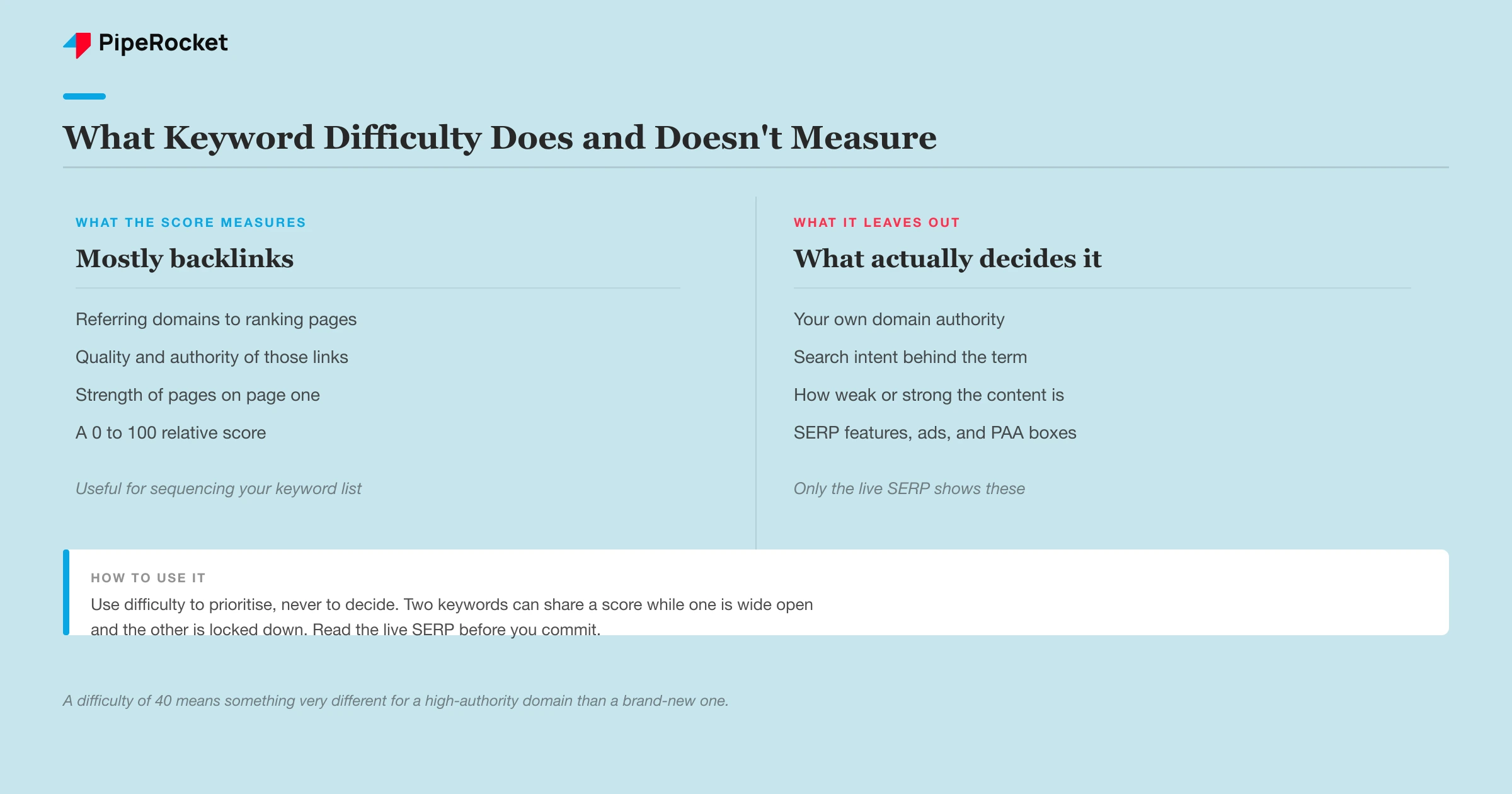
It also helps to remember what the score leaves out. Difficulty rarely accounts for how well the ranking pages match search intent , or how strong their content actually is.
Two keywords can share the same difficulty score while one is wide open and the other is genuinely locked down. That gap is exactly why the number alone never tells the full story, and why the SERP check matters so much.
Why Is Keyword Difficulty Misleading on Its Own?
Keyword difficulty is misleading because the score ignores three things that decide your real odds: your domain’s authority, the quality of your content, and the intent behind the keyword. A number that leaves those out can’t tell you whether you can actually rank.
Two sites looking at the same difficulty score have completely different chances. A keyword scoring 40 is reachable for an authoritative domain and a stretch for a brand-new one. The score is the same, but the reality isn’t, because difficulty doesn’t account for who’s asking.
- It ignores your domain: A difficulty of 40 means something very different for a DR 70 site than a DR 10 site. The score doesn’t know your authority.
- It ignores intent: A low-difficulty keyword with the wrong intent for your product is still a poor target, no matter how easy it looks.
- It ignores content gaps: If the ranking pages are weak or outdated, a genuinely better page can win even at a higher difficulty score.
- It ignores SERP features: Heavy featured snippets, ads, and People Also Ask boxes change the real competition more than the raw score shows.
Here’s the contrarian take: a high difficulty score on a keyword where the ranking pages are all thin and generic is an opportunity, not a warning. The score reflects their links, not their quality. If you can clearly out-cover them, the difficulty number is overstating the real barrier.
Fast Fact: Organic search converts SaaS visitors at 0.92% — more than 3x the rate of AI-driven traffic at 0.26%.
Also read: how to rank for high-difficulty SaaS keywords
How Should SaaS Teams Use Keyword Difficulty?
SaaS teams should use keyword difficulty to prioritise their list, then validate every shortlisted keyword against the live SERP. The score sequences the work. The SERP tells you whether the work is worth doing. Skipping the second step is the common mistake.
Pair difficulty with relevance and your current authority. A new SaaS domain should start with low-difficulty, high-relevance keywords to build momentum and topical depth. As authority grows, harder keywords come into range. The score is a moving target you grow into.
- Filter, don’t decide: Use difficulty to sort keywords into reachable and aspirational buckets, then look closer before committing.
- Weight by relevance: A difficulty-20 keyword your exact buyer searches beats a difficulty-20 keyword that draws an unqualified crowd.
- Match to your authority: Target keywords where your domain authority is realistically in range of the pages already ranking.
- Read the SERP: Open the results. If the top pages are thin, the real difficulty is lower than the score. If they’re deep and well-linked, it’s higher.
A revenue intelligence SaaS with a young domain might ignore “sales forecasting” at difficulty 68 and instead win a cluster of difficulty-15 long-tail terms first. Those rankings build the authority that eventually makes the harder term reachable.
Difficulty used this way becomes a sequencing tool, not a gate. If you want this mapped out properly, that’s the kind of work our SaaS SEO services handle.
Frequently Asked Questions
1. What’s a good keyword difficulty score to target?
There’s no universal number, because it depends on your domain authority. A brand-new SaaS site should generally start with keywords scoring under 20 to 30, where thin competition makes early wins realistic. An established domain with a strong backlink profile can target 40 to 60 and higher. Rather than chasing a fixed score, target keywords where the pages currently ranking are within reach of your own authority and content quality.
2. Why do Ahrefs and Semrush show different difficulty scores?
Because they use different formulas. Ahrefs leans heavily on referring domains to the ranking pages, while Semrush blends in additional signals, and Moz uses its own authority metrics. The same keyword can score 55 in one tool and 45 in another, and neither is wrong. The fix is to pick one tool and stay consistent, so you’re comparing keywords within a single system rather than across mismatched scales.
3. Can I rank for a high-difficulty keyword with a new site?
It’s possible but slow, and usually not the smart first move. High-difficulty keywords are dominated by domains with deep backlink profiles you can’t match quickly. A new site is far better off building authority through low-difficulty, high-relevance keywords first, then targeting harder terms once the domain has earned trust. The exception is a high-difficulty keyword where the ranking pages are genuinely weak, which a clearly better page can sometimes win.
The Bottom Line
Keyword difficulty is a prioritisation signal, not a ranking prediction. Use it to sequence your list, then validate each pick against the live SERP. Want a keyword strategy that targets winnable terms instead of vanity ones? Get in touch or see how the best SaaS SEO agencies approach it.