
What Is CRO? Conversion Rate Optimization for SaaS Teams
 Sabari Rohith
Last updated on
Sabari Rohith
Last updated on
Conversion rate optimization (CRO) is the ongoing practice of figuring out why visitors don’t take the action you want, then fixing those reasons through research, testing, and changes to your pages and flows. For SaaS, it’s how you grow pipeline from the traffic you already have instead of buying more.
TL;DR
- CRO is a research and testing practice, not a one-off redesign or a checklist of button tweaks.
- Your conversion rate is the metric; CRO is the discipline that moves it through deliberate, measured changes.
- Most SaaS teams run CRO on the homepage when the bigger leaks are in signup flows and pricing pages.
- A real CRO process starts with finding out why users drop off, not with a list of test ideas.
- CRO breaks down on low-traffic pages, where qualitative research beats A/B testing every time.
What Is Conversion Rate Optimization (CRO)?
Conversion rate optimization is the practice of systematically increasing the percentage of visitors who take a desired action, like starting a trial or booking a demo. It covers the research that finds the friction, the hypotheses about what to change, and the tests that prove whether the change worked.
The metric it moves is your conversion rate . That number tells you where you stand. CRO is everything you do to change it.
Most teams think CRO means A/B testing headlines and button colors. That’s the part you see, and the least valuable part. The real work is diagnosis: watching session recordings, reading sales call notes, and finding the exact moment users hesitate. Tests without that diagnosis are just guesses with a dashboard.
- Research first: CRO starts with evidence of why users don’t convert, from analytics, recordings, surveys, or sales conversations.
- Hypothesis-driven: Every change ties to a specific, stated belief about user behavior, so you learn something even when a test loses.
- Full-funnel scope: CRO covers landing pages , signup flows, onboarding, and pricing, anywhere a user decides to continue or leave.
- Measured outcomes: Changes ship behind experiments or before-and-after measurement, never on gut feel alone.
- Continuous practice: It’s a loop you run permanently, because every fix changes user behavior and creates the next bottleneck.
How to Run CRO Step by Step
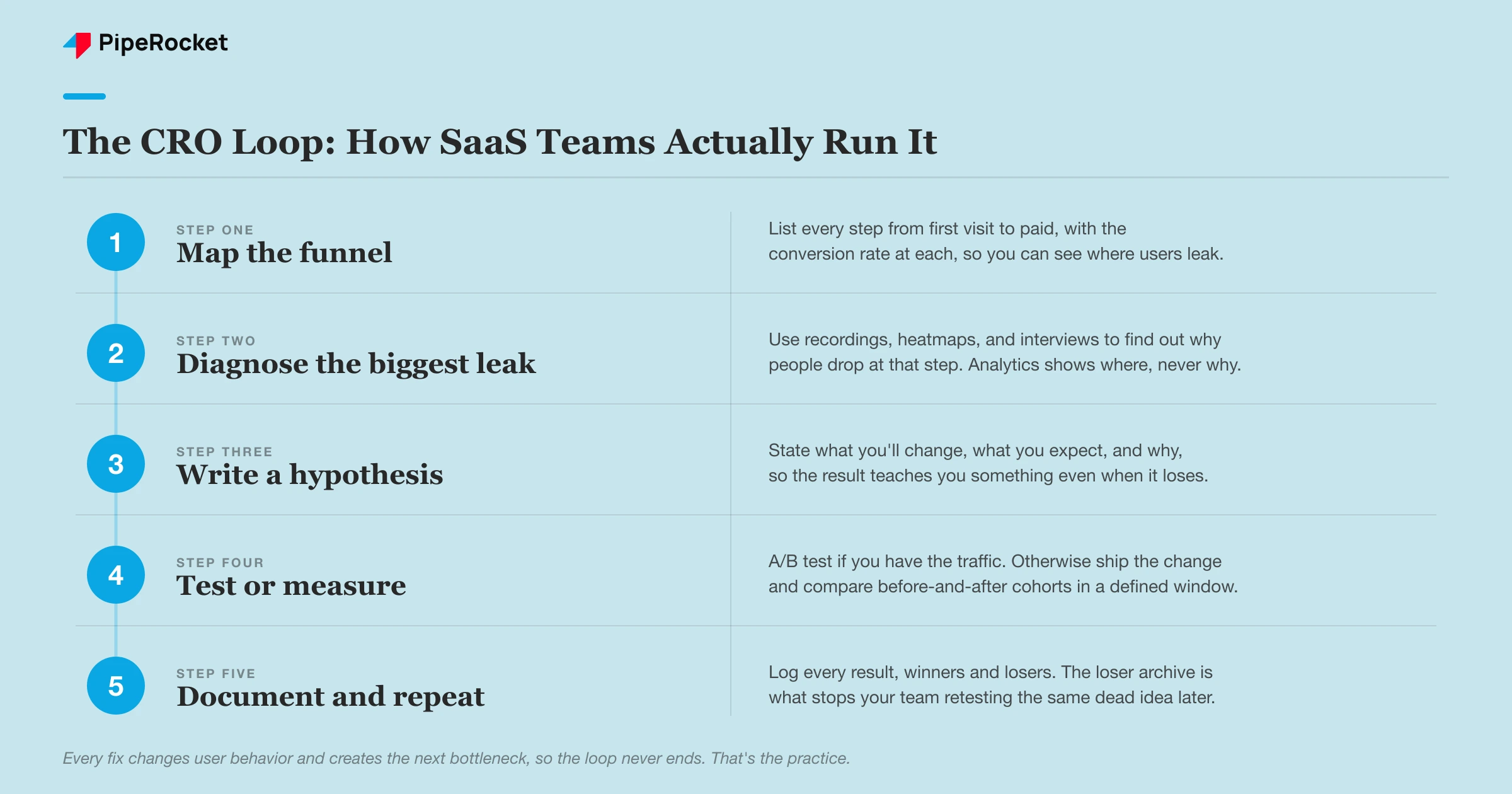
- Map the funnel: List every step from first visit to paid, with the conversion rate at each, so you know where users actually leak.
- Pick the biggest leak: Work on the step losing the most revenue, because a lift on a minor step barely moves revenue.
- Diagnose with real evidence: Use recordings, heatmaps, and user interviews to find why people drop at that step, since analytics shows where but never why.
- Write a hypothesis: State what you’ll change, what you expect to happen, and why, so the result teaches you something either way.
- Test or measure: A/B test if you have the traffic; otherwise ship and compare cohorts before and after, with a defined window.
- Document and repeat: Log every result, winners and losers, because the loser archive is what stops your team retesting the same dead idea next year.
Consider a contract management SaaS for legal teams. Demo requests stall, so the team rewrites the homepage twice. Recordings later show visitors reaching the demo form and abandoning at a “company revenue” field. The friction was one intrusive question, and no homepage rewrite was ever going to fix it.
Fast Fact: The highest-impact CRO wins in SaaS usually come from pricing pages and signup flows, not from the homepage everyone keeps redesigning.
How Is CRO Different from Conversion Rate?
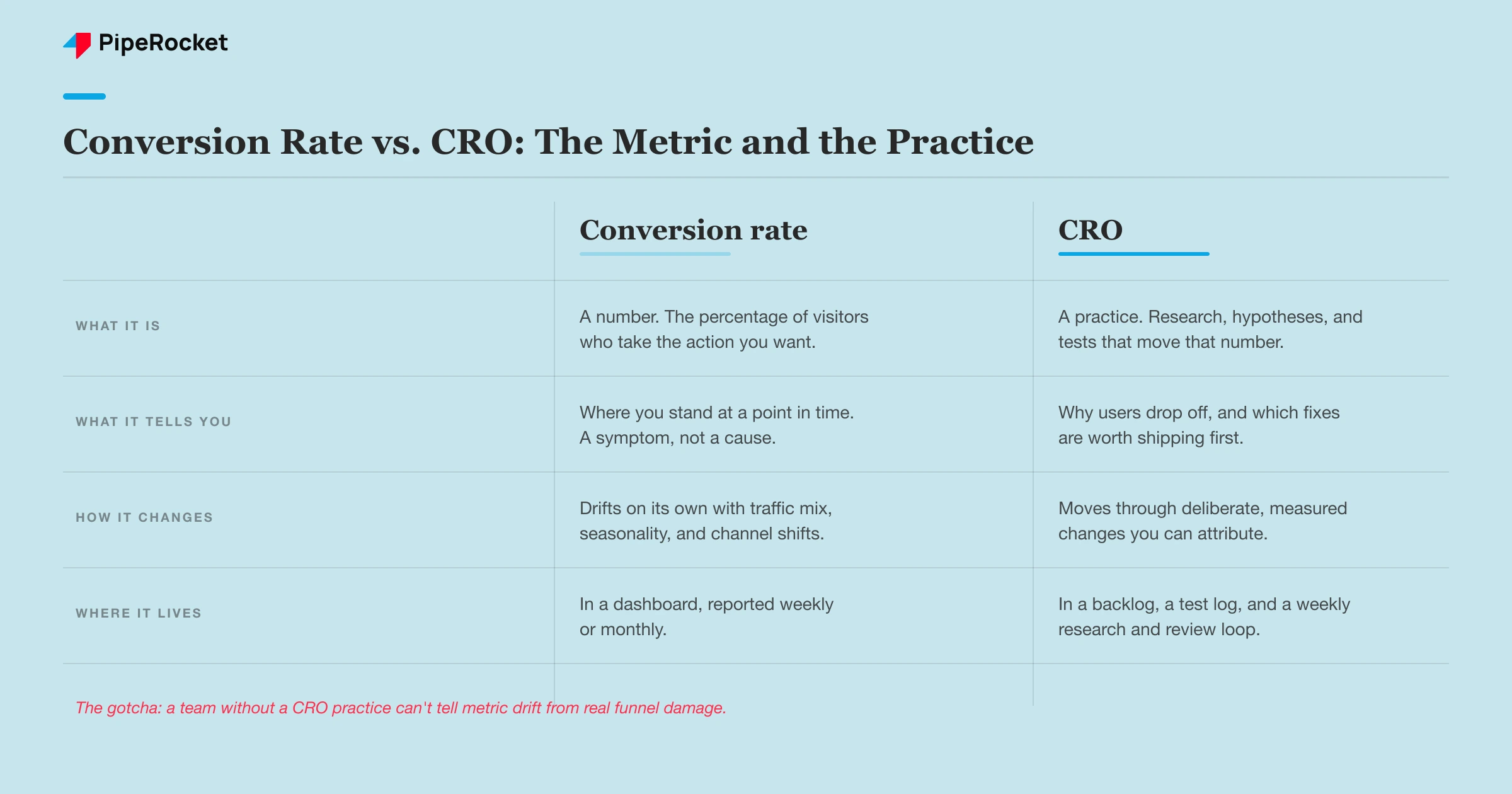
Conversion rate is a number; CRO is the practice that changes it. The metric tells you that 2% of visitors start a trial. CRO is the work of finding out why the other 98% didn’t, and removing the reasons that are fixable.
This distinction sounds pedantic until you watch a team confuse them. Teams that treat the number as the whole story end up “managing” the metric: changing what counts as a conversion, or cherry-picking date ranges. Teams that run CRO treat the number as a symptom and go looking for causes.
- Metric vs. practice: Conversion rate measures an outcome at a point in time; CRO is the ongoing system that improves it.
- Reporting vs. diagnosis: The rate goes in a dashboard; CRO produces explanations for why the rate is what it is.
- Passive vs. active: A rate can drift with traffic mix or seasonality; CRO changes are deliberate and attributable.
- One number vs. many: CRO works across every step’s rate, because the headline number hides where the funnel actually leaks.
Here’s my take: a team without a CRO practice shouldn’t trust its conversion rate. Traffic mix shifts the number constantly. A spike in low-intent visitors from a viral post will tank your rate while nothing on your site got worse. Only a team running CRO can tell drift from damage.
If you need the metric side first, start with our breakdown of what conversion rate is and how to measure it (linked above), then come back to the practice.
Where Should SaaS Teams Run CRO First?
Start where intent is highest and the decision is closest: pricing pages, signup flows, and demo forms. These pages sit one click from revenue, so a small lift there is worth more than a big lift on a blog post.
Most teams do the opposite. The homepage gets endless attention because it’s the most visible page internally, and executives look at it daily. But homepage visitors are a mix of every intent level, which makes results noisy and wins small.
- Pricing page: High intent, high anxiety. Unclear tiers and hidden costs kill more deals here than anywhere else on the site.
- Signup and demo flows: Every extra field or step drops completion. This is usually the cheapest fix with the biggest return.
- Trial onboarding: Signups that never reach first value are conversions you already paid for and then lost.
- High-traffic landing pages: Pages pulling search or paid traffic with clear intent, where message match decides everything.
A useful test before picking a page: multiply its traffic by its current rate by deal value. That’s the revenue flowing through it. Work on the page where a realistic lift moves the most money, not the page your team argues about most.
If your high-intent pages get their traffic from search, CRO and SEO feed each other, since intent match is half the conversion battle. We cover that side in our guide on how to optimize SaaS landing pages for SEO .
What Does a Real CRO Process Look Like Day to Day?
Day to day, CRO is mostly research and prioritization, with testing as the last step, not the whole job. A working rhythm is a loop: review funnel data weekly, watch a batch of session recordings, update the hypothesis backlog, and keep one or two experiments running at a time.
The discipline that separates real programs from theater is documentation. Every test gets a written hypothesis before launch and a written result after, including the losers. Without that log, teams retest old ideas, and worse, they remember losses as wins.
- Weekly funnel review: Check each step’s rate against the previous period, so regressions get caught in days instead of quarters.
- Qualitative batch: Watch recordings or read survey responses on the current focus page, looking for repeated hesitation patterns.
- Backlog grooming: Score hypotheses by expected impact and effort, then kill stale ideas without evidence behind them.
- One test at a time per flow: Overlapping experiments on the same path contaminate each other’s results.
Fast Fact: Most SaaS CRO programs die after the first failed test, even though losing tests are where the real funnel insight comes from.
Imagine a payroll SaaS for staffing agencies running its first experiment: a shorter demo form. The test loses. The lazy reading is “CRO doesn’t work for us.” The useful reading is that form length wasn’t the friction, which points the research somewhere real, like pricing anxiety or unclear positioning.
Also read: how the best SaaS marketing agencies build conversion into every channel
When Does CRO Not Work?
CRO breaks down when you don’t have enough conversions to learn from, or when the product itself is the problem. A/B testing needs volume. On a page with 30 conversions a month, a test can run for two quarters and still not tell you anything trustworthy.
That doesn’t mean low-traffic SaaS should skip CRO. It means the method changes. Below meaningful test volume, you lean on qualitative work: user interviews, recordings, and five-second tests. Ship changes based on that evidence and measure before-and-after cohorts instead of running split tests.
- Low traffic: Without enough conversions per variant, tests produce noise that teams mistake for signal, in both directions.
- No product-market fit : If users don’t want the product, no page change fixes that. CRO polishes the path to a door nobody wants to open.
- Unstable funnels: Mid-repricing or mid-rebrand, baseline numbers move on their own, so attributing any change to your test is fiction.
- Local maximum trap: Endless small tests on a fundamentally weak page beat a redesign never. Sometimes the right move is a bold swing, then iterate.
There’s a trade-off worth naming. Heavy personalization and multi-variant testing can lift conversions meaningfully, but they add tooling cost and maintenance weight. That’s worth it for high-traffic, high-ACV funnels. For an early-stage SaaS, one well-researched page beats a fragile experimentation stack.
This works as described for self-serve and inbound funnels. For enterprise sales-led motions with ten-person buying committees, page-level CRO matters less, because the conversion happens across calls and procurement, not on a landing page.
Also read: SaaS PPC services that treat landing pages as part of the campaign
Frequently Asked Questions
1. How much traffic do I need before A/B testing makes sense?
Think in conversions per month, not visitors. As a working floor, you want a few hundred conversions per variant within a reasonable test window, which usually means roughly 1,000 or more total conversions a month on the page being tested. Below that, tests take months and still produce shaky reads. Use qualitative research and before-and-after cohort comparisons instead, and save split testing for your highest-volume steps.
2. Should CRO sit with marketing, product, or growth?
It depends on where your funnel leaks. If the drop-off is before signup, marketing should own it, since the fixes live in pages and messaging. If signups aren’t activating, that’s product territory, because the fixes live inside the app. Most SaaS teams do best with one accountable owner who can pull from both sides, rather than splitting the funnel into territories nobody crosses. The worst setup is shared ownership with no named owner.
3. How do I know if my CRO program is actually working?
Look at revenue-weighted funnel movement over quarters, not individual test wins. A healthy program shows a rising trend in the step rates you targeted, a documented log of tests with maybe one win in every three to five attempts, and decisions that reference past results. If your team has run tests for six months and can’t name what it learned about your buyers, the program is producing activity, not progress.
The Bottom Line
CRO is a muscle your team builds, not a project you finish. Pick the one step in your funnel losing the most revenue, spend a week understanding why it leaks, then make one evidence-backed change before you touch a testing tool.
If you’d rather have a team that does this across SEO and paid, get in touch or see how our SaaS SEO service builds conversion into the traffic itself.