
What Is a Navigational Keyword? A SaaS SEO Guide
 Kamaraj Mathiarasan (Kim)
Last updated on
Kamaraj Mathiarasan (Kim)
Last updated on
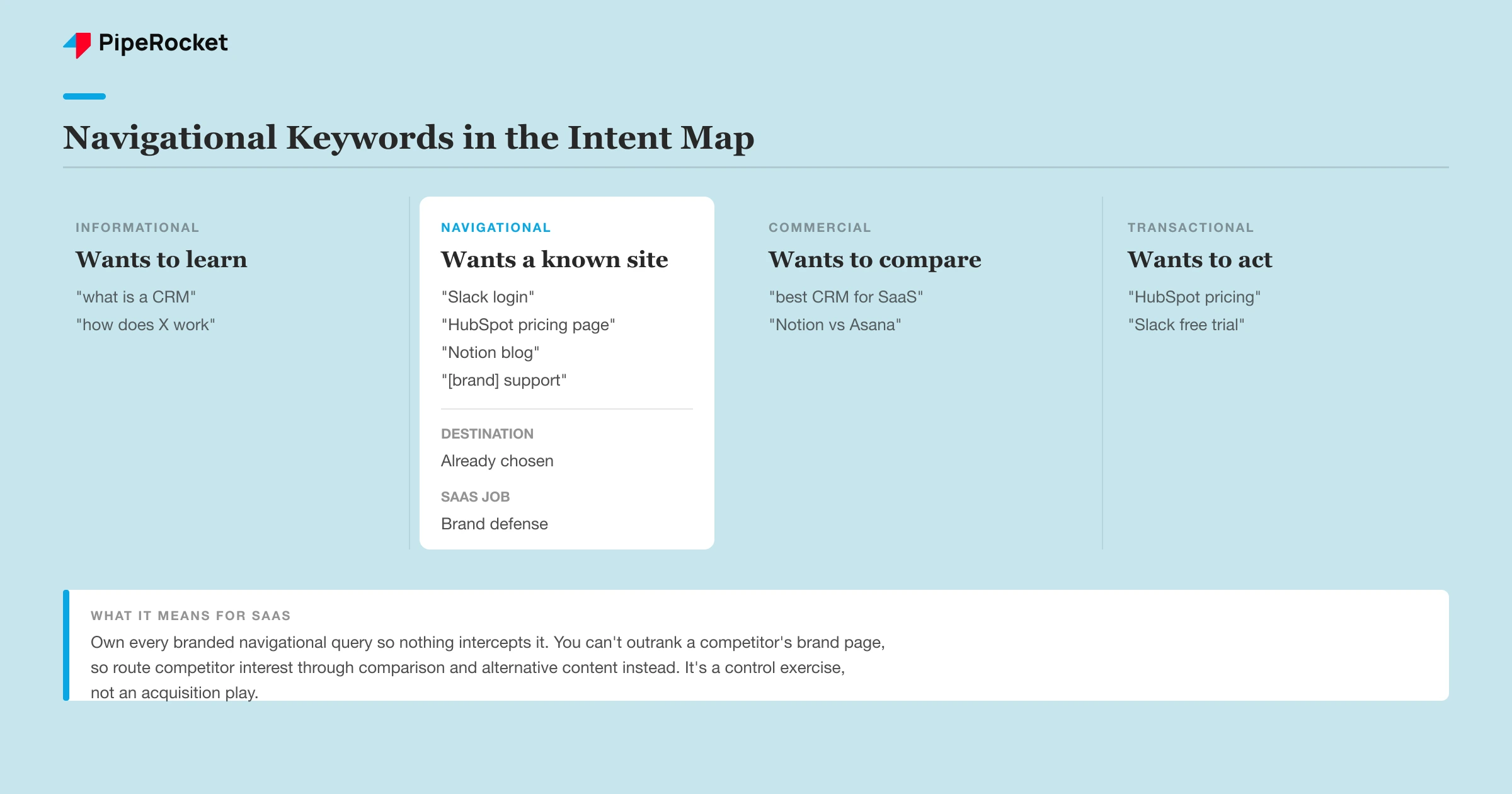
A navigational keyword is a search query where the user already knows where they want to go. “Slack login,” “HubSpot pricing page,” and “Notion blog” are all navigational. For SaaS, these queries are mostly about brand defense and a quiet competitive opportunity most teams miss.
TL;DR
- A navigational keyword is a search aimed at reaching a specific known website or page.
- The searcher has already chosen a destination, so intent is high but the choice is mostly made.
- Most navigational searches are branded, so your own brand terms should always point to your pages.
- Ranking for a competitor’s navigational terms is possible but limited, and it works best through comparison content.
- You rarely create content for navigational keywords directly. You make sure your existing pages own them.
What Is a Navigational Keyword?
A navigational keyword is a query used to find a specific site or page the searcher already has in mind. Rather than typing a full URL, they search the brand or page name and click the top result. “Figma login,” “Stripe docs,” and “Zoom download” are all navigational.
The defining trait is that the destination is already chosen. The searcher isn’t evaluating options or learning a concept . They want to land on a known page. That makes navigational search intent high in certainty but narrow in opportunity, because the search usually resolves to one obvious result.
- Brand-name queries: “[Brand]” on its own, where the searcher wants the homepage. Your homepage should own this without question.
- Brand-plus-page queries: “[Brand] login,” “[Brand] pricing,” “[Brand] blog.” The searcher wants a specific page within a known site.
- Product-name queries: “[Product feature]” searches for a named feature or tool inside a known brand’s product suite.
- Login and account queries: “[Brand] login,” “[Brand] sign in.” Pure utility searches from existing users.
- Support queries: “[Brand] help,” “[Brand] support.” Existing customers looking for a known resource.
Consider a SaaS called Loopflow. Someone searching “Loopflow login” or “Loopflow pricing” is navigational. They’ve chosen Loopflow and want a specific page. The job here isn’t to win new attention. It’s to make sure those pages rank first, fast, and aren’t intercepted by competitors or aggregators.
The practical point: navigational keywords are less about acquisition and more about control. You want to own every navigational query that includes your brand.
Fast Fact: Organic search drives 91.3% of SaaS traffic — AI-referred visits account for less than 9%.
Also read: how to do a keyword gap analysis vs SaaS competitors
How Do You Identify a Navigational Keyword?
The clearest signal is a brand name in the query. If the search includes a specific company, product, or site name, and the searcher clearly wants to reach it, the keyword is navigational. The SERP confirms it, because the brand’s own pages dominate the results.
Navigational queries also tend to have very high click-through rates on the top result, since there’s usually one correct destination. When you see a single domain owning almost all the clicks for a query, you’re looking at navigational intent.
- Brand presence: A specific brand, product, or site name in the query is the strongest signal.
- SERP dominance: If one domain owns the top several results, the query is navigational.
- Utility modifiers: “Login,” “sign in,” “download,” “docs,” “support” attached to a brand confirm navigational intent.
- High top-result CTR : Navigational queries send most clicks to one result, because the searcher has a single destination in mind.
A team auditing “Loopflow vs competitor” would find commercial intent , but “Loopflow login” is purely navigational. The difference matters, because the first is a content opportunity and the second is a brand-defense check to make sure your own page ranks first.
Why Do Navigational Keywords Matter for SaaS?
Navigational keywords matter in two ways most teams underrate. First, they’re brand defense. Your branded navigational queries should always resolve to your pages, not to a competitor’s ad or a third-party aggregator sitting above you. Second, competitor navigational terms hold a narrow but real opportunity.
The honest limit is that you can’t truly rank for a competitor’s brand terms in the organic top spot. Their own pages will almost always win. But you can show up adjacent, through comparison and alternative content, and intercept a sliver of that intent.
- Brand defense: Make sure your homepage, login, and pricing pages own your branded queries so nothing intercepts them.
- Branded ad protection: Competitors sometimes bid on your brand terms. Strong organic ownership reduces how much that costs you.
- Competitor interception: You can’t outrank a competitor’s brand page, but a “[competitor] vs you” or “[competitor] alternatives” page can appear nearby.
- Reputation control: Owning “[brand] review” and “[brand] pricing” pages keeps your narrative in your hands rather than a third party’s.
A contrarian note: chasing competitor navigational keywords directly is mostly wasted effort. You won’t take their brand homepage. What works is building commercial-intent comparison and alternative pages that catch the searcher who’s open to options, not the one who’s firmly headed to a known destination.
Fast Fact: Organic search drives 37x more SaaS leads than AI search tools, yet most teams treat them as equal channels.
Also read: how to find and fix keyword cannibalization on a SaaS site
How Should You Handle Navigational Keywords in Your Strategy?
You rarely build new content for navigational keywords. Instead, you make sure your existing pages own the branded ones and decide where competitor terms fit your broader plan. The work is more about hygiene and positioning than production.
Start with your own brand. Confirm that your homepage, login, pricing, and support pages rank first for their navigational queries. Then look at competitor terms and route that intent through comparison content rather than trying to rank for the brand name itself.
- Own your branded terms: Audit that every “[your brand] + page” query resolves to the correct page of yours in the top spot.
- Protect against intercepts: Watch for competitor ads or aggregators ranking above you on your own brand, and respond with strong pages or paid defense.
- Route competitor intent: Point competitor-adjacent interest to comparison and alternative pages, which capture the open-minded slice without chasing the brand term.
- Keep pages crawlable: Navigational pages like login and pricing should be indexable and fast, so they reliably win their own queries.
The takeaway: navigational keywords are a control and positioning exercise, not a content-volume play. Win your own brand completely, and use commercial content to catch the competitor traffic that’s actually winnable. If you want help auditing where your brand terms stand, our SaaS SEO services cover exactly this.
How Do Navigational Keywords Affect Your SEO Reporting?
Navigational keywords quietly distort SEO reports when nobody separates them out. Branded navigational traffic comes from people who already know you, so it reflects existing demand, not new reach. Lump it in with everything else and a strong brand can mask weak performance on the queries that win buyers.
The fix is simple segmentation. Split branded navigational traffic from non-branded informational, commercial, and transactional traffic in your reporting. That way you can see whether your SEO work is genuinely expanding reach or just riding demand you already had.
- Separate branded from non-branded: Report branded navigational queries on their own line, so they don’t inflate your acquisition numbers.
- Watch the trend, not the volume: Rising branded search often reflects marketing and product momentum, not SEO. Treat it as a brand signal.
- Tie non-branded to growth: Judge SEO’s contribution to new pipeline on non-branded queries, where you’re actually competing for unaware buyers.
- Flag intercepts in reports: If competitors or aggregators rank on your brand terms, surface that as a defense issue, not a content gap.
A SaaS that reports one blended traffic number can look healthy while its non-branded rankings quietly stall. Segmenting navigational traffic out keeps the report honest and points attention where growth actually comes from.
Also read: how the best B2B marketing agencies connect SEO metrics to pipeline
Frequently Asked Questions
1. Can I rank for a competitor’s navigational keyword?
Not really, at least not in the top organic spot for their brand name. A competitor’s own pages will almost always own “[their brand] login” or “[their brand] pricing.” What you can do is rank adjacent content, like “[competitor] vs [you]” or “[competitor] alternatives,” which captures searchers who are open to options. Chasing the pure brand term itself is usually wasted effort, since the intent there is to reach a known destination.
2. Why would I worry about my own branded navigational keywords?
Because they’re not always safe by default. Competitors can bid on your brand terms in paid search, and third-party aggregators or review sites can outrank your pages organically. If someone searching your brand lands on a competitor’s ad or a review site instead of your page, you’ve lost control of that high-intent moment. Auditing and owning your branded queries protects traffic that should already be yours.
3. Do navigational keywords count toward SEO traffic goals?
They do, but they can be misleading if you lump them in with acquisition. Branded navigational traffic mostly comes from people who already know you, so it reflects existing demand rather than new reach. When measuring SEO’s contribution to growth, separate branded navigational traffic from non-branded informational, commercial, and transactional traffic. Otherwise strong brand searches can mask weak performance on the queries that actually win new buyers.
The Bottom Line
Navigational keywords are about control, not acquisition. Own every branded query, and route competitor interest through comparison content instead of chasing brand terms you can’t win. Want a clear read on where your brand stands? Get in touch or see how the best B2B SEO agencies handle it.