
What Is Topical Authority? A SaaS SEO Guide
 Kamaraj Mathiarasan (Kim)
Last updated on
Kamaraj Mathiarasan (Kim)
Last updated on
Topical authority is how much Google trusts your site as a credible source on a specific subject, earned by covering that subject thoroughly across many connected pages. For SaaS, it’s the difference between ranking for a single keyword and owning an entire category in search.
TL;DR
- Topical authority is the trust your site earns on a subject by covering it in depth across multiple linked pages.
- Google rewards depth and breadth on a topic, not just one strong page in isolation.
- A site with topical authority ranks faster and more reliably for new keywords in that subject area.
- You build it with topic clusters: a pillar page plus supporting pages that interlink.
- Authority is topic-specific, so a site can be authoritative on one subject and invisible on another.
What Is Topical Authority?
Topical authority is the credibility your site builds with Google on a particular subject. It comes from covering that subject thoroughly, with depth, breadth, and internal links that show how the pieces connect.
The more completely you cover a topic, the more Google trusts you to rank for queries within it.
Most teams chase individual keywords. They write one post, target one term, and wonder why it stalls. Topical authority works the other way. You earn the right to rank for any keyword in a subject by covering the whole subject, not by optimising one page at a time.
- Subject-level trust: Authority attaches to a topic, not a single keyword. Cover the topic well and you rank for many related terms.
- Depth and breadth: Google looks for thorough coverage, both deep on key concepts and broad across the subtopics around them.
- Internal linking : Links between your related pages signal to Google how your content connects, reinforcing the topic structure.
- Earned over time: Authority compounds as you publish and interlink more on a subject, rather than appearing from one piece.
- Topic-specific: A site can hold strong authority on one subject and none on another, since trust doesn’t transfer across unrelated topics.
Consider a SaaS that sells customer support software. Publishing one post on “reducing ticket volume” rarely ranks well alone. But covering the full subject, with pages on response times, ticket routing, support metrics, and automation, all interlinked, signals deep expertise. Google then ranks the whole set more reliably.
The practical point: topical authority turns SEO from a series of one-off bets into a compounding asset. Each new page on the subject makes the others stronger.
Fast Fact: Organic search drives 91.3% of SaaS traffic — AI-referred visits account for less than 9%.
Also read: how to improve topical authority for a SaaS brand
Why Does Topical Authority Matter for SaaS?
Topical authority matters because it makes every future page in a subject easier to rank. Once Google trusts you on a topic, new content in that area ranks faster and holds longer, even for keywords you haven’t specifically targeted. That compounding effect is hard to match with isolated content.
For SaaS specifically, authority is what lets a smaller brand outrank bigger competitors in a focused niche. You won’t beat a giant across every topic, but you can own one category so completely that you outrank them within it. Depth beats size when the depth is concentrated.
- Faster rankings: New pages in a topic you own rank quicker, because Google already trusts your site on the subject.
- Compounding returns: Each page strengthens the cluster, so the value of your content grows as the set grows.
- Niche dominance: A focused SaaS can out-authority a larger competitor within a specific category, even with fewer resources.
- Resilience to updates: Sites with genuine topical depth tend to weather algorithm updates better than thin, scattered content.
Here’s the contrarian take: publishing one excellent post on a subject and stopping is almost a waste. Without supporting pages around it, that post carries the entire weight of ranking alone, and usually can’t.
The single best piece of content underperforms a network of good ones that prove you own the topic.
Fast Fact: Organic search converts SaaS visitors at 0.92% — more than 3x the rate of AI-driven traffic at 0.26%.
Also read: how to build topic clusters that rank a SaaS site
How Do You Build Topical Authority?
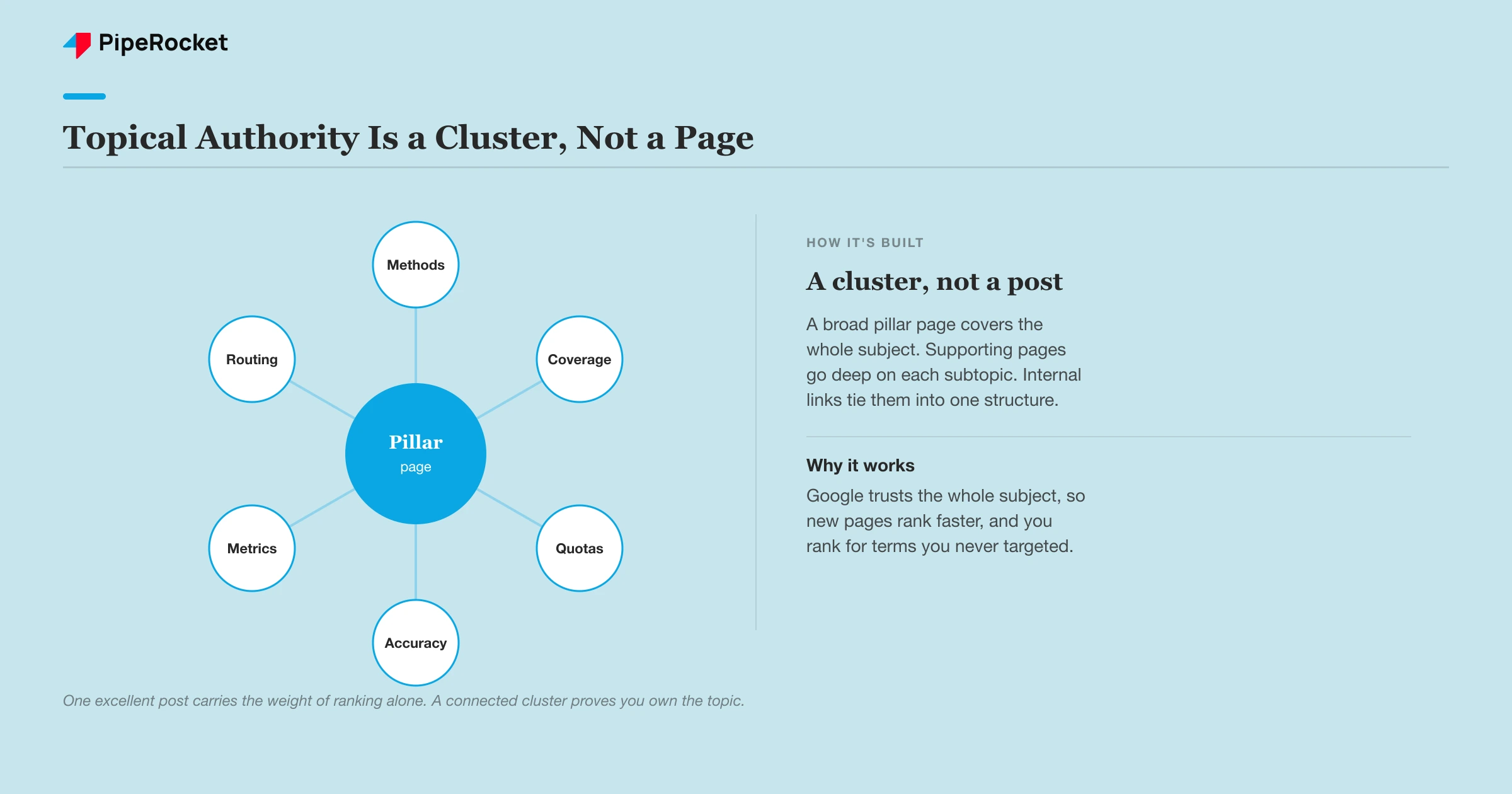
You build topical authority with topic clusters: a central pillar page covering a subject broadly, surrounded by supporting pages that go deep on individual subtopics, all interlinked. The pillar establishes the territory, the supporting pages prove the depth, and the links tie them into a recognisable structure.
Start by mapping the full subject, not just the keywords you want. List every question, concept, and subtopic a knowledgeable person would expect to see covered. That map becomes your content plan, and the gaps in it are exactly where authority leaks away to competitors.
- Pick a focused topic: Choose a subject close to your product where you can realistically become the most thorough source.
- Map the full subject: List the concepts, questions, and subtopics that complete coverage requires, then plan a page for each.
- Build a pillar and spokes: Write a broad pillar page and supporting deep-dive pages, linking them to each other deliberately.
- Interlink with intent: Connect related pages so Google can see the cluster as a structured whole, not scattered posts.
- Keep it current: Refresh and expand the cluster over time, since authority grows with maintained, complete coverage.
A revenue operations SaaS might build a pillar on “sales forecasting” with supporting pages on forecasting methods, pipeline coverage, quota setting, and forecast accuracy, all linked together. That cluster signals real expertise, and it ranks far better than four unconnected posts would.
The structure is what turns individual pages into authority. If you want this mapped and built properly, that’s exactly what our SaaS SEO services focus on.
How Do You Measure Topical Authority?
You measure topical authority by tracking how your rankings, coverage, and visibility grow across a whole subject, not by a single score. There’s no official “topical authority” number from Google, so you read it through several signals that move together as authority builds.
Think of it as reading a dashboard of related trends rather than checking one gauge, since no single metric captures it on its own.
The clearest sign is when you start ranking for keywords you never directly targeted. That’s Google extending trust across the topic. Combined with growing share of voice in the subject and faster indexing of new pages, it tells you the authority is real.
It’s worth tracking these signals together, because any single one can move for unrelated reasons. A ranking bump might come from a competitor slipping, or a backlink landing. When several signals climb at once across the whole subject, that’s the reliable read on authority.
- Rankings for untargeted terms: When pages rank for related keywords you didn’t optimise for, Google is treating you as a topic authority.
- Share of voice: Track what percentage of your target subject’s keywords you rank for versus competitors over time.
- Coverage completeness: Measure how much of your mapped subject you’ve actually published, since gaps cap your authority.
- Faster indexing and ranking: New pages in the topic that rank quickly signal that the trust is established.
A compliance SaaS that built a deep cluster on “SOC 2” might notice it suddenly ranks for “SOC 2 vs ISO 27001” without a dedicated page, simply because Google now trusts its coverage of the broader subject.
That spillover is topical authority working. Measuring it means watching the trend across the cluster, not obsessing over any one keyword.
Frequently Asked Questions
1. How long does it take to build topical authority?
It’s a months-long effort, not a quick win. For a focused subject, a SaaS team publishing and interlinking consistently might see early authority signals in three to six months, with meaningful dominance taking six to twelve months or more. The timeline depends on your starting domain authority , how competitive the subject is, and how completely you cover it. Authority compounds, so the pace usually accelerates once the core cluster is in place.
2. What’s the difference between topical authority and domain authority?
Domain authority is a broad, site-wide measure of trust, driven largely by backlinks across your whole domain. Topical authority is subject-specific, earned by covering a particular topic in depth. A site can have high domain authority overall but weak topical authority on a niche subject, or strong topical authority on one topic despite modest domain authority. For SaaS targeting a focused category, topical authority often matters more than raw domain strength.
3. Can a new SaaS site build topical authority quickly?
It can build it faster on a narrow subject than on a broad one. A new site won’t out-authority established players across a whole category overnight, but by picking a tight, specific topic and covering it more completely than anyone else, it can earn authority in that slice relatively quickly. The key is focus: depth on one narrow subject beats shallow coverage spread across many, especially when the domain is still young.
The Bottom Line
Topical authority is earned by owning a subject completely, not by writing one great page and hoping. Map the full topic, build the cluster, and the rankings compound. Want to own your category in search? Get in touch or see how the best SaaS SEO agencies approach it.