SaaS PPC is paid advertising run by software companies across channels like Google Ads and LinkedIn Ads to drive trials, demos, and recurring revenue. It is measured on pipeline metrics such as CAC, SQLs, and trial-to-paid conversion, not raw clicks.
Key Takeaways
- SaaS PPC succeeds or fails on activation and retention, not on cheap clicks or raw signup volume.
- The core channel stack is Google Ads for high-intent search, LinkedIn Ads for account targeting, plus Meta, Bing, and G2/Capterra for retargeting and vertical reach.
- Match ad messaging and landing pages to funnel stage: ToFu education, MoFu comparison content, BoFu trust signals and CTAs.
- Negative keywords and narrow, evaluation-aligned targeting keep CAC stable by filtering out researchers before they become expensive trial signups.
- Measure ROI through CAC, LTV, activation rate, and trial-to-paid conversion, not CPA alone.
- When hiring an agency, the fastest filter is asking for their kill criteria on underperforming campaigns.
SaaS PPC can feel like gambling some days.
You increase bids… CPC goes up.
You broaden targeting… signup quality tanks.
You push more budget… the pipeline barely moves.
Paid search becomes painfully expensive when it drags in researchers instead of real buyers, and nothing hurts more than demos that never close.
The solution isn’t throwing more money at the problem. It’s designing PPC around intent, not impressions.
A winning SaaS PPC strategy ties every dollar of paid search and paid social to a pipeline outcome, so budget shifts toward the channels, keywords, and stages that produce activated, paying users.
In this guide, we break down how SaaS PPC actually works in 2026 and how to build campaigns that attract activation-ready users who convert, retain, and expand.
Why PPC Works Differently for SaaS
PPC works differently for SaaS because you’re not selling a one-time product. You’re guiding someone into an ongoing relationship. In SaaS, the click isn’t the conversion; it’s the starting point.
Every paid visitor affects activation, retention, and long-term revenue, which means SaaS PPC must prioritize intent, product experience, and LTV instead of surface-level metrics.
1. The Recurring Revenue Model
SaaS grows through recurring revenue, which means the first signup matters far less than whether the user actually sticks around. A campaign that brings in ten high-intent users who activate and stay is more valuable than one that brings in a hundred who churn immediately.
Because of this, PPC strategy shifts from chasing the lowest CPA to attracting users who will engage deeply with the product. LTV becomes the real north star, and PPC is judged by how well it contributes to sustained revenue.
2. The SaaS Buyer Journey
SaaS buyers rarely convert instantly. They explore, compare, take trials, ask peers, and only then decide. Their journey moves through awareness, trial, activation, and finally a paid plan.
If PPC focuses only on the first click, you end up with signups who never come back. To make PPC work, your ads and landing pages must guide users through this entire journey, not just the entry point.
3. Free Trials Change Conversion Patterns
Free trials boost signups easily, but they can also fill your funnel with people who were never serious about solving the problem. If your targeting is too broad, most of those users won’t even log in a second time.
SaaS PPC works best when the ad messaging itself pre-qualifies users by speaking directly to their specific pains, outcomes, and use cases.
4. Feature Parity Creates Unique Competitive Pressure
Most SaaS products look similar on the surface. Everyone claims features like automation, dashboards, and integrations. This makes PPC less about listing features and more about positioning.
Your ads must highlight what makes your product meaningfully different, whether that’s workflow, philosophy, industry focus, or depth of functionality. Clear differentiation attracts users who see your product as the true fit.
SaaS PPC Channels: Where to Spend Beyond Google Ads
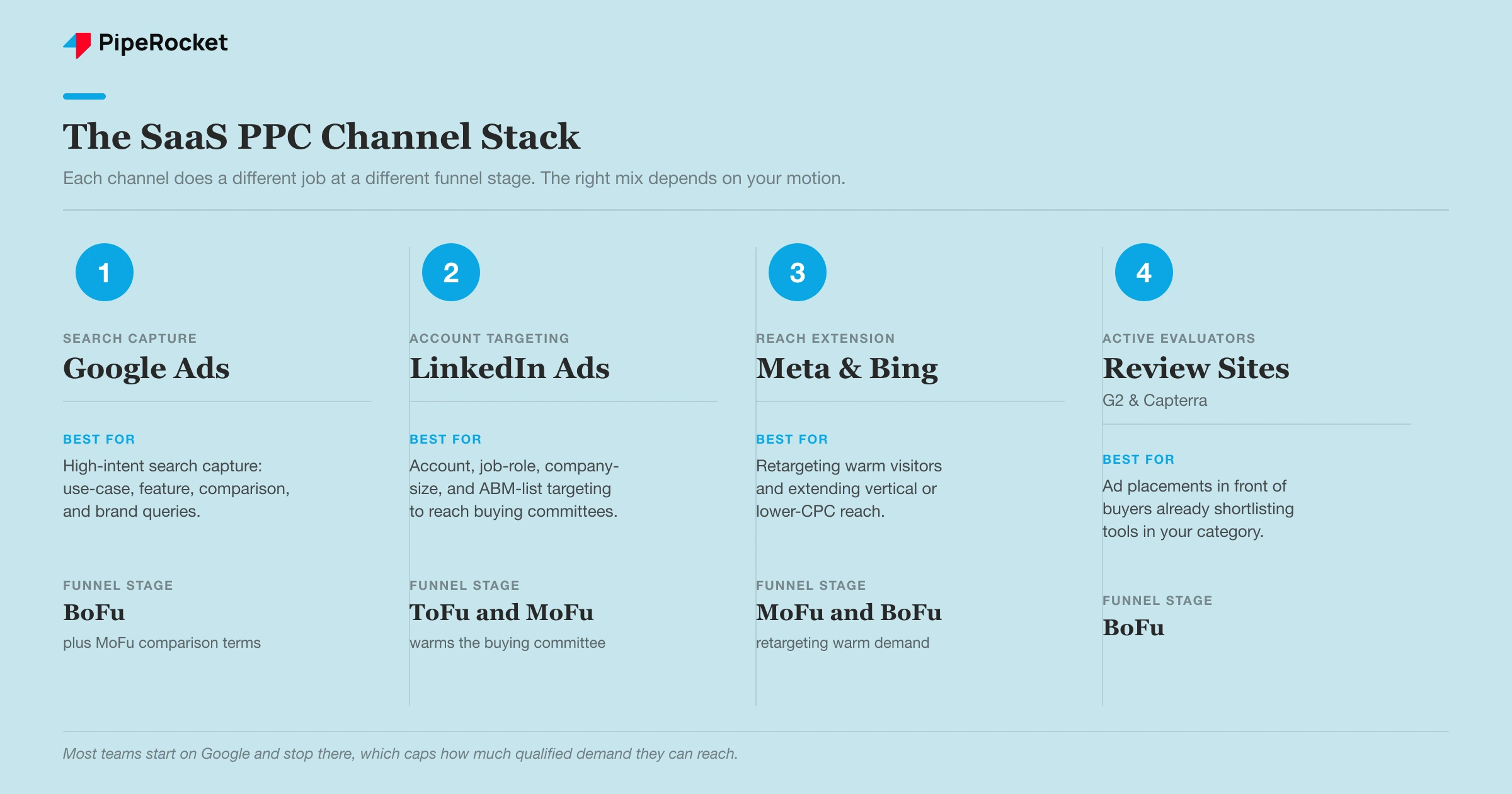
SaaS PPC is a multi-channel stack, not just Google Ads. Google Ads captures high-intent search, LinkedIn Ads targets accounts and job roles, Meta and Bing extend retargeting and vertical reach, and review sites like G2 and Capterra place ads in front of active evaluators.
Most teams run their SaaS PPC ads on Google and stop there, which caps how much qualified demand they can reach. Each channel does a different job at a different funnel stage, so the right mix depends on your motion (PLG or sales-led) and who sits on the buying committee .
| Channel | Best For | Funnel Stage |
|---|---|---|
| Google Ads | High-intent search capture: use-case, feature, comparison, and brand queries | BoFu (and MoFu comparison terms) |
| LinkedIn Ads | Account, job-role, company-size, and ABM-list targeting to reach buying committees | ToFu and MoFu |
| Meta and Bing | Retargeting warm visitors and extending vertical or lower-CPC reach | MoFu and BoFu retargeting |
| Review sites (G2, Capterra) | Ad placements in front of buyers already shortlisting tools in your category | BoFu |
For channel-by-channel depth, we have dedicated guides for running Google Ads for SaaS , LinkedIn Ads for account targeting, and Microsoft Ads for Bing reach. This page stays the multi-channel overview, so treat it as the map and the single-channel guides as the terrain.
The higher the deal size, the more that channel mix actually matters. A low-ACV product can win running on a single channel; a high-ACV deal is a committee decision, and no single channel reaches a whole buying committee. That’s part of why Bing is worth a line item and not just an afterthought: on one SaaS account I audited, the identical category keyword cost $18.16 per click on Microsoft Ads versus $61.61 on Google, roughly 70% cheaper for the same intent, and Bing pulled more volume on that term too (595 clicks vs 144). Meta earns its spot the same way. One of our best-performing Meta campaigns was for a fintech SaaS client: a lead-objective Facebook campaign built on a 1% lookalike of their active users averaged roughly 15 leads a week, one of the highest-performing Meta ads we’ve run. A tight lookalike off real product users beats broad targeting on Meta every time.
Build the Right SaaS PPC Foundation
A strong SaaS PPC foundation rests on four things: a defined ICP, a clear value proposition, sharp differentiation, and a revenue-tied goal. Get these right before touching keywords or ad formats, or every downstream campaign inherits the weakness.
Before you think about keywords, ad formats, or landing pages, your SaaS PPC strategy needs a solid foundation. Here’s how to build one that actually supports growth.
1. Have a Clear ICP + Buyer Personas
The biggest mistake in PPC for SaaS companies is targeting “anyone who might use the product.” This leads to high CPCs, irrelevant traffic, and low-intent signups. SaaS PPC only works when you know exactly who your best users are, such as their role, industry, workflows, and the pain that pushes them into solution mode.
Clear ICPs make your keywords, messaging, and landing pages far more relevant while naturally filtering out users who were never going to convert.
2. Provide a Strong Value Proposition
Once your audience is defined, you need a value proposition that communicates the outcome you deliver, not the features you offer. SaaS buyers want fast clarity.
If your promise isn’t specific and instantly understandable, users skip your ad or bounce immediately. Effective SaaS PPC begins with a value statement that shows what someone can achieve within your product.
3. Differentiate in Your Messaging
Most SaaS categories feel crowded, with every tool offering similar features. That’s why PPC becomes a battle of positioning.
Your messaging must explain how you solve the problem differently, through workflow, automation depth, industry specialization, philosophy, or speed to value. Strong differentiation helps prospects quickly recognize why your product is the better fit.
4. Define Your Goals
Campaigns fall apart when the team isn’t aligned on the actual goal. Are you trying to drive trials? Book qualified demos? Improve onboarding completion? Increase MRR? Each goal requires a different funnel, different messaging, and even different keywords.
Clear goals help you measure performance in a way that ties directly to revenue instead of surface-level metrics.
Why High-Intent Keyword Research Matters for SaaS
High-intent keywords determine whether your PPC brings real buyers or low-quality explorers. When you target intent over volume, trial quality, activation, and CAC improve immediately.
Pair this with our deep dive on running Google Ads for SaaS for the full campaign workflow.
Using the Right Tools to Understand Real Buyer Intent
Tools like Ahrefs, SEMrush, and Google Keyword Planner help you see more than just monthly search volume; they reveal patterns in how SaaS buyers think. When you dig into these insights, you’ll start noticing:
- Search terms tied to specific workflows
- Queries that show comparison or evaluation
- Use-case phrases that signal real purchase intent
These tools make it easier to separate “research behavior” from “buying behavior,” which is crucial for SaaS PPC profitability.
Targeting the Right Types of SaaS Keywords
Not every keyword brings in a serious evaluator. High-intent SaaS PPC relies on terms tied to real jobs-to-be-done and strong commercial intent.
- Use-Case Keywords: Attract users searching for tools for their exact workflow.
Example: “email automation for small businesses”
- Feature Keywords: Bring users who already know what capability they need.
Examples: “workflow automation tool,” “multi-step approvals software.”
- Comparison Keywords: These appear in the final decision stage. Some of the highest-intent queries in SaaS.
Examples: “Notion vs Asana,” “Zendesk alternative.”
- Problem-Based Keywords: Great for capturing pain-aware users.
Examples: “how to reduce onboarding time,” “client management issues”
Why SaaS Brands Should Avoid Broad Keywords Early
Broad terms like “CRM system” or “project management tool” attract students, researchers, and unfocused traffic. In paid search for SaaS, that means inflated CPCs, low activation, and unstable CAC.
Starting with narrow, evaluation-aligned keywords gives you clean data, higher-quality trials, and a safer path to scale.
Avoid the patterns we list in common SaaS Google Ads mistakes before you spend more budget.
Build a Negative Keyword List From Day One
Negative keywords are the fastest lever for CAC control: they block your ads from showing on searches that never convert, so budget stays on evaluators, not researchers.
Add negatives like “free,” “jobs,” “salary,” “tutorial,” “course,” and “reddit” early, then review the search-terms report weekly and add every irrelevant query you find. On broad and phrase match, a maintained negative list is what keeps spend from leaking to students and job seekers.
Bidding on Competitor Brand Terms
Competitor brand-term bidding puts your ad in front of buyers actively searching for a rival, capturing high-intent demand at the exact moment they are comparing tools.
It works best when your ad copy leads with a clear point of difference or a comparison landing page, not a generic pitch. Watch quality score and CPC closely, since competitor terms are unqualified for your own brand and can run expensive if the landing page does not earn the click.
SaaS-Specific PPC Ad Strategies
SaaS PPC wins when every ad fits the buyer’s stage. Match intent to messaging for better trials, demos, and activation rates.
Top-of-the-Funnel (ToFu) Strategies
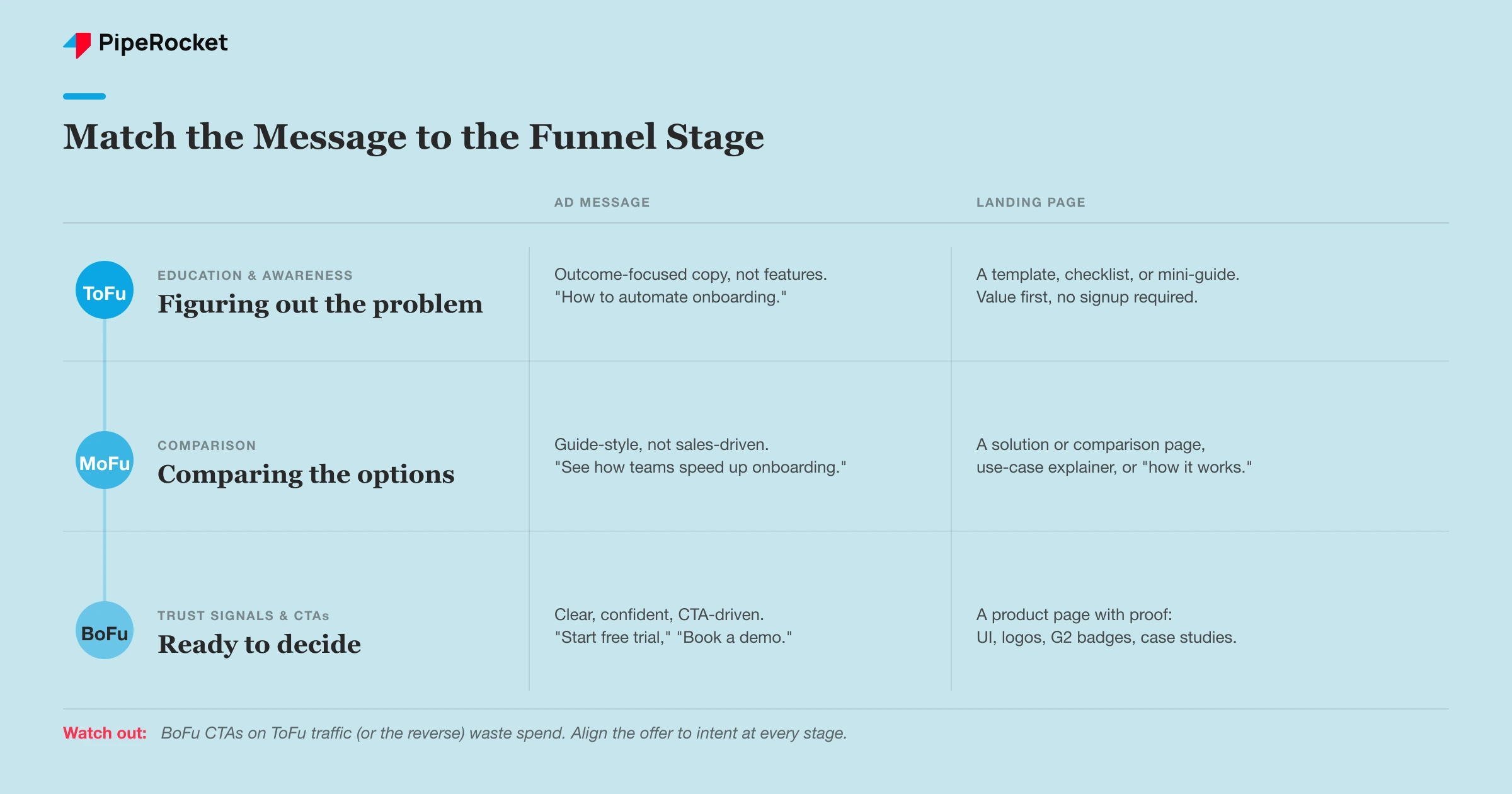
At the top of the funnel, buyers are still figuring out the problem. They’re searching for explanations, ideas, and best practices. A user searching “how to automate onboarding” isn’t ready to choose a tool, but they are hungry for guidance.
The goal is to position your brand as the voice that understands their challenge. ToFu ad copy should focus on outcomes, not features, and the landing pages should offer something genuinely helpful.
A template, a checklist , or a mini-guide works well because it gives the user value without asking for commitment. These value-first touchpoints warm the audience and set you up for stronger intent later.
Middle-of-the-Funnel (MoFu) Strategies
MoFu users know the type of solution they need but aren’t ready to sign up or talk to sales. They’re comparing approaches, evaluating workflows, and trying to understand which tools are designed for teams like theirs. This is where ads pointing to buyer’s guides, use-case explainers, or “how it works” videos become powerful.
Your messaging should act like a guide. Lines such as “See how teams speed up onboarding” or “Explore tools built for your industry” reduce friction because they feel helpful rather than sales-driven.
At this stage, you’re moving users from curiosity to clarity, not pushing them toward a sign-up button.
Bottom-of-the-Funnel (BoFu) Strategies
BoFu users are ready. Their searches become more direct, more commercial, and more urgent. When someone searches “best onboarding software for SaaS teams” or “[product] pricing,” they’re days, sometimes hours away from a decision.
Here, your ads should be clear, confident, and backed by trust signals. This is the right moment to use CTA-driven messaging, such as:
- “Start Your Free Trial”
- “Get Your Sandbox Environment”
- “Book a Demo This Week”
Show product UI, customer logos, G2 badges, and snippets from case studies to remove doubt. At this stage, buyers want confirmation that your product already works for teams like theirs. The more specific and credible your proof is, the faster they convert.
SaaS PPC Campaign Templates for Trials by Funnel Stage
The simplest campaign template for SaaS trials is one campaign per funnel stage, each with its own keywords, offer, and landing page. It keeps intent, message, and destination aligned so trial quality stays high.
| Stage | Keyword type | Offer / CTA | Landing page |
|---|---|---|---|
| ToFu | Problem and how-to queries | Template, checklist, or guide | Educational asset, no signup required |
| MoFu | Use-case and comparison queries | “See how it works,” buyer’s guide | Solution or comparison page |
| BoFu | Feature, brand, and pricing queries | “Start free trial,” “Book a demo” | Product page with proof and trust signals |
Reuse this three-campaign skeleton for each product line or ICP segment. It gives you clean data per stage and a repeatable structure you can scale without guesswork.
How to Build High-Converting SaaS Landing Pages
In SaaS PPC, a great landing page does one thing well: it makes the next step feel obvious. The easier the page feels, the higher your trial and demo conversion rates climb.
Two mechanics sit underneath every high-converting page: speed and testing. A page that loads in under two seconds keeps paid clicks from bouncing before they render, and it protects quality score, which lowers CPC. From there, A/B test one element at a time (headline, hero, form length, CTA copy) so you know which change actually moved trial and demo conversion.
1. For Product-Led Growth (PLG) Products
PLG landing pages exist to get users into the product quickly. There’s no lengthy evaluation cycle; the experience is the pitch. Every element on the page should help users understand the product instantly and feel confident starting a trial.
Key elements of a strong PLG landing page:
- Show the Product Immediately: Users want instant clarity. Screenshots, GIFs, or a short product video above the fold help visitors understand what your tool does in seconds.
- Reduce Signup Friction: Keep onboarding fast. Email-only signups, one-click SSO, and streamlined onboarding flows dramatically lift activation.
- Use Lightweight Trust Signals: PLG buyers don’t need huge case studies; they need reassurance. Customer logos, short testimonials, or G2 badges do the job.
- Make Value Visual: Use GIFs or short walkthrough clips to show how the product fits into real workflows.
- Add Role-Based Personalization: Simple sections for Sales, HR, Finance, etc. help users see themselves in the product immediately.
A strong PLG landing page accelerates the “aha moment”, increasing both trial quality and activation speed.
2. For Sales-Led Growth (SLG) Products
SLG landing pages are built for deeper evaluation. Buyers need validation, detail, and confidence before booking a call.
A strong SLG landing page includes:
- Qualify With Structured Forms: Ask for role, company size, and industry to ensure high-quality sales conversations.
- Lead With Proof and Authority: Use case studies, ROI metrics, analyst mentions, security certifications, and compliance badges.
- Address Risk and Implementation Early: Explain onboarding, support, integrations, training, and migration clearly.
- Make ROI the Core Message: Decision-makers care about efficiency and cost savings. If your value is obvious, the demo request becomes frictionless.
A well-structured SLG page builds trust, reduces uncertainty, and ensures your sales team speaks only with truly ready buyers.
Retargeting & Lifecycle PPC for SaaS
Lifecycle PPC re-engages past visitors and trial users with ads matched to their stage: educational nudges for ToFu, product proof for MoFu, and finish-signup or upgrade prompts for BoFu. It recovers demand your SaaS PPC campaigns already paid to attract.
Smart SaaS growth isn’t just about capturing new demand; it’s about continuously re-engaging users based on where they are in the buying journey. Here’s how to structure a clean, high-performing retargeting engine across ToFu, MoFu, and BoFu.
1. ToFu Retargeting
Your goal at this stage is simple: bring back early-stage visitors and nurture them without pushing the product too early.
- Retarget visitors who viewed blogs, guides, comparison posts, and category pages.
- Promote educational assets like use-case explainers, templates, checklists, benchmarks, or intro webinars.
- Use low-commitment CTAs such as “Learn more,” “See how it works,” or “Explore guide.”
- Reinforce your product category and core problem statements with light brand messaging.
- Keep frequency caps low to avoid ad fatigue and preserve positive brand perception.
This stage warms cold traffic and builds familiarity, so prospects naturally move toward deeper product evaluation.
2. MoFu Retargeting
Now users understand their problem, and your job is to position your product as the solution.
- Retarget users who viewed solution pages, feature pages, or product-led content.
- Promote product tours, live/recorded webinars, in-depth guides, and competitive comparison content.
- Highlight workflows, feature benefits, and “day-in-the-life” value.
- Use soft product-led CTAs like “Watch demo video,” “Explore features,” “Try interactive tour.”
- Introduce messaging around integrations, role-based use cases, and switching benefits.
MoFu is where you build trust, answer objections, and demonstrate a clear product advantage.
3. BoFu Retargeting
This is where buying decisions are made, so your ads must remove friction, drive action, and close the loop.
- Retarget trial users, high-intent visitors, and anyone who viewed pricing, demo, or signup pages.
- Run ads for trial-to-activation nudges, demo reminders, onboarding offers, or “finish signing up” prompts.
- Promote case studies, ROI calculators, customer success metrics, and industry-specific proof.
- Push strong high-intent CTAs like “Start free trial,” “Book demo,” “Claim offer.”
- For active trial users, use retargeting to reinforce upgrade paths and highlight premium features or usage milestones.
Done right, lifecycle PPC becomes a self-optimizing performance marketing system, capturing attention at the top, educating in the middle, and converting at the bottom.
Measuring SaaS PPC ROI
Clicks don’t pay the bills, but activated, retained users do. To understand true ROI, you must connect ad platform data with in-product analytics. Our Google Ads benchmarks put the average B2B SaaS blended cost per lead at $84 across 65+ accounts, a useful reference point before you decide whether your own CPL is actually a problem.
Track these five metrics to measure SaaS PPC on revenue, not clicks:
- Customer Acquisition Cost (CAC): the foundation of SaaS PPC measurement. Track fully loaded CAC (ad spend, landing page costs, operational tools), and compare it by campaign, keyword, intent level, and funnel stage to find your most profitable segments.
- Lifetime Value (LTV): a high CPC can still be profitable if those users stay longer, upgrade, or expand. Evaluating LTV by campaign gives a deeper view of return than CPA alone.
- Activation Rate: how many signups actually engage with your product. High activation indicates strong targeting and messaging; low activation signals misaligned expectations or onboarding issues.
- Trial-to-Paid Conversion: one of the clearest indicators of PPC quality. Segment it by keyword and ad group to uncover which campaigns attract serious evaluators.
- Retention Rate: the long-term fit signal. If PPC users churn quickly, revisit your targeting, messaging, and pre-signup qualification.
To make any of these numbers real, you need to close the loop between the ad click and what happens after signup. Two things make that possible:
- Offline conversion tracking (OCT): Feed closed-won deals and MRR back into the ad platforms so bidding optimizes toward real revenue instead of raw form fills. Without OCT, Google and LinkedIn optimize for the cheapest lead, which is rarely your best one.
- CRM and sales-data integration: Wire your ad platforms into the CRM so each keyword, campaign, and channel maps to a pipeline stage instead of a platform-reported conversion. This is what lets you see which ad group produced SQLs and revenue.
If your account hasn’t been reviewed in a while, run through our SaaS PPC audit framework first.
Why SaaS PPC Campaigns Fail
Most SaaS PPC campaigns fail for a short list of avoidable reasons: broad targeting that pulls in researchers, generic ad copy, no conversion tracking past the click, and a set-and-forget account nobody maintains.
The failure modes cluster into four buckets:
- Targeting too broad, too early. Broad keywords inflate CPC and fill trials with people who never activate. Narrow, evaluation-aligned terms plus a live negative keyword list fix this.
- Message and offer mismatched to stage. BoFu CTAs on ToFu traffic (or the reverse) waste spend. Match the offer to intent at every stage.
- Tracking that stops at the click. Without offline conversion tracking and CRM integration, the platform optimizes toward cheap leads instead of revenue.
- Set-and-forget accounts. No search-term review, no A/B testing, no bid maintenance. SaaS categories move too fast for that, and CAC drifts up quietly.
Catch these early and most underperformance is reversible before it burns a quarter of budget.
How to Choose a SaaS PPC Agency (and When to Stay In-House)
The fastest way to filter a SaaS PPC agency is to ask about their kill criteria: the exact conditions under which they would shut off an underperforming campaign. If they can’t answer that, keep looking.
If you searched “saas ppc,” a lot of you aren’t looking for tactics. You’re deciding whether to hire someone. Here’s the test I’d apply.
Most agencies bill as a percentage of ad spend, which quietly rewards them for keeping losing campaigns alive. A good one makes less money when your ads fail, and will pause an underperforming campaign before you have to ask.
A few more things worth checking before you sign:
- Do they report to pipeline, or to clicks? If it’s CTR and impressions instead of trials, SQLs, and CAC, keep looking.
- Have they run SaaS specifically? SaaS PPC lives or dies on trial-to-paid and activation rather than raw lead volume. Generalists optimise for the wrong number.
- Who actually touches the account? A senior strategist in the pitch and a junior on the account after signing is the oldest trick in the book.
In-house still wins when you have a dedicated paid-search owner, a stable account, and time to test. It breaks down when you need to scale fast, you’re entering a competitive category, or you’re burning budget without knowing why. That is the point to bring in outside SaaS PPC management .
Whichever way you lean, look for a partner who understands SaaS PPC specifically, not just broad B2B PPC . The metrics that matter (trial-to-paid, activation, MRR) are different from generic lead volume.
Buyers compare these agencies in the open, so the r/PPC and r/SaaS threads ranking for this query are worth reading before you commit. For a vetted shortlist, see our ranking of the best SaaS PPC agencies .
Conclusion
SaaS PPC has never been about collecting clicks or swelling your trial count; it’s about attracting users who are ready to activate, ready to engage, and ready to deliver long-term revenue. In 2026, the stakes are even higher. Buyers expect value fast, and according to the G2 2025 Buyer Behavior Report , 57% of software buyers now expect a positive ROI within just three months.
That means your PPC strategy can’t afford guesswork, broad targeting, or vanity metrics. The brands that win are those that build intent-led campaigns, align messaging with real buyer pains, and guide prospects from first click to activation and expansion with zero friction. SaaS PPC works when every dollar is tied to outcomes, activation, retention, and recurring revenue.
If you want to build a PPC engine that delivers exactly that, PipeRocket Digital can help you scale predictable, revenue-driven SaaS growth.
Schedule a call now, and let’s turn your paid traffic into paying customers.
FAQs
1. What is SaaS PPC?
SaaS PPC refers to paid advertising strategies designed specifically for subscription-based software businesses. It focuses on generating high-quality trials, demos, and recurring revenue rather than one-time purchases.
2. What is PPC vs SEO?
PPC delivers instant traffic through SaaS paid ads, while SEO drives organic traffic over time. PPC is ideal for rapid acquisition and testing, while SEO compounds value long-term.
3. Is PPC a part of SEO?
No. PPC and SEO are separate channels: PPC is paid placement, SEO is organic ranking. They share keyword research but run on different budgets, timelines, and mechanics.
4. Why is PPC important for SaaS?
SaaS companies have long funnels and competitive markets. PPC helps reach high-intent buyers, supports product trials, accelerates demos, and improves revenue predictability.
5. What are some mistakes to avoid in SaaS PPC?
Avoid broad keywords early, pushing trials too soon, ignoring landing page experience, and measuring success only by CPA instead of activation or LTV. Poor targeting also leads to low-quality trial signups.
6. How do I choose a SaaS PPC agency?
Start with one question: what are their kill criteria for an underperforming campaign? Agencies that bill as a percentage of ad spend are quietly incentivised to keep losing campaigns running, so a partner who pauses one before you have to ask is worth a lot. Beyond that, check that they report on pipeline, trials, and CAC rather than clicks and impressions, that they have run SaaS accounts specifically since trial-to-paid is a different game than lead volume, and that the senior strategist in the pitch is the person who will actually manage the account day to day.