B2B SaaS SEO: The B2B-Specific Playbook (Beyond General SaaS SEO)
 Kamaraj Mathiarasan (Kim)
Last updated on
Kamaraj Mathiarasan (Kim)
Last updated on
B2B SaaS SEO is the B2B-specific layer that sits on top of general SaaS SEO: same fundamentals, but tuned for long sales cycles, multi-stakeholder buying groups, and high-intent, low-volume keywords that turn organic search into demos, trials, and ARR. General SaaS SEO covers every software audience, including self-serve and B2C. This guide is the drill-down for software sold to businesses.
Many B2B SaaS firms chase the wrong metric: traffic. Pageviews alone do not convert into demos, trials, or real opportunities. This blog shows you how to convert organic traffic into qualified leads through ICP long-tail targeting, product-led content, comparison pages, digital PR for trust, and a resource split weighted toward content and authority (not crawl-budget tinkering). By the end, you will have a road map for turning your site into a predictable deal engine.
Key Takeaways
- B2B SaaS SEO is the B2B-specific playbook layered on general SaaS SEO: it targets business buyers with intent-based keywords, multi-persona content, and long buying cycles.
- This is the B2B drill-down; for the broader SaaS SEO discipline that also covers self-serve and B2C, see the general SaaS SEO pillar guide.
- B2B SaaS SEO succeeds or fails on ICP precision: a mistargeted persona miscalibrates every keyword and content decision downstream.
- Split resources roughly 60% content, 30% digital PR and authority, 10% technical fixes, because B2B SaaS growth is content- and trust-led.
- ICP long-tail queries (persona plus industry plus pain point) carry lower volume but far higher purchase intent than head terms.
- Product-led content and comparison or alternative pages ("[Tool A] vs [Tool B]," “[Competitor] alternative”) are the highest-converting BOFU assets in B2B SaaS.
- Map keywords to TOFU (awareness), MOFU (evaluation), and BOFU (purchase-ready) stages, then measure pipeline (MQLs, SQLs, ARR), not just pageviews.
B2C vs B2B SaaS SEO: What is distinctly different?
B2B SaaS SEO differs from B2C and general SaaS SEO in three concrete ways: it serves a buying group of about 10 people (not one impulse buyer), targets high-intent low-volume keywords (not high-volume head terms), and measures pipeline (not sign-up counts). The fundamentals are shared; the targeting, content, and metrics are not.
B2C is emotional, fast, and low-cost. General SaaS SEO often serves self-serve users who want a quick answer and a free trial. The buying process in B2B SaaS is lengthy, hierarchical, and high-stakes, which changes what you rank for and how you prove value.
| Dimension | B2C / general SaaS SEO | B2B SaaS SEO |
|---|---|---|
| Buyer | One person, quick decision | ~10-person buying group |
| Sales cycle | Days to weeks | Weeks to months |
| Keyword focus | High volume, broad head terms | High intent, low volume, ICP long-tail |
| Content | Educational, self-serve, trial-led | Multi-persona, product-led, comparison and BOFU |
| Success metric | Sign-ups, traffic | MQLs, SQLs, pipeline, ARR |
| Authority | Cold outreach, mass links | Digital PR , partnerships, review platforms |
A 6sense study suggests that the average B2B purchasing team has approximately 10 decision-makers, and all of them contribute to a longer, collective evaluation process in the purchase journey. It implies that your SEO will have to cover several personas, pain points, and funnel stages.
Longer, multi-stakeholder buying journeys
In B2B SaaS, a single keyword will hardly be indicative of the intent of one buyer. Content that you should create needs to be satisfying to end users, managers, CTOs, CFOs, procurement teams, and security evaluators who will have diverse search behavior.
High-value, low-volume keyword focus
B2C brands pursue volume; B2B SaaS brands pursue alignment. The keywords with high intent, like SOC 2 compliance software or best healthcare enterprise CRM, can be low in search volume, but the purchasing intent will be high.
Align SEO with overall demand generation
The most successful B2B SaaS businesses use SEO not as a content generator, but as a source of revenue. This implies coordination of SEO with paid campaigns, lifecycle nurturing, email workflows, and sales enablement.
5 Factors to Consider for a B2B SaaS SEO Strategy
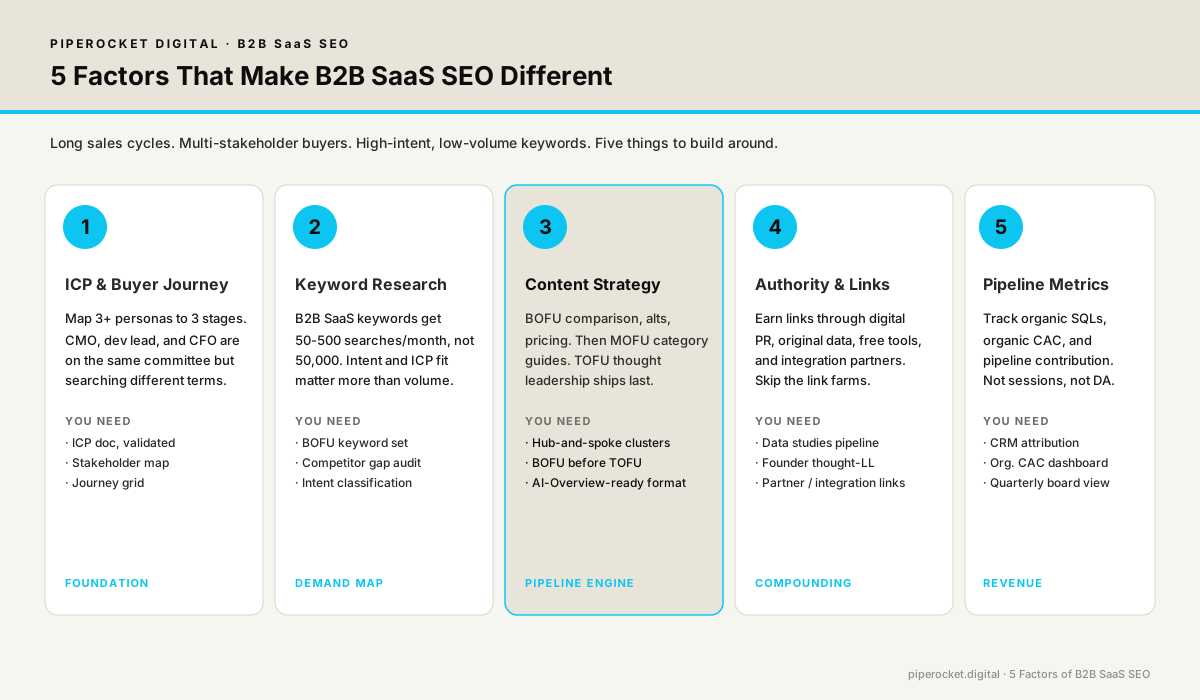
The five factors that make or break a B2B SaaS SEO strategy are: defining ICPs and buyer journeys, high-intent keyword and competitor research, a funnel-stage content strategy, authority through links and partnerships, and pipeline-tied measurement. Work them in that order.
Defining ICPs and Mapping Buyer Journeys
A strong B2B SaaS SEO strategy starts with clearly defining your Ideal Customer Profiles (ICPs) and knowing how each persona searches throughout the buying journey. Get your ICP wrong and every downstream keyword and content decision inherits the error.
In B2B SaaS, a single user does not make a quick decision as it is in B2C. Rather, you strike on many layers within an organization- each layer contains its priorities, pain points, and search habits. There are three main personas that are normally addressed by most B2B SaaS products, and all these should be targeted by your SEO.
- End Users
These are individuals who employ the tool daily. They seek practical and task-oriented queries like:
- “How to automate invoices”
- “best time-tracking tools for developers”
The searches made by them tend to resolve short-term issues, acquire novel workflows, or feature comparisons. The content of this persona would be placed in the TOFU or MOFU level and would feed the persona on tutorials, guides, and lists of tools.
- Managers
Managers are concerned with the efficiency of their operations, reporting, and productivity of teams. Their search queries contain such terms as:
- Finance team workflow automation software.
- SaaS employee productivity tracking.
They require mid-funnel content, which connects product capabilities to team results, demonstrating how a tool enhances processes and reduces manual work.
- Decision-Makers (CTOs, CFOs, Founders)
The concern of this persona is ROI, security, scalability, and long-term value. Example searches:
- ROI enterprise data governance software.
- SOC 2 compliant CRM for banks
They react to BOFU content such as case studies, security documentation, comparison pages , and detailed product pages, which point to financial impact and risk reduction.
The personas coincide with various levels of intent:
TOFU: learning articles, trends, problem-solving manuals.
MOFU: page disintegration, industry comparisons, use-case pages.
BOFU: competitor options, demonstration CTAs, price, and feature pages.
A successful B2B SaaS SEO plan maps each keyword to its persona and funnel stage, creating a connected content journey that moves prospects from learning to evaluating to converting. This alignment ensures that your content brings traffic and feeds the right people toward high-value conversions.
Conducting High-Intent Keyword and Competitor Research
Start by using tools such as Ahrefs, Google Keyword Planner, and SEMrush that can help you find high-intent keywords that can meet the needs of buyers. Look for:
- Pain-point keywords: such as email security issues, or how I mitigate the threat of phishing.
- Keywords related to integration: e.g., Slack integration with ticketing software, Salesforce API, and helpdesk, etc.
- Industry queries: “healthcare compliance software, SaaS to manufacture workflows.
- Comparison keywords: the best project management tool vs Asana, email security software comparison, these are the keywords that tend to turn out to be the highest.
Next, get into competitor analysis:
- Run their most popular pages through Ahrefs or SEMrush.
- Determine what they focus on: compliance, integrations, user onboarding, or security.
- Monitor their conversion of visitors: Do they insist on demos? Free trials? Product tours? Use case studies?
- Spot content gaps: What are they ranking that you do not have? What are some of the high-value queries that are not on your site?
These inputs build a data-driven roadmap anchored in real purchase interest, not arbitrary keywords. Two takeaways to apply:
- Build content around the 3-5 essential touchpoints (awareness, evaluation, decision) so a prospect can move from organic discovery to a demo request or trial sign-up.
- Prioritize the gaps where competitors rank and you do not, especially high-intent comparison and integration queries.
This fits inside the wider SaaS SEO 8-step framework .
Building a Strong Content Strategy
Your keyword research naturally evolves into content buckets, grouping topics by funnel stage and intent to drive a cohesive, high-impact B2B SaaS SEO strategy.
For the SaaS-specific overlay, read our enterprise SaaS SEO guide .
TOFU (Top-of-Funnel) Content
Such works are informative and consciousness-raising, aimed at capturing initial interest. Some of them are trend articles, how-to guides, and industry challenge overviews. For example, topics such as emerging SaaS security risks or workflow automation tool selection are a wide net in terms of expanding visibility and creating trust.
The Content Marketing Institute’s 2026 B2B Content Marketing research found that the most effective content marketing teams point to content relevance and quality as the top factor driving their results (cited by 65%), and the majority of B2B marketers say their content performance has improved year over year. Internal linking is very important: connect TOFU articles with more in-depth, conversion-oriented materials, e.g., the blog PipeRocket has about the best SaaS SEO agencies .
MOFU (Middle-of-Funnel) Content
This is the phase of solution evaluation by prospects. Write use-case tutorials, compare-and-contrast articles, or guidebooks at depth- An example: CRM workflow automation of real estate, or project management software for remote teams. The content assists buyers in comparing, learning, and refining the options. Increase credibility through internal links to strategic articles, that demonstrate authority and a bigger picture of your service offerings. If building this out in-house is stretching your team thin, a specialized SaaS SEO agency can own the execution while you stay focused on product.
BOFU (Bottom-of-Funnel) Content
This is the place where conversions occur. Pay attention to product landing pages , case studies, and ROI calculators, as well as comparison pages such as ‘Asana vs Monday’ or ‘SOC 2 compliance tool pricing’. This content will be directed to the demo requests, trial sign-ups, and purchase decisions.
By adding these three layers together, you make a content system, not merely a group of isolated blog posts. This hierarchy spins motivated traffic throughout the hierarchy and develops a pipeline that supports actual business objectives, as opposed to basic SEO metrics.
Building Authority Through Links and Partnerships
Unlike B2C, where link building often relies on cold outreach and mass campaigns, B2B SaaS SEO focuses on building credibility within its ecosystem. That is, being relationship-focused, trustworthy, and mutually valuable, not doing acquisition of links.
- Partner pages and co-marketing: It will earn you some contextual backlinking with trusted peers, and a wider, more relevant audience through joint webinars, publishing of joint whitepapers, or co-branded case studies.
- Publishing benchmark reports for PR: Original data and research are the gold standard when it comes to link building. An excellent example is the B2B Thought Leadership Impact Report by Edelman in 2025 , which shows that credibility and authority are created through the distribution of well-researched information.
- Listings on high-authority review platforms: The websites such as G2, Capterra, and TrustRadius are particularly potent. They not only generate referral traffic but also good domain-authority backlinks .
- Mutual partnerships through integrations: As you integrate with other SaaS products, you can co-create shared landing pages. These make them places that they cross-link and increase the SEO coverage of each other.
The core philosophy? Connect, not merely combine deals. Trust has become an obligatory currency in B2B.
Measuring What Actually Drives Pipeline
Traffic in itself has no meaning unless it adds value to the pipeline. For B2B SaaS SEO, the metrics that truly matter are those tied to revenue and qualification, not just the number of pageviews or visits.
The key performance indicators you should pay attention to are:
- SQLs, Sales Qualified Leads, and Organic MQLs, Marketing Qualified Leads.
- Demo or trial conversions generated out of organic traffic.
- SEO-driven pipeline value: what percentage of potential ARR is being made using organic channels?
- ARR and CAC Organic and Paid payback.
You must have the correct tools and integrations to gauge this impact. Link Google Analytics 4 (GA4 ) and Google Search Console (GSC). That is the capture of behavioural information and search performance. Afterward, connect your CRM (HubSpot or Salesforce) to trace leads, conversions, and revenue to the touchpoints of organic origin.
The influence of first-touch, multi-touch, and last-touch. This will assist you in the knowledge of whether SEO is creating initial interest or contributing after the buyer has reached another stage. Tag demo and trial pages that use conversion tracking to demonstrate the extent to which organic visitors become engaged users in GA4.
Research backs this up. This points out the significance of multi-touch influence. The 2025 B2B Buyer Experience Report by 6sense states that the point of first contact (POFC) shifted to 61%, i.e., buyers are contacting the sellers earlier than before.
When you use SEO for these high-impact business measures, it ceases to be a vanity channel and turns into a predictable, scalable revenue engine, which can assist you in maximizing CAC payback, affecting the size of pipelines, and achieving sustainable ARR out of organic traffic.
Early-stage teams should check our best SaaS SEO agencies list.
What SEO strategies drive the most qualified organic traffic for B2B software companies?
The SEO strategies that drive the most qualified organic traffic for B2B software companies are ICP long-tail targeting (persona plus industry plus pain point), product-led and comparison or alternative pages that capture demo-ready intent, and digital PR that earns trust. Head-term traffic looks big but rarely converts.
Qualified means the visitor matches your ICP and is close to a buying decision, so the goal is intent density, not raw volume. Three plays produce the highest-qualified organic traffic:
- Rank for BOFU comparison and alternative queries. Pages like “[Tool A] vs [Tool B]” and “[Competitor] alternative” catch buyers who are already evaluating and ready to book a demo.
- Publish product-led content. Articles built around the specific workflow your product solves attract the exact buyer who needs it and pull them into a trial.
- Target ICP long-tail terms. Lower-volume queries that name the persona, industry, and pain point convert far better than broad head terms with tourist traffic.
Layer digital PR and original benchmark data over these so the pages carry the authority to rank, and tie each to CRM tracking so you can prove which queries produce pipeline.
The distinctly B2B signals: resource split, product-led content, and comparison pages
Four signals separate a B2B SaaS SEO strategy from a generic SaaS one: a content-weighted resource split, product-led content, comparison and alternative pages, and ICP long-tail targeting. These are where a general SaaS SEO plan under-invests and a B2B plan wins.
Split resources roughly 60/30/10
Weight your effort about 60% content, 30% digital PR and authority, and 10% technical fixes. B2B SaaS growth is content- and trust-led, so most sites over-spend on crawl-budget tinkering when the real gap is enough high-intent content and enough credibility to rank it. Technical health matters, but it is table stakes, not the lever.
Build product-led content
Product-led content is built around a specific workflow your product solves, not a generic educational topic. A page like “how to reconcile multi-entity invoices” for an accounting platform attracts the exact buyer who has that problem and shows your product solving it, which converts far better than a broad “what is accounting automation” explainer.
Prioritize comparison and alternative pages
Comparison pages ("[Tool A] vs [Tool B]") and alternative pages ("[Competitor] alternative") are among the highest-converting BOFU assets in B2B SaaS. The searcher is already evaluating tools and close to a decision, so these pages capture demo-ready intent that head terms miss.
Target ICP long-tail keywords
ICP long-tail queries combine persona, industry, and pain point (for example “SOC 2 compliant CRM for banks”). They carry lower search volume but dramatically higher purchase intent, and they are usually cheaper to rank for than contested head terms.
On-page and technical SEO for B2B SaaS
On-page and technical SEO for B2B SaaS means fast, crawlable pages with clear intent signals: descriptive title tags and H1s that name the persona and use case, logical internal linking across TOFU/MOFU/BOFU, schema markup, and rendering that does not hide content behind JavaScript. It is table stakes that lets your content rank, not the growth lever itself.
Focus on the fundamentals that block ranking when they break:
- Crawlability and rendering: make sure key content is server-rendered or pre-rendered so search engines and AI crawlers can read it instead of hitting empty client-side JavaScript.
- Page speed and Core Web Vitals: heavy product marketing pages often fail on load speed; compress assets and defer non-critical scripts.
- On-page intent signals: write title tags, H1s, and meta descriptions that state the persona, use case, and outcome, so the query-to-page match is obvious.
- Structured data: add schema (FAQ, Article, Product, Breadcrumb) to help earn rich results and to feed AI answer engines clean, extractable facts.
- Internal linking: connect TOFU articles to MOFU and BOFU pages so authority and buyers both flow toward conversion assets.
Optimizing B2B SaaS product and feature pages for SEO
B2B SaaS product and feature pages rank when they target a real search query, not just describe the product: use a keyword-led H1 (the job the feature does), lead with the outcome and proof, add FAQ and comparison content, and include structured data plus a clear demo or trial CTA. Treat each core feature page as a BOFU landing page.
Most SaaS product pages are written for the brand, so they rank for nothing. Fix that by making each page answer a query a buyer actually types:
- Keyword-led headings: title the page after the job it does (“invoice reconciliation software”) rather than an internal feature name.
- Outcome and proof first: open with the result the buyer gets, backed by a metric, case study, or logo, before the feature tour.
- Answer buyer questions on-page: add an FAQ block covering pricing signals, security, integrations, and comparisons the buying group will ask about.
- Structured data and CTAs: include Product and FAQ schema, plus a demo or trial CTA that matches the page’s BOFU intent.
The Future of B2B SaaS SEO
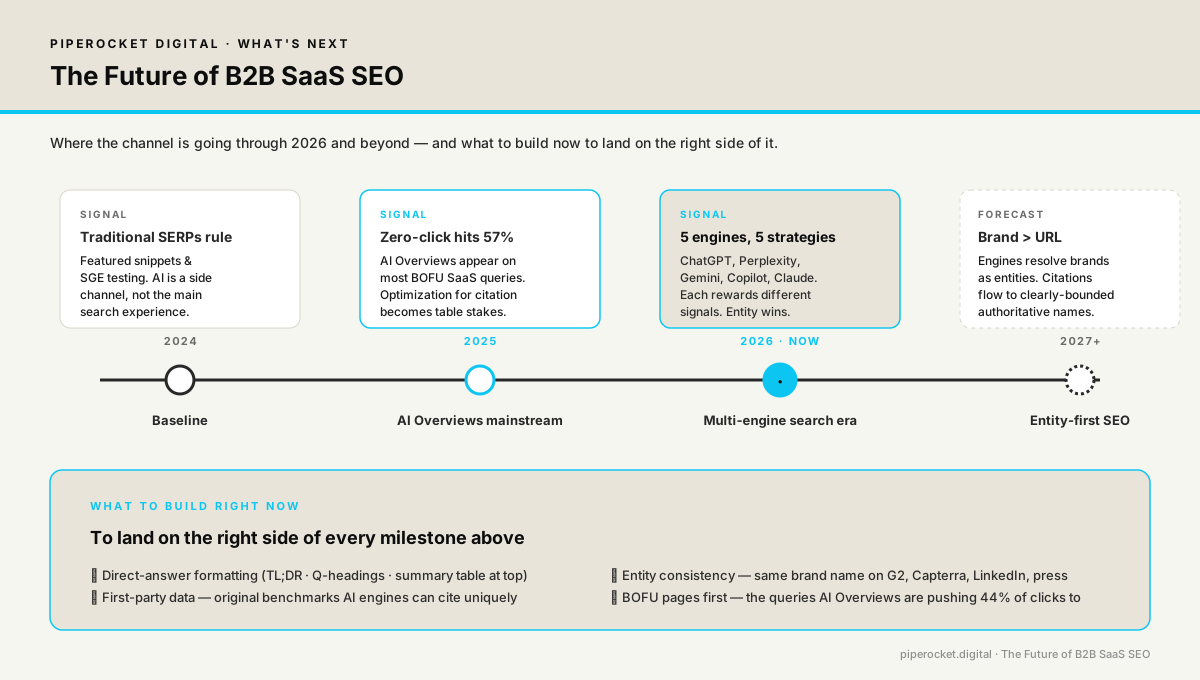
The future of B2B SaaS SEO is being cited inside AI answers, not just ranked beneath them. As zero-click search and AI-generated answers absorb more of the results page, the win shifts from “rank the URL” to “be the source the AI quotes.” Build for extractability now.
Three shifts define what to build for:
- Zero-click is now the default. SparkToro and Similarweb found that about 68% of US Google searches ended without a click across the first four months of 2026, so featured snippets, structured data , and direct answers matter more than ever.
- AI Mode is mainstream. At Google I/O 2026, Google rebuilt Search around Gemini and pushed AI Mode to the forefront, calling it the biggest upgrade to Search in over 25 years (Google ). AI Mode has surpassed one billion monthly users, while AI Overviews reach about 2.5 billion.
- Authority still wins, but deeper. High-authority content survives, but it must be expert-led, first-party, and genuinely worth citing. Brands that pair solid SEO fundamentals with real expertise stand out in AI-driven search.
Generative Engine Optimization (GEO) for B2B SaaS
Generative Engine Optimization (GEO) is the practice of formatting B2B SaaS content so AI answer engines (AI Overviews, ChatGPT, Perplexity, Gemini, Copilot) can extract and cite it. Lead each section with a self-contained answer, keep facts atomic and sourced, and stay consistent about your brand entity so the machine trusts and quotes you.
For B2B SaaS specifically, GEO means:
- Front-load direct answers. Open every page and section with a complete, liftable claim before the context, so an engine can quote it cleanly.
- Use first-party data. Original benchmarks and named case studies give AI engines something only you can be the source for.
- Keep the entity consistent. Use the same brand name, product names, and category language everywhere so answer engines resolve you as one trusted entity.
- Structure for extraction. FAQ blocks, comparison tables, and structured data give both AI Overviews and traditional snippets clean units to pull.
Conclusion
Effective B2B SaaS SEO is more than just rankings; it generates steady, measurable revenue. It starts with an in-depth understanding of your ICP, tracing the intent of the buyer all the way down the funnel, and producing content that answers the questions that buyers have when making real purchases. Build authority by entering into relationships with partners, fostering relationships in the ecosystem, and releasing content based on credibility rather than using individual backlinks.
Measure pipeline (not only the number of pageviews) by connecting the organic performance to your CRM, and measure how SEO is driving demos, trials, and ARR. If you would rather hand this execution to a specialist, compare the best B2B SEO agencies before you commit. Intent, authority, and trust-focused brands will continue to achieve visibility and motivate customers to make purchases even with AI-driven searches, and turn organic traffic into close deals.
Frequently Asked Questions
What is B2B SaaS SEO?
B2B SaaS SEO refers to the process of optimizing a SaaS firm’s website to attract high-intent business buyers through organic search. It focuses on keywords at all phases of the buyer’s journey: problem awareness, solution comparison, and product evaluation. This is done using technical SEO , content strategy, performance tuning, and authority building.
In contrast to traditional SEO, it places more importance on the quality of leads rather than the traffic volume, where the goal is to convert a visitor into a demo, trial, or long-term customer.
What is the difference between B2B SaaS SEO and SaaS SEO?
SaaS SEO is the broad discipline: it optimizes any software product for search, including self-serve and B2C audiences, and often optimizes for sign-ups and traffic volume. B2B SaaS SEO is the B2B-specific layer on top of it, built to sell software to businesses.
The B2B layer changes four things: it targets a roughly 10-person buying group instead of one buyer, prioritizes high-intent low-volume ICP long-tail keywords over broad head terms, leans on product-led content plus comparison and bottom-of-funnel pages that drive demos, and measures pipeline (MQLs, SQLs, ARR) instead of raw users. Think of this guide as the B2B drill-down; the general SaaS SEO pillar is the entry point.
How to implement a successful B2B SaaS SEO strategy?
A successful B2B SaaS SEO strategy begins with identifying your ICP and mapping keywords with all the buyer-journey phases. Next, optimize the technical foundation of your site for speed, crawlability, and clear message delivery. Develop a content pipeline that consists of problem-aware, solution-aware, product-aware topics, including comparison and feature pages.
Establish power through backlinks, online PR, and partners. Continuously optimize conversion paths like demo pages, trial pages, and CTAs. Lastly, track performance using pipeline metrics like MQLs, SQLs, and revenue contribution, and not just traffic. If you would rather have a senior specialist build and run this with your team, work with a SaaS SEO consultant .
Is SEO worth it for B2B SaaS?
Yes. B2B SaaS SEO delivers lower CAC and compounding pipeline versus paid, because product-led and comparison pages keep converting after you publish them. It only pays off when you track it to MQLs, SQLs, and ARR, not just traffic.
Does SEO work for B2B?
Yes. SEO works for B2B when it targets high-intent ICP long-tail and BOFU comparison queries and ties organic visits to demos and pipeline. Buyers research earlier now, so ranking for evaluation-stage terms captures qualified demand.
Which agency is best for B2B SaaS SEO?
The best B2B SaaS SEO agency is one with proven SaaS pipeline results, ICP-led content, and CRM attribution, not just ranking reports. Compare options in our best B2B SEO agencies roundup before you commit.