How to Attribute SEO to Pipeline (B2B SaaS Method)
 Ranjeeth Kumar
Last updated on
Ranjeeth Kumar
Last updated on
Most SaaS teams can tell you their organic traffic to the decimal and have no idea which deals it sourced. The session count is wired up perfectly. The path from “organic visitor” to “closed-won opportunity in the CRM” is held together with guesswork.
That gap is mechanical, not philosophical. You don’t need a new reporting belief. You need the source stamped on the lead and carried into the CRM so a closed deal can be traced back to the page that started it.
Here’s the exact method we use to attribute organic search to pipeline, page by page.
TL;DR
- Attribution is a wiring problem, not a reporting opinion: Organic gets blamed for traffic and starved of revenue credit because the source is never stamped on the lead and carried into the CRM.
- Instrument the source first: Capture the channel, landing page, and a session identifier on every form, then pass them into the CRM as fields on the contact and the deal.
- Stitch organic to the CRM record, not the dashboard: A lead is only attributable when its first organic touch lives on the same record as the closed-won amount.
- Assign first-touch and multi-touch credit deliberately: Last-touch alone makes top-of-funnel content look worthless, so run first-touch and multi-touch views in parallel.
- Accept the limit and report two numbers: Some organic influence shows up as branded and direct, so separate the credit you can prove from the influence you can only infer.
Why Your Analytics Can’t Attribute SEO to Pipeline on Its Own
Your analytics tool stops at the session, so it can never tell you which deal organic sourced. It knows a visitor came from organic search and viewed four pages. It has no idea that visitor became a $40,000 contract eight weeks later, because the deal lives in a different system.
That’s the whole problem in one sentence. The traffic data and the revenue data sit in two tools that don’t talk, and attribution is the act of connecting them on a single record.
Most teams try to solve this in the analytics tool. They build goal funnels, set up conversion events, and stare at “organic conversions” hoping it means pipeline. It doesn’t. A form fill is a conversion event. Whether that form fill became qualified pipeline or closed revenue is a fact that only exists in the CRM.
Our team treats attribution as plumbing. The honest version of this is uncomfortable: no B2B SaaS company has organic attribution perfectly solved, and anyone who says they do is reading a clean dashboard that hides the leaks. The buyer journey crosses devices, sessions, and untracked channels, so some signal is always lost.
Warning: A pretty attribution dashboard is more dangerous than no dashboard. If your tool shows “organic sourced $200K pipeline” but the number was never reconciled against the CRM, you’re reporting a model’s guess as a fact, and one question from finance will expose it.
The fix isn’t a better belief about SEO . It’s three pieces of wiring:
- Stamp the source on the lead.
- Carry it into the CRM.
- Decide how credit gets assigned.
The rest of this guide is those three steps.
Step 1: Instrument the Source on Every Lead
Stamp the channel and entry page onto every lead at the moment it’s created, before anything else. If the source isn’t captured at form submission, it’s gone, and no tool can reconstruct it later with confidence.
Most teams already have analytics firing on the page. What they’re missing is the handoff: the source data never travels with the lead into the CRM. So you capture it explicitly. On every form, pass hidden fields that record:
- The channel and source (organic, the search engine)
- The first landing page that brought them to the site
- The landing page of the converting session
- A timestamp for the first known touch
Those fields ride along with the email and name into your CRM as properties on the contact. Now the lead arrives already labelled. You’re not asking the analytics tool “was this organic?” weeks later. The answer is written on the record from the start.
There’s a device-and-session catch here worth naming. Someone reads your comparison page on a phone at lunch, then fills the demo form on a laptop that evening. To the tools, that’s two visitors. First-touch organic credit on the phone session never reaches the form fill on the laptop unless you’ve got cross-device identity resolution, which most SaaS stacks don’t fully have.
Don’t let that stop you. Capture what you can capture cleanly, label it honestly, and accept that a slice of first touches will be lost. A method that attributes 80% of leads reliably beats one that claims 100% and breaks under scrutiny.
Step 2: Stitch Organic to the Deal Inside the CRM
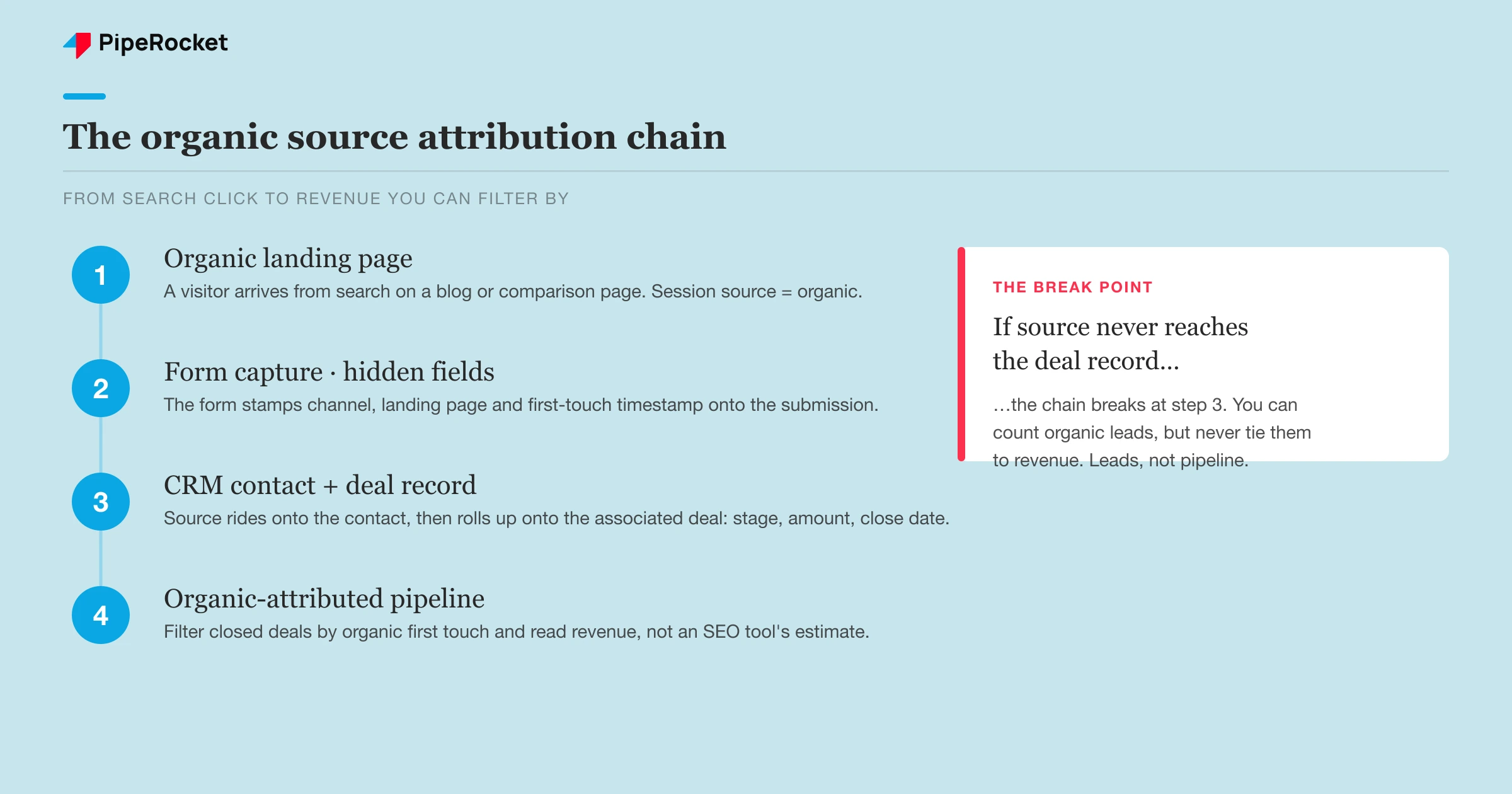
Attribution happens on the CRM record, not in the analytics dashboard, so the channel field has to live on the same object as the closed-won amount. A lead source sitting on a contact while the revenue sits on a deal it isn’t linked to is data you can’t use.
This is the step most teams skip, and it’s the one that actually proves pipeline. Here’s the chain that has to connect end to end:
- The contact carries the organic source captured in Step 1
- The contact is associated with a deal or opportunity
- The deal carries stage, amount, and close date
- The original organic source rolls up so you can filter deals by it
When that chain holds, you can ask the only question that matters: of the deals that closed this quarter, how many carried an organic first touch, and what were they worth? That’s organic-attributed pipeline, and it’s a number from your revenue system, not an SEO tool’s estimate.
Set Up the CRM and Reporting Stack to Carry It
You need a CRM that holds source data on the deal and a way to fill the cross-session gaps. Our own stack does this with HubSpot as the CRM and pipeline system of record, GA4 and Search Console for the organic behaviour layer, and Factors.ai sitting on top to handle reverse-IP identification and stitch touchpoints into pipeline influence. The combination matters more than any single tool.
The reason for the third layer is the device problem from Step 1. A reverse-IP and identity tool catches a chunk of the touches that go dark when a buyer switches devices or comes back days later. It won’t catch everything, but it turns “we lost that path” into “we recovered most of that path,” which is the difference between a defensible number and a shrug.
A compliance SaaS for fintech teams, for instance, might see a security lead read three organic comparison pages , vanish, then book a demo through a sales rep weeks later. Without the stitch, that deal reads as “sales-sourced.” With it, the comparison pages get the first-touch credit they earned.
Step 3: Assign First-Touch and Multi-Touch Credit on Purpose
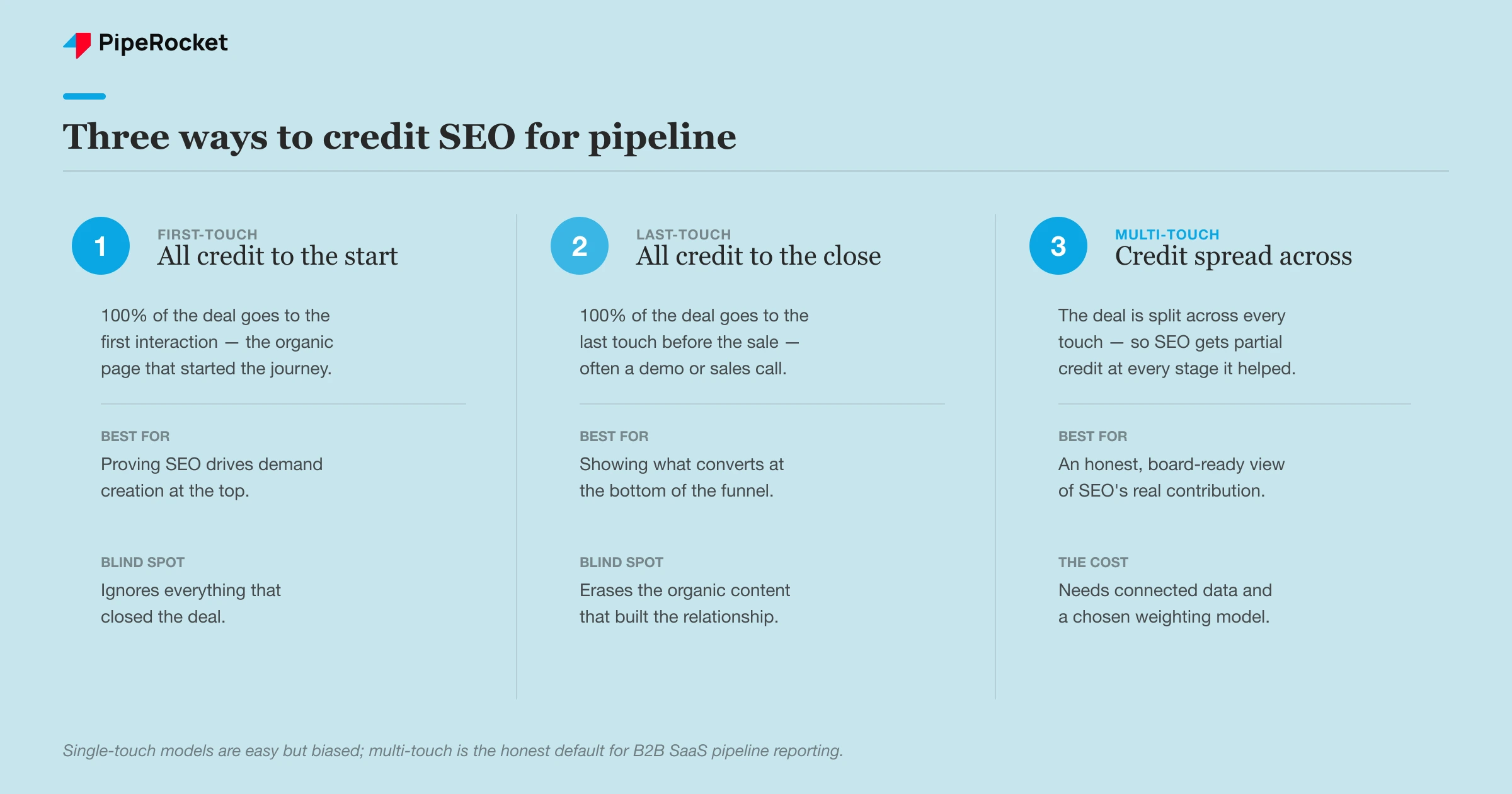
Decide how credit gets split before you report, because the model you pick changes which pages look valuable. Run one model blindly and you’ll defund the wrong content. The two questions are who gets credit and how much.
The trap is last-touch. It hands all the credit to whatever page sat closest to the conversion, usually a demo or pricing page, and gives zero to the top-of-funnel content that started the relationship. Judge SEO on last-touch alone and your blog library looks worthless while your bottom-of-funnel pages look like the whole show. Both readings are wrong.
So run more than one view in parallel and read them together:
| Model | What it credits | Best used for |
|---|---|---|
| First-touch | The page that started the relationship | Valuing top-of-funnel and discovery content |
| Last-touch | The page closest to the conversion | Valuing bottom-of-funnel and decision pages |
| Multi-touch | A share to every page in the path | Seeing the full organic contribution to a deal |
First-touch tells you which content opens relationships that eventually close. Last-touch tells you which pages seal them. Multi-touch spreads credit across the path so an early blog post and a late comparison page both show up in the same closed deal. You want all three, not a winner.
The honest read is that no single model is “correct.” Each is a lens, and the channel influence often only becomes clear when you stop asking “which touchpoint gets the credit” and start asking “what actually moved this deal.” Our team has watched a Factors report make this concrete in a paid context, where one channel was driving the awareness and another was closing, and neither looked right alone under last-click. The same logic governs organic: the assist is real even when it isn’t the last click.
The branded-search bump attribution kept missing
Step 4: Report Provable Pipeline and Influenced Pipeline Separately
Split your number into what the CRM can prove and what organic clearly influenced but can’t claim cleanly. Collapsing them into one figure is how attribution loses a finance team’s trust, because the influenced portion never survives a hard question.
Some organic impact will never carry an “organic” tag. A buyer reads your content, doesn’t convert, then comes back days later by typing your brand name straight into Google, and standard attribution files that as branded or direct. Across the accounts we’ve worked, branded and direct conversions tend to climb in the months that content investment ramps, which is the dark funnel showing up indirectly.
The right response is to report two layers and label them honestly:
- Provable organic pipeline: deals in the CRM that carry a captured organic touch. This is your defensible floor.
- Influenced pipeline: branded and direct growth that tracks with organic investment. Directional, presented as context, never folded into the headline number.
Keep them in separate columns. The provable number is what you take into a budget review. The influenced number explains why branded search keeps rising while you invest in organic. A leader trusts “here’s what I can prove, and here’s what I believe is also happening” far more than one suspiciously clean figure.
Common Mistakes That Break SEO Attribution
The fastest way to lose trust in an attribution number is to wire it sloppily and report it confidently. A few patterns do it every time.
Capturing Source on the Contact but Not the Deal
This is the wiring mistake that quietly caps everything downstream. The lead source lands on the contact or lead record, the revenue lives on the opportunity, and if nothing copies the source across, the two never meet. You can count organic leads all day but never organic revenue, which is the only number leadership cares about.
Fixing it is a two-step wiring job:
- Stamp original source on the contact when it’s created.
- Carry that value onto the opportunity automatically, so every closed deal already knows the channel that started it.
Running Last-Touch as the Only Model
This is the single most common attribution error in B2B SaaS, and it’s the most expensive. Last-touch hands all the credit to the final click before the form fill, which in a long sales cycle is almost always a branded search or a direct visit. The top-of-funnel content that actually started the relationship gets zeroed out, and a few quarters later someone proposes cutting the exact blog posts feeding the pipeline.
Last-touch is fine as a simple view, but only ever alongside a multi-touch model. On its own it should never decide what content lives or dies.
Trusting the Analytics Tool’s “Conversions” as Pipeline
A “conversion” in your analytics or ads platform (a “key event,” in current GA4 terms) is a form fill, a demo request, or a button click. It is not a qualified opportunity and it is certainly not revenue. Teams report these numbers because they’re easy to pull, then get caught when finance reconciles them against the CRM and finds a chunk of those events were students, competitors, or junk leads that never became pipeline.
Until a number has been reconciled against closed-won data in the CRM, treat it as a proxy and label it as one. Proxies don’t survive scrutiny in a revenue review.
Reporting Influenced Pipeline as if It Were Proven
Branded lift, direct-traffic lift, and assisted touches are all real signal, and organic genuinely drives pipeline that standard attribution never credits back. The mistake is baking that believed-influence into the headline figure as if it were proven, because one sharp question about methodology and the whole report wobbles.
Report the two as distinct layers instead:
- Provable pipeline: directly attributed, and your floor.
- Influenced pipeline: clearly labelled as directional, sitting on top.
Candor about the line between them reads as more credible, not less.
How PipeRocket Wires SEO Attribution to Pipeline
We build the plumbing before the report. As a SaaS SEO agency , we instrument source capture on your forms, stitch organic touches onto the CRM deal record, and stand up first-touch and multi-touch views so each page gets the credit it actually earned.
We separate the pipeline we can prove from the branded influence we can only infer, so the number holds up in a revenue review instead of collapsing under one question. If you want organic attributed properly, reach out to us and we’ll wire it with you.
Frequently Asked Questions
How do you attribute SEO to pipeline in a B2B SaaS company?
You capture the organic source on every lead at form submission, carry it into the CRM as a field on both the contact and the deal, then filter closed-won deals by that source. The pipeline number comes from your revenue system, not an SEO tool.
Because B2B buyers cross devices and sessions, you pair this with an identity or reverse-IP layer to recover touches that would otherwise go dark. The result is a count of deals that carried an organic first touch and what they were worth.
What attribution model is best for SEO?
There isn’t one. First-touch credits the page that started the relationship, last-touch credits the page closest to the sale, and multi-touch spreads credit across the whole path. Last-touch alone is the trap, because it zeroes out the top-of-funnel content that opens relationships organic later closes. Run first-touch and multi-touch in parallel and read them together rather than picking a single winner.
Why is SEO so hard to attribute to revenue?
Because the buyer journey crosses tools, devices, and untracked channels that no single system sees end to end. A visitor can read your content on a phone, return on a laptop weeks later, and convert through a brand search that gets filed as direct.
The analytics tool stops at the session and the revenue lives in the CRM, so attribution is the work of connecting them on one record while accepting that some signal is always lost. The honest method proves what it can and labels the rest as influence.