How to Measure Organic CAC for SaaS (the Right Way)
 Vignesh Sampath
Last updated on
Vignesh Sampath
Last updated on
Most SaaS teams quote one CAC number for the whole company and think they’ve measured SEO. They haven’t. A blended CAC tells you what acquisition costs on average, which is exactly the number that hides whether organic is your cheapest channel or a money pit.
Here’s how we actually pull organic CAC apart from the blend: fully-loaded organic cost on top, customers organic sourced on the bottom, measured on a curve instead of a single month.
TL;DR
- Blended CAC hides the organic story: One company-wide CAC averages paid and organic together, so a cheap, compounding SEO channel and an expensive paid one look like one mediocre number.
- The numerator is where teams cheat: Fully-loaded organic cost means agency or salaries, tools, content, design, and internal hours, not just the line item you remember.
- Count customers, not leads, on the bottom: Organic CAC uses customers organic actually sourced in the period, with a clear attribution rule you don’t change between reports.
- Organic CAC reads wrong in a single month: SEO costs are front-loaded and customers arrive late, so an honest read needs a trailing 6-to-12-month window.
- Paid CAC is a floor; organic CAC is a slope: Paid resets to roughly the same cost every month, while organic CAC keeps falling as old content compounds.
Why Blended CAC Is the Wrong Number for SEO
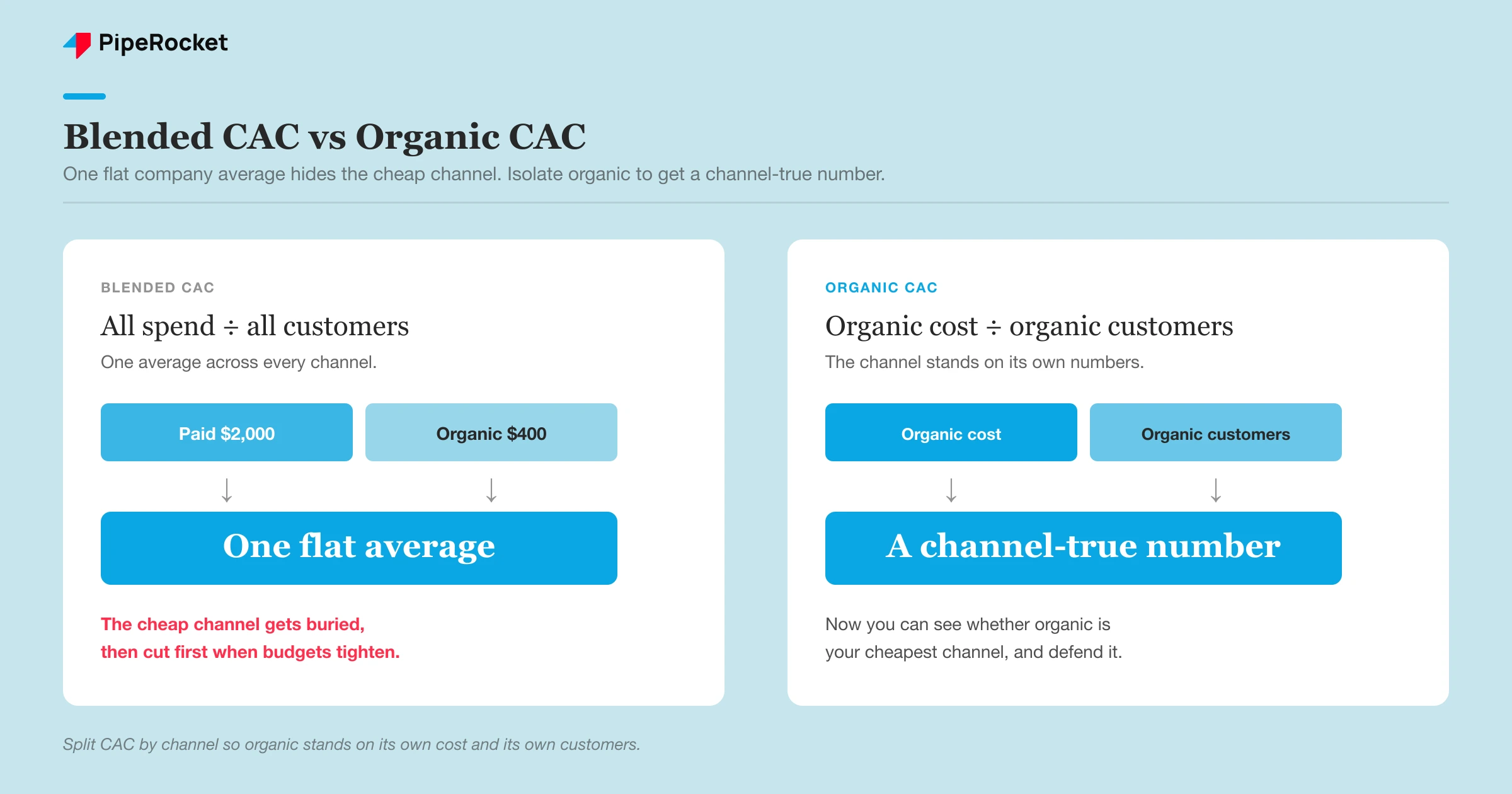
Blended CAC is the number that gets SEO defunded. It takes every dollar of acquisition spend, divides by every customer, and hands you one average that treats a $400 organic customer and a $2,000 paid customer as the same thing.
That average is useful for a board slide and useless for a channel decision. If organic is quietly acquiring customers at a third of your paid cost, the blend buries that. Leadership sees a flat company CAC, can’t tell which channel is pulling weight, and cuts whichever one is hardest to defend, which is almost always organic.
So the first move isn’t a fancier dashboard. It’s splitting CAC by channel so organic has to stand on its own cost and its own customers.
The fix is one denominator change. Stop dividing total spend by total customers and start asking, for organic search specifically:
- What did we spend to run the channel this period?
- How many customers did organic actually source?
That’s organic CAC. Everything else in this guide is making those two numbers honest.
Note: This is a different question from proving the channel pays for itself. The full return ratio is its own exercise; here we’re only building the cost-per-customer number that feeds it.
The Organic CAC Formula (and the Costs People Forget)
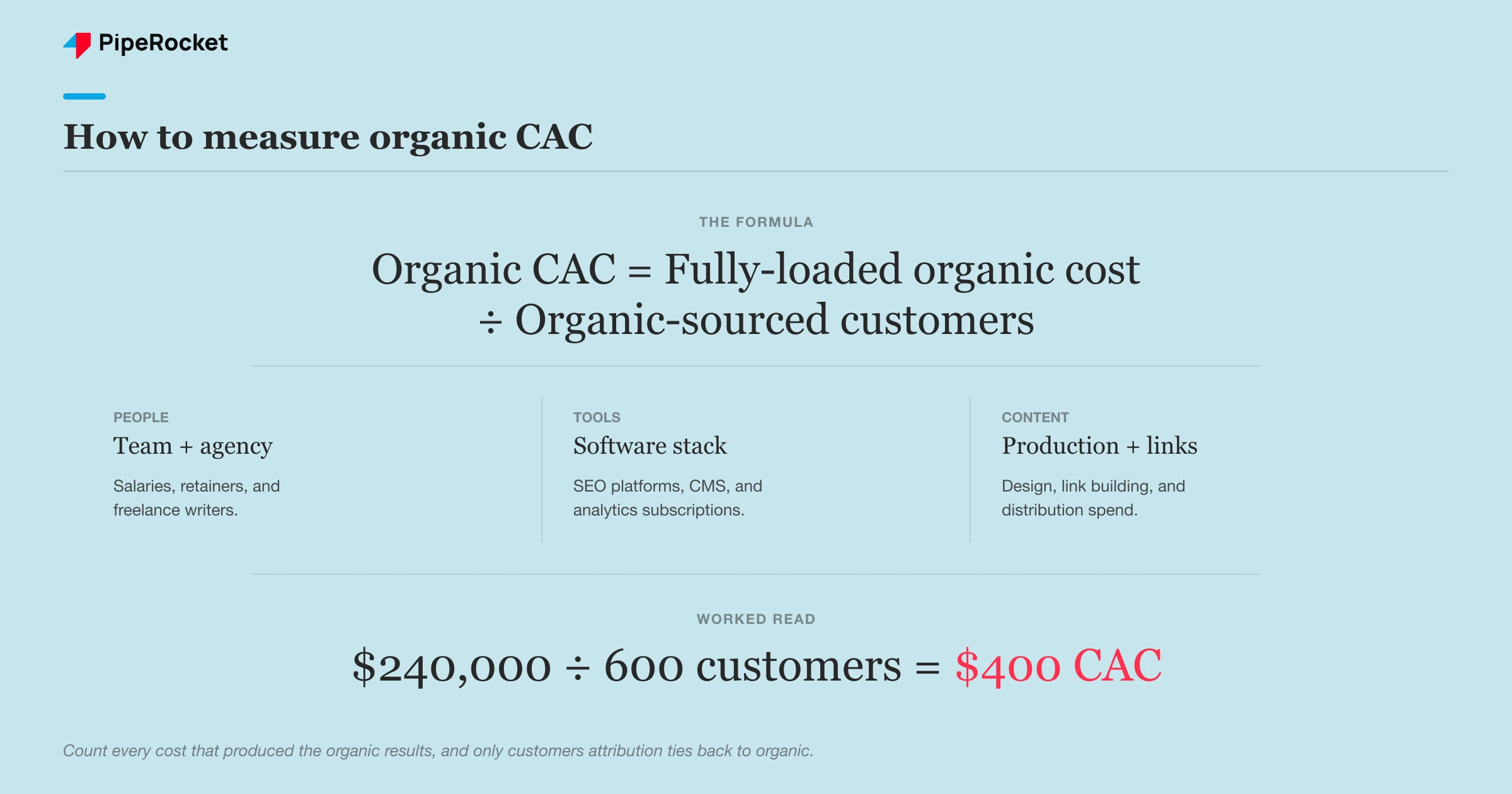
Organic CAC is fully-loaded organic cost divided by customers sourced from organic in the same period. The formula is simple. The numerator is where almost everyone undercounts.
Most teams put their agency retainer on top, divide by customers, and call it organic CAC. That number is fiction, because it ignores most of what the channel actually costs to run. A real numerator is fully loaded.
Here’s what belongs in the organic cost line:
- Agency fees or in-house SEO salaries (loaded with benefits)
- Tools (rank tracking , crawlers, content and reporting software)
- Content production and design
- Internal time from people who aren’t on the SEO team but work on it
That last one is the one teams forget. The product marketer who reviews every brief, the designer who builds the infographics, the founder who sits for a 30-minute interview so the content has a real point of view, all of that is organic cost. Leave it out and your CAC looks better than it is, which feels nice until finance rebuilds the number and trust evaporates.
There’s a tooling trap worth naming too. Across the work we’ve done, the software line adds up faster than anyone expects once you stack rank tracking, a crawler, a content tool, and the reporting stack that assembles the quarterly deck. Be honest about it, because a clean-looking CAC built on a hidden cost base is the fastest way to lose a finance team.
Customers, Not Leads, Go on the Bottom
Put customers on the denominator, not leads or sign-ups. CAC is cost per acquired customer, and the moment you divide by leads instead you’ve quietly invented a much smaller, much prettier number that isn’t CAC at all.
This matters more for organic than people expect, because organic volume can be large and low-intent. Take the volume-trap math our team runs before writing anything:
- a 1,000-search keyword, even ranking top three, brings maybe 100 clicks
- at a typical SaaS conversion rate of 2 to 4%, that’s 4 to 5 customers, not 100
Divide your cost by the clicks and CAC looks tiny. Divide by the 4 to 5 customers who actually bought and you get the real number.
You get the customer count by tagging the source in your CRM, so every closed deal carries the channel that created it. If your stack can’t trace a closed deal back to organic search yet, that’s step zero, because you can’t measure CAC on a channel you can’t attribute.
How to Read Organic CAC Over Time, Not in a Single Month
Never judge organic CAC on one month. SEO costs land up front and the customers show up late, so a single-month snapshot will look catastrophic early and unrealistically cheap later, and neither reading is true.
Picture the first quarter of a new SEO program. You’re paying for content, tools, and people, and almost nobody has bought yet because the pages aren’t ranking. Run the formula on month one and your organic CAC is enormous, sometimes higher than paid. That’s not the channel failing. That’s the channel loading.
Now run the same formula 12 months in. The content you paid for in month one is still ranking, still bringing customers, and you’ve stopped paying to produce it. The cost is flat or falling while the customer count climbs, so CAC drops, then keeps dropping.
That’s why the honest unit is a trailing window, not a calendar month:
- Use a trailing 6-to-12-month period so the lag and the compounding both show up
- Hold the same window every time you report, so the trend is comparable
- Watch the direction of the curve, not the single value
Warning: A one-month organic CAC is the number a skeptical CFO will use to kill the channel in quarter one, right before it starts working. If you report it monthly, you’re handing over the worst possible reading at the worst possible moment. Report the trend, and explain that early CAC is supposed to look high.
Organic CAC vs Paid CAC: a Floor vs a Slope
Paid and organic CAC behave so differently that comparing their raw numbers in a single month is almost meaningless. Paid CAC is a floor you reset to every month. Organic CAC is a slope that keeps bending down.
With paid, the moment you stop spending, the customers stop. Next month you pay roughly the same cost for roughly the same customers, and when you try to scale, CAC usually rises, because the cheap clicks run out first.
We’ve seen this on the paid side directly: push a budget past its ceiling and clicks that cost $30 start costing $70, so doubling spend never doubles customers. Paid CAC has a floor it rarely drops below.
Organic is the opposite. The cost to keep a ranking page live is far lower than the cost to build it, so each month the same content acquires more customers at less marginal cost. The table below is the comparison that actually matters:
| Paid CAC | Organic CAC | |
|---|---|---|
| Behavior over time | Flat, resets monthly | Falls as content compounds |
| When you stop spending | Customers stop immediately | Customers keep arriving |
| Effect of scaling | CAC usually rises (CPC ceiling) | Marginal CAC keeps dropping |
| Best read | Monthly is fine | Trailing 6-to-12 months |
| What it’s good for | Speed, predictable volume | Lowest long-run cost per customer |
This is the real argument for SEO, and it’s a CAC argument, not a traffic one. The catch is patience, because the slope only bends down if you fund the channel through the ugly early months when its CAC honestly looks worse than paid.
There’s also a payback nuance hiding here. CAC payback (how long until a customer’s gross margin repays what you spent to get them) looks brutal for organic in the first months and excellent later, for the same compounding reason. Judge payback on the same trailing window, or you’ll quit a channel right before its CAC crosses below paid.
A Quick Worked Read So the Number Feels Real
Walk one period through end to end so the formula stops being abstract. Take a compliance SaaS for fintech teams running organic for a year.
Add up the fully-loaded organic cost for the trailing 12 months:
- the in-house SEO salary
- the tool stack
- content and design
- the internal hours from product marketing and the founder’s interview time
That total is the numerator, not just the obvious line.
Then pull the denominator from the CRM: every closed-won deal tagged as organic-sourced over the same 12 months, using one attribution rule you don’t change. Divide cost by customers and you have organic CAC for the period.
Run it again next quarter on the same trailing window. If the program is healthy, the number is lower than last quarter even though you kept investing, because the content you already paid for is still acquiring customers. That falling line, quarter over quarter, is the whole point of measuring organic CAC instead of blending it away.
Common Mistakes That Make Organic CAC Lie
The fastest way to get organic CAC wrong is to make the numerator small and the denominator big. A few patterns do it every time.
Counting Only the Agency Invoice
The most common way to understate organic CAC is to put only the agency retainer in the numerator. The channel costs far more than that:
- the SEO tooling stack
- content production and freelance writers
- design and dev time for landing pages
- the internal hours your own team spends managing the work
Drop those and CAC looks impressive right up until finance asks what else the channel consumes, at which point the number collapses. Use the fully-loaded cost from the start; a higher, honest CAC you can defend beats a flattering one that falls apart under a single follow-up.
Dividing by Leads Instead of Customers
CAC is cost per acquired customer, not cost per lead, and that distinction matters most for organic, because organic produces a high volume of low-intent leads. Divide your organic spend by leads and you get a number that looks far better than reality and answers a question nobody asked.
The denominator has to be closed customers. Track cost per qualified opportunity separately if you want an intermediate metric, but never let it stand in for CAC in a finance conversation.
Reading One Month and Reacting
Early organic CAC is supposed to look terrible. You’re spending against content that hasn’t ranked yet, so the cost is real and the customers haven’t arrived.
Reacting to a single bad month is how teams kill a channel in the exact quarter before it compounds. Read organic CAC on a trailing window, three to six months at minimum, and judge the slope rather than any single point. The whole value of organic is that the cost is front-loaded and the customers compound behind it.
Changing the Attribution Rule Between Reports
If you count organic customers one way this quarter and a different way the next, the trend line is meaningless, and the trend is the only thing organic CAC is actually good for.
What protects it is a locked definition: the same attribution model, the same window, and the same rule for what counts as an organic customer, held every quarter even when an unflattering month tempts you to adjust it. That consistency is what lets the number show whether the channel is getting cheaper as it scales.
How PipeRocket Measures Organic CAC With You
We don’t quote one blended CAC and leave it there. As a SaaS SEO agency , we isolate the organic channel: fully-loaded cost on top, CRM-tagged organic customers on the bottom, and a trailing window so the compounding actually shows up in the number.
We separate organic CAC from paid CAC so you can see the slope, not just an average, and decide where the next dollar earns its lowest cost per customer. If you want SEO measured as the falling-cost channel it is, reach out to us and we’ll build it with your real numbers.
Frequently Asked Questions
How do you calculate customer acquisition cost from organic search?
Divide the fully-loaded cost of running your SEO program over a period by the number of customers organic search sourced in that same period. The cost has to include the team or agency, tools, content production, design, and internal hours, not just the obvious invoice.
The customer count comes from tagging organic-sourced deals in your CRM and counting closed customers, not leads. Use a trailing 6-to-12-month window rather than a single month, because SEO costs land early and the customers arrive later.
Why is organic CAC lower than paid CAC for SaaS?
Because organic compounds and paid doesn’t. A page you paid to produce keeps ranking and acquiring customers for months or years after the cost was spent, so each new customer it brings costs almost nothing at the margin.
Paid acquisition resets every month, you pay roughly the same cost for the same customers, and scaling usually pushes CAC up as cheap clicks run out. Over a long enough window, organic’s cost per customer keeps falling while paid’s stays flat, which is why blended CAC hides organic’s real advantage.
Should I measure organic CAC monthly or over a longer period?
Measure it over a trailing 6-to-12-month window, not month to month. SEO costs are front-loaded while the customers arrive on a lag, so a single-month organic CAC reads far too high early in a program and unrealistically low once content matures.
A trailing window lets both the lag and the compounding show up honestly, and holding the same window every report makes the trend comparable. The direction of the curve, falling quarter over quarter, tells you more than any single month’s value.