SaaS Product Marketing Strategy: A Practitioner Guide
 Kamaraj Mathiarasan (Kim)
Last updated on
Kamaraj Mathiarasan (Kim)
Last updated on
Most SaaS teams treat product marketing as launch logistics: write the blog post, brief the sales team, ship the email, move on. That’s a fraction of the job. Product marketing owns the whole market side of the product, who it’s for, why it beats the alternatives, and how every other team tells its story.
Get that right and demand gen has something to convert against, sales has words that land, and the roadmap points at problems buyers actually pay to solve. Get it wrong and you ship features into silence.
TL;DR
- What it is: SaaS product marketing owns the market side of the product: the target buyer, the reason to choose you, the launch, and the story every team repeats.
- The remit: A product marketer sits between product, sales, and marketing and runs the SaaS product marketing strategy: research, positioning, launches, enablement, pricing input, and the connection to demand.
- Research first: Every good strategy starts with real buyer and competitor research rather than a template, because you can’t position a product you don’t understand.
- Positioning and messaging: These are PMM’s two hardest jobs, and each deserves its own deep process rather than a paragraph in a launch brief.
- Launches: Tier your launches so a minor release doesn’t get the same machine as a category-defining one, and your team survives the year.
- Enablement: The objection handling, battle cards, and talk tracks reps actually use in a live deal, rather than a polished deck that dies in a shared drive.
- Pricing input: PMM belongs in pricing and packaging decisions because packaging is a positioning decision wearing a spreadsheet.
- Demand and growth: Product marketing feeds demand gen the raw material and only counts when it moves pipeline rather than asset counts.
- Retention and expansion: PMM’s job doesn’t stop at the sale; onboarding messaging, lifecycle triggers, and expansion-revenue framing are part of the remit too.
What Is SaaS Product Marketing?
SaaS product marketing is the discipline that makes a product make sense to the market. A SaaS product marketing strategy decides who the product is for, what problem it solves better than the alternatives, and how that story shows up in every channel, from the pricing page to the sales call to the launch announcement.
The common belief is that product marketing is a support function: a service desk that produces assets when product or demand gen files a request. That framing is why so much of it feels like busywork. A product marketer who only writes copy on demand is a copywriter with a fancier title.
Real product marketing sets direction. It’s the team that can answer “why would anyone switch to us?” with a specific, defensible answer, then make sure sales, content, and the product roadmap all point the same way. The two framings pull in opposite directions.
| Framing | What you get | Where it breaks |
|---|---|---|
| PMM as an asset factory | Speed: launch content ships fast on demand | The moment the market crowds, fast generic assets sound identical to every rival’s, and buyers can’t tell you apart |
| PMM as a direction-setter | A defensible reason to switch that sales, content, and the roadmap all repeat | Slower to spin up, and it demands real buyer research before anyone writes copy |
In B2B SaaS, where the buyer is a committee and the sales cycle runs months, that alignment is the difference between a crowded category tuning you out and a shortlist that includes you.
What a Product Marketer Actually Owns
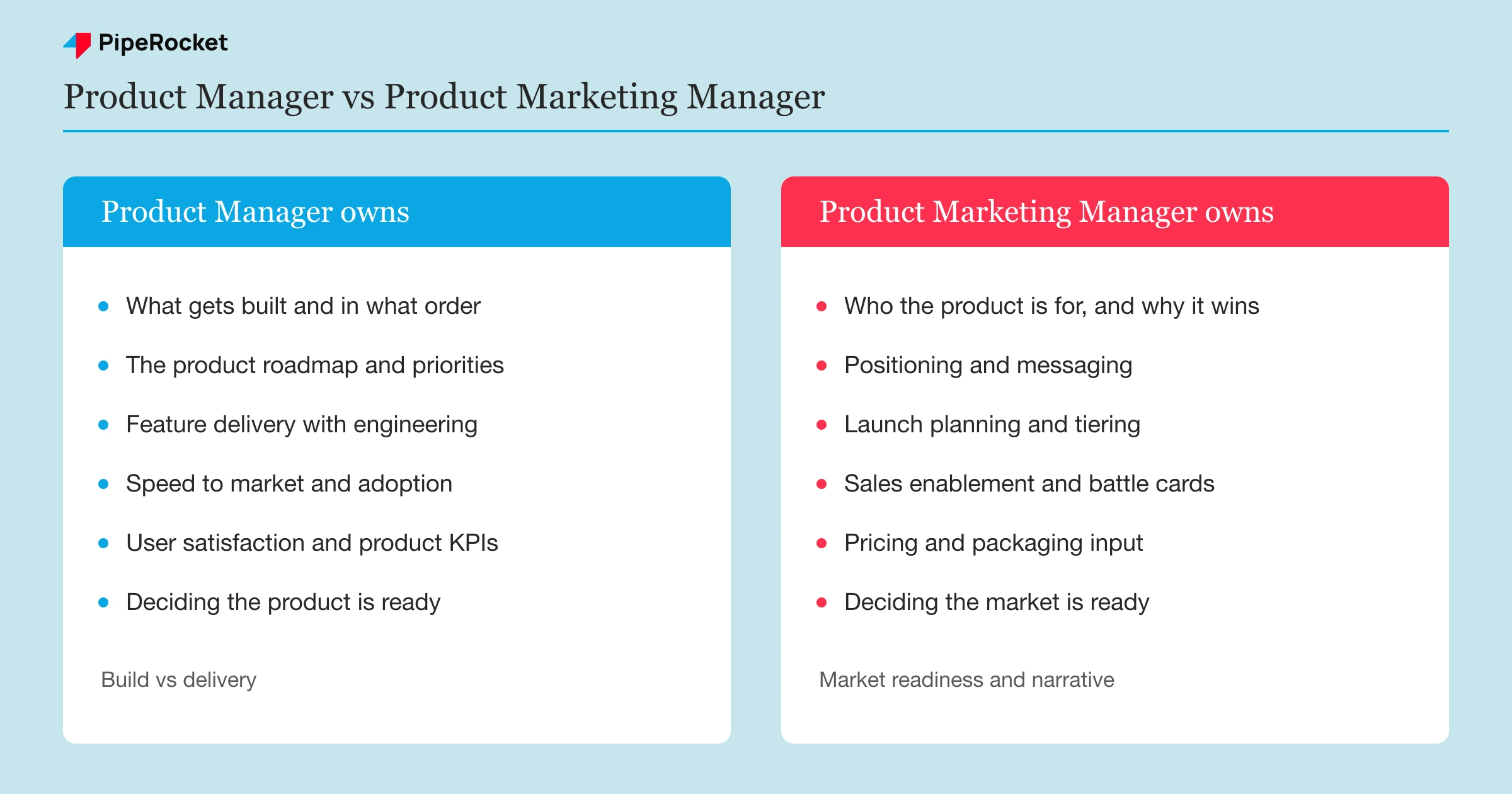
A product marketer owns market readiness and the narrative, while the product manager owns what gets built and shipped. That’s the cleanest line between the two roles, and it’s the first thing any SaaS product marketing strategy has to settle. PM decides the product is ready; PMM decides the market is.
The confusion is understandable because both roles carry “product” in the title and both live close to the roadmap. But they answer different questions. The product manager asks “what should we build and in what order?” The product marketer asks “who is this for, why will they choose it, and how do we tell them?”
The full PMM remit spans more than most job descriptions admit. Here’s how the responsibilities break down.
| Area | What PMM owns |
|---|---|
| Market research | Buyer interviews, win/loss analysis, competitive intel, category naming |
| Positioning | The defensible reason to choose you over rivals and over doing nothing |
| Messaging | The language that carries positioning into every asset and conversation |
| Launches | Go-to-market planning, launch tiering, cross-team coordination |
| Sales enablement | Battle cards, objection handling, demo narratives, talk tracks |
| Pricing and packaging | The buyer-value input that shapes tiers and price metrics |
| Demand support | The raw material demand gen and content turn into campaigns |
The line between PMM and product management
The practical test is direction of ownership. If a decision is about what the software does, it’s the product manager’s call. If it’s about how the market understands and buys the software, it’s the product marketer’s.
Both need each other. A product manager who ships without market readiness launches to silence, and a product marketer who positions without understanding the roadmap sells a story the product can’t back up. The best SaaS teams run these two roles as a tight pair instead of a sequential handoff. When they drift apart, you get products nobody asked for and launches nobody notices.
Start Every Strategy With Market and Buyer Research
Every SaaS product marketing strategy worth running starts with research before anyone touches a positioning template. You can’t decide why a product wins until you understand who’s buying, what they’re comparing you against, and the words they use when they describe the problem to a colleague.
The research that matters most is qualitative and unglamorous. It’s buyer interviews, win/loss calls, sales-call recordings, and support tickets. That’s where you hear the actual language, the real objections, and the moment a deal turned. Surveys and analyst reports give you the shape of the category. Conversations give you the words.
Run these four research inputs before you write a single positioning statement:
- Buyer interviews with recent wins and losses, to hear why they chose or passed
- Win/loss analysis to find the repeatable patterns across deals rather than one-off anecdotes
- Competitive intel on how rivals position, price, and pitch
- Category research on what analysts and buyers officially call this thing
One trap here is researching only the budget owner. In a SaaS deal the champion, the end user, and the economic buyer each search and evaluate differently, so research that talks to one persona builds a strategy blind to the other two.
We’ve seen the raw output of good research pay off far beyond a positioning doc. When a SaaS team feeds its content and campaigns the real inputs, the ICP ’s exact pain points, competitor battle cards, and the objections sales hears every week, everything downstream reads sharper and sounds like the brand actually thinks, instead of like a generic prompt. Better inputs, better everything.
Positioning and Messaging: PMM’s Two Hardest Jobs
Positioning and messaging are the two jobs a SaaS product marketing strategy lives or dies on, and they’re distinct. Positioning is the strategic decision about where your product sits in the buyer’s mind and why it wins. Messaging is the language that carries that decision into every asset and conversation.
Positioning answers a set of questions before any copy gets written:
- What market category are you competing in?
- Who is the product genuinely best for?
- What do you do that the alternatives can’t?
- What does a buyer give up by choosing something else?
Get positioning wrong and no amount of clever copy saves you, because you’re selling the right words about the wrong idea. This is a deep enough discipline that it deserves its own treatment, so we cover the full framework separately in our SaaS positioning guide rather than compress it here.
Messaging is where positioning meets the reader. It’s the hierarchy of what you say first, second, and third, the proof you attach to each claim, and the way that stays consistent whether a buyer lands on your homepage, reads a sales email, or hears a demo. Weak messaging is usually a symptom of fuzzy positioning rather than a copywriting problem. The full messaging architecture, how to build a message house and pressure-test it, gets its own deep dive in our SaaS messaging strategy guide.
The reason to keep these separate from launches and enablement is simple. Positioning and messaging are the source. Everything else, the launch, the deck, the pricing page, is a downstream expression of them. Fix the source and the expressions get easier. Skip it and you’re forever patching symptoms.
How to Run a Launch Without Setting the Company on Fire
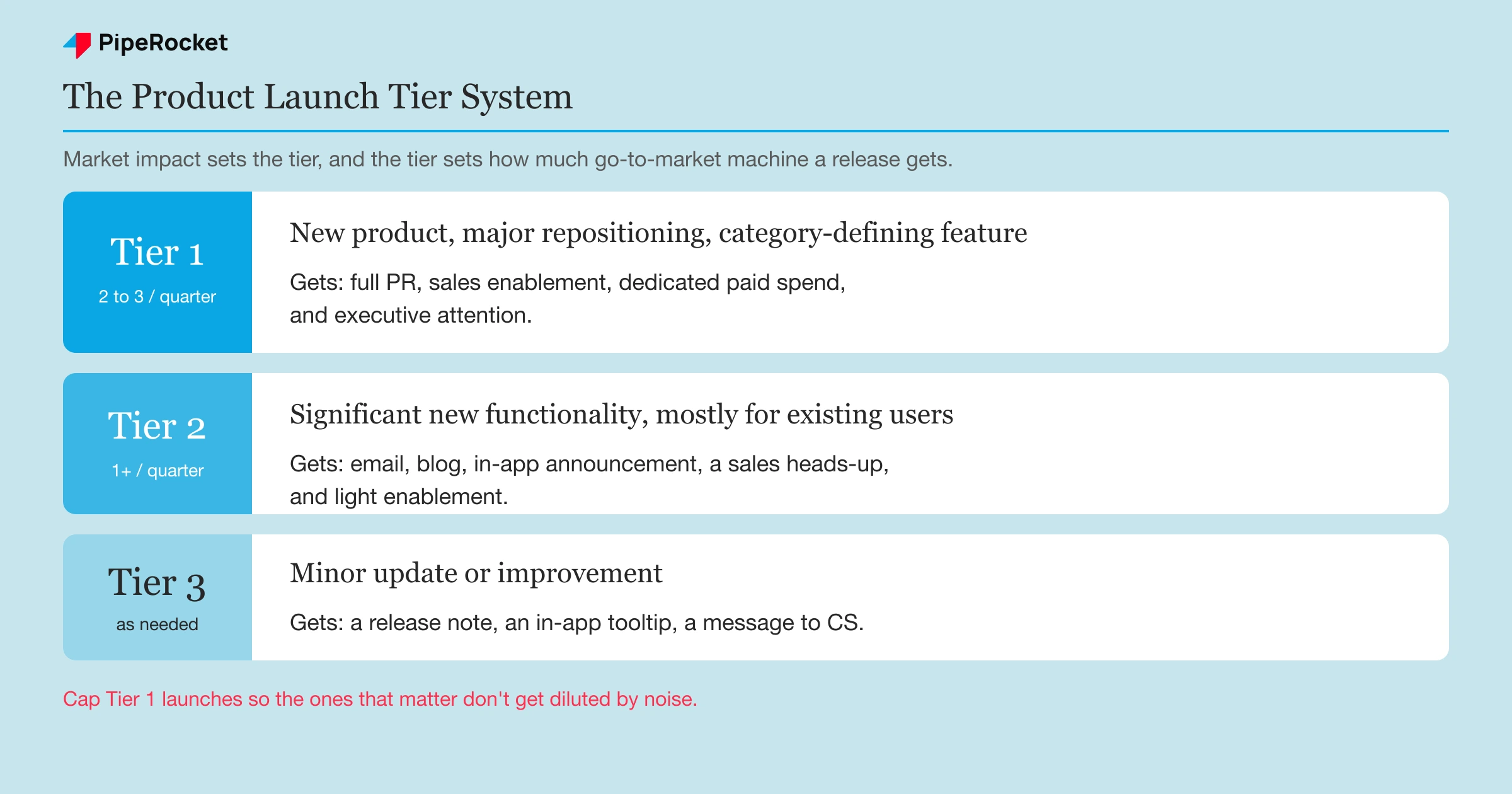
Inside a SaaS product marketing strategy, the single highest-leverage change most teams can make to launches is tiering them. Not every release deserves a full go-to-market motion, and treating a minor update like a category-defining product is how product marketers burn out and how real launches get diluted by noise.
A launch tier decides how much machine a release gets. It’s set by market impact rather than by how much engineering effort went in, so the tier reflects where a release sits in the wider SaaS product strategy. A tiny code change that touches pricing or forces sales to re-learn the demo is a big launch. A months-long backend rebuild that no buyer will ever notice is a small one.
Here’s the tiering most SaaS product teams settle on.
| Tier | What it is | What it gets |
|---|---|---|
| Tier 1 | New product, major repositioning, or category-defining feature | Full PR, sales enablement, paid spend, exec attention |
| Tier 2 | Significant new functionality, mostly for existing users | Email, blog, in-app, a sales heads-up, light enablement |
| Tier 3 | Minor update or improvement | Release note, in-app tooltip, a message to customer success |
Cap your Tier 1 launches on purpose
Tier 1 launches are expensive in attention, so you can’t run many. Product marketing practitioners generally cap them at two to three per quarter, and aim for at least one or two per year. If you’re blowing past that, either you’re over-tiering ordinary releases or your product team is shipping faster than your PMM headcount can carry.
The discipline is saying no. When every team wants their release to be a Tier 1, the tiering system gives you a neutral rule to point at. Impact sets the tier, not politics, and that protects the launches that genuinely move the market.
Plan the go-to-market before the launch date
A go-to-market plan for a Tier 1 launch is a cross-team sequence you build well ahead of the launch date. It covers the segment you’re targeting, the channels you’ll use, the messaging each audience hears, and the internal readiness of sales and support before a single external asset goes live.
The failure mode is launching outward before you’ve launched inward. If sales can’t demo it and support can’t answer questions about it, external buzz just generates confused conversations. Launch internally first, get the teams ready, then open the doors.
Arm Sales With What They Actually Use
Sales enablement is where a SaaS product marketing strategy reaches the rep: the objection handling, battle cards, and talk tracks they reach for in a live deal. A polished slide deck that dies in a shared drive doesn’t count. The real test is whether a rep uses the material under pressure on a call, and whether it holds up when a buyer pushes back.
The best enablement material comes straight from the research. The objections sales hears every week, the competitors that keep showing up in deals, and the moments a buyer hesitates all become the content reps need. That’s why PMM owns it: product marketing is the team closest to both the market and the message.
Build these three enablement pieces before a Tier 1 launch:
- Battle cards for the two or three competitors reps actually face, with honest strengths and where you win
- Objection handling for the pushback that shows up in real deals, with a tested response
- Demo narrative that tells a story around the buyer’s problem instead of touring features
A battle card that pretends the competitor has no strengths is worse than none, because the first time a buyer names a real advantage the rep looks uninformed and the card loses credibility. Concede where the rival genuinely wins, then be specific about where you don’t. Honesty makes the rest of the card believable.
Enablement also has a shelf life. Positioning shifts, competitors change their pitch, and last quarter’s battle card goes stale fast. Treat it as a living system with an owner and a refresh cadence, or it quietly rots into advice reps stop trusting.
Earn a Seat in Pricing and Packaging
Product marketing belongs in pricing and packaging decisions because packaging is a positioning decision wearing a spreadsheet. Leave pricing out of a SaaS product marketing strategy and the tiers end up telling a different story than the positioning does. How you bundle features into tiers, what you name those tiers, and what you charge for all signal who the product is for and what it’s worth. That’s PMM’s territory.
The mistake is treating pricing as a finance-only exercise. Finance owns the model and the margins, and they should. But the question of which features belong in which tier, and how a buyer perceives the jump from one plan to the next, is a market question. It needs the person who understands the buyer’s willingness to pay and the competitive frame.
PMM’s contribution to pricing usually comes down to three inputs:
- Buyer value: what each segment actually values and would pay more to get
- Competitive frame: how rivals package and price, and where the gaps sit
- Packaging logic: which features anchor which tier, and why the upgrade path makes sense
This works when product marketing has done the buyer research to back its input. It breaks when PMM shows up to a pricing conversation with opinions and no evidence, at which point finance rightly overrules them. Earn the seat with research, and the packaging gets sharper.
Where Product Marketing Meets Demand and Growth
Product marketing feeds demand generation the raw material and gets judged on whether that material moves pipeline. In a SaaS product marketing strategy, PMM decides who to target and what to say; demand gen decides how to reach them at scale and turns the budget into leads. When the two are aligned, campaigns convert. When they drift, demand gen runs efficient campaigns for the wrong story.
The clearest way to see the relationship is by what each side owns.
| Product marketing owns | Demand generation owns |
|---|---|
| Target buyer and segments | Channel mix and budget |
| Positioning and messaging | Campaign execution at scale |
| Launch narrative and assets | Lead capture and nurture |
| Competitive and buyer intel | Pipeline and conversion metrics |
There’s a failure mode worth naming here. When a SaaS company repositions, moves upmarket, or changes its ICP, the demand and organic channels don’t update themselves. We’ve seen the ranking pages, the keywords driving traffic, and the way review sites describe the company all keep reflecting the old positioning for months. Traffic looks healthy while the wrong buyers land. Treat the channel rebuild as part of the repositioning itself, and start it the day the positioning changes.
Paid channels are the same story. Our team has watched the SaaS teams that scale well treat paid spend like R&D, where every dollar tests an angle, a message, and a positioning bet, rather than a vending machine that dispenses leads. The ones that win tune the whole system first, message, offer, and landing page , then turn up spend with confidence. Product marketing owns that message layer.
Retention and Expansion Revenue Belong to Product Marketing Too
Product marketing’s job doesn’t end when a deal closes, so neither should your SaaS product marketing strategy. PMM owns the message and the trigger content that carry a customer from first login to renewal and upsell: onboarding copy, lifecycle emails tied to in-product behavior, and the framing that makes an add-on, a higher tier, or another seat feel like an obvious next step.
In a SaaS model, most of the lifetime value shows up after the first sale, so a strategy that stops at acquisition leaves the larger half of the revenue on the table. Retention and expansion are where positioning has to prove itself: the promise you sold has to keep landing every time the customer opens the product.
PMM’s contribution here stays at the message layer rather than the mechanics:
- Onboarding messaging: the in-app cues and welcome sequence that get a new user to the “aha” moment fast, so the product delivers on the reason they bought
- Lifecycle triggers: the content behind behavioral emails and prompts, fired by what the user does rather than by a calendar
- Expansion framing: the story that positions the next tier, add-on, or extra seat as a natural upgrade instead of an upsell, grounded in the value the buyer already feels
The mechanics of running these motions, the freemium models, activation loops, and in-product growth engineering, sit inside the product-led growth discipline and deserve their own treatment. Slack’s onboarding, which walks a new team into sending its first messages before asking for anything, is a recognizable example of onboarding copy doing the positioning work: the product proves the promise before the pitch. PMM writes that promise and makes sure it holds from the pricing page through to the hundredth login.
Common Mistakes to Avoid
Product marketing goes wrong in predictable ways, and most of them trace back to treating it as an output factory instead of a strategic function. Here are the ones that do the most damage to a SaaS product marketing strategy.
Treating PMM as an on-demand asset desk
The most common mistake is scoping product marketing as a service desk that produces decks and one-pagers when other teams file requests. It keeps PMM busy and strips it of the one thing that makes it valuable: direction. A product marketer who never gets to set strategy is an expensive copywriter, and the market can tell.
Skipping research and positioning straight from a template
Plenty of teams grab a positioning canvas, fill in the blanks in an afternoon, and call it done. Positioning built without buyer research is a guess in a nice format. It reads fine internally and lands nowhere externally, because it’s built on what the team assumes buyers want rather than what buyers actually said.
Giving every launch the full treatment
Running every release as a Tier 1 launch feels rigorous and quietly destroys your team. The big launches get diluted by the noise of the small ones, and the product marketers running the machine burn out by Q3. Without a tiering rule, you have no neutral way to say no, so everything becomes urgent and nothing gets the focus it deserves.
Building enablement nobody uses
A polished sales deck that reps never open is a failure, even if it wins an internal award. Enablement that ignores the objections reps actually hear, or that pretends competitors have no strengths, gets abandoned on the first real call. If you didn’t build it from live-deal reality, don’t expect it to survive one.
Measuring PMM by asset count
Counting the number of launches shipped or one-pagers produced tells you PMM was busy, and says nothing about whether it worked. Output metrics reward activity and hide whether any of it moved a deal. When the only scoreboard is volume, product marketing optimizes for volume, and the strategy quietly disappears.
How to Know If Product Marketing Is Working
You know a SaaS product marketing strategy is working when it moves pipeline and win rates. The volume of assets it ships says nothing on its own. The hardest part of measuring PMM is that its impact is indirect: it shows up in how well demand gen converts, how fast sales closes, and how often you make competitive shortlists, rather than in a clean dashboard of its own.
Focus on the metrics that connect PMM to revenue:
- Win rate, especially against the specific competitors your battle cards cover
- Sales cycle length, since sharper messaging and enablement shorten it
- Pipeline influenced by launches and repositioning, tracked through the CRM
- Message resonance, from win/loss interviews and how buyers echo your language back
Attribution here is honestly imperfect, and pretending otherwise is a trap. Product marketing’s fingerprints are on deals it can’t cleanly claim, because a rep closed using a talk track PMM wrote or a buyer shortlisted you because of a comparison page. Look for the pattern across many deals instead of demanding a clean line on every one.
The qualitative signal matters as much as the numbers. When sales reps start repeating your messaging unprompted, when buyers describe your product using your own words, and when reps ask for the battle card before a competitive deal, product marketing is working. Those are hard to fake and hard to measure, and they’re the truest read you’ll get.
How PipeRocket Digital Helps SaaS Teams Get This Right
Product marketing sets the story. We turn it into pipeline. At PipeRocket, we take a SaaS company’s positioning and messaging and build the search and content engine that carries it to buyers, ranked comparison pages , BOFU content, and the intent-led pages where deals actually get made.
When your positioning shifts, we rebuild the organic channel around the new ICP instead of letting it rank the old company. If you want a partner to own that execution, compare the best SaaS marketing agencies , see how we run SaaS SEO , or just reach out to us here .
Frequently Asked Questions
What does a product marketing manager do?
A product marketing manager owns how a product reaches and resonates with its market. In a SaaS product marketing strategy, that means running buyer and competitive research, defining positioning and messaging, planning and coordinating launches, enabling the sales team, and feeding demand generation the raw material for campaigns. They sit at the intersection of product, sales, and marketing, translating what the product does into why the market should care. In SaaS, they also usually have input into pricing and packaging, because those decisions signal who the product is for.
What is the difference between product marketing and product management?
The product manager owns what gets built and shipped; the product marketing manager owns how the market understands and buys it. Product management decides the roadmap, prioritizes features, and works with engineering to deliver the product. Product marketing decides who the product is for, why it wins, and how every team tells its story. The simplest test: if a question is about what the software does, it belongs to product management, and if it’s about how the market perceives and purchases it, it belongs to product marketing. Both roles depend on each other and work best as a tight pair.
What is the difference between product marketing and growth marketing?
Product marketing focuses on aligning positioning with buyer needs, while growth marketing focuses on scaling acquisition and conversion. Product marketing leans on competitive analysis, market research, positioning, and launches, and its work sets the strategic direction and story. Growth marketing leans on funnel analysis, experimentation, and in-product experiences, and it optimizes the mechanics of acquiring and retaining users at scale. In practice they overlap and hand off constantly: product marketing decides the message and target, and growth marketing runs the experiments that move users through the funnel. Strong SaaS teams keep both and make them collaborate rather than compete.