SaaS Positioning Strategy: How to Decide Where You Win
 Kamaraj Mathiarasan (Kim)
Last updated on
Kamaraj Mathiarasan (Kim)
Last updated on
Most SaaS positioning problems get misdiagnosed as copywriting problems. The homepage reads flat, so the team rewrites the headline, and nothing moves. Positioning is the strategic layer underneath that copy: the category you compete in and the reason a buyer picks you over the obvious alternative.
TL;DR
- Positioning is a strategy decision: It sets the category you compete in and why a buyer chooses you, long before anyone writes a headline.
- SaaS positioning has its own failure mode: Crowded categories and buying committees mean one product has to make sense to several people at once.
- Five building blocks feed it: Strong positioning is assembled from real inputs, and every one of them comes from your best customers rather than a brainstorm.
- Category choice frames everything: The category you claim tells buyers what to compare you against, so pick the one that makes your strengths obvious.
- Positioning fits one of four archetypes: Most SaaS positions land as category creation, category challenger, niche dominance, or bundle disruption, and naming yours focuses every decision downstream.
- Win a segment you can dominate: A narrow best-fit segment beats a broad audience, because positioning aimed at everyone persuades no one.
- A positioning statement keeps teams honest: The classic template forces you to write down who you serve and what you beat in one testable sentence.
- Positioning has to reach your go-to-market: When you reposition, your site, SEO, and sales assets keep selling the old company until you rebuild them.
- Measure it by buyer behaviour: Shorter sales cycles and cleaner inbound tell you positioning landed. Confusion on demo calls tells you it hasn’t.
What Is a SaaS Positioning Strategy?
A SaaS positioning strategy is the deliberate choice of how you want buyers to understand your product relative to the alternatives they already know. It answers three questions before a single asset gets built: what category you belong to, who you serve best, and why those people should pick you over what they’d use instead.
It’s the input to everything downstream. Your homepage, your paid ads, your sales deck, and your SEO all execute a positioning decision, whether you made that decision on purpose or backed into it by accident. Get it right and the rest of go-to-market gets easier. Get it wrong and you’re paying to confuse people at scale.
This guide covers positioning itself. How you phrase it in headlines and campaigns is messaging, which is a separate discipline with its own guide.
Why SaaS Positioning Breaks Where Other Positioning Doesn’t
SaaS positioning breaks because one product has to make sense to a whole buying committee at once, inside a category crowded with tools that all describe themselves the same way. Difference alone doesn’t fix that, the buyer needs a reference frame before your differences register.
The common belief is that positioning is about being different. Find your unique feature, say it loudly, and you’re positioned. That’s incomplete, and for SaaS it’s often backwards. People understand a new product by comparing it to something familiar first, and only then do your differences register.
SaaS makes that framing harder for two structural reasons.
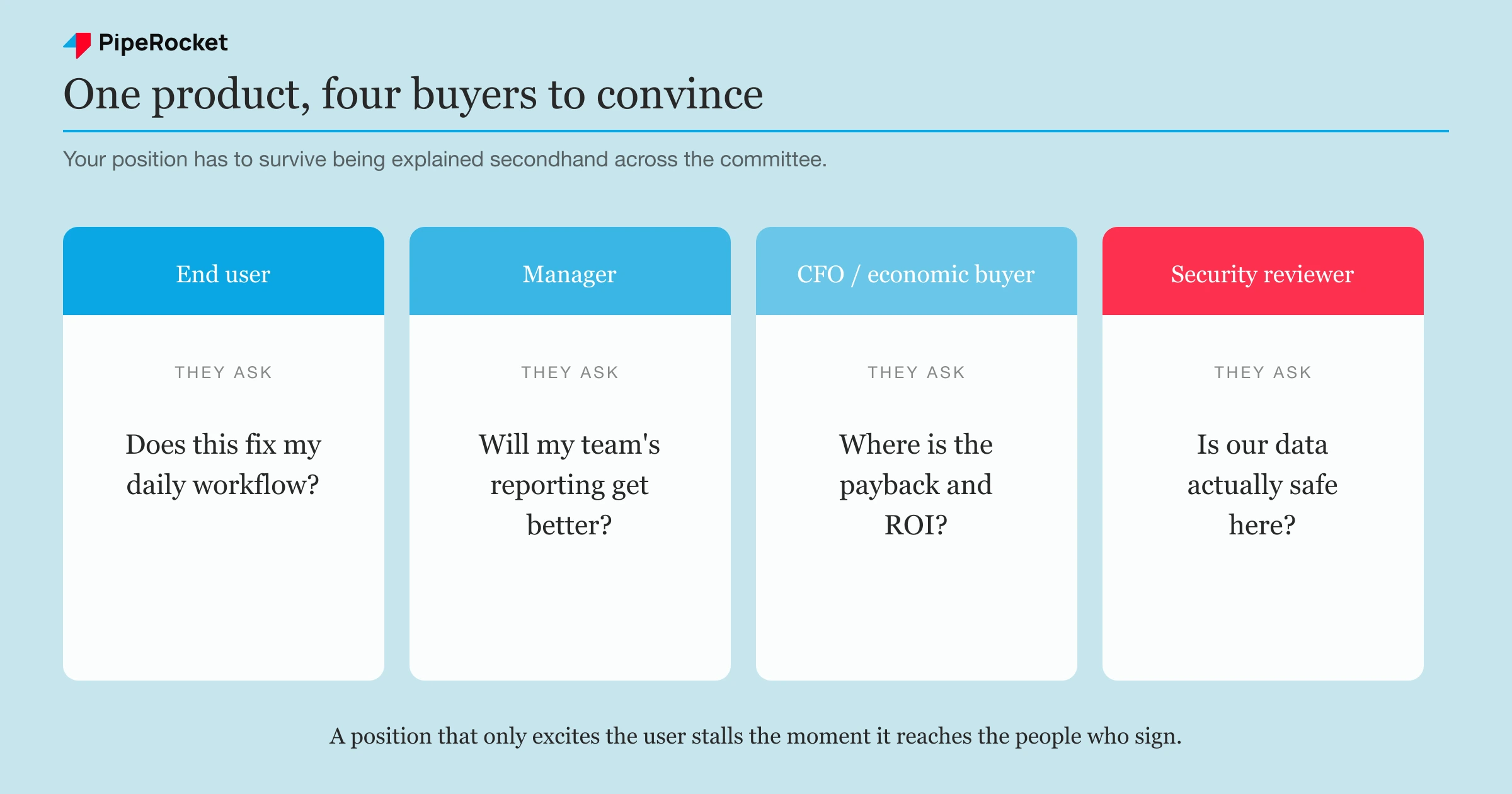
One product has to sell to a whole committee
In B2B SaaS, no single person decides. Gartner puts the average buying group at six to ten people, each judging your product by a different question:
| Stakeholder | The question they judge you by |
|---|---|
| End user | Does this fix my daily workflow? |
| Manager | Does it give me reporting and control? |
| CFO / economic buyer | Does it pay back, and why does it matter to the business? |
| Security reviewer | Is it safe, and will it leak our data? |
Positioning that lands with one of them can read as noise to the others. So SaaS positioning has to hold a shape that survives being explained secondhand, from a champion to a boss who never saw your homepage. You can’t position purely on a single technical feature the end user loves, that feature is your way in. A position that only excites the user stalls the moment it reaches the people who sign.
Your category is probably crowded and blurry
Most SaaS categories are packed with tools that describe themselves in nearly identical language. When ten competitors all claim to be the “all-in-one platform,” the label stops carrying information. Buyers can’t tell you apart, so they default to price or to whoever showed up first.
That’s the real job of positioning in a crowded category: give the buyer a reference frame where your strengths are the ones that matter. Without product-market fit and a clear sense of who you’re for, positioning just scales the confusion faster. Fix the fit first, then position.
The Five Building Blocks of SaaS Positioning
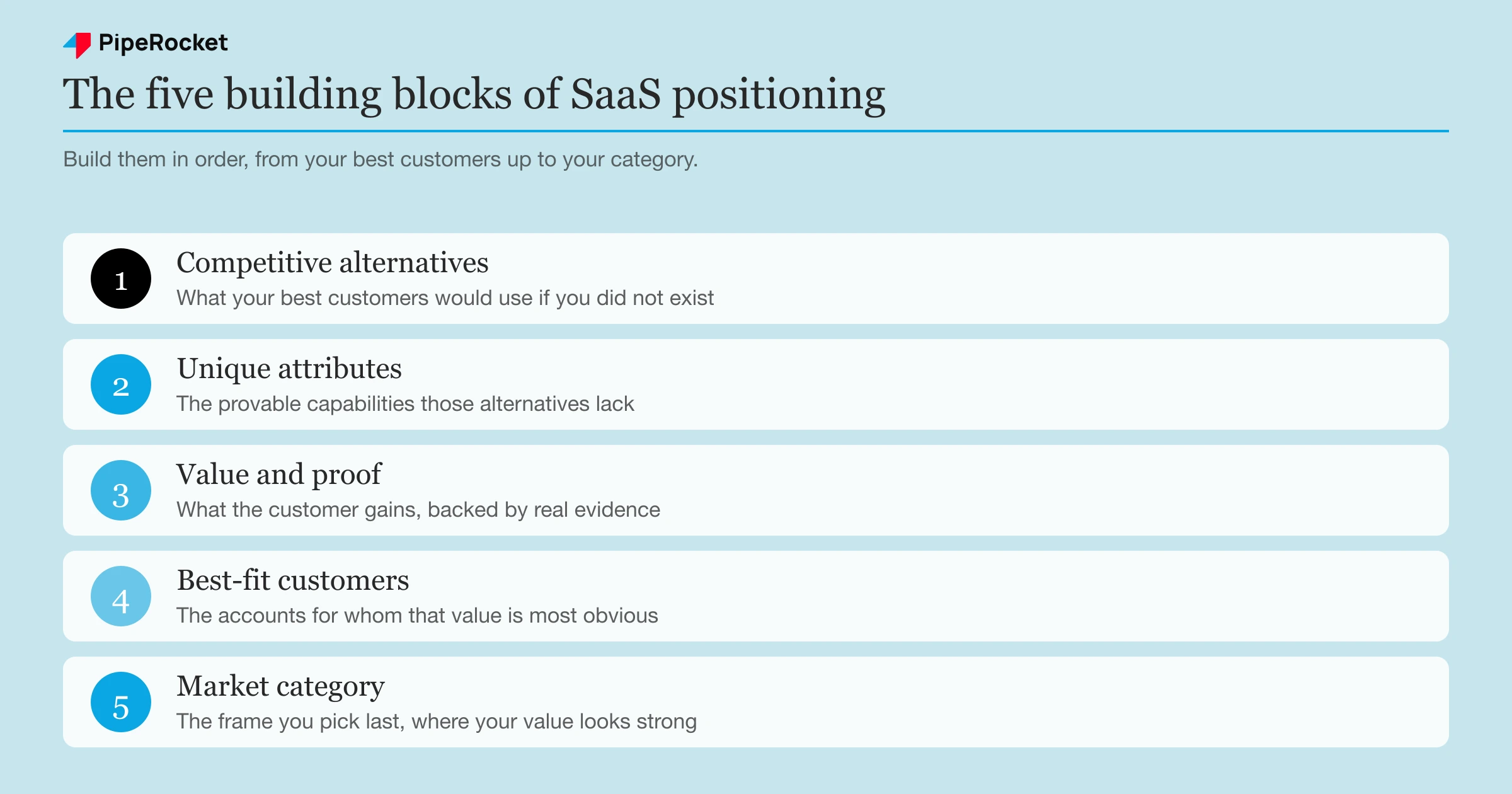
Strong SaaS positioning is built from five inputs in order: competitive alternatives, unique attributes, value and proof, best-fit customers, and market category. Work them bottom-up from real customers rather than top-down from a category you wish you owned.
This is the spine of April Dunford’s work in Obviously Awesome, and it’s the most practical model I’ve used with SaaS teams because the order forces every claim back to evidence.
Analyze customer reality first
Before you map anything, interview your best customers. Ask what they tried before you, what frustrated them, the words they use for the problem, and what it costs them to do nothing. That cost of inaction is the pressure your positioning has to name, and the buyer’s own language is the raw material for every input below.
Skip the interviews and you build positioning on a conference-room guess. The five inputs that follow are only as honest as the customer reality you feed them.
Start with the competitive alternatives
Begin with what your best customers would actually do if you didn’t exist. That’s rarely the competitor you obsess over. It’s often a spreadsheet, a manual process, or an in-house build. Those alternatives set the reference frame the buyer is already using.
We split competitors into two groups here. Direct rivals show you the product arguments and objections buyers weigh. The alternative that keeps coming up in sales calls, though, is the one your positioning has to beat, even when it isn’t software at all. Name it honestly before you name your advantages.
Isolate the attributes only you have
Once you know the alternatives, list the capabilities you have that they lack. Keep this to attributes that are true and provable rather than aspirational. A feature only counts as an attribute if a buyer could verify it. This is where most teams cheat and list things every competitor also claims, which is why their positioning collapses on a demo.
Then group the attributes into two or three themed clusters instead of shipping a flat list of twenty. This is difference chunking: a buyer remembers “built for regulated fintech” plus “audit-ready by default” far better than a scattered feature dump. Chunk the differences into a few ideas a champion can repeat from memory.
Translate attributes into value
An attribute on its own gives a buyer no reason to act. The value it creates does. For each unique attribute, ask what the customer gets because of it, and push until you reach something a buyer cares about. “Real-time sync” is an attribute. “Your finance team stops reconciling two systems by hand every Friday” is value.
Avoid generic promises when you write this down. Words like “fast,” “easy,” “reliable,” and “all-in-one” describe every tool in the category, so they carry no information and buyers skim right past them. Replace each one with a concrete, outcome-based claim tied to a number, a workflow, or a named result. The specific version is what the product marketing team then turns into pages and campaigns.
Attach proof to each one, since a claim without evidence reads as marketing. Proof can take a few forms:
- A customer quote
- A benchmark number
- A named integration
- A workflow you can demo live
The more skeptical the buying committee , the more the proof does the persuading while the adjective does none.
Name your best-fit customers
Now describe the customers for whom that value is most obvious. These are the accounts that understood you fast and bought fast. There’s usually a shared characteristic among them, whether it’s a team size, a tech stack, a regulatory pressure, or a specific workflow. That characteristic becomes your targeting filter for the whole go-to-market.
Choose the market category last
Only now do you pick the category. The category is the context that tells a buyer what you’re for and what to compare you against. Choosing it last means you pick the frame where your value already looks strong, rather than jamming your product into a label and hoping the value follows.
How to Choose Your Market Category
Category is the highest-impact decision in the whole exercise, because it sets every assumption a buyer brings before they read a word of your copy. Say “CRM” and people instantly expect a certain feature set, a certain set of rivals, and a certain price band. The frame does the work. The wrong frame makes you fight comparisons you can’t win.
You have two real options, and they carry very different costs.
| Approach | When it fits | The cost |
|---|---|---|
| Compete in an existing category | Buyers already search for the category; you can win on a sharp sub-segment or a clear angle | You inherit the leader’s feature checklist and price expectations |
| Create or reframe a category | The existing labels genuinely misrepresent what you do and force bad comparisons | You pay to educate the market on a term nobody searches yet |
There’s a quieter third mistake: picking a category so broad it means nothing. Labelling yourself a “productivity platform” or a “data platform” sounds ambitious, but it hands the buyer no reference frame and invites comparison to every well-funded incumbent at once. A narrower category label almost always positions a challenger better than a grand one.
Most SaaS companies should compete in an existing category and win a slice of it. Creating a category is expensive and slow, and it only pays off when the existing frame is actively hurting you. G2 and Gartner effectively publish the category names an industry already recognises, so they’re a fast gut-check on whether the label you want to claim exists in buyers’ heads yet.
A compliance SaaS built for fintech teams doesn’t need to invent “continuous fintech assurance.” It can position inside the known compliance-automation category and win the fintech slice, where its specific integrations and controls read as obvious advantages.
Four positioning archetypes to choose from
Category choice usually resolves into one of four archetypes. Naming yours picks the fight you can win and focuses every decision downstream.
| Archetype | What it means | When it fits |
|---|---|---|
| Category creation | You define a brand-new category and teach the market its name | The existing labels genuinely misrepresent you and force losing comparisons |
| Category challenger | You compete inside a known category against a clear leader, on a sharper angle | Buyers already search the category and the incumbent has a soft spot you can own |
| Niche dominance | You become the obvious best answer for one narrow segment | A specific segment feels the pain sharply and the giants serve it poorly |
| Bundle disruption | You unbundle or rebundle features an incumbent suite ties together | Buyers resent paying for a bloated suite to get one job done well |
Category creation is the hardest of the four. If you’re a category-creating SaaS whose site has to educate the market on a brand-new term, expect a long, expensive run of demand creation before search volume for your category even exists. You’re funding the market’s education, so budget for content, analyst relations, and sales enablement that all repeat the new definition until it sticks. Most teams are better served as a category challenger or niche dominator first, then graduate to category creation once they own a beachhead. That is also the moment your go-to-market motion has to change, because you’re now creating demand rather than capturing it.
Pick the Target Segment You Can Actually Win
Positioning that targets everyone persuades no one. The instinct to keep the market broad “so we don’t limit ourselves” is the exact move that makes a product forgettable. A narrow segment lets you say something specific enough to stick, and specific is what gets remembered and repeated inside a buying committee.
Pick the beachhead segment where three things line up:
- Your value is most obvious to them
- They feel the pain sharply enough to buy now
- You can reach them without a fortune in acquisition cost
This is a focus decision, and focus feels like loss. You’re not deleting the other buyers. You’re choosing whose problem you’ll be the clear best answer for first, then expanding from a position of strength once you own that beachhead.
The trap is choosing a segment by size instead of by fit. The biggest addressable segment is usually the most contested and the least convinced by a young product. Start with whichever segment maps to your easiest sales conversation, the one where deals already close faster and churn stays low.
Take a project-management tool that technically works for any team. Positioned for “teams,” it competes head-on with the giants and drowns. Positioned for creative agencies that bill by the hour, it can lead with time-tracking tied to client retainers and speak the language of billable utilisation. Suddenly it reads as purpose-built, and the same product pulls far harder from one chosen segment.
You expand later by treating the next segment as its own positioning exercise rather than by diluting the first one. Owning one segment gives you the proof, the references, and the authority to enter the next from strength.
Common Positioning Approaches
Within your chosen archetype, three approaches sharpen the angle. Each one narrows what you claim so buyers remember it, and they combine well.
- Niche down: Position for one narrow segment instead of a broad market, so the value reads as purpose-built for exactly them.
- Single-benefit focus: Lead with one dominant outcome rather than a feature list, so the buyer remembers a single reason to switch.
- Simplicity positioning: Win on being easier to adopt and run than a heavier incumbent, so the choice feels lower-risk to the whole committee.
The mistake is trying to run all three loudly at once. Pick the one that maps to your best-fit segment’s sharpest pain, then let the other two support it.
Write a Positioning Statement That Holds Up
A positioning statement is the internal document that forces every decision above into one testable place. It isn’t a tagline and it never ships to customers. Its job is to align the team, so sales, product, and marketing describe the same company. The classic template, from Geoffrey Moore’s work on crossing the chasm, still holds up.
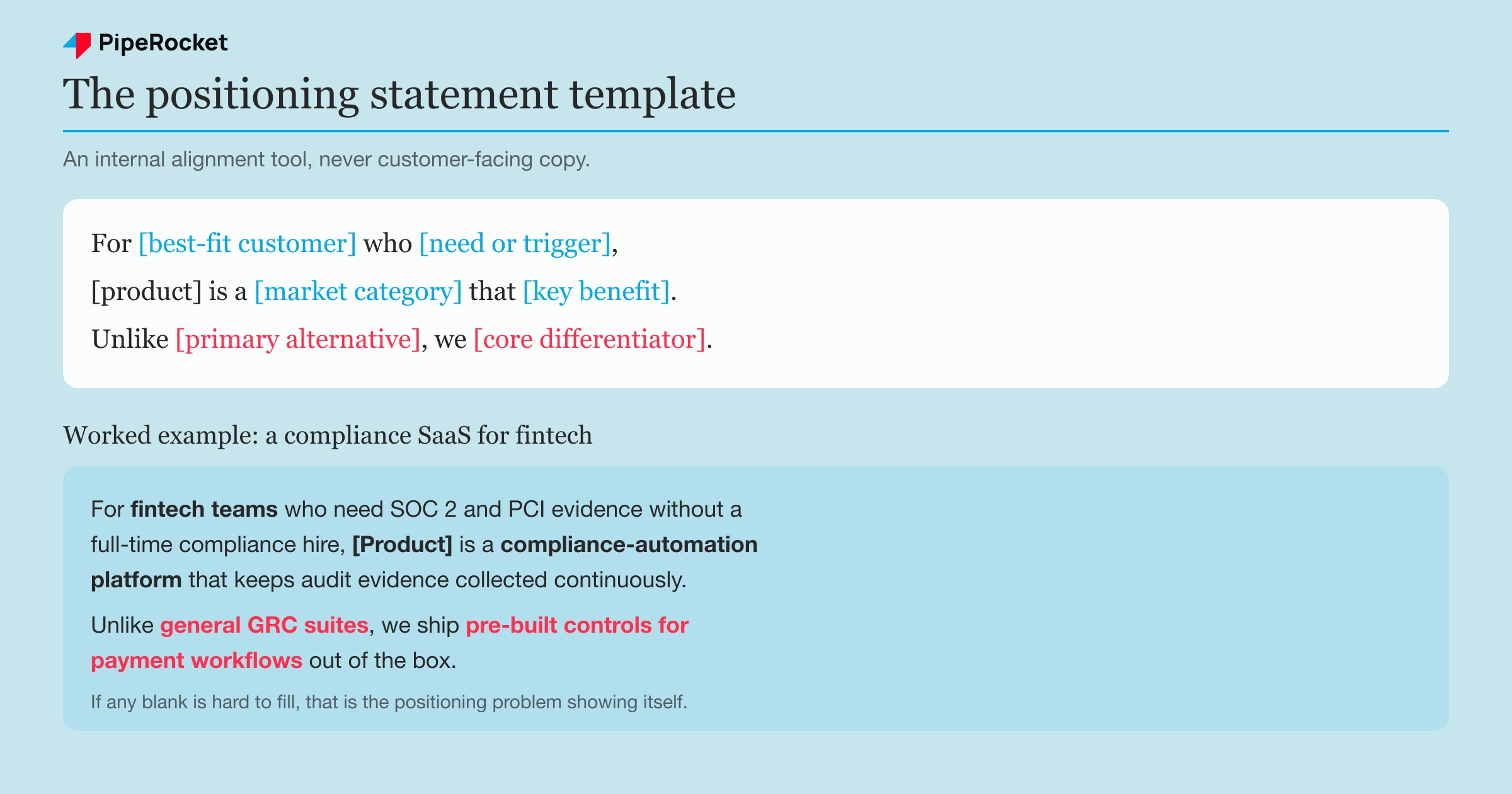
The structure runs like this:
For [best-fit customer] who [need or trigger], [product] is a [market category] that [key benefit]. Unlike [primary alternative], we [core differentiator].
Filled in for that fintech compliance example, it reads: “For fintech teams who need SOC 2 and PCI evidence without a full-time compliance hire, [Product] is a compliance-automation platform that keeps audit evidence collected continuously. Unlike general GRC suites, we ship pre-built controls for payment workflows out of the box.”
Notice what the template refuses to let you skip. You can’t write it without naming a real customer, a real alternative, and a benefit you can defend. If any blank makes you uncomfortable, that discomfort is the positioning problem showing itself. Build the statement from customer input rather than a conference-room guess, or you’ll write something that sounds right and sells nothing.
How Positioning Drives Go-To-Market
Positioning is only worth anything once it reaches the assets buyers actually touch. This is where most repositioning efforts quietly fail. The strategy deck gets approved, everyone nods, and then the website, the search footprint, and the sales collateral keep running the old story.
Your SEO keeps ranking the old company
I see this constantly with SaaS companies that repositioned in the last year and can’t work out why lead quality never improved. The organic footprint is still ranking the old version of the company. Search doesn’t update itself when you change your ICP or move upmarket. Several things stay frozen in the old positioning:
- The pages that rank
- The keywords that pull traffic
- The backlinks pointing in
- The way review sites and listicles describe you
So the traffic looks healthy while the wrong people keep landing and bouncing. Fixing it takes a rebuild rather than a metadata refresh: audit what still fits the new positioning, rewrite or consolidate what doesn’t, and rebuild the keyword strategy around the new segment’s language. Treat search and content as part of the repositioning itself rather than cleanup you get to later.
Re-arm the sales team on the new story
Sales assets carry the same risk. When positioning changes, the pitch deck, the one-pagers, and the battle cards keep arming reps with the old competitive story. Reps then improvise, and a committee that hears three different versions of what you are trusts none of them. Rebuilding the sales narrative around the new alternative and the new segment is part of shipping the positioning rather than an afterthought for later.
Don’t put paid behind a muddled message
The same discipline applies to paid. A SaaS isn’t ready to pour money into acquisition until it has a clear value proposition and differentiation to spend behind. Our team treats a shaky positioning as a reason to pause spend, because paying to amplify a muddled message just buys you an expensive education in what doesn’t land.
Common Mistakes to Avoid
Leading with the category instead of the customer
Teams pick a flashy category first, then reverse-engineer customers to fit it. That’s the framework upside down. The category should fall out of who your best customers are and what they compare you to. Choose it first and you’ll keep defending a frame your product doesn’t actually win in.
Positioning against everyone
Trying to be the best choice for every buyer produces language so generic it slides off all of them. Broad positioning feels safe and reads as noise. Pick the segment you can genuinely win and let the rest hear a message that isn’t built for them yet.
Treating your tagline as your positioning
A clever line on the homepage isn’t a positioning strategy. When the underlying decisions about category, segment, and alternative are fuzzy, no headline rescues them. The copy is downstream. Fix the strategy and the messaging gets dramatically easier to write.
Setting positioning once and never revisiting it
Positioning isn’t a launch-day artifact. Moving upmarket, adding a product line, or watching a new competitor reframe the category all break your current position. If your fundamentals changed in the last year and your positioning didn’t, it’s already stale.
How to Know Your Positioning Is Working
You know your positioning is working when buyer behaviour changes: sales cycles shorten, win rates climb against the alternative you targeted, and inbound skews toward your best-fit segment. The honest signals live in buyer behaviour rather than in how proud the team feels about the deck.
Watch for these shifts after a positioning change:
- Sales cycles get shorter because buyers grasp what you are faster
- Win rates climb against the specific alternative you positioned against
- Demo calls open with fewer “so what does this actually do” questions
- Inbound skews closer to your best-fit segment instead of tire-kickers
The clearest tell is what prospects say back to you. When a buyer can describe your product to their boss in a sentence that matches your positioning, it landed. When your own sales reps describe the product three different ways on three different calls, it hasn’t, and no amount of new creative will fix a strategy gap underneath.
How PipeRocket Digital Helps SaaS Teams Turn Positioning Into Pipeline
We treat positioning as the thing that has to reach the pipeline, not something that sits in a slide. When SaaS teams reposition, we rebuild the SEO and content footprint around the new segment’s language so search stops ranking the old company. If you’d rather compare specialists first, look at the best B2B marketing agencies before you commit. When you’re ready to turn a positioning decision into ranked pages and real demos, reach out to us here .
Frequently Asked Questions
What is the difference between positioning and messaging?
Positioning is the strategy. Messaging is the execution. Positioning decides which category you compete in, who you’re for, and why you beat the alternative. Messaging is how you say that in a headline, an ad, or a sales email, adapting the tone for each context. Positioning is the input and messaging is the output, so you can’t write good messaging on top of unclear positioning. If the copy keeps feeling weak after multiple rewrites, the real problem is almost always the positioning underneath it.
What is a positioning statement?
A positioning statement is a short internal document that captures your positioning decisions in one place so the whole team stays aligned. It usually names your best-fit customer, their need, your market category, the key benefit you deliver, and the main alternative you beat. It’s a working tool for sales, product, and marketing, and it isn’t customer-facing copy. A tagline or a homepage headline is the public expression, while the positioning statement is the private source of truth those public assets get built from.
What are the five positioning strategies?
Five common SaaS positioning strategies are: niche down, single-benefit focus, simplicity positioning, category challenger, and category creation. Pick the one that fits your best-fit segment and archetype, then build every asset around it.
Should a SaaS create a new category or compete in an existing one?
Most SaaS companies should compete in an existing category and win a specific slice of it. Creating a category is expensive because you have to teach the market a term nobody searches for yet, and that education can take years of spend most teams don’t have. Category creation only pays off when the existing labels genuinely misrepresent what you do and force comparisons you keep losing. If buyers already search for your category and you can carve out a sharp sub-segment, competing inside it is faster and far cheaper.