SaaS Messaging Strategy: A Framework That Converts
 Kamaraj Mathiarasan (Kim)
Last updated on
Kamaraj Mathiarasan (Kim)
Last updated on
Most SaaS teams write their messaging the week they redesign the homepage. Someone opens a doc, drafts a headline, argues about verbs, and ships it. Six months later nobody on the team says the product the same way twice, and buyers can’t repeat back what you do.
The root cause sits one layer up from the words. It’s a missing messaging strategy, and no amount of copywriting fixes it.
This guide is about turning positioning into a messaging framework your whole team can use. Positioning decides who you’re for and what you own. Messaging is how you say that out loud on every page, deck, and email. I’ll show you how to build the framework, write value propositions buyers actually repeat, message a whole buying committee, keep it consistent across the funnel, and test it before you scale it.
TL;DR
- Messaging is downstream of positioning: a messaging strategy translates your positioning into repeatable language, so it can only ever be as sharp as the positioning underneath it.
- A message house gives you one system: one core message on top, three supporting pillars, and proof underneath, so every team says the product the same way.
- Value propositions win on outcomes: buyers repeat back what a product does for them, so lead with the outcome and the trigger, then let features prove it.
- Message the whole buying committee: a B2B deal runs through six to ten people, and a persona-message matrix keeps each of them addressed while the core message stays constant.
- Consistency across the funnel is the real test: the homepage, the ad, the sales deck, and the SEO pages have to carry one story, or buyers feel the seams.
- Test messaging on real buyers before you scale spend: if an ICP buyer can’t restate what you do and why it matters, the copy isn’t ready, no matter how good it sounds internally.
- The common mistakes are avoidable once named: feature-first copy, writing for everyone, drift from positioning, and shipping untested messaging are the four that sink most SaaS messaging.
- Working messaging shows up in behaviour: buyers repeat your words back, reps stop re-explaining the product, and the leads that convert get better-qualified.
What a SaaS Messaging Strategy Actually Is
A SaaS messaging strategy is the system that decides what you say about your product, to whom, in what order, and with what proof, so every touchpoint tells one story. It’s the bridge between a positioning decision made in a strategy room and the words a buyer reads on your pricing page.
Positioning is the input here, and I’m treating it as already done. If you haven’t decided your category, your target segment, and the one problem you own better than anyone, that’s a SaaS positioning strategy job and it comes first. Messaging assumes those calls are made.
The reason the two get confused is that they feel like the same conversation. They aren’t. One useful way to hold the difference:
- Positioning is the strategic decision: who you’re for, who you’re against, the problem you own.
- Messaging is how you communicate that decision across contexts, from a homepage hero to a cold email subject line.
If positioning is the architecture, messaging is what the building actually says to the person walking in. And messaging can only be as effective as the positioning it expresses, which is why a great copywriter can’t save fuzzy positioning. They’ll just write beautiful sentences that point in five directions.
Here’s the practical stakes. Praveen, who runs paid at PipeRocket, has a rule that a SaaS isn’t ready to spend real money on ads until it has a clear value proposition and enough patience to test. Without that clarity, you’re not buying pipeline. You’re paying for an expensive education while every channel amplifies a muddy message.
Turn Your Positioning Into a Message House
The fastest way to make messaging repeatable is to build a message house: a single structure that holds your core message, the two or three ideas that support it, and the proof underneath. It’s the artifact your writers, sales reps, and product marketers all pull from, so the product sounds the same whether it’s a webinar or a footer.
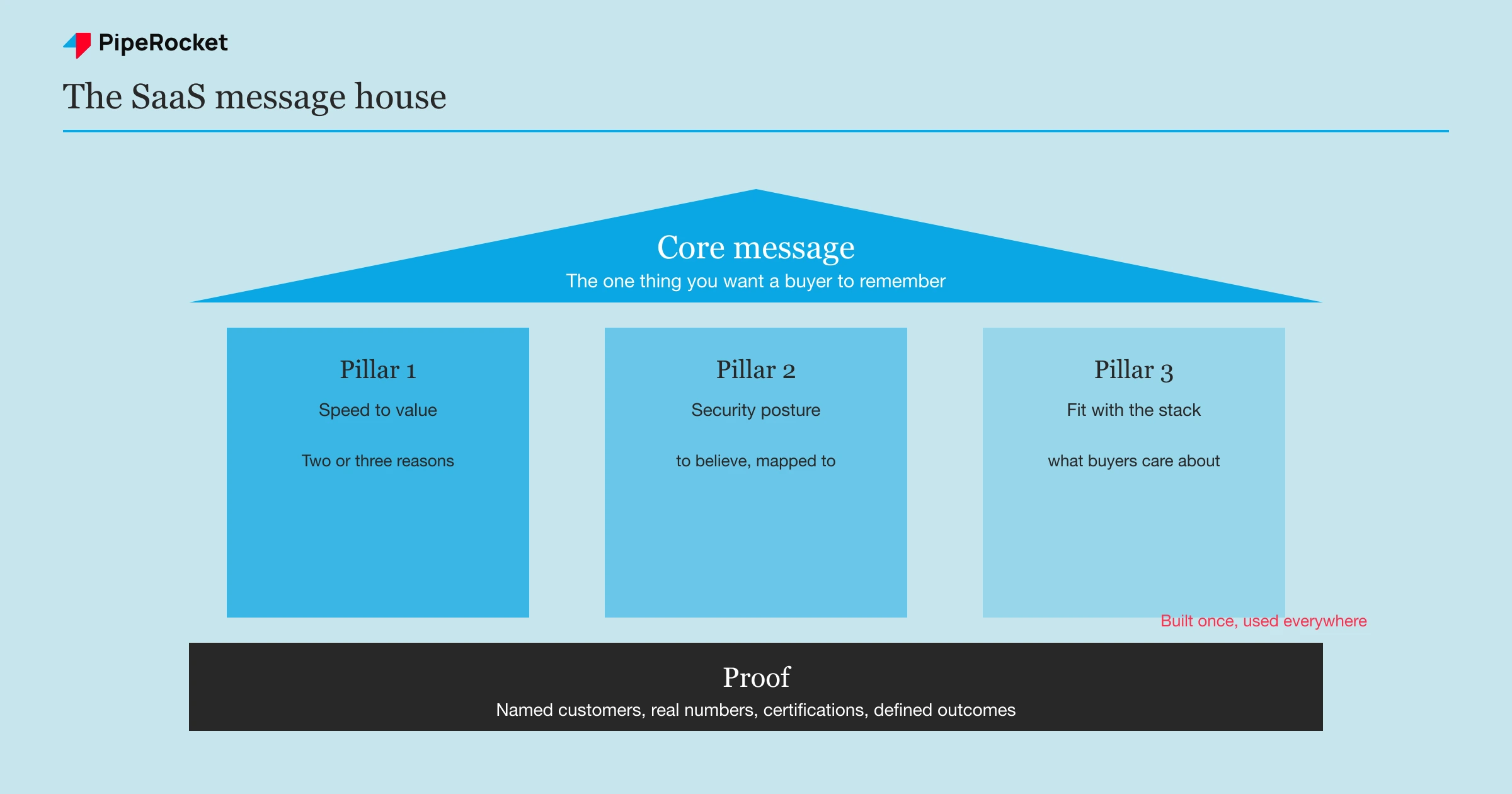
Think of it in three layers, top to bottom.
The core message is the one thing you want remembered
The roof of the house is a single sentence that captures what you do and why it matters to your ICP . It’s not a tagline and it’s not clever. It’s the plain answer to “what is this and why should I care,” written so a buyer could repeat it to a colleague after one read.
A good core message names the outcome and hints at who it’s for. A compliance platform for fintech teams might land on something like “get audit-ready in weeks instead of quarters.” That’s a promise a CFO understands without a demo. Keep it to one sentence you’d actually say out loud.
The pillars are the two or three reasons to believe
Under the roof sit your supporting messages, the pillars that hold the core claim up. Most SaaS products need two or three, no more. Each pillar answers a different objection or maps to a different thing your buyer cares about, like speed of implementation, security posture, or fit with an existing stack.
Pillars are where segment differences show up. A pillar that matters to a security evaluator (“SOC 2 without the six-month project”) won’t be the one that moves an end user. You write the pillars once, then decide per audience which to lead with, which is what makes this a reusable framework rather than a one-off script.
The proof is what makes any of it believable
The foundation is evidence, and it’s the layer teams skip. A claim with no proof underneath is just a wish. Under each pillar, attach the specifics that make it credible:
- Named customers a buyer recognises
- Real numbers and defined outcomes
- Integration lists and security certs
- A concrete before-and-after
Vague proof reads as wallpaper. “Trusted by 500+ companies” says nothing a buyer can hold. A named logo they recognise, a quote with a title attached, or a defined outcome does the work. When our team rebuilds landing pages , swapping generic trust badges for specific proof is one of the most reliable lifts, because the buyer stops skimming and starts believing.
Write Value Propositions Buyers Actually Repeat Back
Your value proposition is the sharpest expression of the core message, and it wins when it leads with the outcome the buyer wants over the feature that delivers it. Buyers care about features after they trust the value. Copy that opens with specs skips the reason people buy in the first place.
Lead with the outcome, then let the feature prove it
Here’s the pattern I trust:
- State the outcome the buyer gets.
- Name the trigger that sent them looking.
- Let the feature prove the claim, once you’ve earned the attention.
Features belong in the evidence layer, under the promise. A buyer searching at 11pm because an audit got scheduled doesn’t want “automated evidence collection.” They want to stop panicking about the audit.
The only test that matters is whether they repeat it back
A value proposition passes one test: a buyer can repeat it back after reading it once. If someone in your ICP reads the hero and can’t tell a colleague what you do and why it’s for them, the copy hasn’t landed yet. Clever loses to clear every time a buyer is in a hurry, and B2B buyers are always in a hurry.
One trade-off worth naming. Outcome-led messaging pulls in the right buyer fast, but it can feel thin if you never back it with substance. It works when the proof layer is strong. It breaks when you lead with a bold outcome and the page underneath has nothing concrete to support it, because then you’ve raised a promise you can’t keep and the bounce is worse than a boring headline.
Message the Buying Committee, Not One Hero Persona
A B2B SaaS purchase runs through a group, and your messaging has to hold up for all of them at once. Gartner’s research puts the average B2B buying group at six to ten decision-makers , each with their own priorities and their own version of “why should I care.” Message to one hero persona and the other five to nine feel like the product isn’t for them.
This is where the message house earns its keep. The core message stays constant so the company reads as one product, but you lead with a different pillar depending on who’s reading. The end user, the manager, and the economic buyer are three different conversations sharing one core claim.
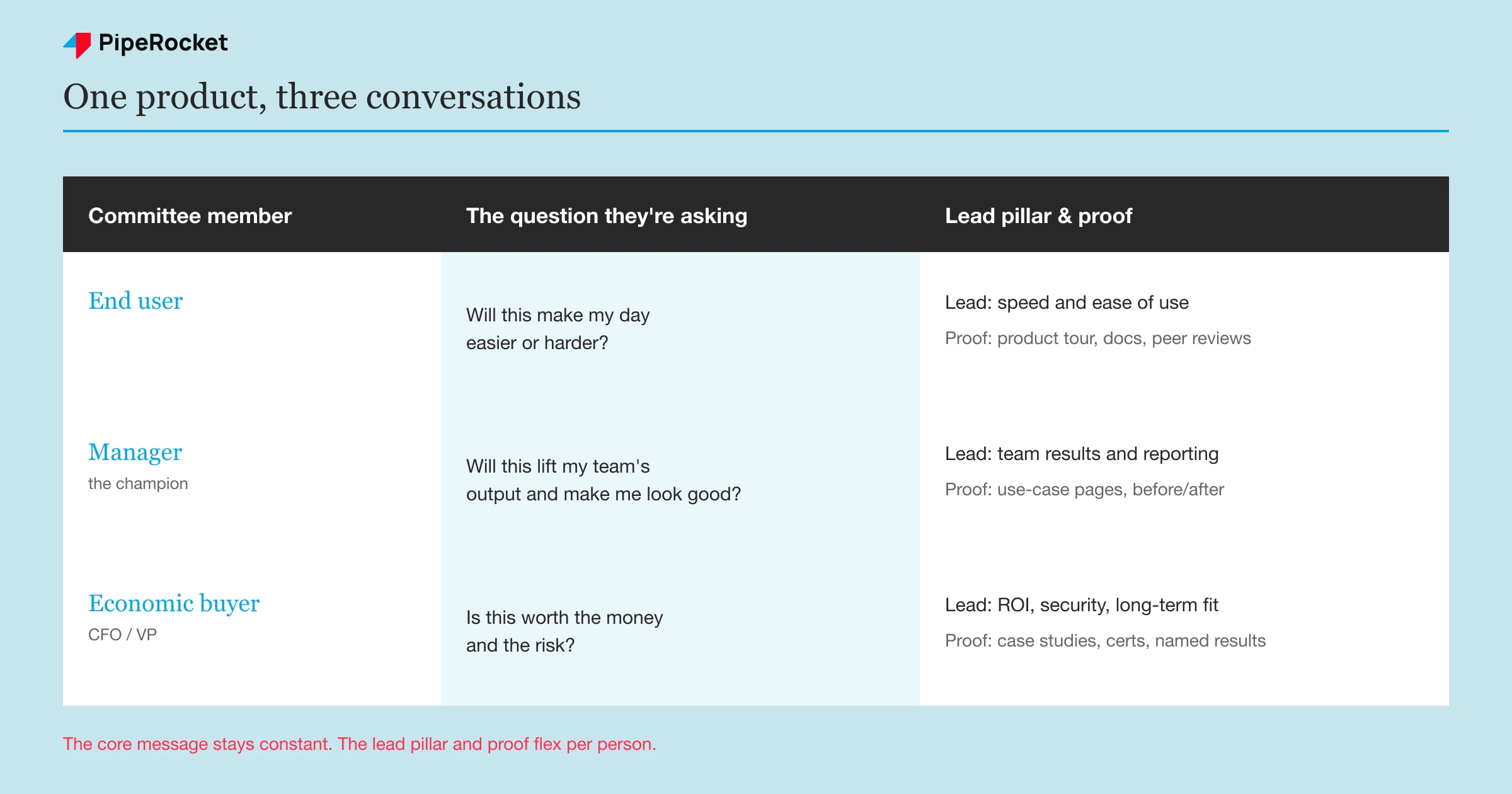
A persona-message matrix keeps this organised. Map each committee member to the question they’re really asking, the pillar you lead with, and the proof that lands for them.
| Committee member | The question they’re really asking | Lead pillar | Proof that lands |
|---|---|---|---|
| End user | Will this make my day easier or harder? | Speed and ease of daily use | Product tour, quick-start docs, peer reviews |
| Manager / champion | Will this improve my team’s output and make me look good? | Team results and reporting | Use-case pages, before-and-after outcomes |
| Economic buyer (CFO, VP) | Is this worth the money and the risk? | ROI, security, and long-term fit | Case studies, security certs, named-customer results |
Notice what stays fixed and what flexes. The core message (“get audit-ready in weeks”) doesn’t change per persona. The lead pillar and the proof do. You’re not writing three products. You’re writing one product three people can each see themselves in.
The champion deserves special attention, because that’s the person who has to sell you internally when you’re not in the room. Give them the language to do it. If your messaging arms the champion with a one-line reason the CFO will accept, you’ve done more for the deal than any homepage animation.
Keep the Message Consistent Across the Whole Funnel
Consistency is where most messaging strategies quietly fall apart, and it’s the part a framework is built to protect. A buyer meets your message in fragments over weeks: an ad, then a blog post, then a G2 listing, then a sales deck, then the pricing page. When those fragments tell slightly different stories, the buyer feels the seams and trust leaks out.
The failure is rarely dramatic. It’s drift that accumulates. Marketing updates the homepage, sales keeps using last year’s deck, the SEO pages were written to an old ICP, and support talks about the product a fourth way. Each is defensible on its own. Together they read like four companies.
SEO is the sneakiest place this hides. When a SaaS repositions or sharpens its messaging, the website doesn’t update itself. Our team sees this constantly: a company shifts its message, but the ranking pages, the traffic-driving keywords, and the way review sites describe them all still reflect the old story. Traffic looks healthy while the wrong buyers land and the message they meet is a year stale.
So treat the message house as the source of truth every channel checks against, and audit for drift on a cadence. A simple pass:
- Does the homepage hero match the current core message?
- Does the sales deck open with the same promise, or a different one?
- Do the top-ranking organic pages describe the product the way you describe it now?
- Do your G2, Capterra, and listicle mentions still fit the current positioning?
The same discipline shows up when teams scale AI-written content. The brands that grow feed the model their real positioning, ICP, and customer language first, so the output sounds like how they actually think.
The ones that lose feed it a keyword and a generic prompt, and end up with pages that read like everyone else and match no coherent message. The fix is one message, said consistently everywhere, long before it’s more content.
Test and Validate Messaging Before You Scale It
Never scale spend behind messaging you’ve only tested on your own team. The people who built the product are the worst judges of whether the copy is clear, because they can’t un-know what it means. The only test that counts is whether a buyer who matches your ICP can restate what you do, why it matters to them, and why you’re different, without you prompting them.
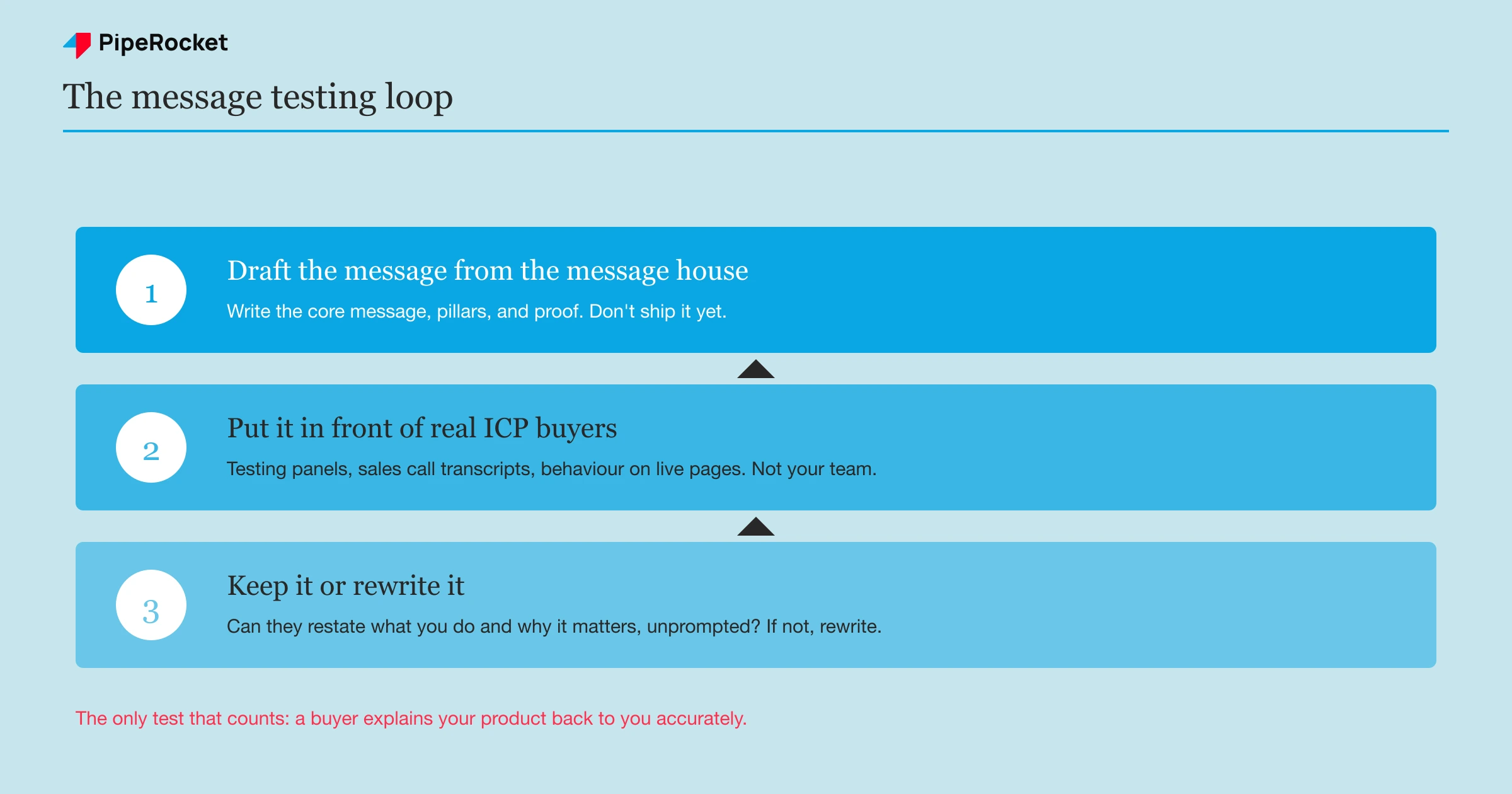
There are a few honest ways to get that signal:
- Message testing panels: put a draft in front of people who match your ICP and ask them to explain it back. Tools like Wynter exist for exactly this.
- Sales call transcripts: the words prospects use to describe their own problem are the words your messaging should echo. Mine the calls.
- Live pages with real behaviour: for pages with traffic, watch what buyers actually do with your copy rather than what they say they’d do.
I’ve seen a clean copy fix beat a whole backlink budget.
A client was stuck on page two to three for a core keyword, and the page itself was the problem: all methodology and frameworks while the searcher wanted a fix for a mess. We rewrote the first fold from “we are an X firm with Y years of experience” to a plain problem-then-solution promise: struggling with this, here’s how we fix it in weeks.
Within days the page moved from page two to position two, with roughly a 30% traffic lift. No links bought. Just copy matched to what the searcher actually wanted.
That’s the whole point of testing. It replaces “we think this is clear” with “a buyer told us it’s clear.” One warning though. Message testing works when you test with real ICP buyers. It’s close to worthless when you test with whoever’s easy to reach, because friendly non-buyers will tell you it’s great and teach you nothing. Test with the people whose money you want.
Common Mistakes to Avoid
Most messaging problems aren’t exotic. They’re the same handful of mistakes, and every one is avoidable once you can name it.
Leading with features before the buyer trusts the value
Feature-first copy is the default failure mode. A team builds something they’re proud of and opens with what it does, technically. The buyer doesn’t care yet. They care about the outcome and whether it’s for someone like them. Lead with the value and the outcome, then let the features prove it once you’ve earned the attention.
Writing for “everyone” so it lands for no one
Words like “businesses,” “teams,” and “users” feel safe because they don’t exclude anyone. They also don’t connect with anyone. Messaging written for everyone reads like it’s for no one, and readers tune out the moment they don’t feel seen. Pick your ICP, name them specifically, and write one variant per real segment if you serve more than one.
Letting positioning and messaging drift apart
Messaging built on last year’s positioning is worse than no messaging, because it confidently points the wrong way. When you move upmarket, change your ICP, or sharpen your category, the messaging doesn’t follow automatically. Re-derive the message house from the current positioning, and update every channel, not just the homepage.
Shipping messaging you never tested on real buyers
Internal consensus is not validation. A message everyone in the room loves can still be gibberish to a buyer, because the room has context the buyer doesn’t. If you haven’t watched an ICP buyer restate your message back accurately, you don’t have evidence it works. You have a hypothesis you’re about to fund.
How to Know Your Messaging Is Working
Good messaging shows up in buyer behaviour, not in internal applause. The clearest signal is whether buyers repeat your language back to you, in sales calls, in support tickets, in the way they describe you to peers. When prospects start using your words for their problem, the message has taken hold.
Beyond that, watch the leading indicators tied to each surface:
- On the homepage: are visitors getting past the first fold and clicking the primary CTA, or bouncing at the hero?
- In sales: are reps hearing “I already get what you do” instead of spending the first ten minutes re-explaining the product?
- In the pipeline: are the leads better-qualified, meaning the message is attracting the right buyer and filtering out the wrong one?
That last one matters most. Sharp messaging improves who converts, on top of lifting how many. A message that’s specific to your ICP does double duty as a magnet for the right buyer and a filter for the wrong one, so you get fewer junk leads and more that sales actually wants. If your volume looks flat but your win rate climbs, your messaging is doing its job.
Why PipeRocket Digital Helps SaaS Teams Get Messaging Right
We treat messaging as the layer that makes every other channel work, so we start from your positioning and build the message house before touching a single page. Then we make it consistent everywhere buyers meet you, from organic pages to paid landing pages, and we test it against real ICP buyers instead of internal opinion. Most agencies execute tasks. We own outcomes. If you want your messaging built to move pipeline, compare the best B2B marketing agencies or just reach out to us here .
Frequently Asked Questions
What is the difference between positioning and messaging?
Positioning is the strategic decision about who you’re for, who you compete against, and the one problem you own better than anyone. Messaging is how you communicate that decision across contexts, like your homepage, sales deck, and emails. Positioning is an internal exercise that aligns your team; messaging is the external expression that speaks to buyers. You decide positioning first, then write messaging from it, because messaging can only ever be as clear as the positioning underneath it.
What should a SaaS messaging framework include?
A working SaaS messaging framework includes a core message (the one thing you want a buyer to remember), two or three supporting pillars (the reasons to believe that map to what your buyers care about), and proof under each pillar (named customers, real numbers, certifications). Most teams also add a persona-message matrix that maps each buying-committee member to the pillar you lead with for them. It’s a living document you sharpen as you learn, not a one-time project.
How do you test SaaS messaging before launching it?
Put the actual draft in front of people who match your ICP and ask them to restate what you do, why it matters to them, and why you’re different, without prompting. If they can’t restate it accurately, the copy isn’t ready. Message testing panels, sales call transcripts, and behaviour on live pages all give real signal. The one rule that matters: test with real ICP buyers, not whoever’s convenient, because friendly non-buyers will praise it and teach you nothing.