SaaS Internal Linking Strategy: Architecting Your Content Hierarchy for Authority Flow
 Vignesh Sampath
Last updated on
Vignesh Sampath
Last updated on
A SaaS internal linking strategy means designing your content hierarchy, pillar pages, spoke pages, and their planned link paths, before you publish anything, so authority routes to commercial pages by structure rather than by accident.
TL;DR
- Internal linking strategy is a structure decision made at the planning stage, not a tactic applied after pages are live.
- Model every cluster as a hub with spokes underneath it, and decide the spoke-to-hub link paths before the first spoke is written.
- Tier every page by commercial priority, not funnel stage alone, so you know exactly which pages exist to receive authority.
- Map how authority is meant to flow across the whole site before checking whether any single page has enough links.
- Rebuilding a site’s architecture after 40+ pages exist is possible, but it costs far more than deciding the shape up front.
Why Site Architecture Comes Before Any Individual Link
Most internal linking advice starts at the wrong layer. It tells you which anchor text to use, how many links per page, how to fix orphan pages. All of that matters, and our tactical playbook for adding internal links covers it in detail. None of it works if the site underneath was never designed to hold links in the first place.
Here’s the problem I run into on almost every SaaS content audit: a team has 60, 80, sometimes 150 published pages, and no one can draw the site’s shape on a whiteboard. That symptom shows up the same way every time:
- Pages got created because a keyword had volume, not because it filled a slot in a planned hierarchy.
- No one on the team can name the site’s hubs or say which spokes report to which.
- The fix that gets reached for is always “add more internal links,” which treats a structural gap as a tactical one.
Architecture is the set of decisions you make before a single page is written: how many hubs the site has, what spokes report to each hub, and which pages are built specifically to receive authority rather than to earn it. Link placement is what happens after those decisions are already locked in.
Think of it as plumbing versus construction. Plumbing fixes a leak, while construction decides where the pipes go before the walls go up. Most SaaS content teams are excellent plumbers working inside a building nobody designed.
The SERP gap this fills
Search a query like “internal linking for SaaS” and almost everything ranking is plumbing advice: anchor text rules, link counts, orphan-page audits. Almost nothing addresses the layer above it, how to design the hierarchy those tactics get applied to. That’s the gap this piece owns.
Model Your Content as Hubs and Spokes, Not a List of Pages
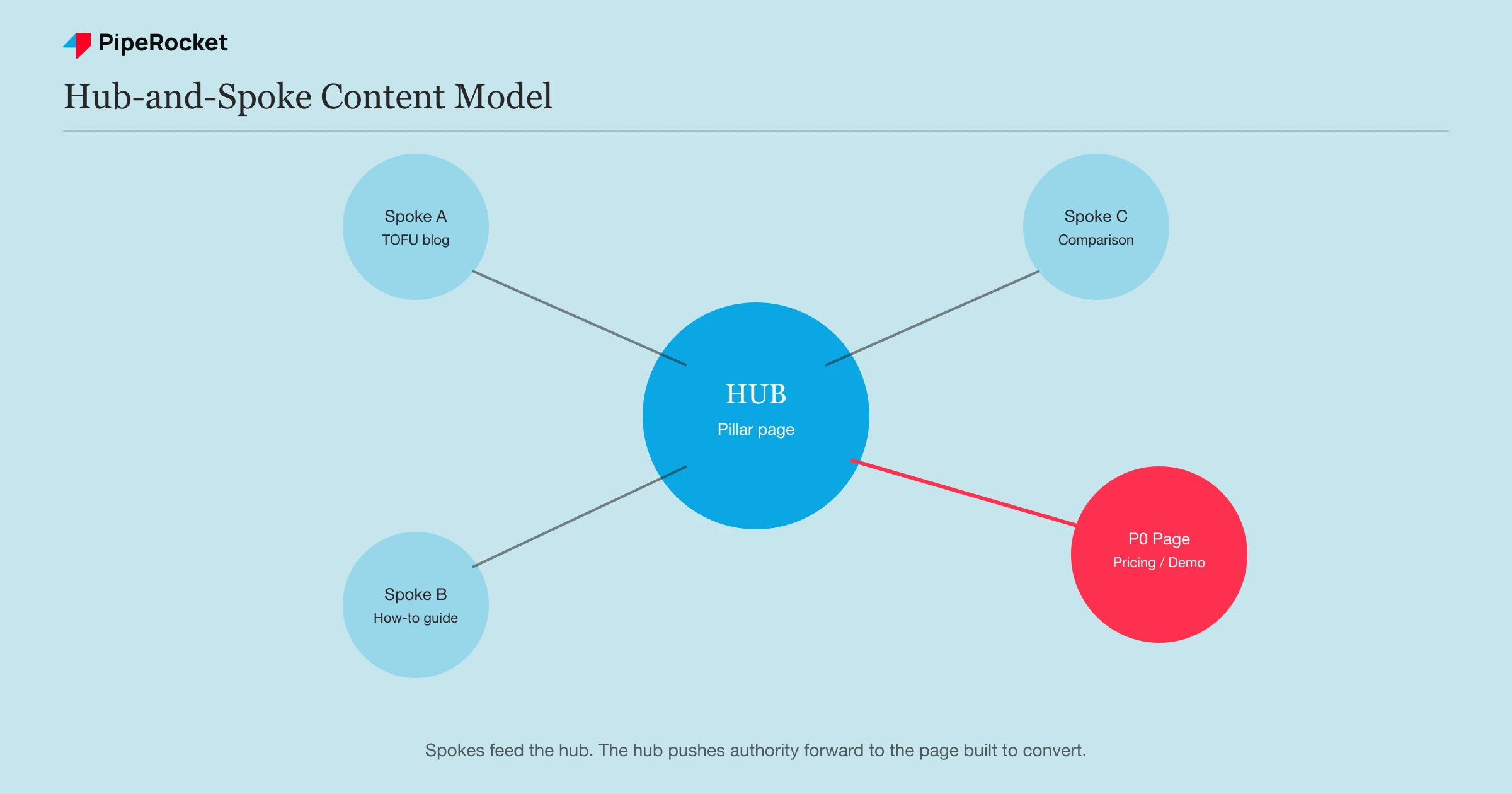
A hub-and-spoke model treats your content as a small number of pillar hubs, each with a defined set of spoke pages that report to it. A flat list of blog posts has no hierarchy. A hub-and-spoke model does, and that hierarchy is what internal linking is supposed to express.
Picture a SaaS company selling compliance software for fintech teams. Publishing “SOC 2 audit checklist,” “SOC 2 vs ISO 27001,” and “how to prepare for a SOC 2 audit” as three unrelated blog posts wastes the connection between them. The hub-and-spoke model treats “SOC 2 compliance” as one hub, with those three pieces as spokes that all link back to the hub and forward toward the pricing or demo page the hub is built to support.
What counts as a hub
A hub is the page you’d want ranking for the broadest, highest-volume term in a topic area. It’s usually a pillar guide or a category page. Under our model, a hub earns that role by satisfying three conditions:
- It targets the broadest commercially relevant term in the cluster, not the highest-volume term overall (a “what is SOC 2” definitional page might get more searches, but it’s rarely the hub, because it doesn’t sit next to a buying decision).
- It’s built to receive links from every spoke beneath it, and to pass a portion of that authority forward to a BOFU page.
- It’s maintained on a longer cycle than its spokes. Spokes get refreshed for freshness signals; hubs get rebuilt when the category itself shifts.
What counts as a spoke
A spoke is narrower, answers one specific sub-question, and exists to feed the hub, not to stand alone. A spoke that never links back to its hub isn’t part of the cluster. It’s just a page that happens to share a topic.
Spokes fail their job in one specific way more than any other: they get written, published, and then never connected to the hub. Usually because the hub didn’t exist yet when the spoke went live, or because no one tracked which hub it was supposed to support. Fixing that connection is the single highest-leverage internal linking task on most SaaS sites, and it belongs at the structural layer, not the tactical one.
Tier Every Page by Commercial Priority Before You Decide Any Link Path
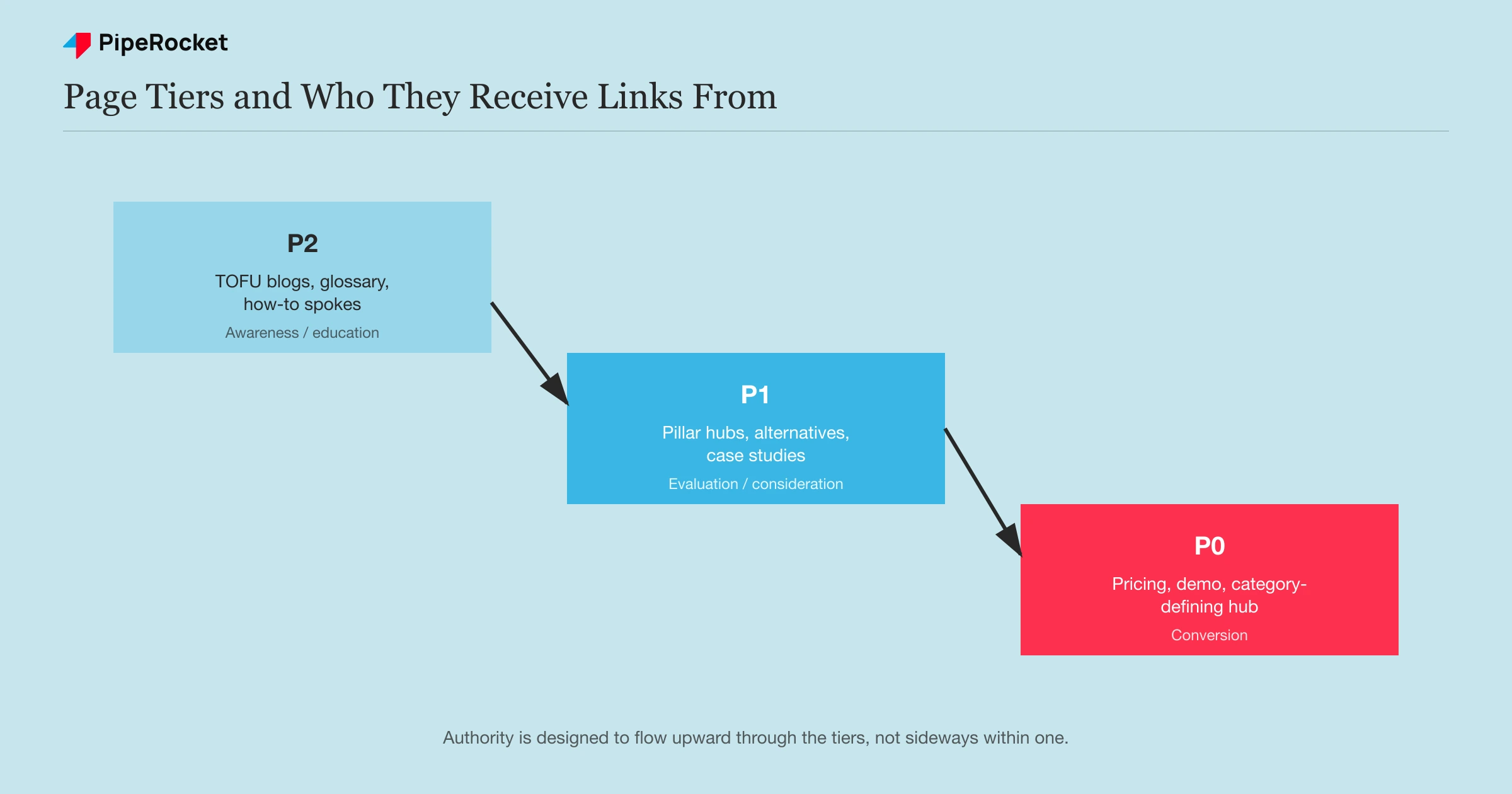
Page tiering assigns every page in your content library a priority level based on how close it sits to revenue, and that tier determines how much internal link authority it’s supposed to receive. This is the conceptual model behind how a linking script like add_interlinks.py enforces P0/P1/P2 rules: not a random labeling scheme, but a deliberate ranking of which pages the whole site exists to support.
| Tier | Page type | Role | Should receive links from |
|---|---|---|---|
| P0 | Pricing, demo, comparison, category-defining hub | Conversion or category ownership | Every relevant spoke and hub in the site |
| P1 | Pillar hubs, alternatives pages , case studies | Evaluation and consideration | Spokes within their own cluster, plus adjacent P1s |
| P2 | TOFU blogs, glossary entries, how-to spokes | Awareness and education | Each other sparingly; mostly link upward to P1/P0 |
Tiering comes first, linking decisions come after
If you don’t tier pages first, every internal linking decision becomes a judgment call made in isolation. One writer decides a blog should link to the homepage, another decides it should link to a related blog, and neither decision reflects an actual priority. Tiering removes the guesswork. Once a page is marked P0, every other page in its cluster already knows it’s a candidate destination.
The tiering also protects P0 pages from getting starved. A pricing page that only receives links when a writer happens to remember it exists will always underperform a pricing page that’s a mandatory destination for every P1 and P2 page in its cluster. Set the tier once, apply it consistently, and the flow takes care of itself.
The trade-off between tiering rigidly and tiering flexibly
A fixed tier list is easy to enforce but can go stale. A category shifts, a new competitor pushes an alternatives page ahead of a comparison page in priority, and the tier list doesn’t know that happened until someone updates it. Review tiers on the same cadence you review your keyword map, roughly quarterly, so the hierarchy keeps reflecting where the market actually is.
Design the Authority Flow Across the Whole Cluster, Not Page by Page
Authority flow design means mapping how link equity is supposed to move across an entire cluster before you check whether any individual page has “enough” links. Most teams do this backwards. They audit page by page (does this post have 6 to 10 internal links, is the anchor text descriptive), which is useful maintenance work but answers the wrong question first.
The right first question is a cluster-level one: does authority flow toward the pages tiered P0 and P1, or does it pool in P2 content because that’s where most of the pages and most of the natural first-mention links happen to sit?
What a healthy flow map looks like
Picture a cluster built around “SaaS customer onboarding.” The hub page targets the broad category term and sits at P1. Beneath it: four spoke blogs covering specific onboarding tactics (P2), one comparison page pitting onboarding software options against each other (P1), and one pricing page for the company’s own onboarding tool (P0).
In a healthy flow map, all four spokes link to the hub and to the comparison page. The hub and comparison page both link to the pricing page. None of the spokes link to each other more than once or twice, because spoke-to-spoke links spread equity horizontally instead of pushing it toward P0 and P1.
What a broken flow map looks like
The most common broken pattern is links pointing the wrong direction, even when the raw link count looks healthy. A site with 80 published pages can have thousands of internal links and still fail this test, if the vast majority of those links connect P2 spokes to each other while the P0 pricing page sits with three inbound links total.
We’ve seen this exact pattern on SaaS sites that published consistently for two or three years without anyone drawing the flow map even once: strong page count, strong raw link volume, and a pricing page that ranks nowhere near where the content investment should have put it. The content existed. The architecture routing authority toward the page that mattered didn’t.
Common Mistakes That Break a Linking Strategy Before It Starts
These four mistakes show up at the architecture layer, before a single anchor text decision gets made, which is why fixing them later is expensive.
Publishing spokes before the hub exists
Writing spoke content before the hub is live leaves every spoke with nowhere strategic to link. Teams often publish the specific, easier-to-rank pieces first because they’re faster wins, then build the hub months later. By that point, spokes have already been indexed, linked elsewhere, and half-forgotten. Reconnecting them retroactively works, but it’s cleanup, not design.
Treating every cluster as equally important
Not every topic in a content plan deserves a hub. Some subjects are genuinely spoke-only: narrow enough that they should link up into an existing hub rather than anchor a new one. Building a hub for every keyword with decent volume produces a site with dozens of shallow hubs and no clear hierarchy, which is functionally the same problem as having no hierarchy at all.
Letting the org chart decide the architecture
A site where each team or writer owns their own cluster in isolation tends to produce hubs that never link to each other. If the SEO team’s compliance cluster and the product team’s integrations cluster never cross-link even though a reader evaluating compliance software genuinely cares about integrations, that’s an organizational silo showing up as a structural gap. The hierarchy needs one owner who sees the whole map.
Skipping the audit that reveals the real shape of the site
A site’s planned hierarchy and its actual link graph often diverge within six months of active publishing. Pages get added faster than anyone updates the architecture doc. Running a crawl to see the real link graph, not the one in the planning spreadsheet, is the only way to catch that drift before it compounds across another 50 pages.
How to Know the Architecture Is Working
Rankings on individual keywords are a lagging signal for architecture problems. Two structural checks catch issues faster.
- Depth-to-P0 distance. For any P2 page, count how many clicks it takes to reach the nearest P0 page through the links actually on the page. If that number climbs past two or three across a growing share of your P2 content, authority isn’t reaching the pages that convert.
- Hub inbound link concentration. For each hub, check what share of its inbound internal links come from its own tagged spokes versus from unrelated pages. A hub getting most of its links from outside its own cluster usually means the cluster boundaries were never enforced.
Neither check requires new tooling beyond a standard site crawl and a spreadsheet mapping URLs to their intended tier and cluster, the same map you should have built before publishing the first spoke.
How PipeRocket Digital Builds SaaS Content Architecture
We build the hub-and-spoke map and P0/P1/P2 tiering before a single article gets written. That sequencing is what separates a content program that compounds from one that just accumulates pages, not an afterthought bolted on once a client’s blog has already sprawled. If your SaaS site has grown past the point where anyone can describe its structure out loud, talk to our team or see how we run this as part of our SaaS SEO agency work.
Frequently Asked Questions
What is a SaaS internal linking strategy?
A SaaS internal linking strategy is the planning layer that decides how a site’s content hierarchy is structured, which pages act as hubs, which act as spokes, and how authority is meant to flow between them, before any individual links get placed. It’s the architecture internal linking tactics get applied to, not a synonym for the tactics themselves.
What’s the difference between internal linking and content architecture?
Internal linking is the set of individual links placed on individual pages: anchor text, placement, link counts. Content architecture is the hierarchy those links are supposed to express: which pages are hubs, which are spokes, and which pages exist specifically to receive authority. You can follow every internal linking best practice perfectly and still fail if the underlying architecture routes authority toward the wrong pages.
How often should a SaaS site’s content hierarchy be reviewed?
Quarterly is a reasonable default, on the same cycle as a keyword map review. Categories shift, competitors change what pages they prioritize, and new pages get added faster than most teams update their architecture documentation. A quarterly review catches drift between the planned hierarchy and the site’s actual link graph before it compounds across dozens of new pages.