AEO for SaaS: How B2B Software Companies Get Cited by AI Engines
 Kamaraj Mathiarasan (Kim)
Last updated on
Kamaraj Mathiarasan (Kim)
Last updated on
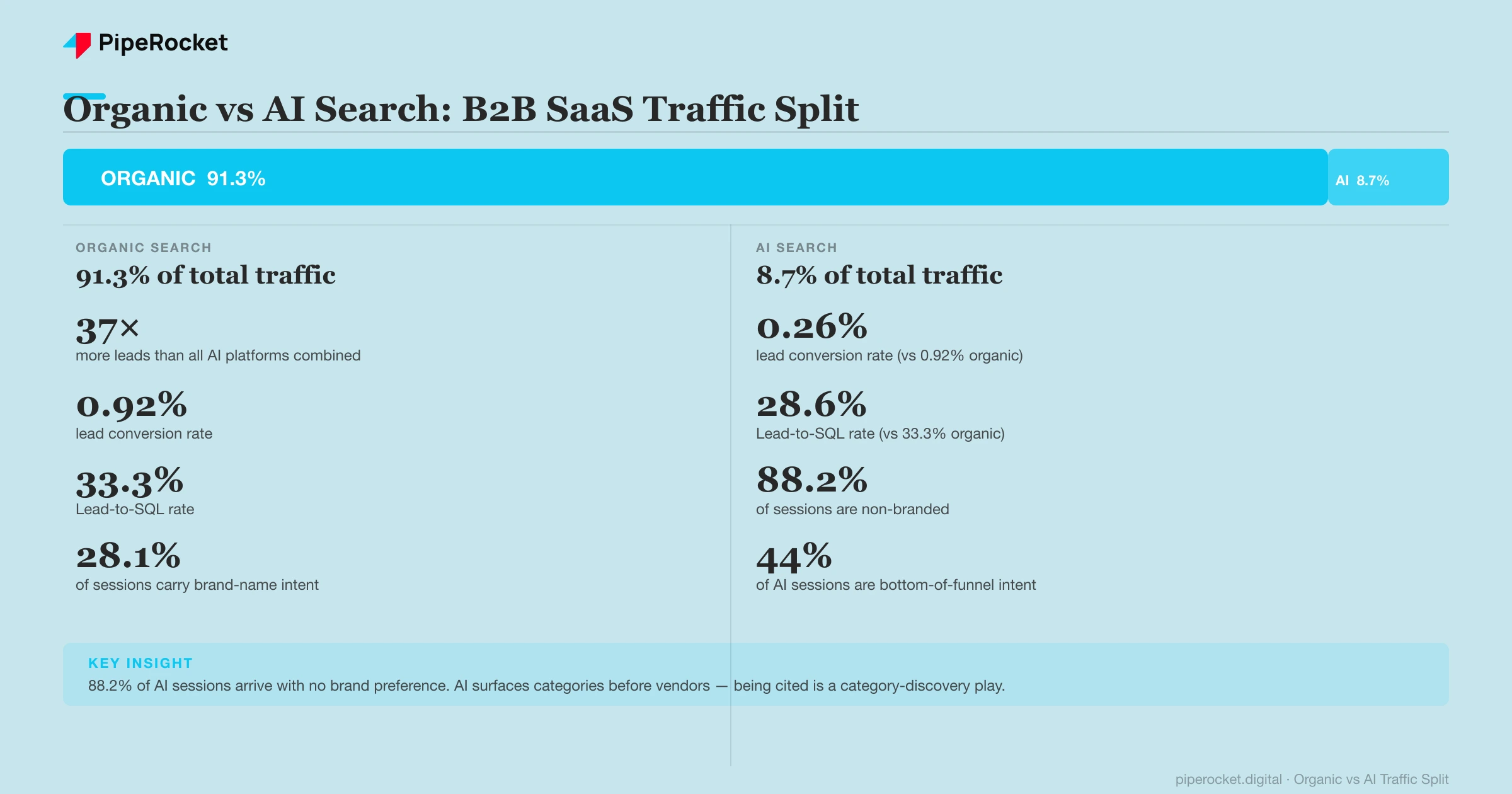
Across 53 B2B SaaS brands we tracked over eight months, AI engines sent 8.7% of total website traffic. Organic search sent 91.3%. Those numbers will shift as AI search grows, and they already tell us something important about how to approach AEO for SaaS in 2026.
The scale is no longer speculative. Google’s AI Overviews now reach roughly 2.5 billion monthly users, and AI Mode passed 1 billion monthly users at Google I/O 2026, one year after launch. AI search is an established discovery surface, not an experiment.
AI search adds a second discovery layer on top of organic, with a different intent profile. It does not replace it. The 88.2% of AI sessions that arrive without brand intent represent buyers who have not yet formed a vendor preference. They are asking AI which tools exist, which companies others recommend, which software handles a specific use case. Being cited in that answer is the opportunity.
This guide covers what AEO for SaaS actually requires, the data on how AI and organic traffic compare for B2B software companies, the four levers that determine AI citation eligibility, and why most AI-visibility tools are giving you numbers you cannot act on.
TL;DR
- AI drives 8.7% of B2B SaaS traffic vs 91.3% for organic: AI is a real and growing discovery channel. Organic still does the majority of the work. The right approach builds for both rather than treating them as alternatives.
- 88.2% of AI sessions are non-branded: AI surfaces categories before brands. Most AI-referred visitors have not formed a vendor preference yet, which makes AI traffic a meaningful non-branded discovery layer.
- The four citation levers are structure, third-party authority, brand signals, and freshness: AI engines prefer clear, answer-first content cited by credible third parties with consistent brand signals across the web.
- Copilot sends 3.1% of AI traffic but the highest Lead-to-SQL: Volume and quality are not correlated across platforms. Tracking aggregate AI traffic misses a 20-percentage-point spread in conversion quality by platform.
- Commercial-intent money pages earn the highest-value citations: Competitor-alternative pages, pricing pages, and best-of listicles are the pages AI engines cite for buyers close to a decision. Build them deliberately.
- Most AI tracking tools measure synthetic prompts rather than real users: Treat AI-visibility dashboards as directional estimates. Build real visibility through SEO fundamentals rather than optimizing for a metric.
The AI vs Organic Split: What the Data Shows
The data from our study makes the current state of AI search clear for B2B SaaS brands.
| Metric | Organic | AI engines |
|---|---|---|
| Share of total traffic | 91.3% | 8.7% |
| Absolute leads (8-month period) | 37× more | n/a |
| Session-to-lead rate | 0.92% | 0.26% |
| Lead-to-SQL rate | 33.3% | 28.6% |
| Sessions with brand intent | 28.1% | 11.8% |
| BoFu session share | 41% | 44%* |
*AI’s higher BoFu % is offset by volume: organic drove 4.4× more absolute BoFu traffic.
The brand intent gap is the most important number in that table. Only 11.8% of AI-referred sessions carried brand-name search intent versus 28.1% for organic, a 16.3-point gap. The 88.2% of AI sessions that arrive non-branded represent buyers exploring the category who have not yet formed a vendor preference. That is a different kind of discovery than organic provides, and the reason AEO matters.
AEO for SaaS is an additive strategy layered on top of a working organic foundation, not a replacement for it.
What AEO for SaaS Actually Means
AEO for SaaS is the practice of structuring your content, authority, and brand signals so AI engines cite your product when buyers ask category questions. There is no submission process: the model decides at inference time based on structure, third-party trust, brand presence, and freshness.
AEO (Answer Engine Optimization ) is the practice of making your content easy for AI engines to cite in their generated answers. It overlaps with GEO (Generative Engine Optimization ) in most practical work.
The distinction matters primarily in terminology: AEO focuses on being cited in direct answers to specific questions; GEO is the broader optimization for AI-generated outputs including summaries, comparisons, and recommendation responses. For B2B SaaS, the practical question is the same regardless of which label you use.
When a founder, VP of engineering, or procurement manager asks an AI engine “what is the best project management software for remote teams” or “which CRM integrates with HubSpot and works for mid-market B2B”, does your product appear in the answer? That is the AEO for SaaS question.
Getting cited is different from getting ranked. You cannot submit a URL to be indexed in ChatGPT. There is no position checker for Perplexity in the same way there is for Google. The citation decision is made by the model at inference time, based on what the model learned during training and what it retrieves through real-time web browsing where available.
The levers are indirect:
- Write content structured to be extractable by AI systems
- Build genuine third-party mentions on platforms AI engines trust
- Maintain consistent brand signals across the web
- Keep content current with accurate freshness signals
None of these are new disciplines. They are the same things that drive organic rankings, with a few specific additions for AI citation eligibility.
Google’s own AI optimization guidance
reinforces this. Google states that appearing in its AI features “is still SEO” and that you do not need llms.txt files, content broken into tiny chunks, AI-specific rewriting, or any special schema to show up. The work that earns AI citations is the work that earns rankings.
How AI Engines Decide What to Cite
AI engines cite brands through two distinct mechanisms: real-time web retrieval and training-data frequency. Understanding both explains why some SaaS brands appear consistently in AI answers while others with comparable products do not.
| Real-time browsing engines | Training-data-only engines | |
|---|---|---|
| Engines | Perplexity, Copilot, ChatGPT Plus | Base ChatGPT, Claude without web access |
| How they cite | Retrieve pages at inference time; rank them like search | Surface brands from training corpus frequency |
| Primary signal | Domain authority , content quality, recency | Credible mentions on news sites, Reddit, G2, Capterra |
| What to build | Rank for organic search | Third-party review presence and industry coverage |
The practical implication: brands that rank well for organic search and have strong third-party review presence appear more consistently in AI answers across both mechanisms. The same signals that drive organic authority are the inputs AI engines use to decide which brands are trustworthy enough to cite.
This is why AEO for SaaS starts with organic SEO fundamentals, not with special AI optimization techniques.
The Four Levers for AI Citation Eligibility
Four areas specifically determine how consistently AI engines cite your content. They apply across ChatGPT, Perplexity, Gemini, Copilot, and Claude.
Lever 1: Content structure and direct answers
AI engines extract specific answers to specific questions. Content written with an answer-first structure is significantly easier for models to extract than flowing prose. The structural markers that help AI systems parse your content:
- A clear H2 and H3 heading hierarchy
- Short paragraphs under 80 words
- Topic sentences that state the answer before the explanation
- FAQ sections written in the natural language of how buyers actually ask questions
This is not just a formatting choice. When an AI engine is deciding which sentence to pull for a citation, the page that answers the question in the first sentence of a section wins over the page that builds to the answer over four paragraphs. A handful of AI content optimization tools score drafts against this kind of answer-first structure before you publish, which is a faster feedback loop than waiting to see whether a model decides to cite the page.
The most reliable source for that natural buyer language is your own support tickets and sales call transcripts. Buyers describe their problems to your team in the exact phrasing they later type into an AI engine. Mine those transcripts for the recurring questions and word choices, then write your headings and FAQ answers in that language rather than in internal product vocabulary.
Lever 2: Third-party mentions and citations
AI models trust Reddit threads, G2 and Capterra reviews, Clutch profiles, Quora answers, and comparison articles on independent sites more than vendor marketing pages. That is not intuitive, but the citation mechanism makes it clear.
The counter-nuance matters, though: third-party trust is not the whole story. A first-party domain with genuine authority (strong organic rankings, real backlinks, a track record of accurate content) can outperform a passing mention on Reddit, Wikipedia, or Forbes. Third-party presence and your own domain authority compound each other, so build both rather than chasing citations off-site while your own pages stay thin.
How We Appeared in Google's AI Overview
For SaaS companies, this means building genuine review profiles and participating in the conversations where your product gets mentioned in context. Aim for real user testimonials that describe specific problems your product solved, in the language of the problem, rather than manufactured reviews.
The same authenticity bar applies to your own published content, since AI engines and the third parties citing you both penalize obviously generated copy. Running drafts through AI content detection tools is a cheap way to confirm your pages read as genuine, experience-backed material rather than spun output.
Lever 3: Structured data and brand signals
Organization schema, Article schema with a named author, FAQPage schema on pages with structured Q&A, and consistent NAP data across the web help AI citation systems verify that your content is attributable to a real entity with a real presence. Brand mentions across diverse third-party platforms (news articles, podcast appearances, industry reports, partner pages) build the brand signal that AI models use to distinguish established companies from unknown vendors.
Google is explicit that no special schema is required to appear in its AI features. Treat the schema above as ordinary SEO hygiene that also helps entity verification, not as an AI-specific requirement. It is low-cost to implement and already earns its place in standard SEO, so there is no reason to skip it.
Lever 4: Content freshness and dateModified signals
For topics where facts change (SaaS pricing comparisons, AI engine capabilities, software feature matrices, market statistics), AI engines with browsing capability prefer recently updated content. A page with a current lastmod and visible “Updated [date]” signals is more likely to be cited for a time-sensitive query than an identical page untouched in 18 months.
Platform-Specific Considerations: Volume vs Quality
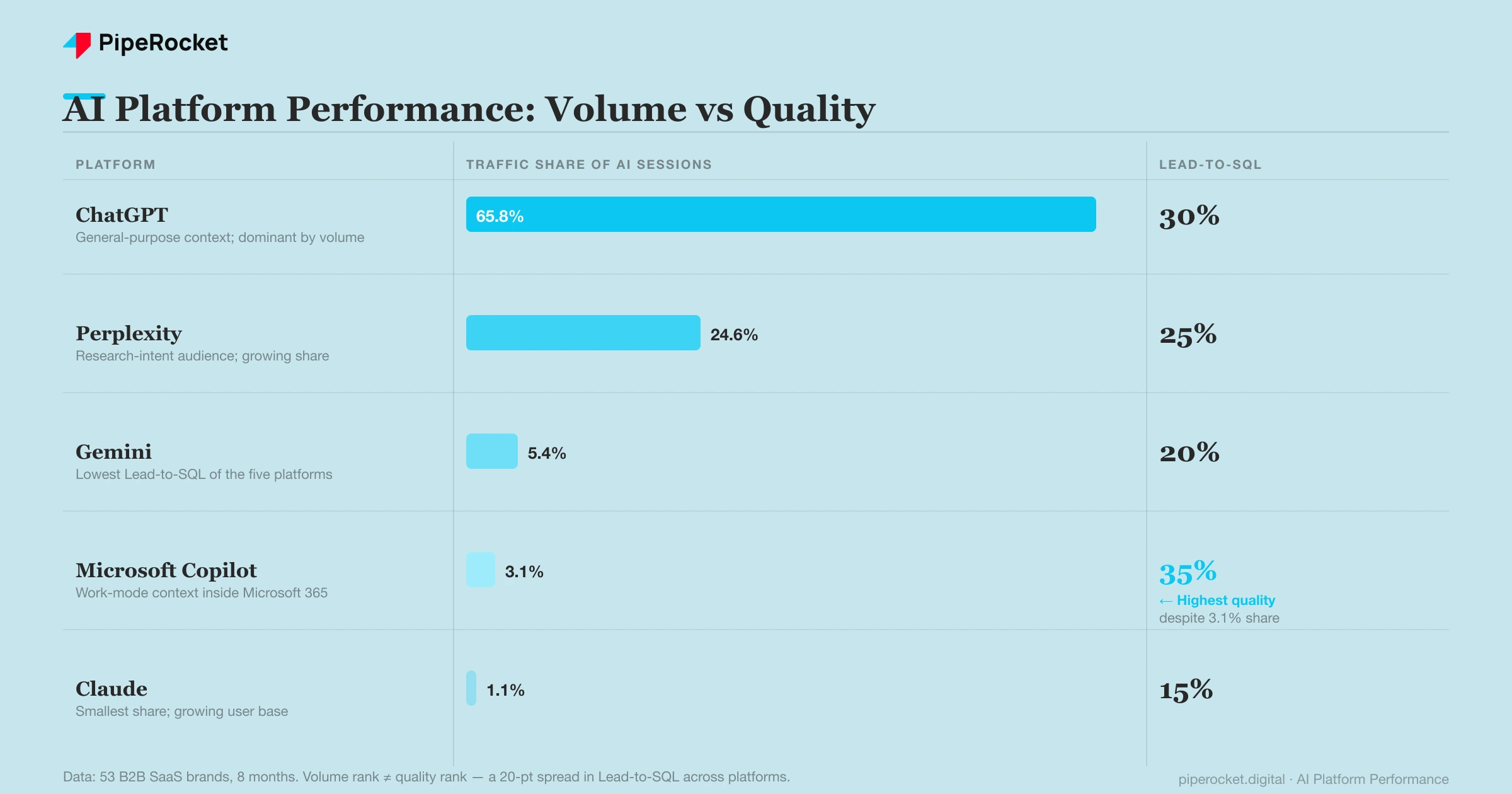
The five AI platforms in the dataset send very different quality traffic. The quality ranking does not match the volume ranking, which matters for how you think about platform-specific AEO.
| Platform | Share of AI traffic | Lead-to-SQL | Note |
|---|---|---|---|
| ChatGPT | 65.8% | 30% | Dominant by volume; general-purpose context |
| Perplexity | 24.6% | 25% | Research-intent audience; growing share |
| Gemini | 5.4% | 20% | Lowest conversion quality of the five |
| Microsoft Copilot | 3.1% | 35% | Highest Lead-to-SQL; work-mode context inside Microsoft 365 |
| Claude | 1.1% | 15% | Growing user base; currently lowest share |
The volume-to-quality inversion matters. Copilot sends 21 times less traffic than ChatGPT but converts to SQL at a 5-point higher rate. Copilot users are primarily inside Microsoft 365 applications, searching for software solutions as part of active work tasks. The context is work-mode rather than general browsing.
Treating AI search as a single homogeneous channel misses a 20-percentage-point spread in Lead-to-SQL quality across platforms. Separate tracking by platform in GA4 gives you an accurate picture of what your AEO investment is actually producing.
Measuring AEO: What the Tools Actually Tell You
Most AI-visibility tools measure synthetic prompts run through the model, not what real users searched. Treat their dashboards as directional estimates. The reliable measurement is AI-referred traffic in GA4 split by platform, plus your brand’s review and mention footprint on the sites AI engines trust.
First-hand take“Most LLM SEO tracking tools right now? Pure guesswork.” I have spent significant time evaluating more than 40 AI-monitoring tools across categories, and the hard truths are consistent.
The hard truths about AI-visibility dashboards:
They do not track real user queries
ChatGPT and Gemini do not share first-party intent data with third-party tools. Every tool claiming to show you your “AI search ranking” is running synthetic prompts through the model, not tracking what real users actually searched.
The one real first-party signal is narrow. As of June 2026, Search Console reports AI impressions for AI Overviews, AI Mode, and Discover. It covers only Google’s surfaces, not ChatGPT or Perplexity, and it shows impressions without click data yet. Useful, but not a full picture.
There is no universal rank
LLM outputs are personalized by location, IP address, chat history, and context window. A tool that says “you rank third for CRM software” is reporting that its bot ranked third when it ran that specific query with a specific context. That result may not match what your target customer sees.
They rely on traditional signals under the hood
Despite the branding, most AI-visibility tools ultimately measure content quality, domain authority, and third-party mentions. These are the same inputs that drive traditional SEO. If your SEO fundamentals are strong, you are likely already appearing in AI answers for relevant queries, whether or not a dashboard shows it.
Until AI platforms open their data, these tools provide directional signal at best. That caveat applies across the whole category, whether you evaluate dedicated AEO tools for citation tracking or the broader all-in-one AI SEO platforms that bundle visibility monitoring with the rest of an SEO workflow.
The most defensible approach is measuring AI-referred traffic in GA4 by platform, tracking brand mentions on third-party review sites over time, and using AI-visibility tools as one imperfect indicator alongside stronger signals.
The single most reliable leading indicator of AEO performance is not an AI-visibility score. It is whether your brand appears in the places AI engines actually trust: G2 and Capterra with detailed, specific reviews describing the problems your product solved, Clutch with verified project records, and Reddit threads where buyers in your category are genuinely asking for tool recommendations. Build presence there, and AI citations follow.
Building a Content Architecture for AI Citation
A content architecture built for AI citation has four parts: topical authority clusters, answer-first structure at the page level, schema on every page, and recency signals on time-sensitive content. Each one shapes how easily AI engines traverse and extract from your site.
The content structure that serves AI citation is the same structure that serves human readers: organized, scannable, and answer-first. But specific architectural decisions determine how easily AI engines can traverse and extract content from your site.
Topical authority clusters
AI engines do not evaluate pages in isolation. They assess how comprehensively a domain covers a topic.
A hub page on AEO for SaaS surrounded by spoke pages signals to AI engines that this domain is an authoritative source on the topic. Those spoke pages typically cover:
- Specific tactics (schema, third-party review presence, freshness workflows)
- Platform guides (ChatGPT, Perplexity, Copilot, Gemini)
- Case studies and data studies tied to buyer-journey stages
A single well-written page with no related content signals narrower authority. Building deep topical clusters is as important for AI citation as it is for organic rankings.
Commercial-intent money pages
Some of the most valuable AI citations come from commercial-intent pages, not top-of-funnel explainers. When a buyer asks an AI engine “best X for Y,” “X alternatives,” or “how much does X cost,” the engine pulls from pages built to answer exactly those queries.
Build these page types deliberately:
- Competitor-alternative pages ("[Competitor] alternatives for mid-market B2B")
- Pricing and pricing-comparison pages that state real numbers
- Best-of and comparison listicles for your category
These are the pages AI engines cite for a buyer who is close to a decision. One early GSC signal on this page, a “aeo tracking for alternative-to queries” query sitting in striking distance, points at exactly this demand. Treat alternative pages, pricing pages, and best-of listicles as a core part of the architecture that earns real commercial-intent citations.
Answer-first content structure at the page level
The structural principle that most directly improves AI citation eligibility is placing the direct answer in the first sentence of each section. AI extraction systems look for the most relevant sentence to cite for a given query.
A section that opens with “Copilot sends 3.1% of AI-referred B2B SaaS traffic but produces the highest Lead-to-SQL rate of any platform in our dataset” is a citeable sentence. A section that opens with “There are several factors to consider when evaluating platform quality” is not.
Schema implementation at the site level
Organization schema on every page, Article schema on every editorial page, and FAQ schema on pages with structured Q&A sections are the structured data requirements for maximizing AI citation eligibility. The author property should point to a specific named person with a verifiable URL. A generic “author: Company Name” has less citation value than a named author linked to a real bio page.
Recency signals on time-sensitive content
For pages covering topics where facts change (market statistics, product comparisons, pricing, AI engine capabilities), the dateModified field in Article schema should reflect the date of the most recent substantive content update. AI systems that use freshness signals to assess citation suitability will deprioritize pages that are technically unmodified even when the facts have changed. Refresh content when the underlying data changes, not just when the URL gets a technical touch.
AEO and SEO: Where They Overlap
AEO for SaaS and traditional SEO share most of their inputs. The signals that help AI engines cite your content are the same signals that help Google rank your pages, so a working organic program already does most of the AEO work.
Those shared signals are:
- A clear site structure
- Well-organized content with direct answers
- Genuine third-party authority through backlinks and reviews
- Accurate and current information
- Structured data that establishes brand identity
AEO adds a few specific optimizations on top of the SEO foundation:
- Lead with the answer in the first sentence of every section
- Write FAQ sections in natural question language, not formal headers
- Organization, Article, and FAQPage schema on every relevant page, with
authorpointing to a named person with a real bio URL - Maintain brand presence on G2, Clutch, Reddit, and industry forums with genuine, specific reviews
- Set
dateModifiedto reflect actual content updates, not just technical touches
Teams that pursue AEO for SaaS in isolation, without a working organic SEO foundation, consistently underperform against teams that build SEO fundamentals first. The organic foundation is not optional. It is the mechanism through which most AEO citation eligibility is built.
One tactic worth naming explicitly: original research earns citations. The 53-brand data study behind this guide is a repeatable move any SaaS team can apply. Publish proprietary numbers your competitors cannot copy (survey results, benchmark studies, first-party performance data), and you give AI engines a reason to cite you as the source rather than a page that restates common knowledge.
Timeline: What to Expect From AEO for SaaS
AEO for SaaS moves on the same timeline as the SEO work underneath it, so plan in months rather than weeks. Because AI citation eligibility is built on organic authority, third-party review presence, and content the model has time to encounter, there is no overnight switch to flip.
A realistic shape:
- Weeks 1 to 4: structural work (answer-first rewrites, schema, freshness signals) ships and gets indexed.
- Months 2 to 4: third-party review and mention presence builds; browsing-based engines start surfacing recently updated pages.
- Months 4 and beyond: training-data-based citations accumulate as your brand’s frequency across trusted sources grows.
The teams that see results earliest are the ones that already have an organic foundation to build on. Starting AEO from a standing start takes longer because you are building the underlying authority at the same time. This SaaS-specific playbook sits alongside our broader AI SEO strategy and framework work and the platform-level detail in how to rank on ChatGPT, which go deeper on the program design and single-engine tactics this page only summarizes.
Common Mistakes to Avoid
Most AEO for SaaS failures trace back to a handful of repeatable mistakes. Each one is avoidable.
Optimizing for an AI-visibility score instead of real signals
Chasing a dashboard number treats a synthetic-prompt estimate as ground truth. The tools run bot queries, not real user searches. Build presence on the sites AI engines trust and measure AI-referred traffic in GA4, then use visibility tools only as one directional input.
Skipping the organic foundation
Pursuing AEO without a working SEO base underperforms every time. Domain authority, content quality, and third-party mentions are the inputs AI engines use to decide who to cite. Without them, there is nothing for the model to surface.
Treating AI search as one homogeneous channel
Aggregating all AI traffic hides a 20-percentage-point spread in Lead-to-SQL quality across platforms. Copilot converts far better than Gemini despite far less volume. Track each platform separately in GA4 so your investment follows the traffic that actually converts.
Manufacturing reviews instead of earning them
Spun copy and fake reviews get penalized by both AI engines and the third parties that would otherwise cite you. Aim for genuine, specific testimonials that describe the problems your product solved, in the language of the problem.
Why PipeRocket Works on Both AEO and SEO
We work with B2B SaaS companies building visibility across organic search and AI discovery channels. Our AI SEO services cover structured data implementation, content architecture for AI citation eligibility, and platform-level AEO strategy. If you want to understand where your brand stands across AI engines and what changes would move the needle, visit our AI SEO services page, compare the best AEO agencies , or reach out via our contact page .
Frequently Asked Questions
What is AEO for SaaS?
AEO (Answer Engine Optimization ) for SaaS is the practice of making your content easy for AI engines to cite when buyers ask questions about software in your category. Unlike traditional SEO, there is no direct submission process.
Citation decisions are made by the model at inference time based on content structure, third-party authority signals, brand presence across the web, and content freshness. The practical goal is ensuring your product appears when a prospect asks an AI engine which tools handle a specific problem you solve.
Does AEO replace SEO for SaaS companies?
No. Data from 53 B2B SaaS brands shows organic search sends 91.3% of total website traffic versus 8.7% from all AI engines combined. In absolute lead volume, organic produces 37 times more leads.
AEO is an additive channel. The signals that drive organic rankings (content quality, domain authority, third-party mentions, structured data) are largely the same signals that drive AI citation eligibility. Building SEO fundamentals first is not optional; it is the mechanism through which most AEO citation potential is established.
How do you track AEO performance for a SaaS brand?
Tracking AEO precisely is difficult because AI platforms do not share first-party query data. Most AI-visibility tools run synthetic prompts rather than tracking real user searches.
In practice, the most reliable approach combines three signals:
- Measure AI-referred traffic in GA4 with platform-level breakdown (separate ChatGPT, Perplexity, and Copilot)
- Track your brand’s review volume and average rating on G2 and Clutch over time
- Monitor for brand mentions in relevant Reddit and forum threads
Treat AI-visibility tool dashboards as directional indicators, not precise measurements.