
Schema Markup for SaaS: The Types That Actually Earn Rich Results and AI Citations
 Sabari Rohith
Last updated on
Sabari Rohith
Last updated on
Schema markup for SaaS means adding structured data (SoftwareApplication, Product, FAQPage, Organization, and BreadcrumbList) to your site’s code so search engines and AI models can parse your product, pricing, and content accurately instead of guessing at it.
TL;DR
- SoftwareApplication and Product schema give Google and AI models a structured version of your pricing and category, which is exactly the kind of fact both surfaces pull for comparisons.
- FAQPage schema turns your existing FAQ content into a machine-readable answer set that AI Overviews and LLMs can lift almost verbatim.
- Organization schema builds the entity graph that ties your brand, logo, and social profiles together, which matters more for AI trust signals than most teams realize.
- BreadcrumbList schema is low effort and mostly a hygiene item, but it still helps Google understand where a page sits in your site structure.
- Most SaaS schema fails not because the type is wrong, but because the values inside it don’t match what’s actually on the page.
Most SaaS Teams Treat Schema as an SEO Checkbox, Not an AI Data Feed
I still see SaaS sites add one generic Organization schema block during a site launch and never touch structured data again. That’s the standard playbook, and it’s incomplete.
Schema used to be a rich-results lever, full stop. Add the right JSON-LD to a SoftwareApplication or Product page, and you could earn a star rating in the SERP. That’s still true, but it’s no longer the whole story.
AI Overviews, ChatGPT, and Perplexity all need a fast, unambiguous way to pull facts about your product:
- What it does
- What it costs
- Who it’s for
Prose buries those facts. Schema hands them over pre-parsed. A SaaS site with clean SoftwareApplication and Product markup is handing the model a fact sheet. A site without it is asking the model to guess from a features page written for humans.
This is the gap most schema guides miss. They write for the SERP snippet, and that snippet opportunity has already shrunk. Your SaaS site needs to write for both the shrinking snippet and the model doing the citing.
Which Schema Types Actually Move the Needle for SaaS
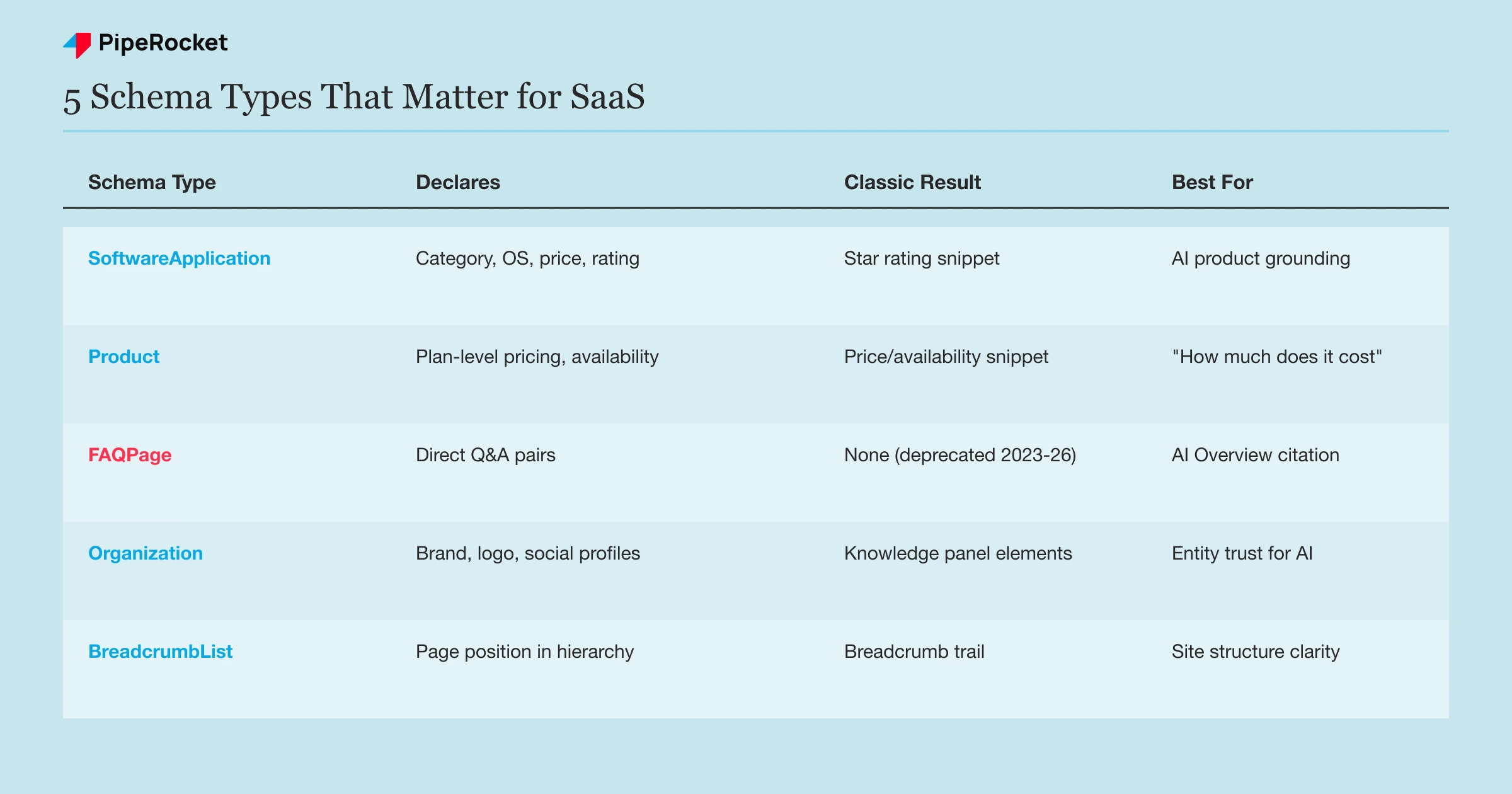
Not every schema type on schema.org matters here. SaaS sites get real value from five, and each does a different job.
| Schema type | What it declares | Classic rich result | Highest-leverage for |
|---|---|---|---|
| SoftwareApplication | Category, OS, price, aggregate rating | Star rating snippet | AI grounding on “what is this product” |
| Product | Plan-level pricing, availability | Price/availability snippet | AI answers on “how much does it cost” |
| FAQPage | Direct question-and-answer pairs | None (deprecated 2023-2026) | AI Overview and LLM citation |
| Organization | Brand identity , logo, social profiles | Knowledge panel elements | Entity trust for AI grounding |
| BreadcrumbList | Page position in site hierarchy | Breadcrumb trail in SERP | Site structure clarity for crawlers |
SoftwareApplication Schema Tells Search Engines What Your Product Is
This is the type most SaaS sites skip, and it’s the one doing the most work for both rich results and AI grounding.
SoftwareApplication schema lets you declare the application category, operating system, and pricing in a structured block instead of hoping Google infers it from your homepage copy. For a compliance SaaS built for fintech ops teams, that means explicitly stating applicationCategory: BusinessApplication instead of leaving Google to guess between “business software” and “finance tool” from ambiguous page copy.
Here’s a minimal but complete example:
{
  "@context": "https://schema.org",
  "@type": "SoftwareApplication",
  "name": "YourApp",
  "applicationCategory": "BusinessApplication",
  "operatingSystem": "Web",
  "offers": {
    "@type": "Offer",
    "price": "49.00",
    "priceCurrency": "USD"
  },
  "aggregateRating": {
    "@type": "AggregateRating",
    "ratingValue": "4.6",
    "ratingCount": "218"
  }
}
The aggregateRating field is what actually earns the star rating in the SERP
, but only if the rating is real and pulled from a live review source. I’ll get to why that matters in the mistakes section.
Product Schema Handles Pricing and Plans Directly
SoftwareApplication and Product schema overlap, and most SaaS sites only need one, not both stacked on the same page. Use Product schema when your pricing page has distinct SKUs or plan tiers you want individually addressable, like Starter, Growth, and Enterprise.
The advantage here is specific to pricing pages: Offer objects let you mark each plan’s price, currency, and availability separately. When someone asks an AI assistant “how much does [tool] cost,” a clean Product/Offer block is the fastest path to a correct, current answer. A vague pricing page with “contact sales” buried in prose gives the model nothing to extract.
FAQPage Schema Does the Most Work for AI Citations Now
FAQPage schema stopped earning a SERP dropdown for most sites after Google restricted, then fully removed, FAQ rich results between 2023 and 2026. What it still does, and does well, is hand AI Overviews and LLMs a pre-packaged question-and-answer pair, close to the exact format those systems synthesize into a response.
The mechanism is straightforward. AI Overviews assemble answers from structured, extractable content across multiple sources. A question phrased the way a user would actually ask it, paired with a direct 2 to 3 sentence answer, is exactly what gets lifted. A vague FAQ answer that rambles for a paragraph before landing on the point gets skipped in favor of a competitor’s tighter one.
This is why I tell every SaaS client to treat their FAQ section as content strategy first, schema second. Write the direct answer, then mark it up. Don’t write for humans and hope the schema fixes vague copy. It won’t.
Organization Schema Builds the Entity Graph AI Models Trust
Organization schema is the least visible of the five types and the easiest to underweight. It doesn’t produce a rich result on its own most of the time. What it does is connect your brand name, logo, founding date, and social profiles into one verifiable entity.
That entity graph is part of how AI models decide whether to trust a source enough to cite it. A brand with a thin or inconsistent entity presence, mismatched name variants across pages, no sameAs links to a real LinkedIn or Crunchbase profile, is harder for a model to confirm as a real, stable company.
Get this wrong and every other schema type on the site loses some of its credibility by association.
BreadcrumbList Schema Is a Small, Necessary Hygiene Item
BreadcrumbList schema is the one type on this list that’s mostly about site structure, not AI visibility. It tells Google where a page sits in your hierarchy (Home > Product > Feature, for example) and can produce the breadcrumb trail under your SERP listing instead of a raw URL.
It won’t move rankings on its own. But for a SaaS site with a doc portal, a blog, and a marketing site all under different subpaths, clean breadcrumbs help Google understand which pages belong to which section instead of treating them as a flat, disconnected list.
How to Implement Schema Without Breaking the Page
The implementation choices matter as much as picking the right type. Get these wrong and the schema either doesn’t validate or actively contradicts the page.
Use JSON-LD, Not Microdata or RDFa
JSON-LD is the format Google recommends and the format every major LLM
crawler parses cleanly. It sits in a single <script type="application/ld+json"> block in the page head or body, separate from your HTML, so it doesn’t touch your markup or your CSS.
Microdata and RDFa require sprinkling schema attributes directly into your existing HTML tags. It works, but it’s fragile. A designer changes a div structure during a redesign and the schema silently breaks. I’ve never recommended it for a SaaS site building anything past a one-page marketing site.
Match Every Schema Value to What’s Visible on the Page
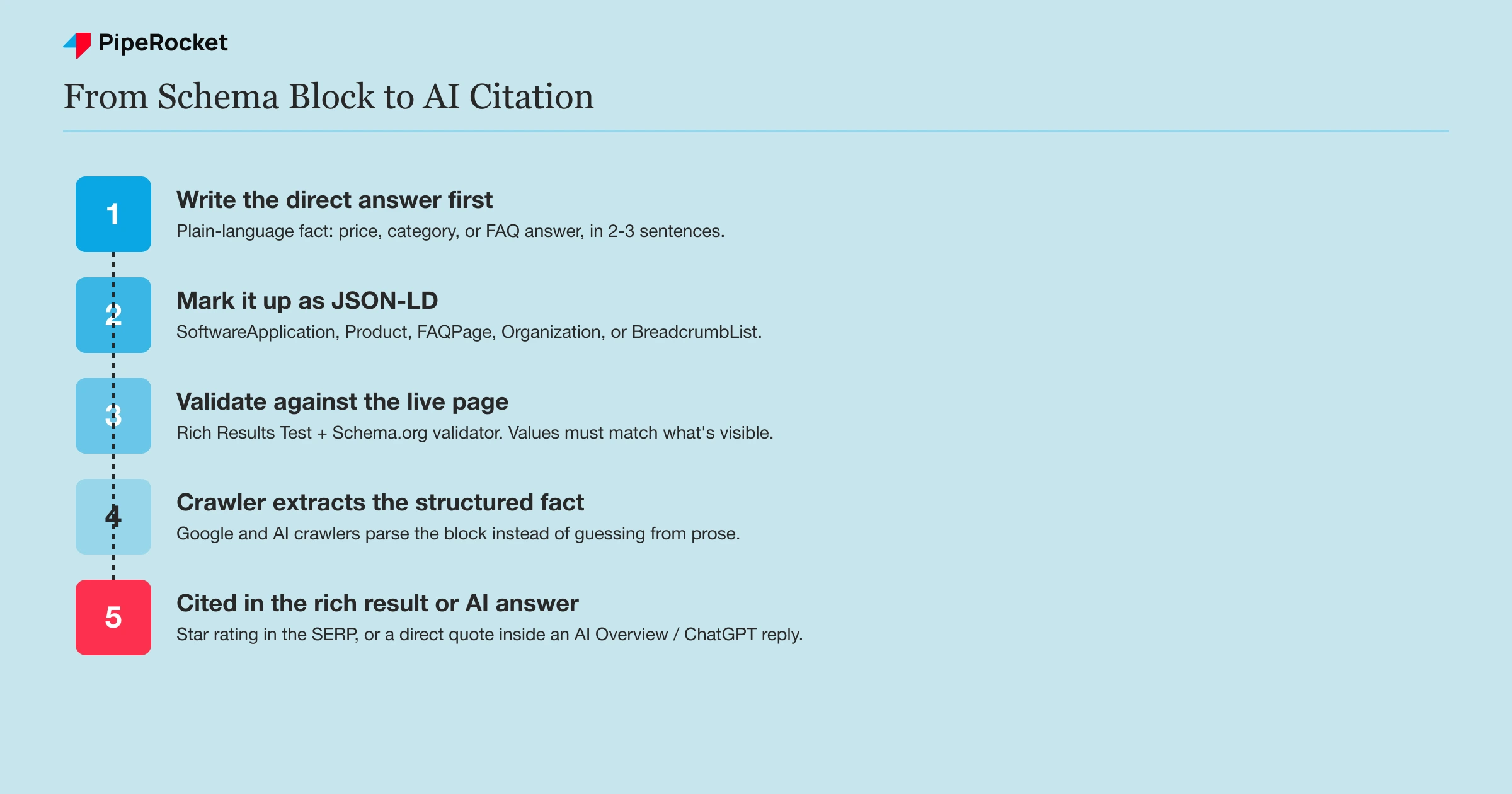
This is the rule that gets ignored most often, and it’s the one Google’s own guidelines call out directly as spam markup. If your SoftwareApplication schema states a price of $49, that number needs to actually appear on the page a human visitor sees.
I’ve audited SaaS sites where the pricing page said “Contact Us” but the schema declared a specific dollar figure from six months earlier, left over from a pricing change nobody updated in the JSON-LD.
Warning: Google treats a schema value that doesn’t match the visible page as manipulation, not a harmless technical bug. If caught, the rich result gets suppressed sitewide, not just on that one page.
Validate Before You Ship, Not After
Run every schema block through Google’s Rich Results Test and the Schema.org validator before it goes live. Both catch structural errors (missing required fields, wrong data types) that would otherwise fail silently. A schema block with one malformed field doesn’t get “partial credit.” Google either parses the whole block or ignores it.
Common Mistakes That Get SaaS Schema Ignored
Stacking Every Schema Type on Every Page
I see SaaS sites paste an identical schema bundle, SoftwareApplication, Product, Organization, FAQPage, onto every URL regardless of what the page actually contains. A blog post doesn’t need SoftwareApplication schema. A pricing page doesn’t need FAQPage schema if it has no FAQ section.
Stacking irrelevant types dilutes the signal and increases the odds one of them fails validation because the page has no matching content. Match the schema to what’s actually on the page and skip the types that don’t apply.
Copying a Competitor’s Schema Template Verbatim
A generic SoftwareApplication template pulled from a tutorial or scraped from a competitor’s page rarely fits your product’s actual pricing model, category, or plan structure. I’ve seen sites carry over a competitor’s applicationCategory value because it was in the template they copied, which then misrepresents their own product to both search engines and AI models.
Build the schema from your own product data every time. A five-minute copy-paste job creates a factual mismatch that takes months to notice and fix.
Letting Ratings Go Stale
An aggregateRating block frozen at a rating and review count from a year ago is worse than having no rating schema at all. It’s an easy, google-flagged form of markup spam once the live number on your actual review platform has moved. Set a quarterly reminder to pull current numbers from your live review source, not once and forget it.
Ignoring Schema for Doc Portals and Help Centers
SaaS companies obsess over marketing-site schema and leave the docs subdomain with nothing. That’s a mistake specifically for AI visibility, because a lot of the practical “how do I do X in [tool]” queries that AI assistants answer draw from documentation and help articles, not the homepage.
FAQPage schema on a help center’s most-viewed articles is often more valuable than another pass on the marketing site.
How PipeRocket Digital Helps SaaS Teams Get Schema Right
We build and audit structured data as part of every SaaS SEO engagement, matching schema types to what each page actually needs instead of shipping a generic bundle. If you want a second pair of eyes on your current markup, or want us to build the full schema stack from scratch, reach out to our team .
We also cover this exact kind of implementation work in our broader technical audits, the same standard the B2B SEO agencies clients trust hold themselves to.
Frequently Asked Questions
What is schema markup for SaaS?
Schema markup for SaaS is structured data code, usually written in JSON-LD, added to a SaaS website so search engines and AI models can read exact facts about the product instead of inferring them from prose. It covers pricing, application category, FAQs, and company identity, and it feeds both classic Google rich results and newer AI citation surfaces like AI Overviews and ChatGPT.
Does schema markup directly improve SEO rankings?
Schema markup isn’t a direct ranking factor Google confirms it uses in its core algorithm. What it does is improve how your pages are understood and displayed, which indirectly affects rankings through better click-through rates from rich results and clearer entity signals. For AI-driven surfaces, the effect is more direct: structured data is one of the easiest formats for an AI model to extract and cite, so accurate schema increases your odds of being the source an AI answer points to.
Can I add schema markup myself without a developer?
Yes, for most SaaS sites. Plugins and CMS-native tools can generate basic Organization and FAQPage schema without touching code. SoftwareApplication and Product schema with accurate offers and ratings usually need a short developer pass to make sure the JSON-LD pulls live data instead of hardcoded values that go stale. Either way, run the final markup through Google’s Rich Results Test before publishing.

