
How to Run a SaaS SEO Audit (Without Wasting Two Weeks on It)
 Omar Sheriff
Last updated on
Omar Sheriff
Last updated on

A SaaS SEO audit is a structured check across four layers, technical health, content and intent alignment, on-page and conversion, and off-page and competitors, that tells you which pages are losing rankings and why, so fixes get prioritized by revenue impact instead of guesswork. Whether you search it as a SaaS SEO audit or an audit SEO SaaS, the goal is the same: find the issues suppressing organic sign-ups and fix them in the right order.
TL;DR
- A full SaaS SEO audit covers four layers: technical health, content and intent alignment, on-page and conversion, and off-page and competitors.
- Crawlability and indexation get checked first because a technical block hides every content and on-page problem underneath it.
- Content and intent alignment means mapping each keyword to the right page type and merging pages that cannibalize each other.
- Keyword cannibalization between overlapping SaaS pages should be merged or redirected before it drags down rankings on both pages.
- On-page and conversion checks whether the CTA or trial flow itself is the barrier, not just whether the page ranks.
- An AI search visibility check (are your pages crawlable and extractable by AI answer engines) now belongs inside a full SaaS SEO audit.
- Fixes get prioritized by which pages sit closest to pipeline, not by which issues look the most broken.
Why Most SaaS SEO Audits Start in the Wrong Place
Most SaaS teams open an SEO audit by staring at their homepage title tag. That’s backwards. If Google can’t crawl or index half your app-adjacent pages, no amount of on-page polish on the pages it can see will fix the traffic problem.
We’ve run this audit on SaaS sites where the marketing team spent weeks rewriting meta descriptions while a sizeable chunk of the blog archive sat unindexed the whole time. The meta descriptions were fine. The sitemap was the actual issue, and nobody had opened Search Console in months.
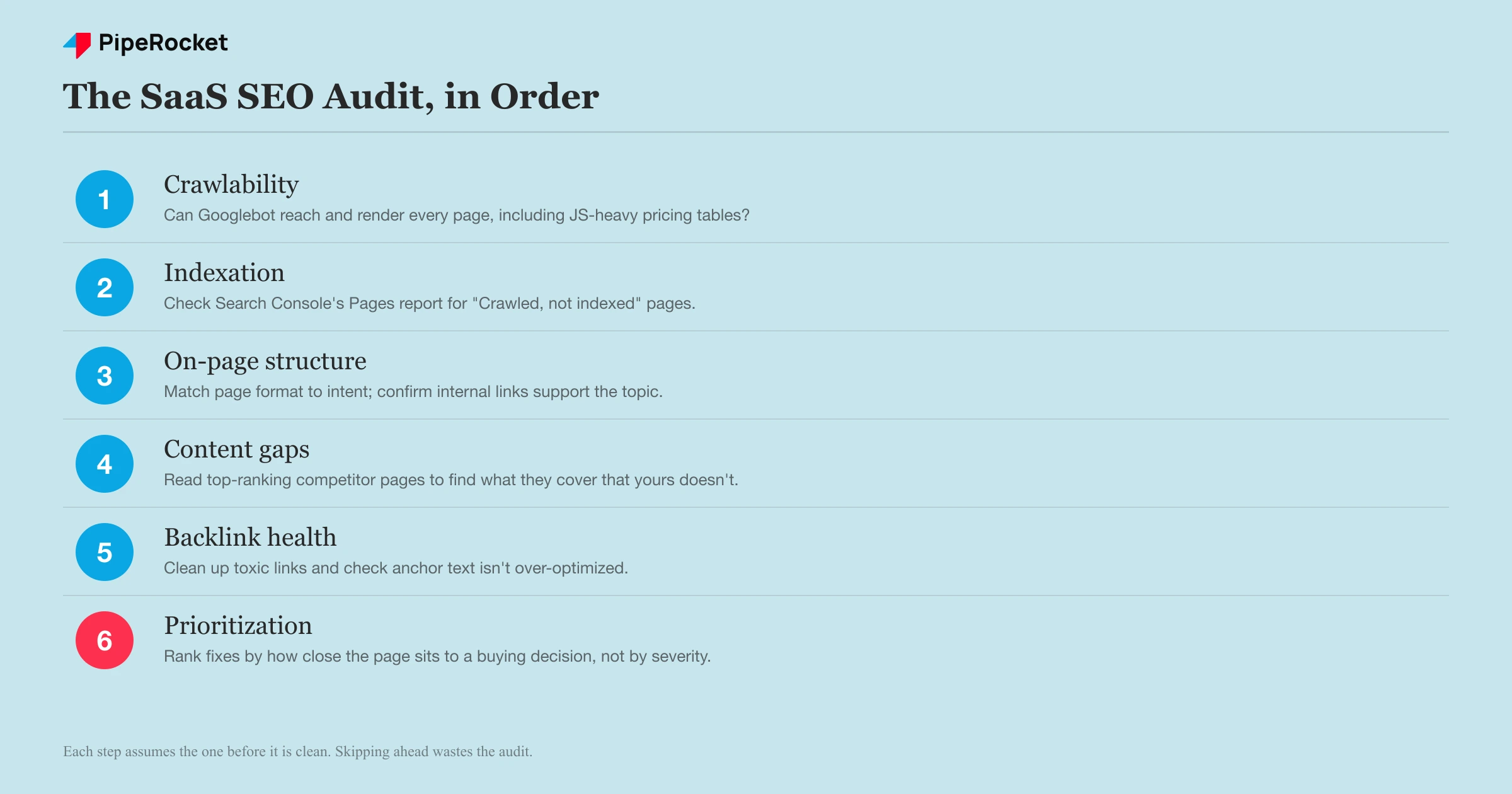
The order matters because each layer masks the one underneath it. A crawlability problem hides an indexation problem. An indexation problem hides a content problem. Fix them out of order and you’ll spend a sprint improving a page Google was never going to show anyone anyway.
This audit works through four layers, in this order, and each layer assumes the one before it is clean:
- Technical SEO: crawlability, indexation, site speed, architecture
- Content and intent alignment: keyword mapping, cannibalization, content depth
- On-page and conversion: metadata, headers, internal links, CTA barriers
- Off-page and competitors: backlink health, gap analysis
Then a fifth check most audits skip, AI search visibility, before you prioritize what to fix first.
Technical SEO: Crawlability, Indexation, Speed, and Architecture
Technical SEO is the layer that decides whether Google can reach, render, and index your pages at all, so it gets audited first because nothing downstream matters if the crawler can’t get in or the page never enters the index. Work through crawlability, indexation , site speed, and URL architecture in that order.
Check Crawlability Before Anything Else
Crawlability is whether Googlebot can even reach and render your pages, and it’s the first thing to check because nothing downstream matters if the crawler can’t get in. Pull up robots.txt and read the whole file line by line.
SaaS sites accumulate blocked paths over time, usually from a developer who blocked /app/ during a staging phase and never removed the rule once it went to production. That single leftover line can quietly block a help center or a blog category nested under the wrong path.
Open Search Console’s Crawl Stats report and compare it against robots.txt. If a section of your site barely gets crawled and it’s not disallowed, weak internal linking
is usually the actual cause, not a robots rule.
SaaS marketing sites love client-side rendered pricing tables, feature comparison grids, and interactive calculators. Use the URL Inspection tool’s “View Crawled Page” screenshot to see what Googlebot actually rendered, since that can differ sharply from what you see in your own browser. If the rendered screenshot is missing your pricing tiers or feature list, that content doesn’t exist for ranking purposes. This is the single most common technical issue we find on SaaS sites.
Audit What’s Actually Indexed
Indexation is a separate check from crawlability: a page can be perfectly crawlable and still sit outside Google’s index because Google decided it wasn’t worth including. Search Console’s Pages report under Indexing shows you exactly why, page by page.
Look for the “Crawled, currently not indexed” and “Discovered, currently not indexed” buckets first. These are pages Google has seen and chosen to leave out, usually because the content is thin, near-duplicate, or the page carries no unique value versus something else on the site.
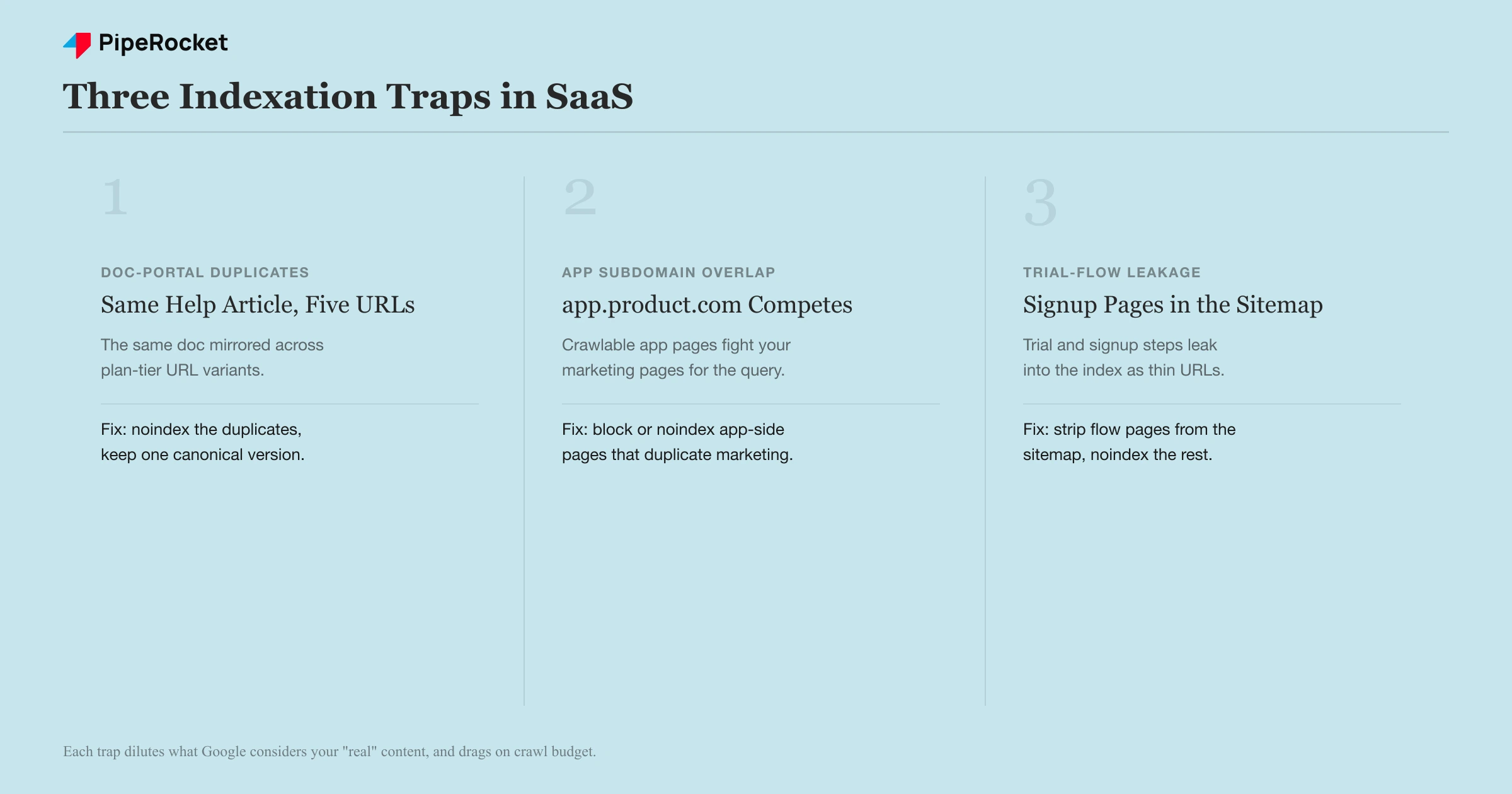
SaaS sites specifically run into a few indexation traps that a generic SEO audit checklist won’t catch:
- Doc-portal pages that mirror the same help article across five URL variants for different plan tiers
- App subdomain pages (like
app.yourproduct.com/onboarding) that get crawled and compete with marketing pages for the same query - Trial and signup flow pages that leak into the sitemap and get indexed as thin, low-value URLs
Each of these dilutes what Google considers your “real” content. The fix isn’t always deletion. Noindexing the doc-portal duplicates and consolidating the trial-flow noise into a clean XML sitemap usually recovers crawl budget within a few weeks.
Check Site Speed and Core Web Vitals on Conversion Pages
Site speed matters most on the pages that convert, so audit Core Web Vitals on your pricing, demo, and trial pages before your blog. Use Search Console’s Core Web Vitals report and PageSpeed Insights to check Largest Contentful Paint, Interaction to Next Paint, and Cumulative Layout Shift.
A pricing page that loads slowly loses trial sign-ups every day and sends Google a weak experience signal on your highest-intent URL. On SaaS sites the usual culprits are heavy client-side JavaScript, unoptimized hero images, and third-party marketing scripts stacked on the money pages. Check the same pages on mobile too, since Google indexes mobile-first and a layout that shifts on a phone costs you both rankings and conversions.
Check Your URL and Site Architecture
URL and site architecture is whether your pages sit in a clean, shallow, scalable hierarchy that groups related topics and lets link equity flow to money pages. Audit it by mapping every important URL and asking how many clicks it sits from the homepage.
SaaS sites drift into messy architecture as they add feature pages, integrations, and use-case pages faster than anyone plans the structure. Watch for orphaned feature pages buried four clicks deep, inconsistent URL patterns (/features/x versus /product/y), and category paths that no longer match how buyers actually search.
Content and Intent Alignment
Content and intent alignment is whether each page targets the right query with the right format and depth, and whether pages are competing with each other instead of covering distinct intents. Audit keyword-to-page mapping, cannibalization , and content depth in that order.
Map Each Keyword to the Right Page Type
Keyword-to-page mapping is assigning every target query to a single page whose type matches the query’s intent: commercial terms go to landing, feature, or comparison pages , and informational terms go to blog posts or guides. Audit it by listing your priority keywords and confirming each maps to exactly one page of the correct type.
The common SaaS failure is a blog post ranking (weakly) for a commercial query that should belong to a feature or comparison page, or a landing page trying to rank for an informational how-to term it will never satisfy. Solid keyword research upfront prevents most of this, but an audit still catches the drift that builds up over time.
Find and Fix Keyword Cannibalization
Keyword cannibalization is two or more of your pages competing for the same query, which splits click-through and link signals so neither page ranks as well as one consolidated page would. Find it by searching site:yourdomain.com "target keyword" and by grouping your Search Console queries to spot two URLs trading positions for the same term.
Once you find overlapping pages, decide whether to merge them into one stronger page and redirect the weaker URL, or to re-target one page at a distinct intent so they stop competing. SaaS sites hit this most often when a use-case page, a feature page, and an old blog post all chase the same commercial phrase.
Close the Content Gaps Competitors Are Filling
A content gap is a query your buyers search where a competitor’s page satisfies the intent and yours doesn’t, whether your page misses what the searcher needs or doesn’t exist at all. This is different from a generic keyword gap report.
I don’t put much weight on a spreadsheet of 3,000 keywords a competitor ranks for and we don’t. Most of that list is noise. What matters is reading the top-ranking competitor page and asking what specific question it answers that our closest equivalent page doesn’t.
Open the top 3 competitors’ pages for a keyword your page should own and read them start to finish. Note what section, table, or example they include that yours skips. That’s the gap, and it’s usually one specific thing, not a wholesale rewrite. Sometimes the gap is that the page doesn’t exist yet, like a comparison page for a tool pairing your buyers search but you’ve never built. Depth gaps get fixed by expanding a section; existence gaps need a new page in the plan. A full SaaS content audit , covered separately, goes deeper into scoring, refresh, and thin-content decisions across the whole library.
On-Page and Conversion
On-page and conversion is whether each page’s metadata, headers, and internal links tell Google what the page is about, and whether the conversion path on the page actually lets a visitor act. Keyword density barely factors into it anymore; intent match and internal linking do.
Audit Metadata, Headers, and Internal Linking
Start by comparing your page against the top 5 ranking results for its target keyword. If every top result is a comparison table and yours is a 1,500-word narrative, the format is the problem before the copy is.
| What to check | What “good” looks like | Common SaaS failure |
|---|---|---|
| Title tag intent match | Matches the searcher’s actual question, not just the keyword | Generic “Best X Software” titles that ignore buyer stage |
| Heading structure | One clear H1, logical H2/H3 hierarchy | Multiple H1s from a page builder, or headings used for styling only |
| Internal linking | Links flow up to service pages, sideways to related guides | Orphaned blog posts with zero inbound internal links |
| Schema markup | FAQ, Article, or SoftwareApplication schema where relevant | No schema at all, or schema copied from a template and never updated |
The internal linking row is where SaaS sites lose the most without noticing. A blog post with no inbound links from anywhere else on the site is telling Google that post doesn’t matter much, even if the content itself is strong.
Audit the CRO Blocks and CTA Barriers
A CRO block is anything on a ranking page that stops a visitor from converting once they arrive, so audit whether the trial or demo CTA itself is the barrier, not just whether the page ranks. Walk each money page as a first-time visitor and note where the path to sign up gets fuzzy.
Common SaaS conversion barriers are a demo CTA buried below three scrolls of feature copy, a pricing page that hides the actual price behind “contact sales,” and a trial form asking for a credit card before the visitor sees value. A page that ranks well but converts poorly is still a leak, and it often outranks the priority of a purely technical fix elsewhere.
Off-Page and Competitors
Off-page and competitors is whether your backlink profile builds trust rather than risk, and whether competitors are winning links and pages you’re missing. Audit backlink health first, then run a competitor gap analysis.
Check Your Backlink Health
Backlink health for a SaaS site comes down to link quality, anchor text patterns, and broken links, not raw link count. Pull your profile in a tool like Ahrefs or Semrush and sort by referring domain quality rather than link volume.
- Toxic or low-quality links: SaaS sites accumulate directory links and syndicated guest posts from early growth-hacking phases that sit there for years adding risk. Review whether they warrant a disavow.
- Anchor text distribution: if a large share of inbound anchors are exact-match commercial phrases like “best CRM software,” that pattern looks manufactured and is worth diluting with more branded and natural anchors.
- Broken backlinks : find inbound links pointing to 404s or old URLs and reclaim that equity with a 301 redirect to the live page, or by asking the linking site to update the URL.
- Unlinked brand mentions: search for pages that name your product without linking it, then reach out to convert the mention into a link.
If a manufactured anchor pattern has already cost you rankings, work through how to recover from a Google penalty before earning new links.
Run a Competitor Gap Analysis
A competitor gap analysis is a side-by-side benchmark of your site against the two or three competitors who consistently outrank you, scored across the same audit dimensions so you can see exactly where they lead. Run it on backlinks and pages together.
On the link side, pull the referring domains that point to competitors but not to you, then filter for the ones you could realistically earn. On the page side, list the feature, comparison, and use-case pages they rank with that you’ve never built. A short SEO competitor analysis benchmark turns a vague “they outrank us” into a specific list of pages and links to close.
Run an AI Search Visibility (AEO/GEO) Audit
AI search visibility is whether AI answer engines can reach, parse, and cite your pages when they generate answers, and it now belongs inside a full SaaS SEO audit rather than as a separate project. Check crawler access, extractability, and off-site trust signals.
Confirm your robots.txt doesn’t block AI crawlers you want citing you, and that your key answers sit in plain, extractable HTML rather than JavaScript that only renders client-side. Front-load a direct, self-contained answer near the top of each page so an engine can lift it cleanly, and keep your product’s facts consistent across third-party sites, since AI models weight what other sources say about you. This is the same rendering discipline as the crawlability check, applied to a new set of crawlers.
Prioritize Fixes by Pipeline Distance
Rank every fix by how close the affected page sits to a buying decision. A comparison page or a feature page that converts trials should jump the queue over a top-of-funnel glossary post, even if the glossary post’s issue looks more technically severe on paper.
The instinct after finding fifteen issues is to fix the scariest-looking one first. A broken canonical tag on a low-traffic blog post matters less than a slow-loading pricing page that’s losing trial sign-ups every day it stays broken.
We’ve seen SaaS teams spend a sprint fixing schema markup on a handful of blog posts while a JS-rendering issue quietly kept their pricing page out of the index the whole time. The blog fixes were fine work. They just weren’t the fire that needed putting out first.
Common Mistakes to Avoid
Auditing Every Page With the Same Checklist
Not every page needs the same depth of review. A pricing page tied to revenue deserves a line-by-line audit. A five-year-old glossary entry with no traffic doesn’t need the same treatment, and treating them equally just burns time you don’t have.
Fixing Symptoms Instead of the Root Cause
A page with thin content and a page with a canonical tag pointing somewhere else can both show up as “not ranking,” but the fixes are completely different. Diagnose before you touch anything, or you’ll fix the wrong layer and wonder why nothing changed.
Ignoring the App Subdomain Entirely
SaaS teams often treat app.yourproduct.com as someone else’s problem because engineering owns it. If it’s crawlable and indexable, it’s competing with your marketing site for the same queries whether anyone assigned ownership of it or not.
Treating the Audit as a One-Time Project
An audit done once a year misses the slow drift that happens in between, like a new doc-portal section that quietly duplicates content or a dev team that re-adds a robots.txt block during a redesign. Quarterly checks catch this before it compounds.
How PipeRocket Helps SaaS Teams Run This Audit
We run full SaaS SEO audits as part of our engagements, covering technical health, content and intent alignment, on-page and conversion, and off-page and competitors in the order that actually surfaces what’s costing you rankings. If you’d rather have us run it than do it yourself, get in touch and we’ll walk you through what we find. It’s the same process our SaaS SEO agency work is built on, and you can see how we compare against other options on our list of the best SaaS SEO agencies .
Frequently Asked Questions
What is a SaaS SEO audit?
A SaaS SEO audit is a systematic review of a SaaS site’s technical health, content and intent alignment, on-page and conversion, and off-page and competitor signals, aimed at finding exactly which issues are suppressing rankings so fixes can be prioritized by impact. It’s narrower than a full marketing audit since it focuses only on organic search health, not paid channels or positioning.
Can ChatGPT do an SEO audit?
Partly. ChatGPT and AI tools can flag surface issues like thin content, weak headings, or missing schema from text you paste in, but they can’t read your crawl logs, Search Console data, or live backlink data. Treat them as a screening step, not a replacement for the four-layer audit above.
Which tool is best for an SEO audit?
No single tool covers all four layers. Google Search Console is the essential free starting point for crawl and index data, Screaming Frog is best for site-wide technical crawls, and Ahrefs or Semrush are best for backlink health and competitor gap analysis.
How often should you audit your SaaS site’s SEO?
A full audit once a quarter catches most drift before it compounds, since SaaS sites change fast with new feature pages, doc-portal updates, and app subdomain changes that can quietly affect crawlability or create duplicate content. High-growth teams shipping pages weekly may want a lighter monthly check on indexation status alone.
What tools do you need to run a SaaS SEO audit?
Google Search Console covers most of it for free, specifically the Pages and Sitemaps reports under Indexing plus the Crawl Stats report under Settings. A crawler like Screaming Frog helps catch site-wide issues like broken links or duplicate titles, and a backlink tool such as Ahrefs or Semrush is useful for the link health and competitor gap checks.

