Programmatic SEO for SaaS: The Qualification Test Before You Build 10,000 Pages
 Kamaraj Mathiarasan (Kim)
Last updated on
Kamaraj Mathiarasan (Kim)
Last updated on
Most SaaS companies approach programmatic SEO the wrong way. They ask: how many pages should we build? The right question is: should we build programmatic SEO at all?
Programmatic SEO for SaaS can scale a brand’s organic footprint from 200 pages to 50,000. It can generate a new revenue line from a segment that was previously impossible to reach efficiently. It can also produce 10,000 near-duplicate pages that Google deprioritizes, and a six-month cleanup project that sets organic back further than if you had not started.
The difference between those outcomes is almost always decided before a single template is written. This guide covers the qualification test that separates viable programmatic SEO programs from expensive failures, the scale sequence that catches architecture problems early, and the SaaS use cases where programmatic SEO produces results versus the ones where it doesn’t.
TL;DR
- Programmatic SEO is not for every SaaS company: It works when real per-page variation exists and buyers genuinely search those variations. For thin, generic use cases it produces pages Google has no reason to index or rank.
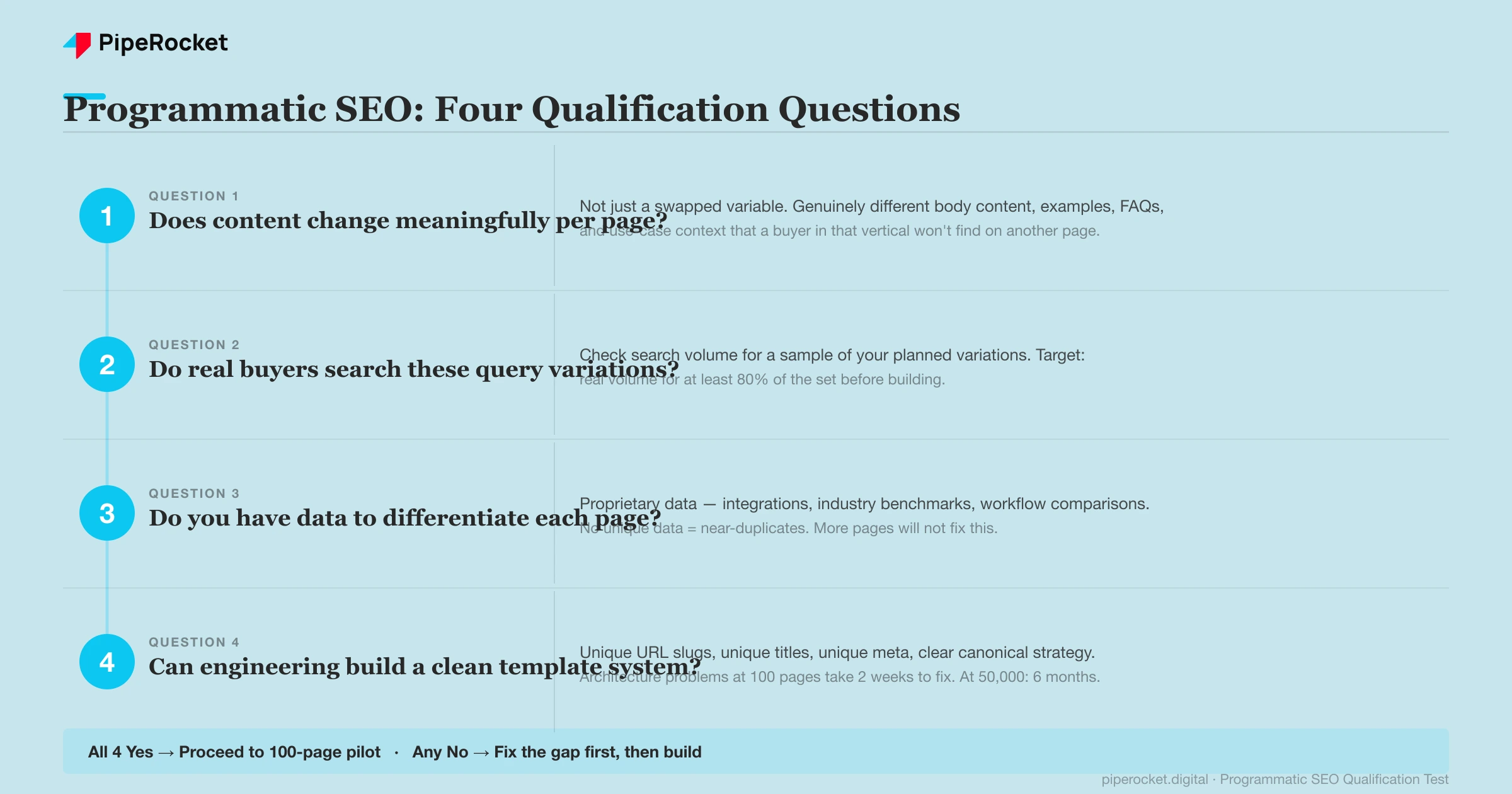
- Answer four questions before building any templates: Does content change meaningfully per page? Do real buyers search these variations? Do you have data to differentiate each page? Can engineering build without creating near-duplicates?
- Architecture problems show up at 100 pages, not 50,000: Launch a 100-page test set. Check GSC Coverage before scaling. Rework the architecture if indexing fails at this stage.
- Scale in stages: 100 to 1K to 10K: Validate indexation and conversion at each stage before proceeding. Most B2B SaaS programs top out effectively at 1,000 to 10,000 pages.
- Depth beats volume in B2B SaaS: Pages that are genuinely useful to a specific ICP searching a specific use case outperform volume strategies that produce shallow coverage at scale.
Why Programmatic SEO Fails for Most SaaS Companies
Programmatic SEO is not a magic volume play. It works for specific types of companies:
- B2B SaaS targeting a niche by industry, geography, or use case
- Software tools with genuine data variation per page
- Content aggregators with structured proprietary datasets
For thin, generic use cases, it produces pages Google has no reason to rank.
The failure mode is well-documented and almost always follows the same path:
- The team identifies a large keyword set, such as “[software] for [industry]” across 50 industries
- They build a template that swaps one variable and publish the pages
- The only meaningful difference between pages is the industry label in the heading
- Google recognizes near-duplicates, and most pages get “Crawled but not indexed” in GSC
- The team doubles down with 5,000 more pages, hoping volume overcomes the quality signal. It does not.
The risk has sharpened. Google’s June 2026 spam update, which finished rolling out on June 26, targeted manipulative and scaled content produced primarily to game rankings rather than help people.
Programmatic SEO sits directly in that risk zone: a template-generated set only earns its place when each page is genuinely useful to the buyer who lands on it. Google’s own spam policies call this out as scaled content abuse. Volume alone is now a liability.
The companies that succeed with programmatic SEO for SaaS do one thing differently before launching: they validate that genuine per-page variation exists. Not a different headline. Genuinely different content, examples, workflow steps, integration notes, or industry-specific context that a buyer in that vertical would not find on any other page in the set.
This validation happens before any template is designed. It is the first of four qualification questions every SaaS team should answer before investing in programmatic SEO.
The Four-Question Qualification Test
These four questions separate viable programmatic SEO programs from ones that produce near-duplicate pages. Answer all four before writing a line of template code.
Question 1: Does content change meaningfully per page?
This is not about swapping a city, industry, or integration name in the heading. Ask whether the body content, examples, FAQs, and use-case descriptions genuinely differ from page to page. A “[software] for [city]” page that only swaps the city name fails this test. A “[software] for [industry]” page that includes industry-specific workflow examples, regulatory requirements, integration notes for tools specific to that vertical, and FAQs written for that industry’s vocabulary passes it, if those elements genuinely differ.
If content does not change meaningfully per page, the programmatic strategy is not ready. More pages will not solve this. Better data will.
Question 2: Do real buyers search these query variations?
Use Keyword Planner or Ahrefs to check search volume for a representative sample of your planned query set. The benchmark: real search volume should exist for at least 80% of the variations you plan to build. If the volume is concentrated in 10% of the variations (often the case with long-tail programmatic sets), the 90% with no search volume will generate pages that never receive organic traffic.
B2B SaaS keyword sets often have a steep volume distribution. The top ten query variations might have genuine search volume. The remaining 490 might have zero. Building 500 pages when 490 have no audience wastes crawl budget on pages that can never earn traffic.
Question 3: Do you have data to differentiate each page?
The best programmatic SEO programs in B2B SaaS are built on proprietary data: integration compatibility matrices, industry benchmark datasets, use-case workflow comparisons, customer-reported outcome data. This data is the ingredient that makes each page genuinely different from both other pages in the set and from competitor content.
If you cannot answer “what unique data does page X contain that page Y does not?” before launching, the pages will look like near-duplicates to Google, because they are.
Question 4: Can engineering build a clean template system?
A programmatic SEO template that creates canonicalization problems, introduces near-duplicate metadata across pages, or produces inconsistent URL patterns will fail at scale even if the content is differentiated. The engineering requirements:
- A clear URL structure (ideally with the variable component as a slug, not a query parameter)
- Unique titles and meta descriptions generated from data fields, not truncated templates with the same first 60 characters
- A canonical strategy that handles the edge cases in the variable set
If the answer to any of these four questions is no, the right move is to fix the underlying issue before building templates, not to proceed and fix it later at 10,000 pages.
Designing the Template That Scales
Once the qualification test is passed, the template design determines whether the program succeeds at scale. Two principles matter above everything else.
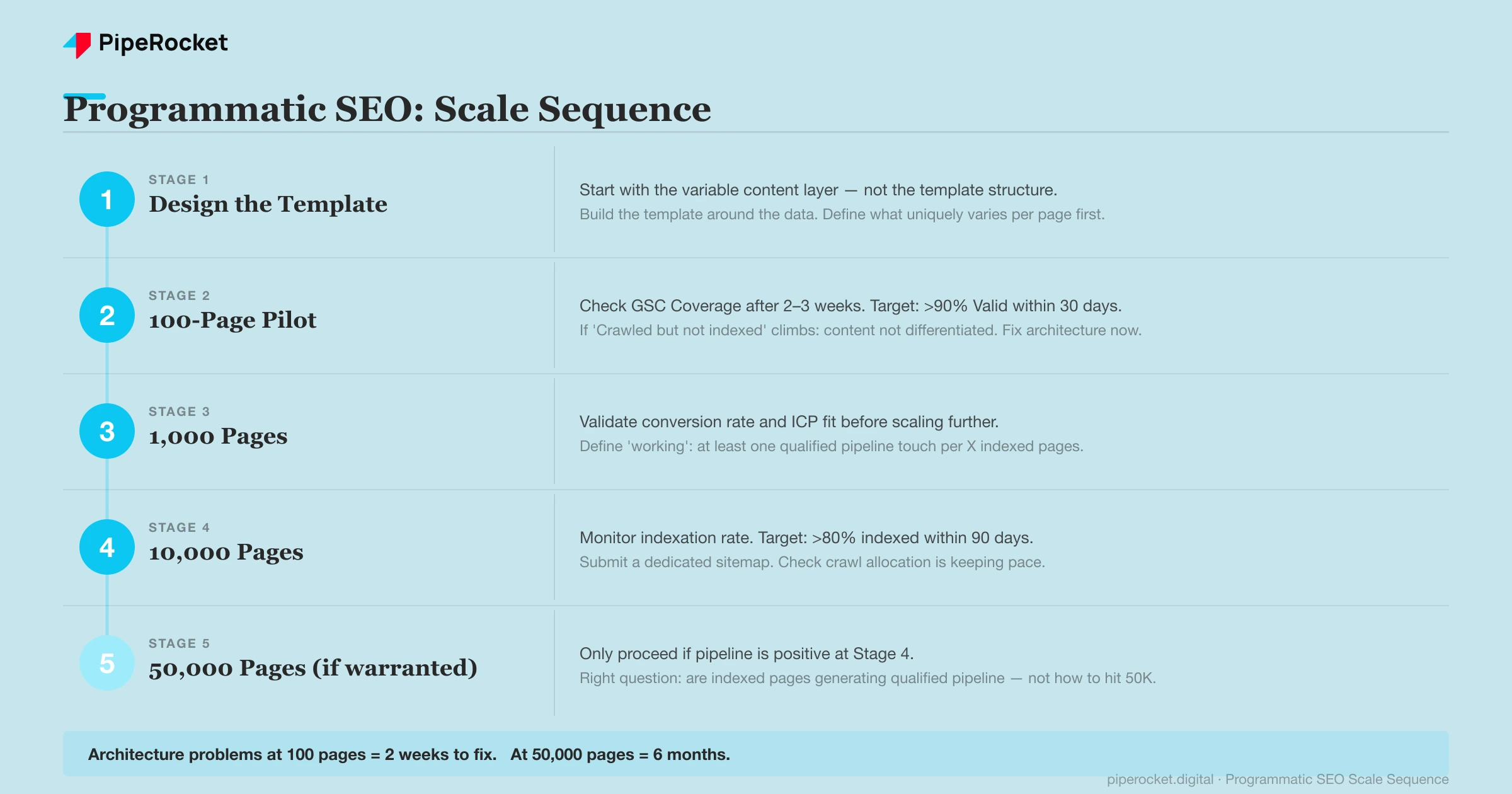
Start with the variable content layer, not the fixed template. Most programmatic SEO templates are designed backwards: the team builds the template structure and then asks what variable data will populate it. The correct approach is the reverse. Start by defining what genuinely varies per page and build the template around the variable content, not around a fixed design structure.
If the variable layer for a “[software] for [industry]” page includes industry-specific workflow steps, a list of integrations used by that industry, three FAQs specific to that industry’s use cases, and a benchmark dataset for that vertical, design the template so each of those elements has a dedicated slot populated from the data source. The fixed template structure is the frame that holds the variable content. The variable content is the reason the page exists.
Canonicalization and internal linking are architecture decisions, not afterthoughts. Every programmatic page needs a clear canonical that points to itself (not to a hub page or a parent page) unless there is a specific reason to consolidate. All programmatic pages should be linked from a hub page that organizes the full set, and the hub page should be linked from the main navigation or the primary content cluster. Pages that are indexed but orphaned from the internal link structure will underperform pages that are connected to the domain’s authority flow.
Internal links from the hub to the programmatic pages, and from the programmatic pages back to the hub, create the crawl signal that tells Google the full set is connected and worth indexing.
The Scale Sequence: 100 to 1K to 10K
Every successful programmatic SEO program for B2B SaaS follows the same basic sequence. Teams that skip stages pay for it in months of cleanup.
Scaling a B2B SaaS Programmatic Set from 100 to 50,000 Pages
Our team ran this sequence for a B2B SaaS client in the Indian market. The company was attracting freelancers and consumers from general keywords despite targeting B2B buyers only. We built a programmatic SEO strategy targeting specific B2B use cases with genuine per-use-case differentiation. We did not launch 50,000 pages at once. We tested the architecture with 100 pages first.
Google initially struggled to index them. The page architecture needed rework. Once we fixed it, indexing kicked in across the test set within a day. Then we scaled: 100 to 1,000 to 10,000 to 50,000 pages. Because the intent was strictly B2B-qualified from the start, sign-ups skyrocketed when the pages began ranking. The client made it a separate revenue line.
The architecture problem that required two weeks of rework at 100 pages would have required six months at 50,000.
Stage 1: 100 pages. Launch the test set. Check GSC Coverage after two to three weeks. Target: more than 90% of pages in Valid status within 30 days. If “Crawled but not indexed” climbs, the content is not differentiated enough. If “Discovered but not indexed” climbs, the internal link structure is not strong enough. Fix the architecture at this stage, not later.
Stage 2: 1,000 pages. Validate conversion rate and audience fit. Define what “working” means before scaling to 10,000. A page that ranks for its target query but attracts the wrong ICP is not working. Set a minimum performance threshold: at least one qualified pipeline touch per X indexed pages. Build hub-page internal links before scaling further.
Stage 3: 10,000 pages. Monitor indexation rate. Target: more than 80% of pages indexed within 90 days of launch. Submit a dedicated sitemap for the programmatic set. Verify that crawl allocation from Google is keeping pace with the expansion. Check for canonicalization anomalies that only appear at higher page counts.
Stage 4: 50,000 pages (if appropriate). Most B2B SaaS programmatic SEO programs do not need this stage. The right question is not “how do we get to 50,000?” but “are the indexed pages generating qualified pipeline?” If the answer is yes at 10,000, scale further. If not, deepen the existing pages before expanding the set.
Managing Crawl Budget for Large Programmatic Sets
Once a programmatic SEO program scales past 1,000 pages, crawl budget management becomes an active responsibility rather than a passive concern.
Google allocates a crawl budget to each domain based on the domain’s authority, server speed, and historical crawl patterns. A SaaS company with a marketing site of 200 pages that suddenly adds 10,000 programmatic pages is asking Googlebot to do 50 times more work without a corresponding increase in crawl allocation. The result: many of the new pages sit in “Discovered but not indexed” status for months because Googlebot simply hasn’t visited them yet.
Practical measures to improve crawl allocation for large programmatic sets:
Submit a dedicated sitemap. Create a separate sitemap file specifically for the programmatic page set (e.g., /sitemap-programmatic.xml) and submit it in Google Search Console. This makes it easy to monitor the indexation rate for the programmatic set in isolation, separate from the rest of the site. A combined sitemap for 10,000 pages makes it hard to tell how the programmatic pages are performing relative to the editorial content.
Internal links from the main domain. The hub page that links to the programmatic set should be linked from the main navigation or from a high-authority editorial page. Crawl budget flows through internal links. A programmatic set that is accessible only through a buried hub page or a sitemap URL will be crawled less frequently than one with internal links from well-established domain pages.
Monitor the crawl rate in GSC. Google Search Console’s Crawl Stats report shows how many pages Googlebot is visiting per day and the distribution of crawl responses. If the daily crawl rate is significantly lower than the number of new pages being added, Googlebot is not keeping pace. Improving internal linking depth and page quality (reducing “Crawled but not indexed” signals) are the two primary levers to increase crawl allocation without adjusting crawl-delay settings.
Prioritize quality over expansion speed. Adding 1,000 pages per month to a programmatic set that is not fully indexed yet is counterproductive. Google’s crawl allocation reflects its assessment of how worthwhile your pages are. Improving the existing set’s indexation rate is more productive than adding pages that join a growing “Discovered but not indexed” backlog.
Use Cases: What Works and What Fails
The works/fails distinction comes down to one question: does the content genuinely differ per page, or does only the variable change?
| Use case | Works when | Common failure |
|---|---|---|
| Integration landing pages | Genuine per-integration content: setup instructions, data flow, use cases, limitations specific to each pair | Generic page where only the integration name is swapped in the heading |
| Use-case / persona pages | Software behavior, features, and primary use cases genuinely differ by role or industry | Product is identical regardless of role; only the persona label changes |
| Comparison / alternative pages | Built on structured, accurate competitive data: pricing, feature matrix, verified reviews | Thin comparisons that restate the same product description with a different competitor name |
| Location-based pages | Distinct offerings, pricing, compliance, or support model by country or region | Only the city or country name differs; no substantive content variation |
| Industry pages | Industry-specific workflows, regulatory requirements, integration notes, and vocabulary per industry | Swapped industry name plus one generic paragraph about the industry |
| City-based pages | SaaS with genuinely different features, pricing, or support by location | Software with no location-specific differentiation; page exists to rank, not to help |
| Thin feature pages | Rich, use-case-specific content per feature variation | Minimal feature content with a thin variation of the same product description |
The diagnostic question: if a buyer landed on two pages in the set side by side, would they see genuinely different, useful information? If no, the use case is not ready for programmatic SEO.
How PipeRocket Approaches Programmatic SEO for SaaS
We have built and audited programmatic SEO programs for B2B SaaS companies across multiple verticals. The most common failure we see is scaling before the architecture is validated.
Our programmatic SEO work starts with the qualification test, launches with a 100-page pilot, and scales only after conversion and indexation are confirmed. If you are planning a programmatic SEO initiative or need an audit of an existing program, visit our programmatic SEO agency page or reach out via our contact page .
Frequently Asked Questions
What is programmatic SEO for SaaS?
Programmatic SEO for SaaS is the practice of generating a large set of search-optimized pages from a structured data source, covering every relevant combination of use case, industry, integration, or persona that a buyer might search for. Instead of writing each page manually, the team designs a template and a data source; the pages are generated automatically at scale.
It works when the data genuinely varies per page and real buyers search those variations. It fails when the variation is superficial and the resulting pages are near-duplicates.
How many programmatic pages should a B2B SaaS company build?
There is no correct number. The right question is: how many pages can you build where each one provides genuinely different value to a specific buyer? Most B2B SaaS companies that have tried programmatic SEO find that 1,000 to 10,000 differentiated pages produce better results than 50,000 shallow ones.
Start with 100 pages. Validate indexation and conversion. Scale to 1,000. Validate again. The total page count is a byproduct of how much genuine variation exists in your data, not a target to be set in advance.
What is the most common reason programmatic SEO fails for SaaS?
Near-duplicate content is the most common reason. Teams build templates that swap one variable (industry, city, feature name) without changing the underlying content meaningfully. Google’s systems recognize that the pages are substantially identical and decline to index them. The “Crawled but not indexed” status in Google Search Console is the reliable indicator of this failure. The fix is redesigning the template to pull genuinely different content per page from a richer data source, not adding more pages or adjusting crawling directives.