
Here’s how we cluster keywords before a single page gets briefed. A spreadsheet of 2,000 keywords is noise, not a plan, and treating each row as its own page is how SaaS sites end up with four thin posts fighting each other for the same query. Clustering groups related searches so one page owns a set of intents, and it tells you how many pages you actually need to build.
TL;DR
- Cluster by shared intent: searches that one page can satisfy belong together, which is what tells you how many pages to build, and string similarity misleads you.
- Map every cluster to one page in a pillar-and-spoke shape: the pillar owns the broad topic, spokes own the specific sub-intents, and links run toward your conversion pages.
- SaaS clusters form around jobs-to-be-done and BOFU intent: use-case, comparison, and alternative searches each get their own home so nothing overlaps.
- Cannibalization is the failure clustering prevents: two pages targeting the same intent split their signals and both stall on page two.
- Watch the cluster boundaries first: most mistakes come from clusters drawn too wide or two clusters that are secretly the same page, so the count of clusters matters more than the count of keywords.
Why a Keyword List Is Not a Keyword Strategy
Most teams export every keyword their tool will surface, sort by volume, and start assigning titles off the top rows. That’s backwards, because volume tells you nothing about how many pages the topic actually supports or which searches a single page can answer together.
A list of 2,000 keywords is noise. A set of 250 topics is a plan. When we group keywords into topics, we’ve seen the same shift every time: the question stops being “how many articles should we write this quarter” and becomes “how many pages does this topic universe actually need.” That’s a business case, not a random ask.
The grouping is the crucial move. Take “what is GRC,” “GRC components,” and “GRC examples.” Those aren’t three articles. They’re one pillar page answering three facets of a single intent. Split them into three thin posts and you’ve built three pages that compete for the same searchers instead of one page strong enough to rank.
For SaaS specifically, the count matters more than people expect. Most single-product SaaS companies have a ceiling of roughly 40 to 60 bottom-of-funnel pages, the software pages, alternatives, comparisons, and pricing. Force more than that and you’re stretching, inventing pages nobody searches for. Clustering surfaces that ceiling early so you plan against a real number.
Step 1: Pull the Keywords, Then Tag Intent
Start by gathering the raw keywords from more than one source, because any single tool gives you a skewed slice. We merge four inputs before grouping anything:
- Product and sales team language (the exact words buyers use in calls)
- Keyword tool exports for volume
- Competitor gaps (what ranks for rivals that you don’t cover)
- Your product’s category pages on review sites like G2
Once the raw list exists, the tagging matters more than the collecting. Every keyword gets an intent label before you try to group it, because two keywords with similar wording can sit at completely different points in the buying decision.
Label Every Keyword by What the Searcher Wants
Tag each keyword as informational, navigational, or transactional, then get more specific for the commercial terms. A searcher typing “what is contract management software” wants an explanation. A searcher typing “contract management software pricing” is close to buying. Same product, opposite ends of the decision, so they can never share a page.
We run this in a master sheet with columns for keyword, search volume, intent, category, sub-category, topic, and priority. The topic column is the one that does the real work, because it’s the pillar each keyword rolls up into. Done properly for a full product, this mapping takes a few days, not an afternoon, and it maps the entire addressable topic space rather than a random handful.
Step 2: Group Keywords Into Clusters by Shared Intent
A cluster is the set of keywords a single page can satisfy in one visit. That’s the test, and it’s about intent overlap, not string similarity. “Best invoicing software” and “invoicing software reviews” can share a page because the same content answers both. “Invoicing software” and “invoicing software API docs” cannot, because one buyer is evaluating and the other is already a customer looking for technical help.
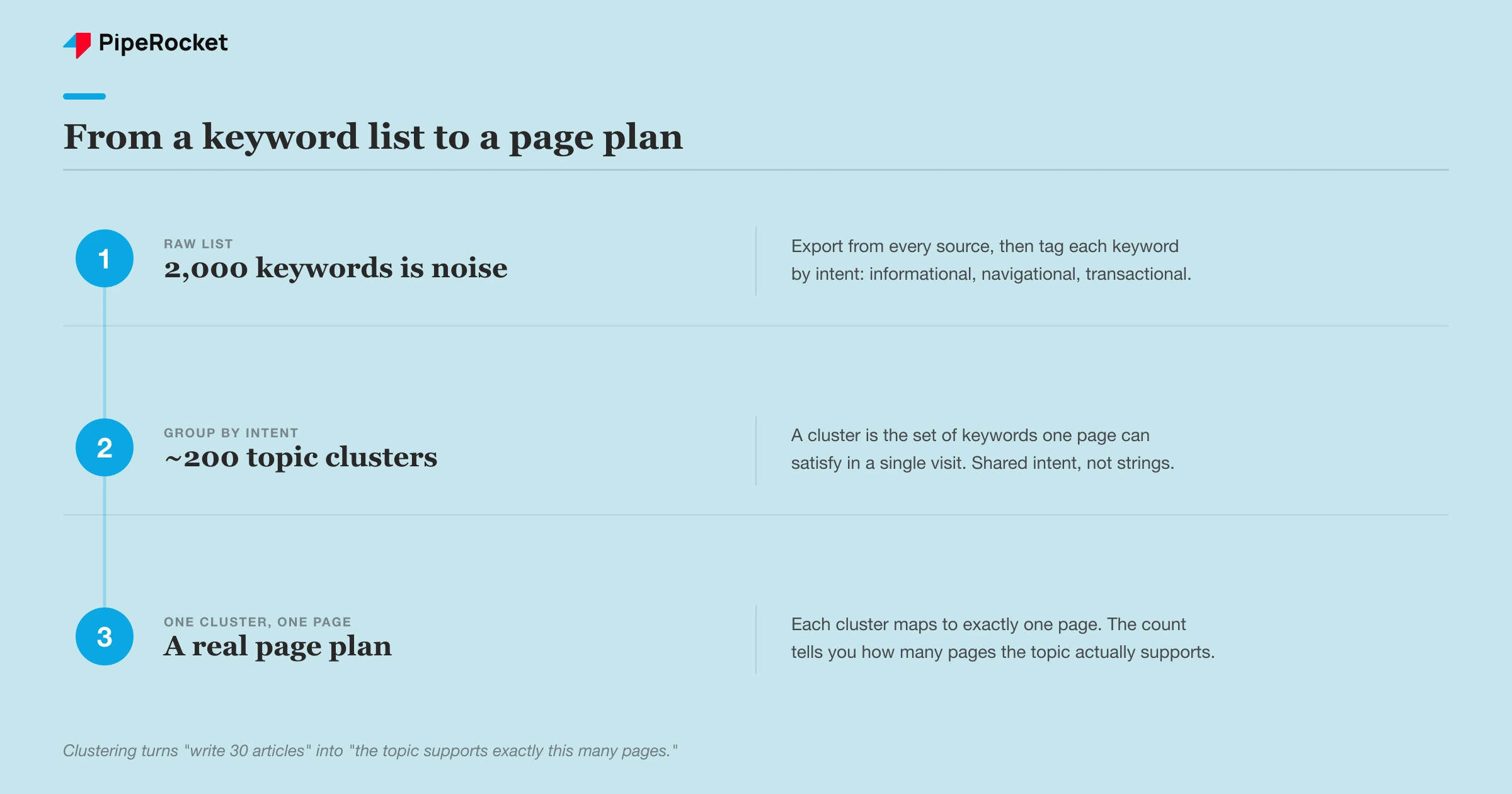
The practical way to draw the boundary is to ask whether one page could rank for every keyword in the group without feeling stitched together. If serving one keyword well would bury another, they’re separate clusters. If a single well-structured page answers all of them, they’re one.
Here’s where SaaS differs from a generic content site. Your clusters don’t form around abstract topics, they form around jobs-to-be-done and buying intent. A compliance SaaS for fintech teams doesn’t cluster around “compliance.” It clusters around the specific jobs its buyers hire it for: SOC 2 readiness, vendor risk reviews, evidence collection. Each job is a cluster, and each maps to a page a buyer would actually land on mid-decision.
Step 3: Map Each Cluster to One Page in a Pillar-and-Spoke Shape
Every cluster gets exactly one page, and every page sits in a pillar-and-spoke structure. The pillar owns the broad topic, the spokes own the narrow sub-intents, and internal links run from the spokes up to the pillar and across toward your conversion pages.
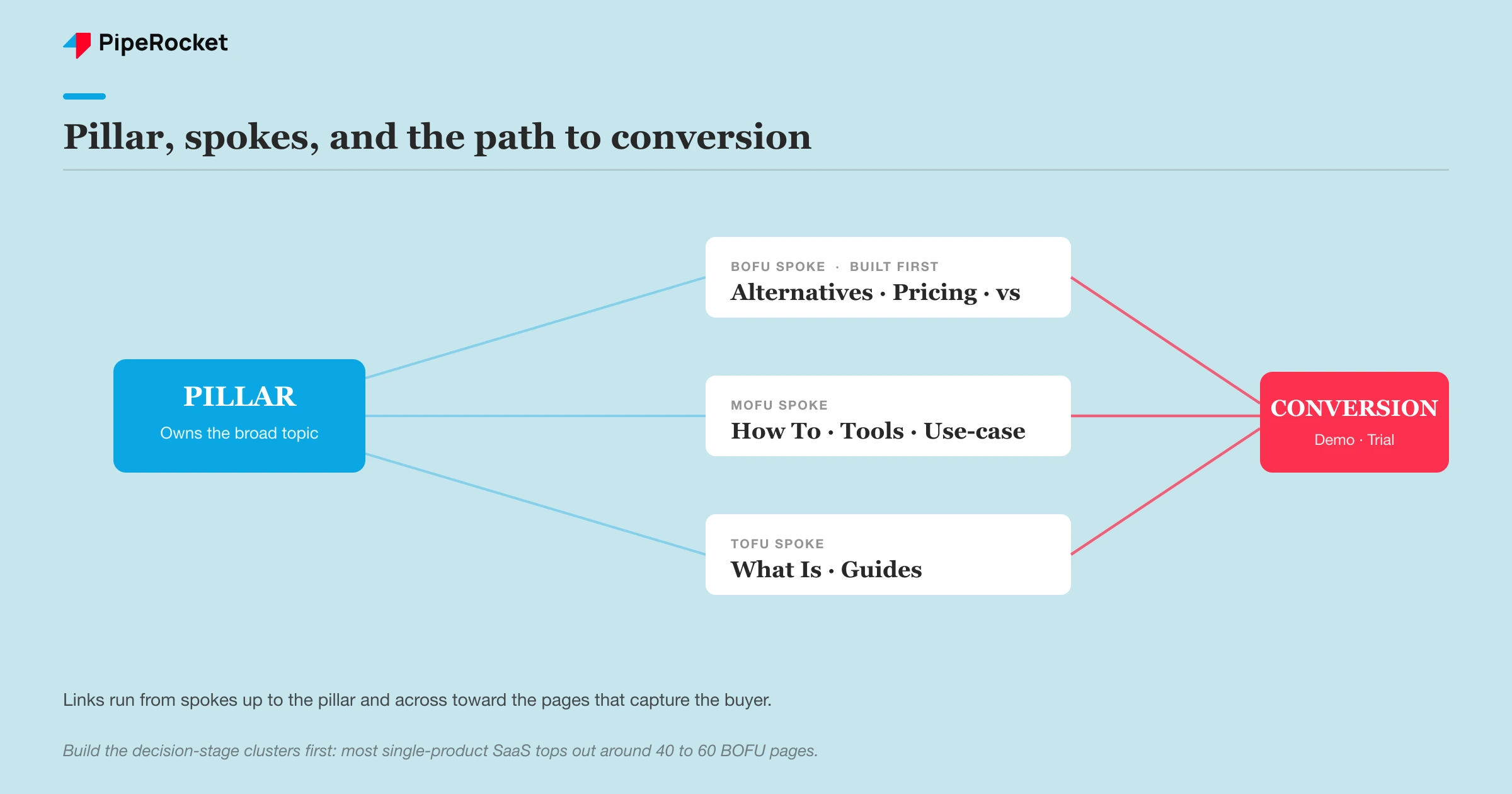
For SaaS, we build the decision-stage clusters first. The shape we’ve seen work is What Is, then How To, then Automate, then Tools, then Alternatives, then Pricing and Reviews, ending at Conversion. The alternatives, pricing, and case-study nodes get built before the awareness content, and everything links toward the page that captures the buyer.
Build the BOFU Clusters Before the TOFU Ones
Decision-stage clusters, the “best,” “vs,” “alternatives,” and “pricing” pages, are the ones that turn a search into a demo, so they come first. Awareness clusters matter, but they don’t rank in isolation without support and they don’t convert on their own. Building the bottom of the funnel first means the pages closest to revenue exist while you’re still filling in the top.
This is also where the SaaS ceiling bites. If your product realistically supports 40 to 60 BOFU pages, that’s your BOFU cluster budget. Map those clusters, assign one page each, and resist the urge to spin a comparison page for a competitor nobody searches against you. A cluster with no real search behind it is a page that dilutes the ones that matter.
Keep Comparison and Alternative Clusters Separate
Comparison and alternative searches feel similar but need different pages, so they never share a cluster. A “Brand A vs Brand B” searcher is choosing between two viable options and wants criteria weighed side by side. An “Brand A alternatives” searcher is already frustrated with a tool and wants an escape. One page makes an argument, the other offers a rescue. Collapse them into one cluster and you write a page that half-serves both searchers and fully serves neither.
Step 4: Check Every Cluster Against Cannibalization
Before any page gets briefed, run the whole map against itself and confirm no two clusters target the same intent. Cannibalization is the exact failure clustering exists to prevent, and it happens quietly: two pages chase the same query, split their internal links and ranking signals between them, and both settle on page two instead of one page reaching the top.
The signal to watch for isn’t obvious in a spreadsheet. It shows up later as rankings that bounce between two of your own URLs for the same term, or a page that never breaks a ceiling no matter how much you improve it. When we audit a stalled SaaS site, one of the first checks is whether two pages are secretly the same cluster wearing different titles.
The fix at planning time is cheap. Merge the two clusters into one page, or sharpen the intent boundary so each owns a distinct search. The fix after publishing is expensive, because now you’re consolidating live pages, redirecting, and rebuilding links. Draw the boundaries right in the map and you never pay that bill.
Common Mistakes to Avoid
Drawing clusters too wide
The most common error is a cluster so broad that no single page can satisfy it. “Project management software” as one cluster sounds efficient, but it swallows evaluation searches, how-to searches, and integration searches that each need their own page. A page trying to serve all of them ranks for none of them well. The test is simple: if you can’t imagine one page answering every keyword in the cluster without feeling padded, the cluster is too wide. Split it along the intent lines, give each sub-intent its own home, and let the pillar page hold the broad term while the spokes catch the specifics.
Clustering by keyword string instead of intent
Grouping “invoice software” with “invoice template” because they share a word is a trap. The strings look related, the intents don’t. One searcher evaluates a product, the other wants a free download and will never buy. A page built to catch both sends mixed signals and converts neither searcher. Always cluster by what the search wants to accomplish, never by which words it contains. Two keywords belong together only when a single page satisfies both jobs. When we retag a client’s list by intent, entire clusters that looked clean on string similarity fall apart, and the real page count drops.
Building awareness clusters before decision clusters
Teams love starting with the high-volume “what is” topics because the traffic looks good on a chart. The problem is those pages rarely move pipeline on their own, and without the decision-stage pages built underneath them, the awareness traffic has nowhere to convert. We’ve seen SaaS sites with strong informational rankings and almost no demos because the “best,” “vs,” and “pricing” clusters were still on the roadmap. Build the bottom-of-funnel clusters first, get the revenue pages live, then fill in the awareness layer that feeds them. Traffic without a decision page to catch it is a vanity number.
Treating the keyword count as the goal
A bigger list feels like more strategy, but the number that matters is the cluster count, not the keyword count. Two thousand keywords might collapse into 200 real clusters, and forcing more pages than the topic supports produces thin content competing with your own stronger pages. The SaaS ceiling is real: most single-product companies top out around 40 to 60 BOFU pages. Chase a keyword count and you build pages nobody searches for. Chase the cluster count and you build exactly the pages the topic supports, each strong enough to rank.
Running clusters at this level of discipline is a staffing question as much as a method one, and our SaaS SEO agency shortlist covers teams that do it continuously.
How PipeRocket Digital Builds Keyword Clusters for SaaS
We start every SaaS SEO engagement by mapping the full topic universe into clusters before anyone briefs a page, so the plan targets real intent and your pages never compete against each other. That map becomes the build order: BOFU clusters first, pillar-and-spoke structure, links pointing at conversion. If you want this run for your product, our SaaS SEO agency team does it end to end, or you can get in touch to talk through your current keyword map .
Frequently Asked Questions
How many keywords should be in one cluster?
There’s no fixed number, because the right size is however many keywords one page can genuinely satisfy in a single visit. Some clusters hold three or four closely related searches, others hold a dozen variations of the same intent. The test is coherence rather than count: if one well-structured page could rank for all of them without feeling stretched, the cluster is the right size. If serving one keyword would bury another, you’ve got two clusters, not one.
What’s the difference between a topic cluster and a pillar page?
A topic cluster is the full group of related keywords and the pages that cover them, while the pillar page is the single hub page at the center that owns the broad topic. The pillar covers the subject at a high level and links out to spoke pages that each handle a narrow sub-intent, and the spokes link back to the pillar. The cluster is the whole structure; the pillar is one node inside it that everything else supports.
Can clustering fix keyword cannibalization I already have?
Yes, and it’s usually the first step. Re-cluster your existing pages by intent and you’ll spot where two or more URLs are targeting the same search, which is the cannibalization. From there you either consolidate them into one stronger page with a redirect, or sharpen each page’s focus so they own distinct intents. Fixing it live is more work than planning it right upfront, but re-clustering is what surfaces exactly which pages are competing and what to merge.