How to Refresh Content to Recover Lost SaaS Rankings
 Omar Sheriff
Last updated on
Omar Sheriff
Last updated on
Your audit flagged a list of posts losing rankings, and the instinct is to open each one, change the publish date, rewrite the intro, and hit update. Changing the publish date is a timestamp change with extra steps, not a refresh, and the rankings won’t come back because nothing about why they dropped actually changed. If you haven’t run that audit yet, here’s the process we use to build the list in the first place.
TL;DR
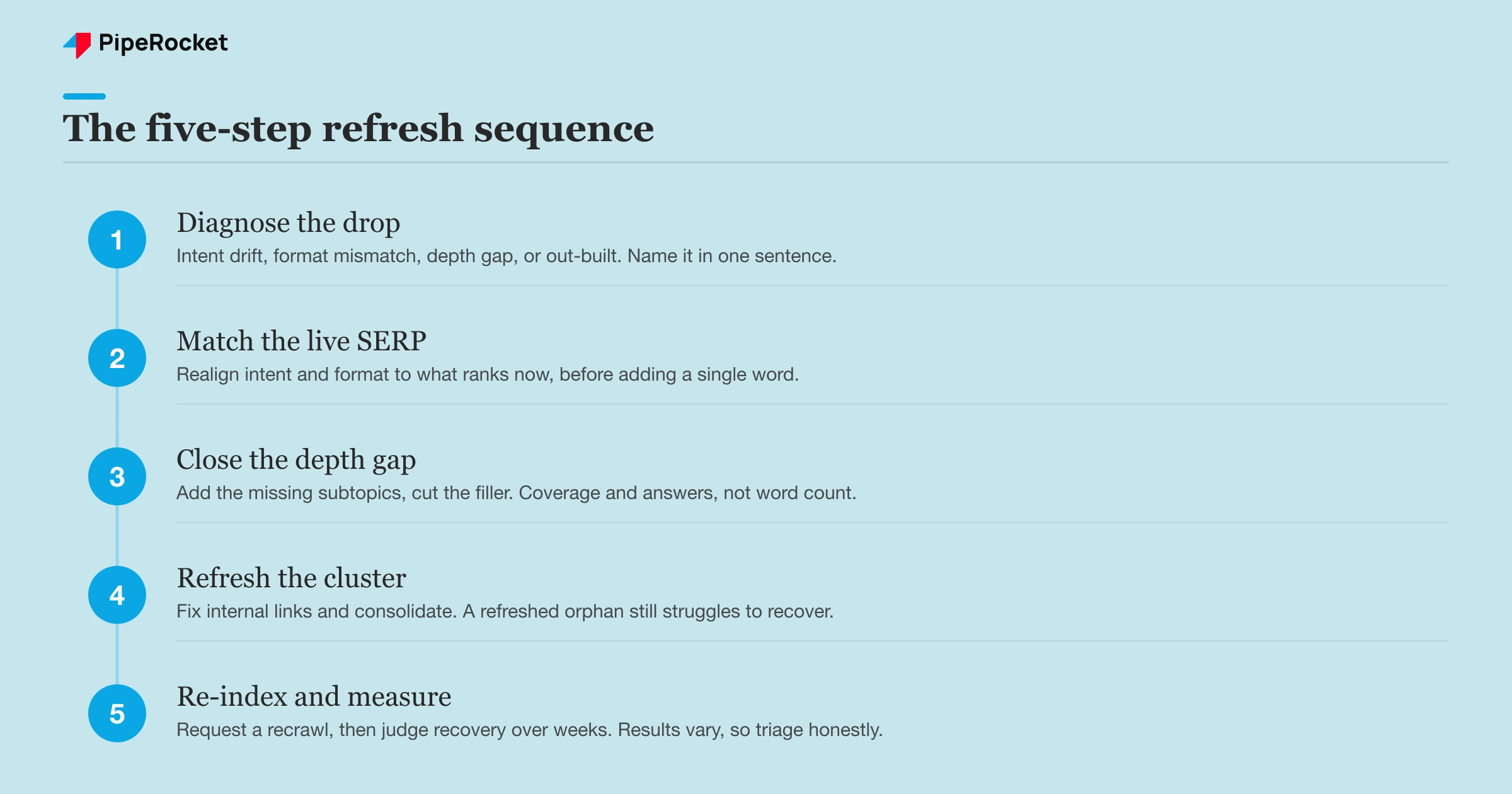
- Cosmetic refreshes don’t work: changing the date and tweaking the intro signals nothing to Google, because the page still answers the wrong intent in the wrong format.
- Diagnose before you touch the draft: figure out whether the drop is intent drift, format mismatch, depth gaps, or a competitor who out-built you.
- Match the live SERP first: re-read what’s ranking now and realign the page’s intent and format before adding a single word.
- Close the depth gap, don’t pad: add the subtopics and answers the page is missing, then cut the filler that was never earning anything.
- Refresh the cluster, not the orphan: a decayed post recovers faster when the pages around it support it, because content works as a connected system.
- Re-index and wait honestly: request a recrawl, then measure recovery over weeks, not days. Results vary, and not every page is worth saving.
Why Changing the Publish Date Won’t Bring Rankings Back
Most teams refresh by editing the surface and leaving the substance alone. They change the date, swap the intro, refresh a stat or two, and expect movement. It almost never comes, because Google didn’t demote the page for being old. It demoted it because something about how well the page answers the query stopped being competitive.
Here’s the contrarian part. Freshness is a ranking signal for a narrow set of queries (news, fast-moving tools, anything with “2026” intent), but for most SaaS topics it’s a tiebreaker at best.
A decayed post sitting on page two doesn’t have a tiebreaker problem. It has a relevance and depth problem, and a new date doesn’t fix either.
Our team treats a steady week-over-week ranking slide as a specific signal, not a vague “needs updating.” Across the SaaS accounts we’ve worked on, that slide is almost always an intent or format misalignment. The SERP shifted under the page, and the page didn’t shift with it, so the cosmetic edits feel productive while changing nothing that matters.
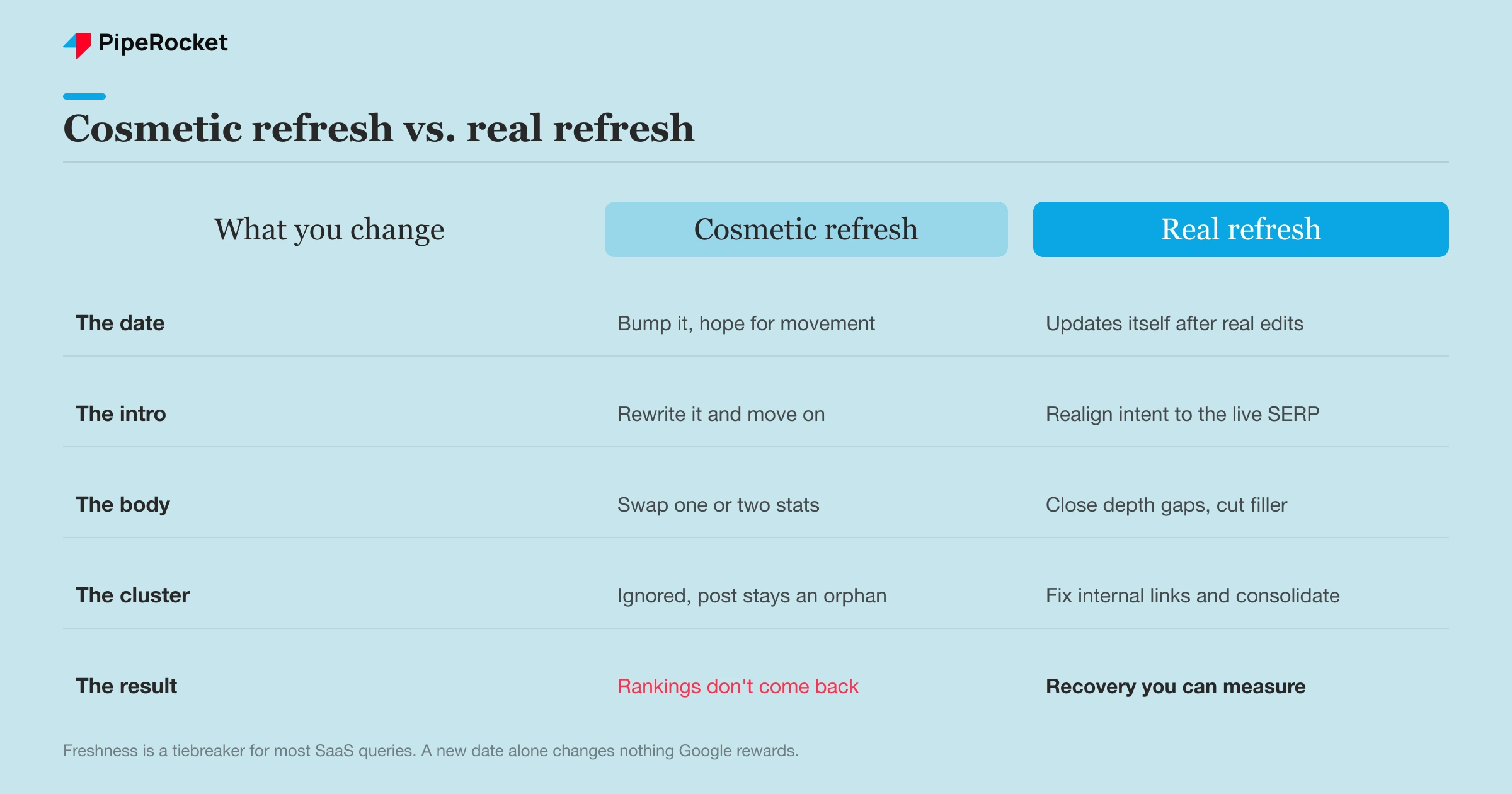
| Cosmetic refresh | Real refresh |
|---|---|
| Change the publish date | Re-diagnose against the live SERP |
| Rewrite the intro | Realign intent and format to what ranks now |
| Swap one or two stats | Close the actual depth and subtopic gaps |
| Hit update, hope for movement | Fix internal links, recrawl, measure over weeks |
| Treats the post as a one-off | Treats the post as part of a cluster |
The rest of this guide is the version that works. It assumes your audit already told you which posts decayed. Now you have to fix them.
Step 1: Diagnose Why the Page Dropped
Before you touch the draft, work out which of four things actually happened, because each one needs a different fix and guessing wastes the whole refresh. A page that dropped from intent drift needs a re-angle. A page that dropped from a thin competitor needs more depth. Treating them the same is how teams “refresh” ten posts and recover none.
Pull the page in Search Console and look at the queries it used to win versus what it ranks for now. Then open the live SERP for the main query and read the top five results properly. The gap between what your page is and what’s ranking is your diagnosis.
Here’s the diagnostic I run on every decayed page:
| Symptom | Likely cause | What the refresh fixes |
|---|---|---|
| SERP now shows a different content type (tool, video, listicle) | Format mismatch | Restructure to match the dominant format |
| You rank for adjacent queries, not the target one | Intent drift | Re-angle the page to the real intent behind the query |
| Top results cover subtopics you skip entirely | Depth gap | Add the missing sections and answers |
| A competitor published something genuinely better | Out-built | Out-depth them or consolidate into a stronger page |
Tip: If two pages on your site both lost rankings for the same query, you don’t have two decay problems. You have cannibalization , and the fix is consolidation, not two separate refreshes.
The output of Step 1 is one sentence per page: “This dropped because ___.” If you can’t write that sentence, you’re not ready to edit. You’re still guessing.
Step 2: Match the Page to the Live SERP
Realign intent and format before you write anything, because depth added on top of the wrong angle is wasted depth. The SERP is Google telling you, in public, what it thinks this query deserves. Your job on a refresh is to stop arguing with it.
Read the current top five and answer two questions:
- Intent: what is the searcher actually trying to do, and does your page do that?
- Format: is the winning format a how-to, a comparison, a definition, a tool, or a listicle, and does your page match it?
When the SERP shifted from informational to commercial, an old “what is X” post won’t recover by adding paragraphs. It recovers by being rebuilt toward the decision the searcher is now making, or by handing that query to a better-fit page and re-pointing the old one at a query it can still win.
Take a compliance SaaS for fintech teams with a post on “SOC 2 audit.” If the SERP is now full of comparison and software pages, a pure explainer is the wrong shape. The recovery move is to add a section that helps the reader choose tooling, or to split that buying intent onto a dedicated page.
Warning: Don’t force a format the page can’t honestly own. If your “best X tools” query is dominated by sites with hands-on testing and you have none, matching the format without the substance just gets you a better-looking page that still loses.
Step 3: Close the Depth Gap Without Padding
Add what the page is genuinely missing, then cut what was never earning its place, because depth is about coverage and answers, not word count. The teams that pad a 1,200-word post to 2,500 words and call it a refresh usually make it worse, since they bury the answer the page used to surface fast.
List every subtopic the top results cover that yours doesn’t. Those gaps are your edit list. For each one, ask whether the searcher needs it to feel satisfied. If yes, write a real section. If it’s there to hit a length target, skip it.
Then do the harder half of the job, which is subtraction:
- Cut sections that answer questions nobody on this SERP is asking
- Merge thin, overlapping subsections into one strong one
- Pull the direct answer back up near the top where it’s scannable
Secondary keywords are the most underrated lever here. A post that ranks for twenty related queries instead of two does the work of several articles, and most decayed posts are leaving that coverage completely untapped. When you close depth gaps properly, you’re often reclaiming those secondary rankings the page quietly lost.
Step 4: Refresh the Cluster, Not Just the Page
A decayed post recovers faster when the pages around it support it, so treat the refresh as a cluster move, not a single-page edit. Our team thinks of content as a connected system that keeps returning pipeline, rather than a pile of one-off posts that each decay alone. A page sitting orphaned, with no internal support, is fighting Google with one hand.
So while you have the post open, fix its place in the cluster:
- Add internal links from related posts that should be pointing at it
- Make sure it links up to the money page or pillar it’s meant to support
- Check no sibling post is competing with it for the same query
This is also where you catch the slow killer. A site that crosses thirty to fifty posts starts to have content working against itself, with overlapping pages splitting authority that should stack behind one URL. A refresh is the natural moment to consolidate two weak pages into one that can actually rank.
The point isn’t to add links for the sake of it. It’s that a refreshed page with no cluster support is still an orphan, and orphans struggle to recover no matter how good the edit is.
Step 5: Re-Index and Measure Recovery Honestly
Request a recrawl, then judge the refresh over weeks, not days, because recovery is rarely instant and rarely linear. Drop the URL into Search Console’s URL Inspection tool and request indexing so Google sees the changes sooner than the normal crawl cycle.
Then watch the right things. Don’t refresh on Monday and panic on Thursday. Track these over a few weeks:
- Average position for the target query and its secondaries
- Impressions and clicks on the page
- Whether the page is holding a new position or bouncing
Results vary, and that’s the honest part most refresh guides skip. Some pages recover well, some recover partially, and some were targeting above their weight class and won’t recover until the whole site’s authority catches up. If a page doesn’t move after a clean refresh and good cluster support, the problem usually isn’t the page. It’s the authority behind it, or the target was never realistic.
Note: A page that flatlines after a genuine refresh is telling you something useful. Either the query is out of reach for now, or the page should be consolidated rather than kept alive. Both are valid outcomes.
Common Mistakes That Sink a Refresh
The most common failure is refreshing everything the audit flagged instead of triaging. Not every decayed post deserves a refresh. Some should be consolidated, some redirected, and a few left alone because the query stopped mattering to your pipeline. Spreading effort evenly across the whole list is how teams burn a month and recover little.
The second mistake is changing too much at once with no way to learn from it. If you re-angle the intent, rewrite half the body, change the title, and re-do the internal links all in one push, and the page moves, you won’t know which change did it. On your highest-value pages, sequence the big changes so you can read the results.
The third is treating the refresh as a one-time event. Content decays continuously as SERPs shift and competitors publish, so the pages you fix today will drift again. The teams that stay ahead build refreshing into a cycle instead of waiting for the next painful audit to surface a backlog.
Why PipeRocket Digital Fixes Decayed Content This Way
We don’t refresh by changing dates and hoping. We diagnose each decayed page against the live SERP, realign intent and format, close the real depth gaps, and rebuild the cluster support around it so the recovery holds. Most of all, we triage, since not every flagged page is worth saving.
If you want a SaaS SEO partner to run this properly, or you’re comparing options among the best SaaS SEO agencies , we’re open for a call .
Frequently Asked Questions
How long does it take for refreshed content to recover its rankings?
It varies by page and by how far it dropped. A page with a clean intent or format fix and solid cluster support can start moving once Google recrawls it, while a page that was targeting an unrealistic query may not recover at all without more site authority.
Request indexing after the refresh to shorten the wait, then measure over weeks rather than days. Recovery is often partial and rarely linear, so judge the trend, not a single day’s position.
How often should I refresh my SaaS blog content?
There’s no fixed cadence, but the trigger matters more than the calendar. Refresh when a page’s rankings slide consistently week over week, when its traffic goes stale, or when the SERP for its target query visibly shifts.
Rather than refreshing everything on a schedule, build a continuous cycle so decayed pages surface and get triaged before the drop becomes a backlog. The goal is to refresh the pages that matter to pipeline, not to touch every post on a timer.
Does updating the publish date actually help SEO?
On its own, no, for most SaaS topics. Freshness is a meaningful signal only for queries where recency genuinely matters, like news or fast-moving tools, and even there it’s usually a tiebreaker rather than a primary factor.
Changing the date without changing the content tells Google nothing about whether the page answers the query better. The date will update naturally when you make real substantive changes, which is the part that actually moves rankings.