
What Is a Commercial Keyword? A SaaS Marketer's Guide
 Kamaraj Mathiarasan (Kim)
Last updated on
Kamaraj Mathiarasan (Kim)
Last updated on
A commercial keyword is a search query from someone actively researching or comparing options before a purchase. They haven’t decided yet, but they’re close. For SaaS, these queries capture the buyers most likely to convert, which makes them some of the most valuable keywords you can rank for.
TL;DR
- A commercial keyword signals a searcher comparing or evaluating options, sitting between learning and buying.
- Typical patterns include “best,” “top,” “vs,” “alternatives,” and “review” plus your category.
- Commercial keywords drive more SaaS pipeline than informational ones because the searcher is already in-market.
- The right content formats are comparison pages , alternative pages, and honest listicles, not definitions.
- Ranking for commercial keywords is harder, so a new domain usually earns the authority through informational content first.
What Is a Commercial Keyword?
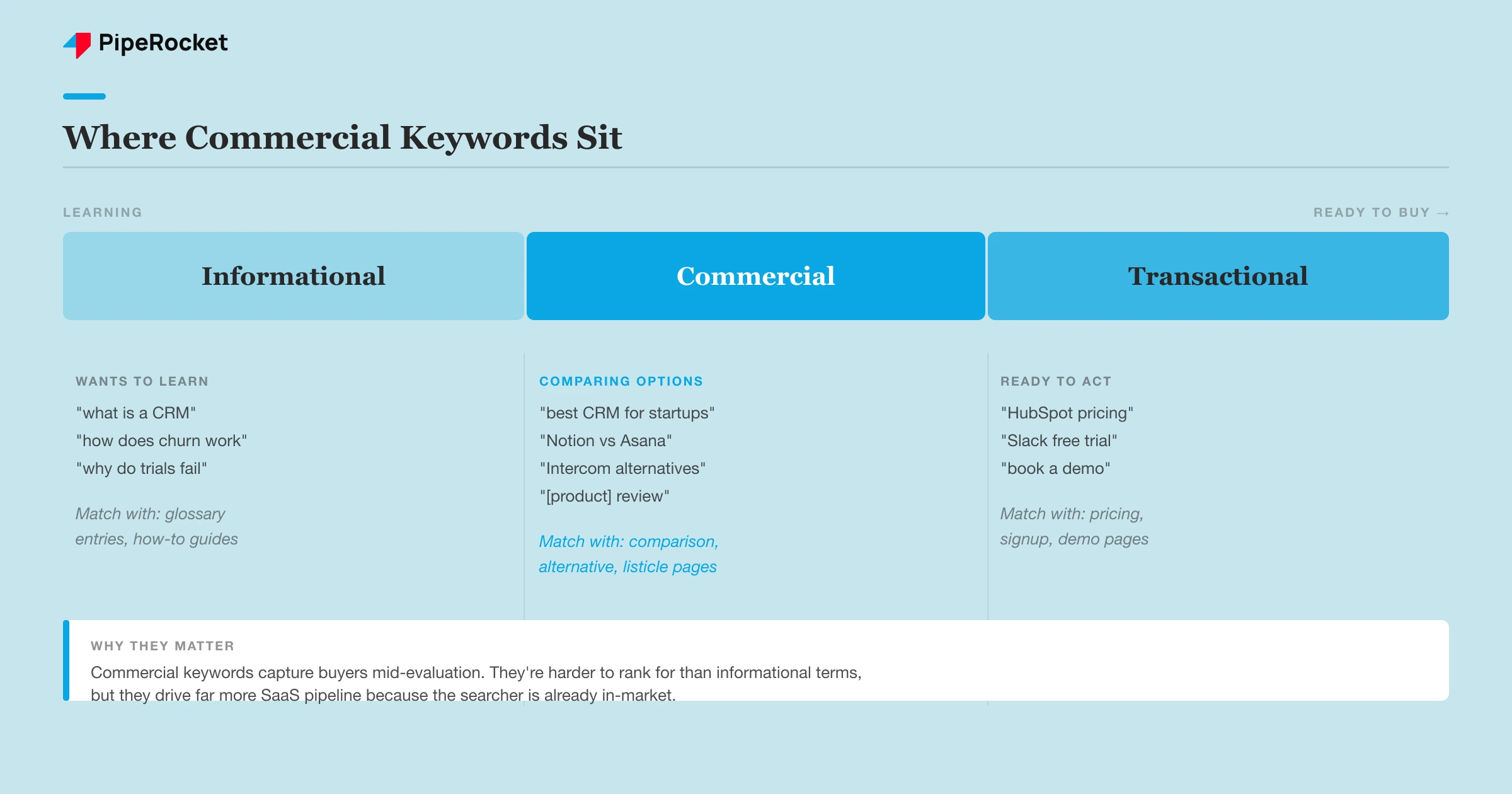
A commercial keyword is a query where the searcher is investigating before they commit. They know they have a problem and roughly what category of tool solves it. Now they’re weighing options. “Best CRM for startups,” “Notion vs Asana,” and “Intercom alternatives” are all commercial.
This sits in the middle of the intent spectrum . Informational queries want to learn. Transactional queries are ready to buy a specific thing. Commercial queries are the bridge, and they’re where a lot of SaaS buying decisions are actually shaped.
- Comparison queries: “X vs Y.” The searcher has two named options and wants help choosing. A structured comparison page matches this best.
- Best-of queries: “Best [category] for [use case].” The searcher wants a shortlist. Honest listicles and category roundups rank here.
- Alternative queries: “[Competitor] alternatives.” The searcher is unhappy with or priced out of a tool and wants options. Alternative pages own this.
- Review queries: “[Product] review.” The searcher wants an unbiased verdict before committing. In-depth review content fits.
- Use-case queries: “[Category] for [industry/role].” The searcher is checking fit for their specific situation.
Consider a SaaS that sells helpdesk software to ecommerce brands. “What is a helpdesk” is informational. “Best helpdesk software for Shopify stores” is commercial. The second searcher has a budget, a use case, and a shortlist forming. That’s the query worth fighting for.
Most teams over-invest in informational content and under-invest in commercial. The traffic looks good, but the pipeline doesn’t move. Commercial keywords are where intent and revenue meet.
Fast Fact: Organic search converts SaaS visitors at 0.92% — more than 3x the rate of AI-driven traffic at 0.26%.
Also read: how to map keywords to the SaaS buyer journey
How Do You Identify a Commercial Keyword?
The fastest test is to read the query and the SERP together. If the wording implies comparison or evaluation, and the top results are listicles, comparison pages, or review content, you’re looking at a commercial keyword.
Word patterns give you the first signal. Modifiers like “best,” “top,” “vs,” “alternatives,” “review,” and “comparison” almost always indicate commercial intent. But the SERP is the final word, because Google has already classified the query for you.
- Modifier check: “Best,” “top,” “vs,” “alternatives,” “review,” “comparison,” “for [use case]” point to commercial intent.
- SERP format: If the top three results are listicles, comparison articles, or review pages, the intent is commercial.
- Ad presence: Commercial queries usually carry ads, because advertisers know the searcher is close to buying.
- People Also Ask : PAA boxes full of “is X better than Y” or “what’s the best X” questions confirm commercial intent.
A project management SaaS researching “Asana vs Monday” would see a SERP dominated by comparison pages and listicles. That tells them a definitional post won’t rank. They need a genuine comparison that helps the reader decide, or they won’t crack the top results.
Why Do Commercial Keywords Matter More for Pipeline?
Commercial keywords matter because the searcher is already in-market. They’ve moved past “do I have a problem” and into “which tool solves it.” That shift in mindset is why commercial traffic converts at a far higher rate than informational traffic.
The honest trade-off is that this traffic is harder to win. Commercial keywords are more competitive, the content takes more effort, and a new domain rarely ranks for them quickly. But the payoff is qualified visitors who are close to a decision.
- Higher conversion intent: The searcher is comparing, which means they’re planning to buy something soon. Your job is to be on the shortlist.
- Better lead quality: Commercial traffic produces demo requests and trials from people who already understand the category.
- Competitive interception: Ranking for “[competitor] alternatives” puts you in front of buyers actively looking to switch.
- Revenue attribution: Commercial pages are far easier to tie to pipeline than top-of-funnel content , which makes the SEO investment defensible.
A compliance SaaS for fintech teams might publish a “best SOC 2 automation tools” listicle that honestly includes competitors. It ranks, it earns trust, and it captures buyers mid-evaluation. That single page can outperform months of informational posts on pipeline contribution.
Fast Fact: Organic search drives 37x more SaaS leads than AI search tools, yet most teams treat them as equal channels.
Also read: how to rank MOFU keywords for SaaS
What Content Should You Build for Commercial Keywords?
Commercial keywords demand content that helps the reader decide, not content that explains a concept. The reader already understands the category. What they need now is a clear basis for comparison and a reason to trust your verdict.
Match the format to the query type. A “vs” query needs a head-to-head comparison. A “best” query needs an honest shortlist. An “alternatives” query needs a page that acknowledges why someone is leaving a tool and offers credible options.
- Comparison pages: Structured, side-by-side breakdowns for “X vs Y” queries. Use a table, name real trade-offs, and don’t pretend you win every category.
- Honest listicles: “Best [category]” roundups that include competitors. Credibility comes from balance, and balance is what earns the ranking.
- Alternative pages: Pages targeting “[competitor] alternatives” that speak to the specific reason someone is switching, like price, complexity, or a missing feature.
- Review pages: In-depth, fair reviews that read like a real assessment rather than a sales page.
The contrarian move that works: include your competitors and be honest about where they’re stronger. A commercial-intent reader can smell a one-sided page, and Google rewards the content that genuinely helps them choose. If you want this built properly, that’s exactly what our SaaS SEO services focus on.
When Should You Prioritise Commercial Keywords?
The right time to prioritise commercial keywords is once your domain has enough authority to actually rank for them. Before that, you’re publishing comparison pages that sit on page three while stronger domains take the clicks. Sequencing matters more than most teams admit.
A useful rule: if your domain is new and thin, lead with informational content to build topical authority . Once you’re ranking for a cluster of informational queries in your category, start layering in commercial pages, because the authority you’ve built now gives them a real shot.
- Domain maturity: Established domains can target competitive commercial terms directly. New domains earn the right through informational coverage first.
- Sales motion fit: Sales-led SaaS should prioritise comparison and alternative pages that support longer evaluations. Product-led SaaS can lean harder on listicles that drive self-serve trials.
- Competitive gaps: If a competitor ranks for “[category] alternatives” and you don’t, that’s a commercial gap worth closing before chasing new informational topics.
- Pipeline pressure: When the board wants pipeline now, commercial keywords are the fastest organic lever, provided you have the authority to compete.
A revenue operations SaaS with six months of solid informational content behind it is in a far better position to win “best RevOps tools” than a brand-new domain attempting the same page. Timing turns a stalled page into a ranking one.
Also read: how to prioritise SaaS keywords by funnel stage
Frequently Asked Questions
1. What’s the difference between a commercial and a transactional keyword?
A commercial keyword signals research and comparison, like “best CRM for SaaS.” A transactional keyword signals readiness to act, like “HubSpot pricing” or “Salesforce free trial.” The commercial searcher is choosing between options, while the transactional searcher has mostly chosen and wants to buy, sign up, or see pricing. Commercial keywords feed comparison and listicle pages, while transactional keywords feed pricing and signup pages.
2. Should a new SaaS site target commercial keywords right away?
Usually not as the first move. Commercial keywords are competitive and dominated by established domains with strong backlink profiles. A new site typically builds topical authority through informational content first, then targets commercial keywords once the domain has earned enough trust to compete. That said, low-competition long-tail commercial queries, like “best [niche tool] for [specific use case],” can be winnable early.
3. How do I know if a commercial keyword is worth the effort?
Check three things: search volume, SERP competition, and ICP fit. A commercial keyword is worth targeting when your exact buyer searches it, the top results aren’t all high-authority giants, and a realistic ranking improvement would put credible pipeline within reach. A high-volume commercial term you can’t realistically rank for is worth less than a lower-volume one where your specific buyer is in the room.
The Bottom Line
Commercial keywords are where SaaS pipeline is won, because the searcher is already deciding. Build pages that genuinely help them choose, and earn the authority to rank through informational content. Want a strategy built around in-market buyers? Get in touch or see how the best SaaS SEO agencies approach it.