MOFU keywords are the middle-funnel queries where a SaaS buyer already knows they have a problem and is now comparing ways to solve it. Think “best X software,” “how to do Y,” use-case and integration searches. They don’t close a deal on their own. Ranked right, they feed the pages that do.
TL;DR
- Why MOFU content stalls at position 12: The page answers the keyword but not the searcher’s moment, so it loses to whatever format Google is already rewarding.
- The format decides the ranking: MOFU pages stall because the format fights the SERP, so match what Google already rewards before you obsess over word count.
- Make it un-fakeable: MOFU content ranks for SaaS when it carries real practitioner experience the SERP doesn’t already have, rather than another paraphrase of the top five results.
- Rank on the whole cluster: A MOFU piece ranks on the authority of the topic around it, so build the supporting set and link it toward your money pages.
- Tie it back to the product: Every MOFU page needs a clear next step into the BOFU layer, or you rank and pull traffic that moves zero pipeline.
- MOFU is not BOFU execution: The two layers rank on different signals and play different roles, so don’t run the same playbook on both.
Why Your MOFU Content Stalls at Position 12
Because it answers the keyword but not the moment. A consideration-stage searcher has accepted the problem and is comparing ways to solve it, so they want a shortlist or a clear method, not the patient explainer you’d write for someone just learning the category. Hand them an essay and Google quietly parks it on page two.
Most SaaS teams treat every middle-funnel query as one bucket of “content keywords” and write the same blog shape for each. That’s where it breaks: a buyer searching “how to run a SOC 2 audit” wants a walkthrough, while “best SOC 2 software” wants a shortlist with a verdict. Same funnel stage, different page.
The other common mistake is treating MOFU like your decision pages. It isn’t the same job. BOFU pages capture buyers who already want a tool; MOFU pages earn the buyer who’s still deciding what kind of tool they need.
Which stage a given keyword belongs to gets settled in mapping keywords to the buyer journey , and the full spread of query types lives in the keyword type breakdown . Ranking comes after that, not before.
The trade-off is real. Treating MOFU like awareness content works fine when all you want is traffic and a busy dashboard. It breaks the moment leadership asks how many readers turned into pipeline, because consideration-stage readers are close enough to buy that ranking them with the wrong format wastes a genuine shot at a lead.
Match the SERP Format Before You Write a Word
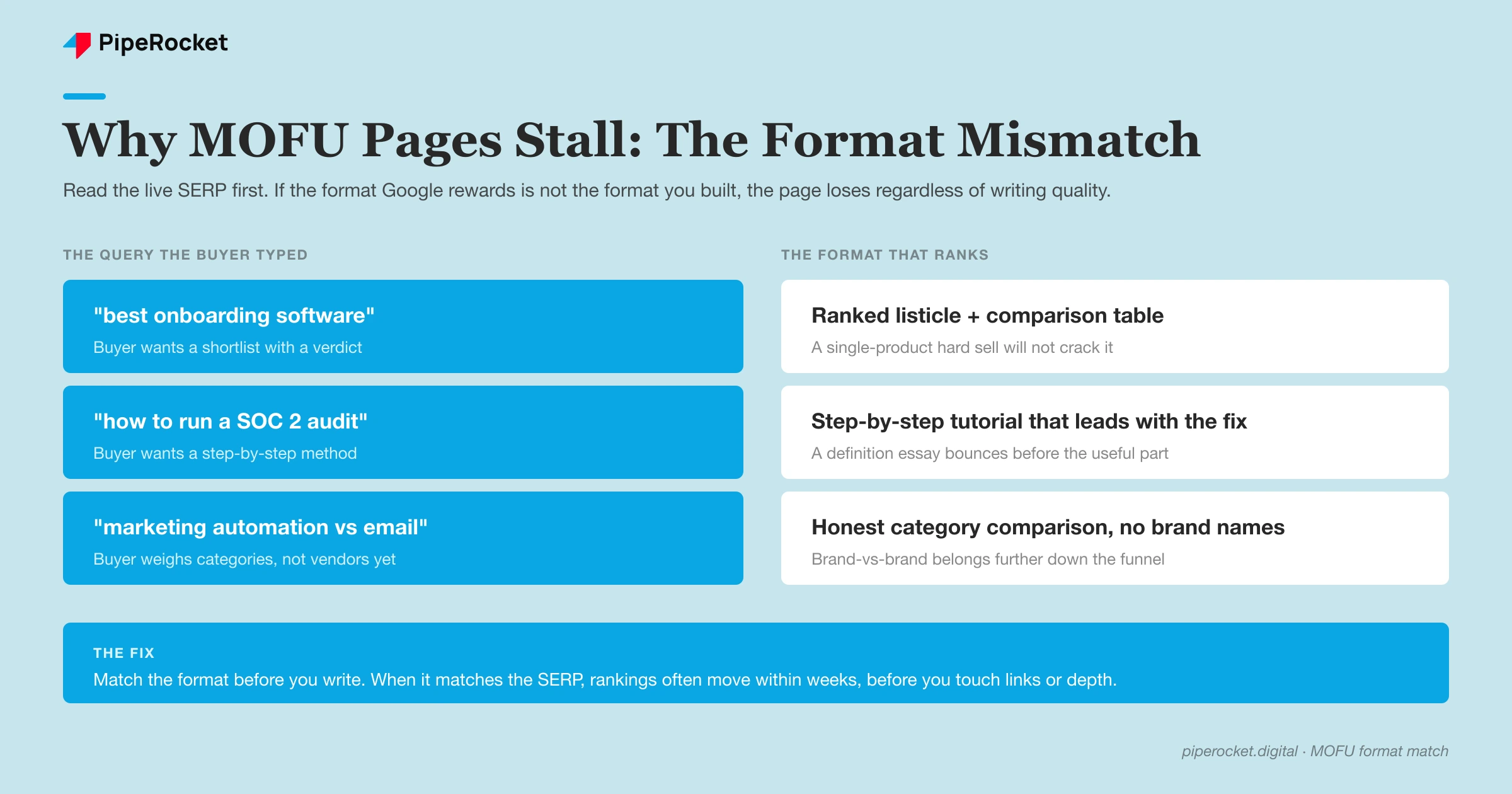
The single biggest thing you can do to rank a MOFU keyword is match the content format Google is already rewarding for it. Most MOFU content stuck between positions 8 and 20 is there because the format fights the SERP . A long narrative essay loses to a scannable listicle when every top result is a listicle.
So before writing, run the query and read the first page. Ask what type of page is winning:
- Is it a ranked listicle with a comparison table?
- Is it a step-by-step tutorial?
- Is it a category-explainer with a clear definition up top?
Then build that type. If the top 10 for “best onboarding software” are all listicles with pricing tables, a single-product hard-sell page won’t crack it, because you’re answering a different question than the searcher asked. When the format matches, rankings often move within weeks before you touch links or depth.
This is also where MOFU and BOFU execution split. A BOFU “X vs Y” page has one obvious format and the work is conversion copy. MOFU formats vary by query type, so the format read is the first real decision. The deeper version of this call lives in search volume versus search intent .
The one trap: don’t blindly clone the #1 result if it’s an aggregator like G2 or Capterra. They often rank on raw domain power, not because their structure is replicable on a younger site. Copy the format pattern across the top results, not one giant’s page.
What Actually Makes MOFU Content Rank for SaaS
MOFU content ranks for SaaS when it carries something the rest of the SERP doesn’t have: real experience. The middle of the funnel is the most crowded part of the SaaS internet. Every competitor has a “best X” post and a “how to do Y” guide, and most read identically because they came from the same five articles already ranking.
The fix is the Interview Method we use ourselves. Find someone who’s actually done the thing, like a founder or a customer, and sit with them for 30 minutes asking hard questions. Does this actually work? When did it fail? Then turn that conversation into the article.
AI can’t hallucinate experience, but it can process yours. Meaningful content is expert input plus AI efficiency plus human verification, and we’ve run this exact playbook on around ten of our own posts with all of them landing in the top two pages.
For a category-education MOFU query especially, the depth has to be real. A “how does GRC automation work” piece that just restates definitions gets crawled and ignored. One that walks through the actual workflow, the steps a real team takes and the place it usually breaks, earns the dwell time that holds a ranking.
There’s a second lever almost everyone leaves on the floor: secondary keywords. A single MOFU post written to cover one primary keyword wastes most of its potential. Written to cover the 15 to 20 related questions around that topic, the same post does the work of ten thin articles.
Across 50 pieces that compounding is enormous, and it’s how you map a topic instead of a list, which I cover in the SaaS keyword research process .
Rank From the Cluster, Not the Standalone Page
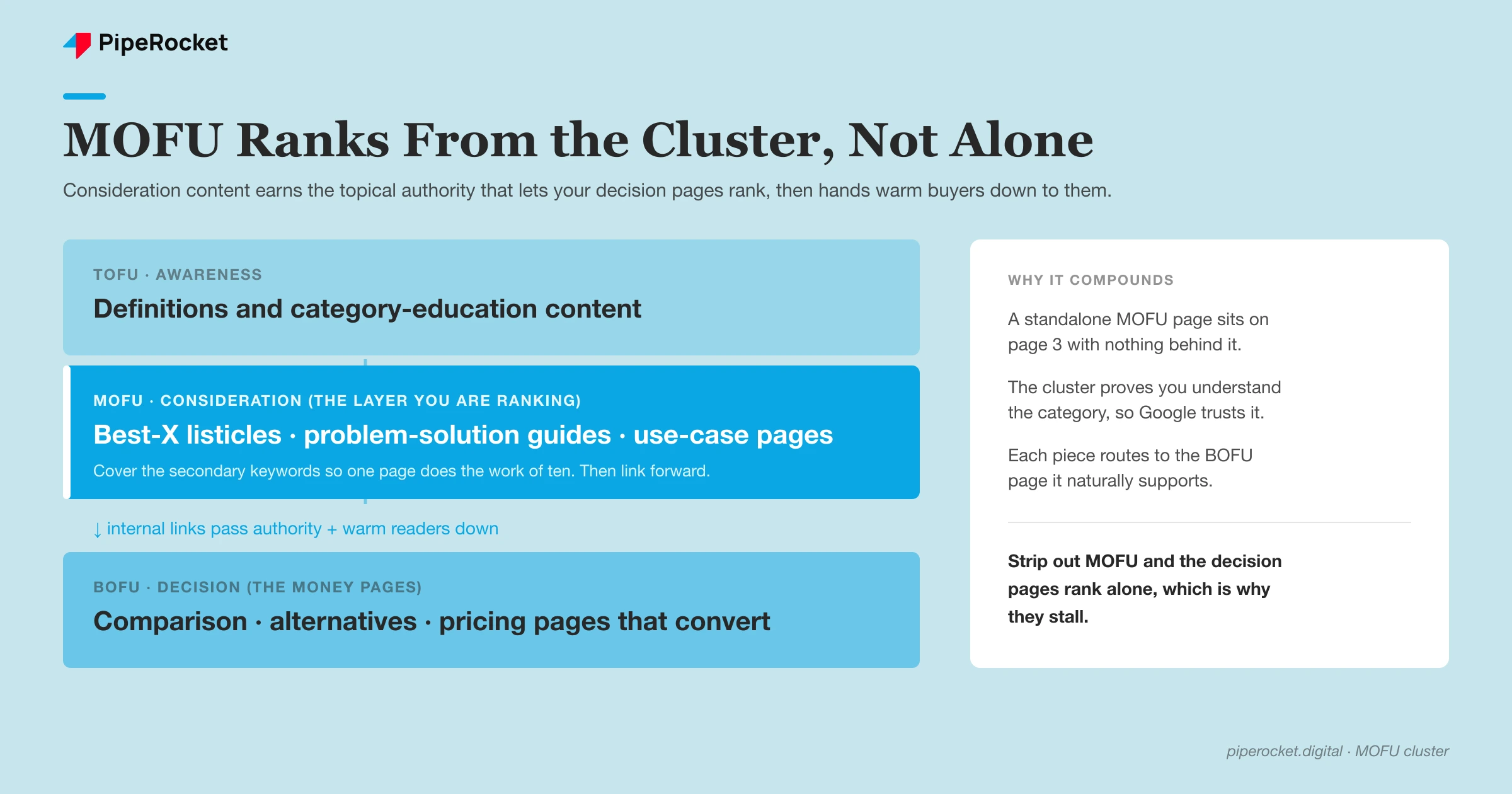
A MOFU page rarely ranks on its own. It ranks on the topical authority of the cluster around it. Google decides whether to trust your “best [category] software” page partly by whether the rest of your site proves you understand that category at all.
This is the part teams skip. They publish a high-value MOFU listicle, it sits on page 3, and they assume the page is the problem. Usually the page is fine and the site around it is empty.
There’s no supporting content signalling category depth, no internal links pointing authority at the page, nothing telling Google this site is a credible source on the topic.
Build the cluster deliberately. The MOFU layer is the educational and comparison middle that connects your top-of-funnel awareness content to your decision pages:
- Category-education pieces that explain how the category works
- Use-case pages for each segment you serve
- “Best X” and “how to” pages that catch comparison intent
- Integration content for the tools your buyers already run
Then link them toward your money pages. The full architecture, what’s a pillar versus a spoke and how the internal links carry weight, is in the topic clusters guide .
The point for MOFU specifically: your consideration content exists to build the authority that lets your decision pages rank, and to hand warm buyers down to them. Treat content as a connected product that keeps returning pipeline. Built that way it compounds instead of decaying.
Tie Every MOFU Page Back to the Product
A MOFU page that ranks and gets traffic but never points anywhere is a dead end. We’ve audited plenty of these: top-3 rankings for a strong consideration keyword, healthy sessions, conversions flat. The page taught the buyer something and then let them leave.
The fix is a contextual next step woven into the content where the buyer would naturally want it, not a banner ad bolted to the sidebar.
Inside a “how to do Y” tutorial, the moment you describe the manual, painful version of a step is where a line like “if you’d rather automate this, here’s how our tool handles it” belongs. It reads as help.
Map the next step to the page type:
- A “best X” listicle should hand the buyer to your comparison or category page
- A “how to” tutorial should point to the product feature that does the job
- A use-case page should route to the matching decision page for that segment
The honesty matters here. On a “best X” listicle where you include yourself, concede the cases where a competitor genuinely wins. Buyers trust the recommendation more, and the ones who fit you self-select toward the demo.
Ranking with the wrong content type, or with content that converts nobody, is as good as not ranking. Traffic on its own isn’t the point, so the conversion layer is where most MOFU audits should start.
How MOFU Ranking Differs From BOFU Execution
MOFU and BOFU rank on different signals and do different jobs, so running one playbook on both is where SaaS content programs quietly waste a quarter. The split looks like this:
| Dimension | BOFU | MOFU |
|---|---|---|
| Job | Convert a buyer who already wants a tool. Closing. | Earn the buyer who’s still deciding and build the topical authority that lets BOFU rank. Qualifying and supporting. |
| Page count / sequencing | Few and finite, usually 40 to 60 per single-product company. Build these first for fast pipeline. | Broader, since consideration covers more ground. Expand this layer next to feed the decision pages. |
| How to measure | Direct conversions and last-click. Mostly accurate. | Contribution by page type, not last-click. MOFU assists deals rather than closing them. |
BOFU pages (comparison, alternatives, pricing) are landing pages , so the execution is sales copy and an honest comparison table matching SERP intent. The detailed BOFU side, page types and ranking timelines, stays in the BOFU playbook so this piece doesn’t double it.
The full sequencing call, build the high-intent decision pages first and expand the MOFU layer to feed them, is in how to prioritise keywords by funnel stage .
On measurement, report by page type and hold each to its own benchmark. Comparison pages convert higher. Educational pages convert lower, often on an asset rather than a demo. Judge a MOFU page on last-click and you’ll cut pages that were doing real work.
If you’re scoring which MOFU terms even deserve the effort, the ICP-intent scoring filter and the ICP definition keep you focused on the buyer who actually pays.
Covering both tiers properly needs more writing capacity than most teams have, and the SaaS SEO agency shortlist covers firms built for it.
How PipeRocket Digital Ranks MOFU Pages for SaaS
We don’t publish consideration content and hope it ranks. We pick one category to go deep in, read the live SERP to set the format for every MOFU page, then build the educational and comparison layer that earns topical authority and feeds the decision pages.
Every piece carries real practitioner experience, and every page points somewhere with a contextual step into the product. If you want this built as a connected system rather than scattered posts, reach out to us or see how we run SaaS SEO .
Frequently Asked Questions
How long does it take to rank MOFU content for SaaS?
It depends on your domain’s authority and how contested the keyword is, but MOFU often shows first movement in weeks rather than months when the format already matches the SERP.
The fastest wins come from fixing existing pages stuck between positions 8 and 20, where a format change or broader secondary coverage moves rankings before you build anything new. Brand-new pages on a young domain take longer, because they need the surrounding cluster to mature before Google trusts them on the topic.
How is ranking MOFU keywords different from ranking BOFU keywords?
BOFU pages are conversion-focused landing pages that capture buyers who already want a tool, and they rank on tight SERP-intent matching and sales copy. MOFU pages do two jobs: they qualify buyers who are still deciding, and they build the topical authority that lets your BOFU pages rank.
BOFU is finite, usually 40 to 60 pages, while MOFU is broader. You should also measure them differently, because MOFU usually assists deals rather than closing them, so last-click attribution undervalues it.
How do I get MOFU content to actually convert instead of just getting traffic?
Tie every MOFU page to a contextual next step that matches its type, and weave it into the content rather than bolting on a banner. A “how to” tutorial should point to the product feature that does the job at the moment you describe the manual version.
A “best X” listicle should hand the reader to your comparison or category page. Be honest about where competitors win on listicles, because the buyers who fit you will self-select toward the demo. A page that ranks but routes nowhere is a dead end.