
What Is Keyword Ranking? A SaaS Team's Plain-English Guide
 Kamaraj Mathiarasan (Kim)
Last updated on
Kamaraj Mathiarasan (Kim)
Last updated on
Keyword ranking is the position your web page holds in Google’s search results for a specific query. The higher your rank, the more visible your page is to people searching that term. Ranking first for the wrong keyword is just as useless as not ranking at all.
TL;DR
- Keyword ranking is the numbered position your page holds in Google’s organic results for a specific search query.
- Rankings shift constantly based on algorithm updates, competitor activity, and changes to your own site.
- Position one captures roughly 28% of clicks for most queries, though SERP features like featured snippets cut into that.
- Tracking rankings only makes sense if the keywords you’re monitoring are tied to real buyer intent.
- SaaS teams that chase position over qualified traffic often watch their traffic grow while pipeline stays flat.
What Is Keyword Ranking?
Keyword ranking is where your page appears when someone types a specific query into Google. Position one is the top organic result. Position ten is the last slot on page one. Page two and beyond is, for most practical purposes, invisible.
Most teams treat ranking as the goal. It’s not. Ranking is a proxy. The real goal is qualified visitors who convert. You can rank third for a term that drives zero pipeline, or eighth for one that generates your best leads. Position matters, but only in context.
- Position: The numbered slot your page holds in organic results for a given keyword. Positions one through three capture most of the clicks.
- Organic result: A listing Google shows because your page earned it, not because you paid for placement. Separate from the ads above and below.
- SERP features: Featured snippets, People Also Ask boxes, and local packs can push organic listings down even if your raw ranking stays the same.
- Ranking volatility: Google updates its algorithm thousands of times per year. A page at position two today can drop to six tomorrow with no change on your end.
- Tracked vs. actual position: Rank tracking tools report an average position. The real position varies by location, device, and user history.
Consider a SaaS built for finance teams managing expense approvals. They rank second for “expense management software,” a high-volume, broadly competitive term. But they rank fourth for “expense approval workflow for mid-market finance teams,” a more specific query with a clear buyer.
That second ranking often drives better outcomes even though the position is lower. Ranking reports are useful only if you’re tracking the right keywords. A page at position fifteen for a perfectly-matched buyer keyword beats one at position five for a term your buyers never search.
Fast Fact: Organic search drives 91.3% of SaaS traffic — AI-referred visits account for less than 9%.
Which rankings are worth chasing is a strategy call, and how the best SaaS SEO agencies prioritise keyword targets for pipeline impact is a reasonable place to start.
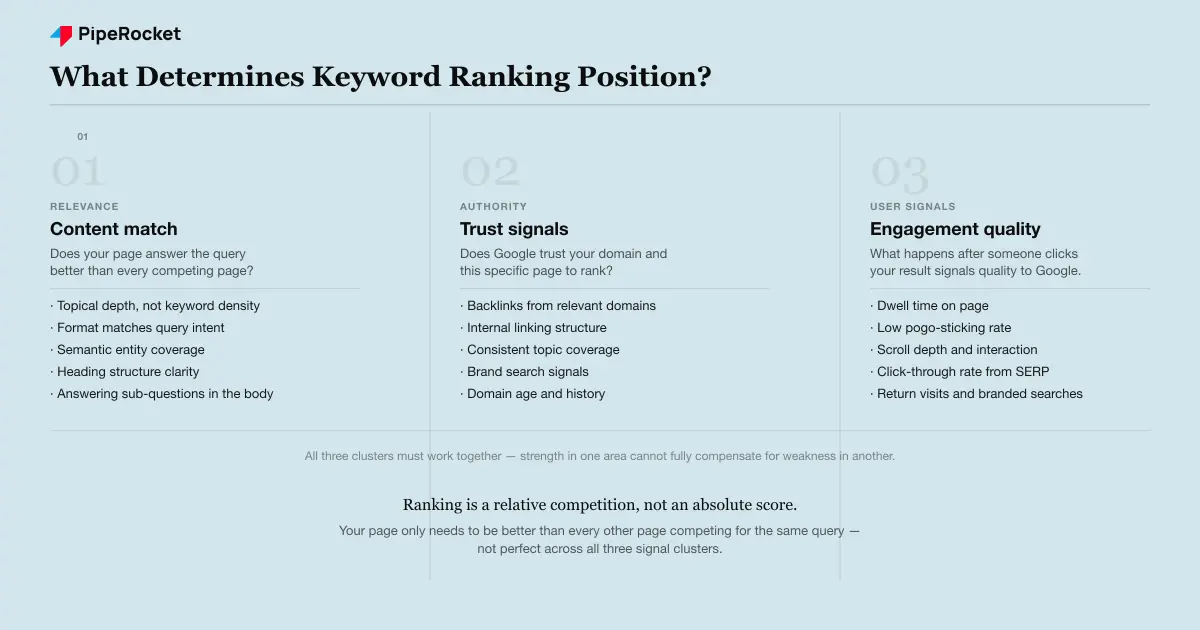
How Does Google Decide Where Your Page Ranks?
Google ranks pages based on hundreds of signals, but the core logic is simpler than most guides make it sound. Google wants to show the most useful, trustworthy result for each query. Your job is to make that case better than everyone else already ranking.
The signals fall into three buckets: relevance, authority, and experience. Relevance means your page clearly covers what the searcher wants. Authority means your domain has earned trust through links and consistent topical coverage. Experience means your page loads fast, works on mobile, and delivers.
- Relevance signals: How closely your page matches the intent behind the query. Title, headings, body copy, and on-page structure all send relevance signals.
- Domain authority : The overall trust and link equity of your domain. New SaaS sites with no backlinks struggle to rank for competitive terms.
- Backlinks: Links from trusted sites act as third-party endorsements. A single link from a respected SaaS publication often outweighs dozens from low-quality directories.
- Core Web Vitals: Google’s page experience signals cover loading speed, visual stability, and interactivity. A slow page can lose ground to a faster competitor.
- Content freshness: For fast-moving topics, Google favours recently updated content. Stale pages drift down as fresher competitors publish.
Here’s the part most SaaS teams underestimate. Ranking isn’t just about the page itself. It’s about the whole site around it. A single good page on a weak domain struggles. The same page on a domain that owns its topic ranks faster and holds longer.
Fast Fact: Organic search converts SaaS visitors at 0.92% — more than 3x the rate of AI-driven traffic at 0.26%.
What’s a Good Keyword Ranking for SaaS?
“Good” depends entirely on the keyword. For a high-volume competitive term like “project management software,” cracking the top twenty is a real milestone for a newer domain. For a specific long-tail query like “project management tool for architecture firms,” the top five should be achievable within months.
The click-through rate data tells the honest story. Position one gets roughly 28% of clicks. Position three drops to about 11%. By position ten, you’re below 3%. Below page one, clicks are close to zero.
- Positions one to three: Where most organic clicks go. Worth targeting for any keyword with real buyer intent at your domain’s authority level.
- Positions four to ten: Still valuable, especially for bottom-of-funnel queries close to a decision. A position seven ranking for a BOFU comparison keyword can still drive pipeline.
- Page two and beyond: Not worth tracking as an outcome. If you’re stuck here, the page needs stronger content, more links, or better intent alignment.
- Featured snippets: Position zero. Google pulls a direct answer above all organic results. Capturing a snippet can double click-through rate even if your ranking doesn’t change.
A useful benchmark: if a keyword matters and your page isn’t in the top ten after six months of consistent effort, something structural needs attention. It’s usually authority, intent mismatch, or a competitor with deeper content.
Also read: how to rank BOFU keywords for SaaS
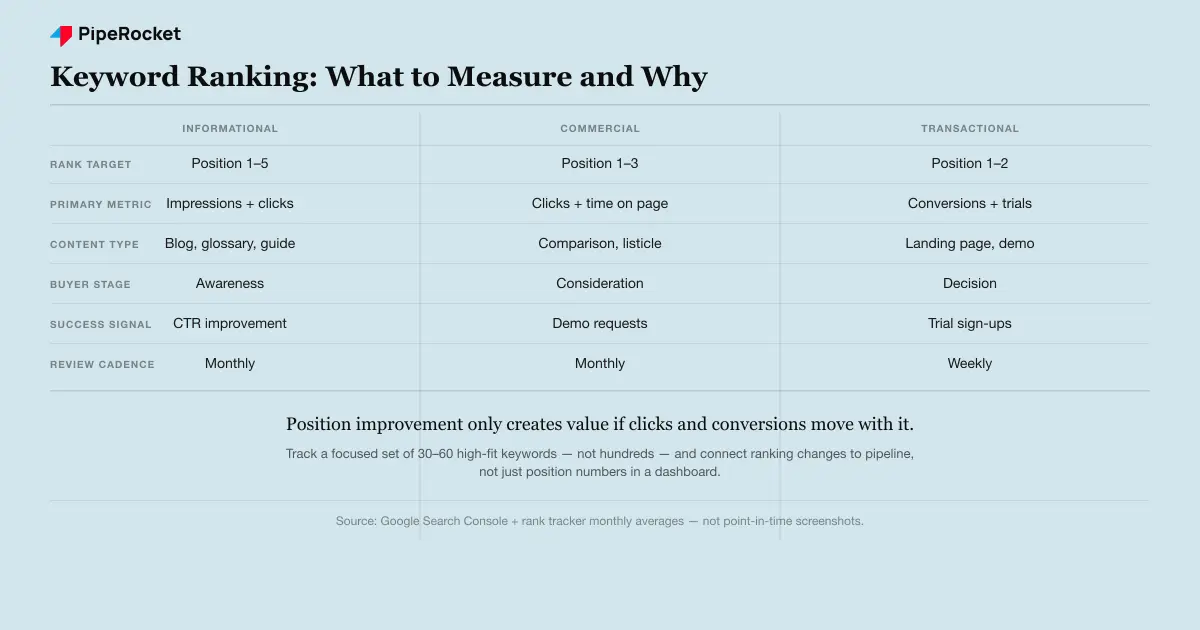
How Do You Track Keyword Rankings?
Tracking rankings sounds simple. In practice, most teams track the wrong keywords, look at vanity metrics, and draw the wrong conclusions.
The right approach starts with deciding which keywords actually matter. Not every keyword you rank for is worth monitoring. Focus on terms that map to real buyer intent, sit close to your product category, and carry enough volume to matter if you move up.
- Google Search Console: Free, direct from Google. Shows your average position, impressions, and clicks per keyword. The most accurate source for real performance data on your own site.
- Ahrefs or Semrush: Paid tools that track rankings over time, show competitor positions, and alert you to movements. Better for competitive analysis than GSC alone.
- Keyword groups, not individual terms: Track clusters of related keywords. A page often ranks for dozens of variations, so monitoring one target keyword misses most of the picture.
- Trend over time: A page that moved from position fifteen to eight over three months tells you more than a snapshot. Movement shows whether your efforts are working.
If you want to go deeper on selecting and prioritising keyword targets for a SaaS site, keyword research is the right starting point.
Why Do Rankings Fluctuate?
If you’ve woken up to find a page dropped from position four to twelve overnight, you know how disorienting ranking volatility can be. It happens constantly, and most of the time it’s not a crisis.
Google updates its algorithm thousands of times a year. Most updates are minor. Occasionally a broader update reshuffles rankings significantly across entire industries.
- Algorithm updates: Core updates can move rankings significantly, especially for pages built on thin content or manipulative links. Broad, well-researched content tends to be more stable.
- Competitor activity: If a competitor publishes a stronger page on the same topic and earns a few good links, your ranking can slip without you doing anything wrong.
- Seasonality: Search volume and ranking difficulty shift with seasonal trends. Some SaaS keywords are far more competitive in Q1 than Q3.
- Technical issues: A broken page, an accidental noindex tag, or a crawl error can cause a sudden drop that looks like an algorithm hit but isn’t.
- SERP feature changes: Google adding a featured snippet or a People Also Ask box can push your listing down, reducing clicks even if your position holds.
The honest advice: don’t optimise for ranking stability. Optimise for relevance and authority. Pages that genuinely serve the searcher and earn real links are far more durable through algorithm changes than pages built to game one signal.
Frequently Asked Questions
1. How long does it take to rank a new SaaS page?
It depends on domain authority, keyword difficulty , and how well the page matches search intent. A new page on a low-authority domain targeting a competitive keyword can take twelve months or more to reach page one. A well-optimised page on a domain with established authority targeting a specific long-tail query can rank within weeks. Most SaaS teams should plan for three to six months as a realistic window for meaningful movement on core keywords.
2. Should I prioritise ranking position or organic traffic?
Traffic is the more useful metric, but it depends on what you’re trying to learn. A high ranking for a zero-volume keyword generates no traffic. High traffic from a keyword with the wrong intent generates no pipeline. The best lens is qualified traffic: are the visitors landing on your page actually close to buying? If yes, the ranking matters. If not, a better position on the same keyword won’t fix the problem.
3. Why does my page rank differently on different devices?
Google personalises results based on device type, location, search history, and other signals. Your page might rank fifth on desktop in one city and eighth on mobile in another. This is why rank tracking tools report an average position rather than a single fixed number. For SaaS, desktop rankings tend to matter more for decision-stage queries, while mobile matters more for quick informational lookups.
The Bottom Line
Ranking higher is worth pursuing only if you’re targeting the right keywords. Fix the intent alignment first, then the position. Want a keyword strategy tied to pipeline, not vanity metrics? Reach out to our team or see how our SaaS SEO service approaches it.