How to Rank for High-Difficulty Keywords: A SaaS SEO Playbook
 Vignesh Sampath
Last updated on
Vignesh Sampath
Last updated on
High-difficulty keywords are the terms every SaaS team wants to rank for, and almost no one has a real plan to get there. You know the ones: KD 70+, dominated by Gartner, G2, HubSpot, and category leaders who’ve been building domain authority since before your product existed.
Most teams do one of two things: they either avoid those terms entirely, or they publish a page targeting them and wait. Neither works.
Here’s what actually does: a cluster-first approach where you build topical authority around the target keyword before the target page goes live. I’ll walk through how we do it, when it’s worth attempting, and when to skip the term and chase something more winnable right now.
TL;DR
- Assess before you commit: Most teams skip the authority gap analysis and go straight to publishing. That’s how you waste six months targeting a keyword you were never going to rank for.
- Build the cluster first: The target page doesn’t rank on its own. The spoke pages around it build the topical signal that makes Google trust the pillar.
- Choose the right cluster topics: Spoke pages must match what buyers actually search at each stage of the problem, not just any adjacent keyword.
- Earn the right links: Link acquisition for a high-KD term is a different exercise from general link building. It has to be targeted at the exact pages that need the authority.
- Know when to skip it: Some high-KD terms are simply not winnable at your current domain strength. Recognising that early saves budget and avoids months of stalled rankings.
- Measure what signals progress: Rankings for the target keyword are a lagging indicator. There are earlier signals that tell you the cluster is working before the target page cracks page one.
Why Publishing the Target Page First Is the Wrong Move
I’ll be direct: if your site has a Domain Rating below 40 and you publish a standalone page targeting a KD 70 keyword expecting to rank within three months, you’re going to be disappointed.
Google doesn’t rank pages in isolation. It ranks pages within the context of a site’s topical authority. A single well-written page targeting “best project management software for SaaS” doesn’t earn topical trust if the rest of your site has nothing else about project management. You’re asking Google to trust a page on a topic your site hasn’t established yet.
Keyword Difficulty Is Not a Fixed Obstacle
KD is a snapshot of current competition. It doesn’t tell you whether you’re close to the threshold where your site could compete, or miles off it. That gap is what you need to measure before you decide to pursue a term.
What the KD Number Actually Tells You
KD in tools like Ahrefs and Semrush is a proxy for the number and quality of backlinks pointing at currently ranking pages. A KD of 70 generally means the pages on page one have strong link profiles and the site-level authority to match.
What it doesn’t factor in: topical relevance, content depth, internal linking structure, or the on-page match to search intent. Those are your levers as a smaller domain. You can’t out-link a category leader in the short term, but you can out-depth them on a specific sub-topic if you build it right.
The Gap Between DR and KD
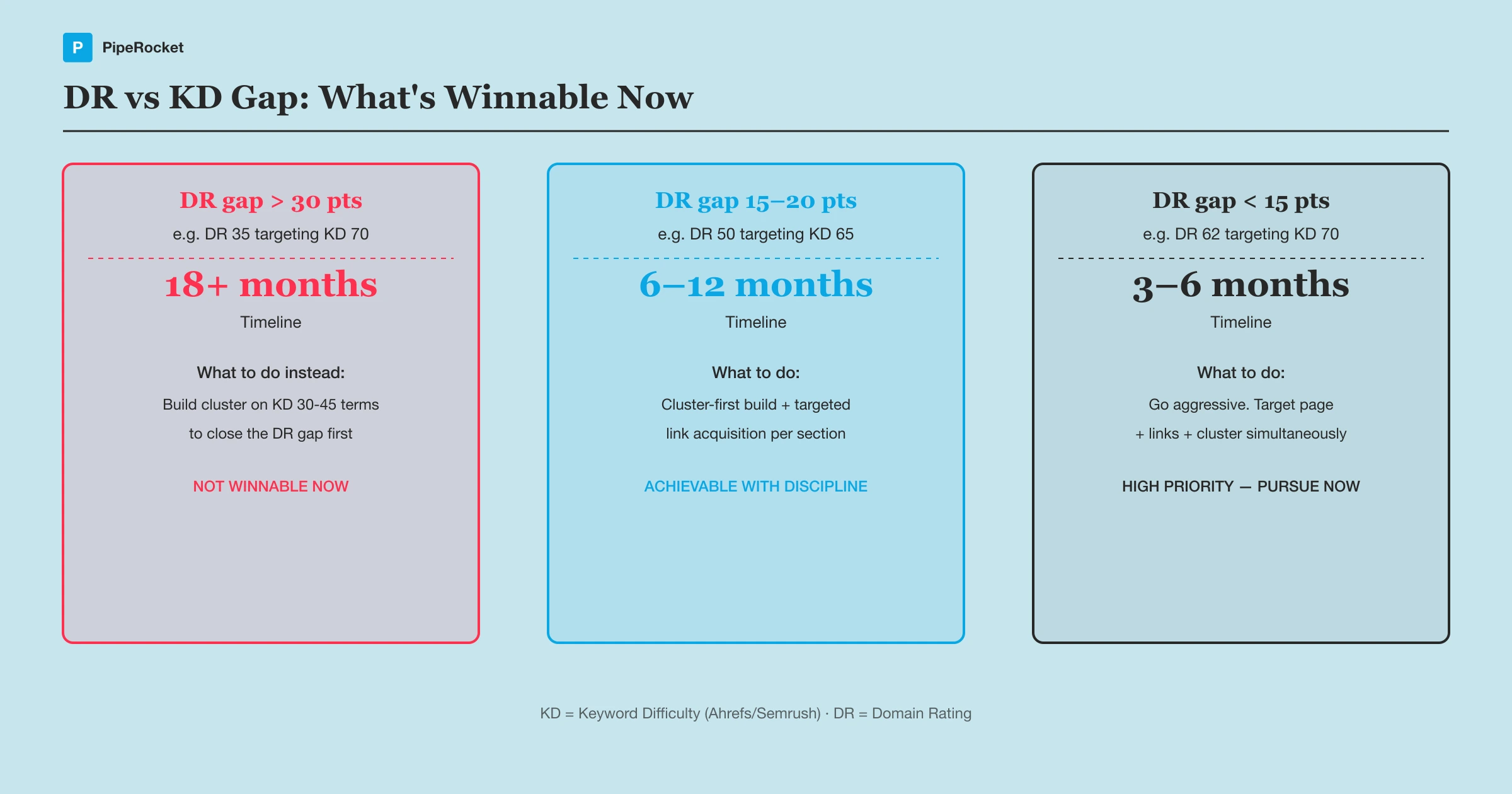
Here’s a rough heuristic our team uses. If the gap between your DR and the keyword’s KD is more than 30 points, that term is a 12-to-18-month play, not a 90-day one. A DR 35 site targeting KD 70 terms needs to build domain authority , topical depth, and links simultaneously. That takes time.
If the gap is 15 to 20 points, you’re in range. Hard, but achievable in six to twelve months with a disciplined cluster build and targeted link acquisition. That’s the zone worth pursuing.
If you’re at DR 60+ targeting KD 75 terms in your core category, the gap is small and you should be going for it aggressively.
Step 1: Run the Authority Gap Analysis Before You Write a Single Word
Before the cluster plan, before the content brief , before any writing, you need an honest authority gap analysis. This is the step most SaaS teams skip. It takes a few hours and produces no visible output, but it determines whether the whole exercise is worth doing.
The analysis covers four things:
- Your domain’s topical footprint. How many pages do you currently have that cover this topic cluster? How many rank in positions 1 to 20? What’s the average position for those pages? That tells you where your topical authority currently sits.
- The competing pages’ link profiles. Pull the top 10 ranking pages for the target keyword. Check each one’s referring domains, DR of those domains, and how many links were earned recently versus accumulated over years. A page sitting on 800 links built over five years is a different challenge from a page that earned 50 high-quality links in the last year.
- Content depth and format. What format are the top 10 using? Long-form pillar? Listicle? Tool-style comparison page ? If 8 of the 10 are listicles, a 4,000-word narrative pillar is the wrong format. SERP format alignment is often the faster win, before authority even becomes the issue.
- Topical gaps in the current top 10. This is your angle. Read the top 5 ranking pages carefully. What sub-topics do they miss or cover superficially? That’s where your cluster can out-depth them. It earns citations, and becomes the reason newer links point to you instead of them.
Step 2: Build the Cluster Before the Target Page Goes Live
This is the core of the approach. It’s the step that separates teams who eventually rank high-KD terms from teams who keep publishing and wondering why nothing moves.
The cluster builds the topical signal that makes Google trust the target page. You’re not just building support content. You’re building proof that your site understands the topic deeply enough to deserve to rank on its most competitive query.
Structure Your Cluster Around the Target Page
Here’s how to set it up:
The Spoke Pages Come First
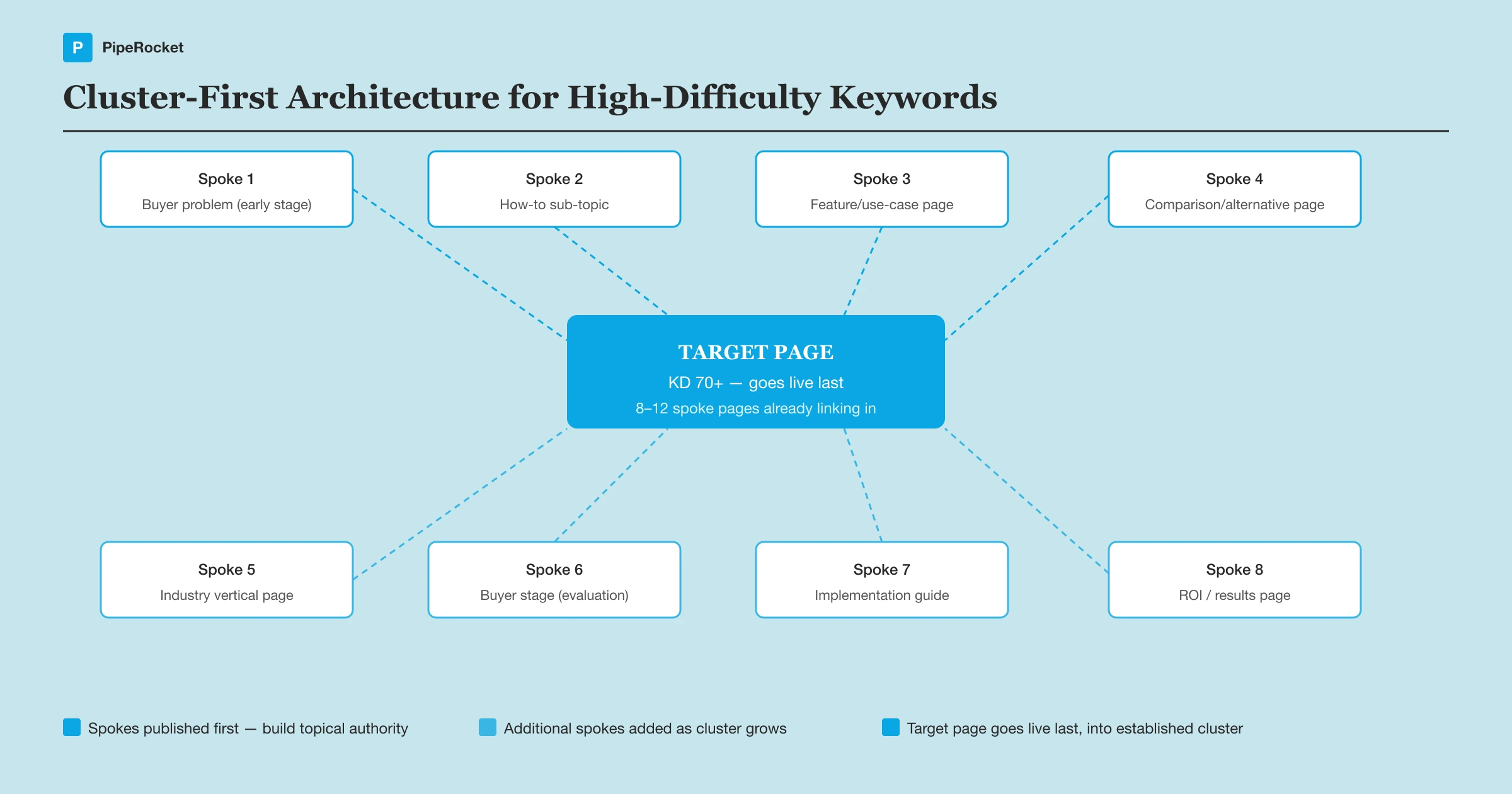
Pick eight to twelve supporting topics that sit inside the same topical cluster as your target keyword. These should be searches your buyers make at different stages of the problem, not just semantically adjacent keywords. A spoke page on “how to choose project management software” earns topical trust for “best project management software” in a way that a page on “project management statistics” doesn’t.
Each Spoke Needs to Actually Rank
The cluster only builds authority for the target page if the spokes are getting traction. Ten spoke pages stuck on page 4 contribute less than four spoke pages sitting at positions 8 to 15 and climbing. Build fewer spokes and make each one strong.
Internal Links Go Both Directions
Every spoke page links to the target page. The target page links back to each spoke that’s relevant to a specific section. The internal link graph creates the topical association that crawlers follow.
Pick Spoke Topics That Buyers Actually Search
Filter spoke topics by whether buyers actually search them, not just by volume. Teams often pick spoke topics based on keyword volume and topical adjacency. The better filter: does this represent a genuine search a buyer makes when working through the problem your product solves?
Spoke topics that reflect real buyer searches earn real engagement. Real engagement (time on page, low bounce rate, return visits) is a signal Google uses to evaluate whether a page deserves to rank. A spoke page at position 12 with good engagement contributes to topical authority. A spoke page at position 15 with 10-second bounces does almost nothing.
Note: The quickest way to find the right spoke topics: open Google Search Console for your existing content and look at the queries driving clicks. You’ll find clusters of related searches you haven’t published dedicated pages for. Those are your spoke candidates.
Set Up the Internal Link Structure Before You Publish the Target Page
The target page should go live into a cluster that already has internal links pointing at it. You can do this by publishing spoke pages first with internal links that reference the “coming soon” topic. More practically: plan the whole cluster at the start and stagger publish dates so the target page goes live last.
When the target page goes live with eight established spoke pages already linking to it, Google crawls it into a context that already signals topical relevance. That’s a fundamentally different crawl environment from a standalone page landing cold into nothing.
Step 3: Target the Right Links for the Right Pages
Link building for a high-KD term is not the same as general link building. Most advice tells you to build links to your domain broadly. For a specific high-KD term, you need links to specific pages: the target page and the cluster’s highest-performing spoke pages.
Here’s how we sequence it.
Start With Spoke Pages
Before the target page is live, build links to the spoke pages ranking or climbing in positions 10 to 20. Two to four quality referring domains pointing at a spoke page that’s already getting traction will often move it from position 15 to position 8–12. That movement builds the cluster’s real authority.
Then Point Links at the Target Page
Once the cluster has traction and the target page is live, acquire links specifically to that page. Use the target keyword or a close variant as the anchor in roughly 30–40% of new links. The rest should be natural brand anchors and URL anchors.
Source Matters More Than Quantity
A link from a DR 60 site in your industry is worth more than five links from DR 30 general directories. For high-KD terms, you need links from sites that the ranking pages also get links from. Pull the top 5 ranking pages’ link profiles, filter for domains with DR above 50 in your space, and those are your outreach targets.
Two link acquisition approaches our team finds most effective for SaaS:
- Original data and research. A report or dataset your industry hasn’t seen earns natural links from journalists, analysts, and other blogs. These are the highest-quality links and the hardest to replicate. They also rank independently, which compounds the benefit.
- Contributor placements. Write for publications that your target page’s competitors already get linked from. You’re not just building a link. You’re borrowing the trust signal those publications already give to the other ranking pages.
Step 4: Get the On-Page Match Right Before Links Do the Heavy Lifting
I’ve seen well-linked pages that won’t rank because they’re fighting the SERP format. On-page alignment to search intent is a prerequisite, not an afterthought.
Read the top 5 ranking pages for your target keyword. Answer these questions:
- What’s the dominant format? (Listicle, how-to, comparison, long-form pillar?)
- What H2 structure do the ranking pages use?
- What questions do they answer that you haven’t?
- What are they covering superficially that you could cover in real depth?
The last question is your differentiation. You can’t out-rank a DR 80 site on authority alone. But if your page covers a sub-topic in far more depth than anything currently ranking, you earn the links and engagement signals that push you up.
One note on format: don’t fight the SERP. The pages actually ranking tell you more about what Google rewards for that query than any content tool does. Use their structure as a baseline, then go deeper on the gaps.
E-E-A-T Signals Are Non-Negotiable at KD 70+
For high-KD terms, Google applies more scrutiny to E-E-A-T (Experience, Expertise, Authoritativeness, Trustworthiness) signals. Author expertise indicators, real case examples, citations to credible sources, and evidence of first-hand experience all matter more here than they do for KD 30 terms.
On your target page and key spoke pages, make sure:
- The author has a visible bio with relevant credentials
- The page cites real data (your own research is best; named external sources are fine too)
- You include real examples with specifics, not generic illustrations
- The page has been updated recently, with a visible last-modified date
These are table-stakes for the competitive SERP you’re trying to enter.
Step 5: Know When to Skip a High-KD Term
This is the most useful and least discussed part of ranking for competitive keywords. Not every high-KD term is worth pursuing at your current authority level. Recognising that early isn’t defeatism. It’s strategy.
Here are the signals we use to advise a client to skip a term for now:
| Signal | What it means |
|---|---|
| DR gap > 30 points | 18+ month play; pursue lower-KD cluster terms first |
| All top-10 results are brand domains | Google is rewarding brand trust, not topical relevance |
| Top results are G2/Capterra/Gartner | Category aggregators dominate; build for adjacent terms |
| Term has no commercial sub-queries | Ranking won’t generate leads even if you get there |
| Your cluster has zero existing traction | No topical signal; cluster-build needed before target |
The third row deserves extra attention for SaaS teams.
Note: If every page on page one is G2, Capterra, or a similar aggregator, you’re not fighting for the organic ranking. You’re competing for a featured listing on those platforms. That’s a different channel with different investment logic.
For terms where the top 10 is all aggregators, target sub-queries around that term instead. Searches like “best [category] for [specific vertical]” or “cheapest [category] with [specific feature]” return more diverse SERPs, ones where a dedicated page can actually compete.
Our team evaluates each term across six dimensions:
| Dimension | What “strong” looks like | What “weak” looks like |
|---|---|---|
| Topical authority | 10+ ranking cluster pages covering the topic | Fewer than 3 pages on the topic, none ranking |
| Technical SEO and UX | Fast load, mobile-friendly, clean crawl | Core Web Vitals failures, crawl errors, thin structure |
| User intent mapping | Content format matches the dominant SERP format | Narrative post targeting a listicle SERP |
| Backlinks and authority | DR gap ≤ 20 vs. top-ranking pages | DR gap > 30; no quality links to cluster pages |
| Brand signals | Brand searches exist; Google Knowledge Panel present | No branded search volume; entity unrecognised |
| AI readiness | Structured data, clear entity signals, cited by LLMs | No schema, no citations, no E-E-A-T indicators |
A client who scores “weak” on three or more of those dimensions is not ready to win KD 70+ terms. Pushing into those terms burns time and budget that’s better spent building the foundation.
The “Winnable Now” Shortlist
When you skip a high-KD target term for now, you need to know what to pursue instead. The shortlist should be keywords where:
- KD is 10 to 20 points below your DR
- The SERP has at least 3 to 4 results from sites with similar or lower DR than yours
- The keyword maps to a stage of the buyer’s journey where your product is the obvious answer
- A cluster of 6 to 8 supporting topics already exists or can be built quickly
Ranking these terms builds the domain authority and topical footprint that makes the high-KD target winnable later. It’s not settling for less. It’s sequencing correctly.
Step 6: Track the Right Signals While the Cluster Builds
Here’s a mistake teams make once the cluster is live: they check the target keyword’s ranking every week, then lose confidence when it’s still on page 4 three months in. That’s the wrong signal to track during the build phase.
During the first four to six months, track these instead:
- Spoke page rankings. Are the cluster pages moving into positions 10 to 20? That’s the topical authority signal building.
- Impressions for the target keyword. Even if you’re on page 4, growing impressions means Google is showing the page for the query. Flat impressions usually mean the page needs work: content depth or format alignment.
- Referring domains to cluster pages. Is the outreach translating into new linking domains? Even one or two quality links per month compounds over six months.
- Average position trend for the cluster. If the cluster’s average position across all spoke pages is improving, the authority is building.
When these signals are positive, the target keyword ranking will follow, usually around month six to eight for a well-executed cluster against a KD 65–75 term on a DR 45–55 site.
How a SaaS SEO Agency Runs This Playbook
Ranking high-difficulty keywords requires a sequenced program: authority gap analysis, cluster architecture, targeted link acquisition, and on-page alignment that compounds over time. That’s not a campaign. It’s a compounding system.
It’s the work we do for SaaS clients at PipeRocket, from building the cluster strategy to the link programme that moves the target pages.
If you would rather buy the playbook than build it, our SaaS SEO agency shortlist ranks fourteen firms on how they run exactly this work.
If you’re looking at a set of competitive terms and want a clear-eyed view of what it would take to rank them, get in touch . We work with SaaS teams as a SaaS SEO agency focused on pipeline, not traffic.
Frequently Asked Questions
How long does it take to rank for a high-difficulty keyword?
For a site with a Domain Rating between 45 and 55 targeting a KD 65 to 75 keyword, our team typically sees meaningful movement in six to twelve months with a disciplined cluster-first approach.
The timeline depends on the DR gap, the quality of the cluster, and the pace of link acquisition. Higher-authority sites will see movement faster. Sites with larger DR gaps should plan for 12 to 18 months and focus on closing that gap through lower-KD cluster terms first.
Is it better to target one high-KD keyword or multiple lower-KD keywords?
For most SaaS sites below DR 50, the better approach is to target multiple lower-KD keywords that sit within the same topical cluster as the high-KD target. These lower-KD terms build the topical authority and internal link structure that makes the high-KD term winnable.
You’re not choosing between them. You’re sequencing the lower-KD terms first because they build the domain signal the harder target needs.
Do backlinks alone help you rank for high-difficulty keywords?
Backlinks are necessary but not sufficient for high-KD terms. A well-linked page with mismatched content format, thin topical depth, or weak E-E-A-T signals will stall at positions 8 to 15 and rarely break into the top five. Links confirm relevance. They don’t create it.
The content, cluster architecture, and on-page E-E-A-T signals have to be strong before links do the heavy lifting that gets a page into the top three.