How to Write an SEO Content Brief (That Writers Actually Use)
 Vignesh Sampath
Last updated on
Vignesh Sampath
Last updated on

Here’s the part nobody tells you about SEO content: the brief decides whether the draft ranks, long before the writer opens the doc. Hand someone a keyword and a word count and you’ve handed them a guess. They’ll write something fluent, you’ll publish it, and it’ll sit on page three wondering what it did wrong.
I write briefs so the writer doesn’t have to guess. The argument, the format, the entities to cover, the pages to link, all of it gets decided before a single sentence is drafted. The brief is where the SEO thinking happens. The draft is just execution.
TL;DR
- A keyword and a word count is the reason drafts miss intent. It was never a brief. A real brief pre-decides the argument, the format, and the gaps to beat.
- Read the SERP before you read your keyword tool. Google has already told you what format and intent it rewards. Match it or rank nowhere.
- Pre-decide the argument, not just the topic. A brief that says “cover content briefs” gets you mush. A brief that names the point gets you a position.
- List the entities the page must mention. Coverage of the right sub-topics is what separates a page that reads complete from one that reads thin.
- Name the internal-link targets in the brief. If you don’t tell the writer where the page sits in your site, it’ll sit nowhere.
- The common mistakes are all the same mistake: leaving a decision to the writer that you should have made yourself.
Why Most “Briefs” Produce Drafts That Miss Intent
Most SEO briefs fail because they brief the topic, not the intent. A keyword, a target word count, maybe a few “keywords to include,” and the writer is sent off to figure out the rest. So they do the reasonable thing. They write a clear, competent piece about the topic. And it misses, because the topic was never the assignment. The search intent was.
Here’s the belief I want to challenge: that a good writer can take a thin brief and “do the SEO themselves.” They can’t, and it’s not their job to. A writer optimizing for readability and a SERP optimizing for intent-match are solving two different problems.
When the brief stays silent on intent, the writer fills the gap with their own instinct, and their instinct is to write well, not to write what ranks.
The clearest tell is when a draft comes back and it’s genuinely good prose that answers the wrong question. Somebody searching “how to write an SEO content brief” wants a process they can copy by Friday. If the draft opens with three paragraphs on the philosophy of content strategy, it’s lost them, no matter how polished it reads.
A thin brief outsources the most important decision to the person least set up to make it. The writer owns the words. You own the SEO call. So make the call in the brief.
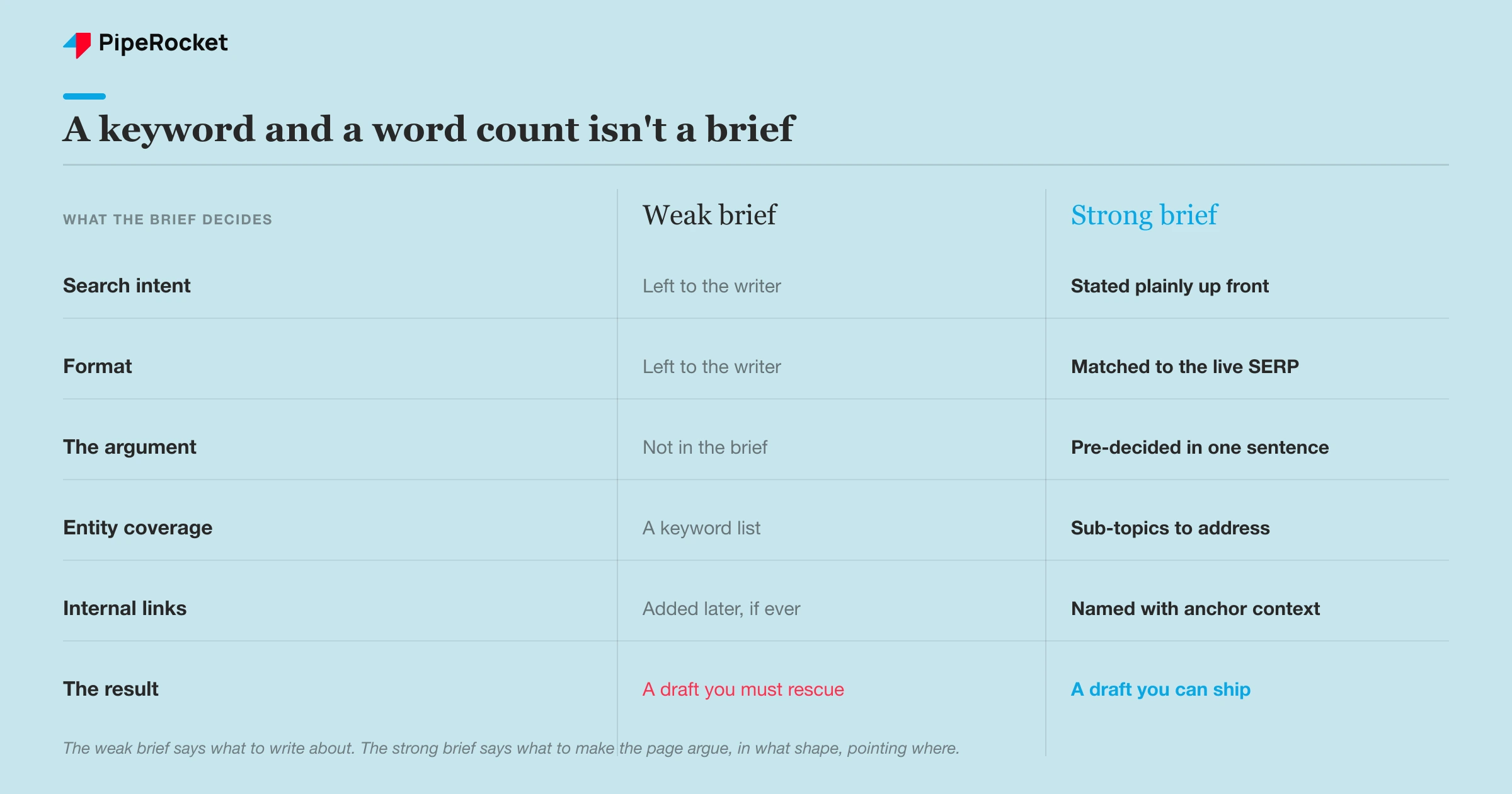
Below is the difference between the brief that creates this problem and the brief that solves it.
| What the brief includes | Weak brief | Strong brief |
|---|---|---|
| Keyword | Yes | Yes |
| Word count | Yes | Yes, but as a range tied to the SERP |
| Search intent | Left to the writer | Stated plainly: what job the reader is hiring this page for |
| Format | Left to the writer | Matched to the SERP: listicle, how-to, comparison |
| The argument | Not in the brief | Pre-decided: the specific point the page commits to |
| Entities to cover | A keyword list | The sub-topics a complete answer must address |
| Internal links | Added later, if ever | Named in the brief, with anchor context |
The weak brief tells the writer what to write about. The strong brief tells them what to make the page argue, in what shape, covering what, pointing where. One produces a draft you have to rescue. The other produces a draft you can ship.
Step 1: Read the SERP Before You Write a Word of the Brief
The SERP is your real brief, and it’s already written. Before I decide anything about the page, I search the keyword and study what Google is actually ranking. Not what the volume says it should rank. What it does rank, right now, on the first page.
This is the step most briefs skip, and skipping it is why so many drafts fight the SERP and lose. Google has spent years deciding what satisfies this query. If every result on page one is a step-by-step how-to and your brief asks for a thought-leadership essay, you’ve lost before the writer starts. Format-intent match is what the SERP rewards, and writing quality rarely overrides it.
So I read the top five to ten results and pull out the pattern. Here’s what I’m looking for, and what each thing tells me to put in the brief:
- Dominant format. Listicle, how-to, definition guide, comparison? Whatever Google rewards, the brief specifies. You match the format or you don’t compete.
- Depth and structure. Are the top pages skimmable with tables and steps, or long narrative essays? The brief inherits whatever the SERP rewards.
- What the top results don’t cover. The gap is your angle. If every result explains what a brief is but none show a fill-in template, the template is your differentiator, and it goes in the brief as a required section.
- The People Also Ask box and related searches. These are your FAQ section and your secondary intents, handed to you for free.
Tip: don’t blindly copy the page one structure of a giant brand. They sometimes rank on domain authority , not on format-fit, and you don’t have their authority to lean on. Copy the structure that repeats across several mid-sized sites, not the one outlier that ranks because it’s a well-known name.
The output of this step is two lines at the top of every brief: the format Google rewards, and the gap nobody on page one is filling. Everything else in the brief serves those two lines.
Step 2: Pre-Decide the Argument, Not Just the Topic
A brief that names the topic gets you a draft about the topic. A brief that names the argument gets you a draft that takes a position, and positions are what rank and get cited. This is the single biggest upgrade you can make to how you brief.
The difference is small to write and huge in effect. “Cover SEO content briefs” is a topic. “Argue that most briefs fail because they’re a keyword plus a word count, and a real brief pre-decides intent and format” is an argument. The first sends the writer hunting for something to say. The second tells them what to prove, so every section pushes toward one point instead of wandering.
When I pre-decide the argument, I write three things into the brief:
- The one-sentence point the whole page commits to. If you can’t write it in a sentence, the page doesn’t have a point yet, and the draft won’t either.
- The contrarian angle, if there is one. What does this page say that the page one results don’t? That’s the line that earns the backlink and the citation.
- A point of view per section, written into the brief rather than left as a bare heading. “Step 2: the argument” is a label. “Step 2: argue the writer can’t do the SEO themselves, and it’s not their job to” is a brief.
Here’s the trap to avoid. Don’t over-script it into a paint-by-numbers doc where you’ve basically written the article in note form. The writer still needs room to write. You’re deciding what the page argues and what it covers, not dictating every sentence. Give them the position and the guardrails, then trust them with the prose.
The test I use: can a writer read the brief and tell me, in one sentence, what this page is trying to prove? If they can, the argument is in the brief. If they shrug and say “it’s about content briefs,” go back and put the point in.
Step 3: List the Entities and Sub-Topics the Page Must Cover
A page ranks as “complete” when it covers the sub-topics Google associates with the query, so the brief should hand the writer that list, not a keyword list. These two things look similar and they’re not. A keyword list optimizes for matching strings. An entity list optimizes for covering concepts, which is what relevance actually is now.
The mistake is treating “keywords to include” as the coverage plan. Stuffing in “SEO content brief template” four times does nothing if the page never explains what goes in the template. Mentioning a concept once in passing isn’t coverage. Coverage means the page actually addresses the thing a reader, and Google, expects a complete answer to address.
So how do I build the list? I pull sub-topics from three places:
- The SERP itself. The H2s and sections that repeat across the top results are the concepts Google expects. If four of five top pages have a “template” section, that’s an entity you can’t skip.
- People Also Ask and related searches. Each one is a sub-intent the page should resolve, either in a section or in the FAQ.
- The reader’s actual workflow. What does someone doing this job need next? For a content brief, that’s the SERP read, the argument, the entities, the links. The workflow is the outline.
Note: don’t pad the list to look thorough. Ten entities the page genuinely covers beats thirty it name-drops. A list that forces the writer to mention things the reader doesn’t care about produces a bloated draft that reads padded, and padded pages don’t hold a reader or a ranking. Relevance is coverage of what matters, not coverage of everything.
The deliverable here is a checklist the writer ticks off, and an editor can verify against, before the draft is called done. If a sub-topic on the list isn’t genuinely addressed in the draft, the draft isn’t finished. That’s the whole point of putting it in the brief instead of hoping the writer thinks of it.
Step 4: Name the Internal-Link Targets in the Brief
If you don’t tell the writer where the page sits in your site, it sits nowhere, orphaned and unsupported. The brief is where you decide the page’s place in your structure, and that means naming the internal links before the draft exists, not bolting them on after.
Most briefs treat internal linking as a cleanup task someone does later, which is why it usually doesn’t happen. A page that links to nothing and nothing links to is a page Google has little reason to crawl deeply or trust. The link plan belongs in the brief because the brief is where you’re already thinking about how this topic relates to everything else you’ve published.
For each new page, I name two things in the brief:
- The pages this one should link out to. The cluster pages it supports, the related guides, the money page it’s meant to feed. Each with a note on the natural anchor context, not just a bare URL.
- The pages that should link into this one. Which existing pages will get a new link pointing here once this publishes. A page with zero inbound internal links is a page you’ve buried.
One honest caveat. Don’t force a writer to cram links where the context doesn’t earn them. The brief names the targets and the rough context; the writer places them only where a sentence genuinely calls for the link. A link shoved into an unrelated sentence helps nothing and reads like exactly what it is.
If your team runs internal linking as a separate automated pass after the draft, the brief still matters: it’s where you register that this page exists in the structure at all, so the linking step has something to point at. Either way, the decision is yours, made in the brief, not left to chance.
Common Mistakes That Quietly Kill the Brief
Every brief mistake is the same mistake wearing a different hat: leaving a decision to the writer that you should have made yourself. Once you see it that way, the fixes are obvious.
- The keyword-and-word-count brief. The original sin. No intent, no format, no argument, so the writer guesses and the draft misses. Fix: every brief carries the SERP read and the one-sentence argument.
- Briefing format from the volume tool instead of the SERP. The tool says “high volume, write a guide.” The SERP says “everyone ranking here is a listicle.” The SERP wins, always. Fix: read the SERP first, brief the format second.
- A keyword list masquerading as a coverage plan. Strings to match instead of concepts to cover. Fix: list the entities and sub-topics, and verify the draft actually addresses them.
- No link plan. The page publishes orphaned. Fix: name the inbound and outbound links in the brief.
- Over-scripting the whole article in note form. The opposite failure. You’ve written the draft in shorthand and the writer just expands your notes into flat prose with no life. Fix: decide the argument and the coverage, then leave the writing to the writer.
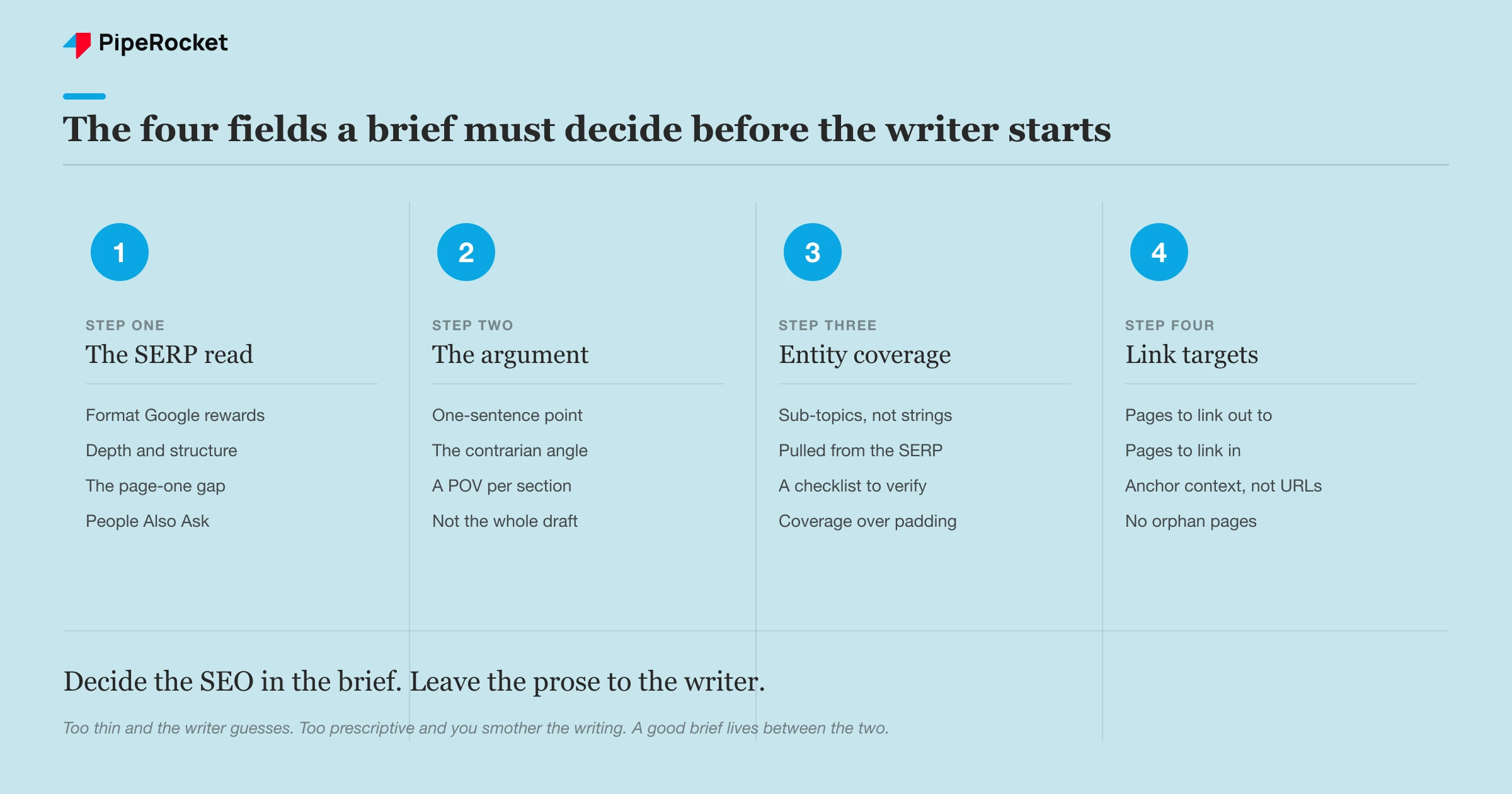
The brief that works lives between two failures. Too thin and the writer guesses. Too prescriptive and you’ve smothered the writing. Decide the SEO yourself, and leave the prose to the writer.
How PipeRocket Digital Builds Briefs That Rank
We treat the brief as the SEO deliverable, not the paperwork before one. Before we hand anything to a writer, we read the live SERP, pre-decide the argument and the format, list the entities the page has to cover, and name where it sits in the site. The draft becomes execution against a decided plan, not a guess.
If you want this built for your SaaS, our SaaS SEO agency does exactly this, and you can reach out to us here to talk it through.
Frequently Asked Questions
What should an SEO content brief include?
At minimum, a usable SEO content brief includes:
- The target keyword
- The search intent stated in plain language
- The format the SERP rewards
- The one-sentence argument the page commits to
- The entities or sub-topics the page must cover
- The internal-link targets
Word count belongs there too, but as a range guided by what’s ranking, not a fixed number pulled from nowhere. Anything less and you’re asking the writer to make SEO decisions they aren’t set up to make. The brief is where intent and format get decided, so the draft can just execute.
How long should a content brief be?
Long enough to remove the writer’s guesswork, short enough that it isn’t the article written twice. For most pages that’s one to two pages: a few lines on intent and format, the argument, a coverage checklist, and the link plan.
If your brief is longer than the article you’ve drifted into writing the draft yourself, which defeats the point and usually flattens the writing. Aim for a brief the writer can read in a couple of minutes and walk away knowing exactly what to prove and what to cover.
Who should write the SEO content brief, the SEO or the writer?
The SEO should own the brief, because the brief is where the SEO decisions live: intent, format, entity coverage, and internal links. The writer owns the prose. When you flip it and ask the writer to brief themselves, they optimize for readability over intent-match, because that’s the job they’re trained for, and the draft drifts off the SERP.
The cleanest setup is the SEO writing the brief and the writer pushing back on anything that would hurt the reading experience. Two roles, two decisions, one page that ranks and reads well.