How to Rank on ChatGPT in 2026: Strategies and Tips
 Kamaraj Mathiarasan (Kim)
Last updated on
Kamaraj Mathiarasan (Kim)
Last updated on
Everyone’s losing their minds over ChatGPT, Perplexity, and Gemini right now. I see founders panicking every day, thinking traditional search is just dead and they need to find some secret back door into AI responses.
But most of the advice I’m seeing regarding this is complete garbage. People are out there buying these AI SEO tools that literally do nothing. You can’t treat an LLM like a magic trick. If you want to actually show up in these generative answers, you need a strategy grounded in reality.
Let’s just talk through how to rank on ChatGPT based on our strategies.
TL;DR
- You can rank on ChatGPT by building undeniable consensus across the web and answering specific conversational prompts directly. Make sure you’re mentioned alongside category leaders on authoritative sites so the LLM associates your brand with the solution. Stop using fluff and start giving the machine clear, factual data.
- We’re seeing so many teams ignore their technical debt while chasing AI rankings, but if the crawler can’t read your site, the AI won’t even know you exist. You have to fix the foundational stuff like the redirects and 404s, before you even think about “optimizing” for a prompt.
- The real gold isn’t in a keyword tool; it’s in your sales calls. You need to map the messy, 15-word questions your actual customers are asking because that’s the conversational language the AI is designed to retrieve and summarize for users.
- ChatGPT started turning brand names into clickable links in May 2026, so being named in an answer now drives real referral traffic, not just visibility.
- Google Search Console now reports AI Overview and AI Mode impressions in the standard performance report (as of mid-2026), so you can measure AI visibility instead of guessing.
How Do AI Search Engines Actually Work?
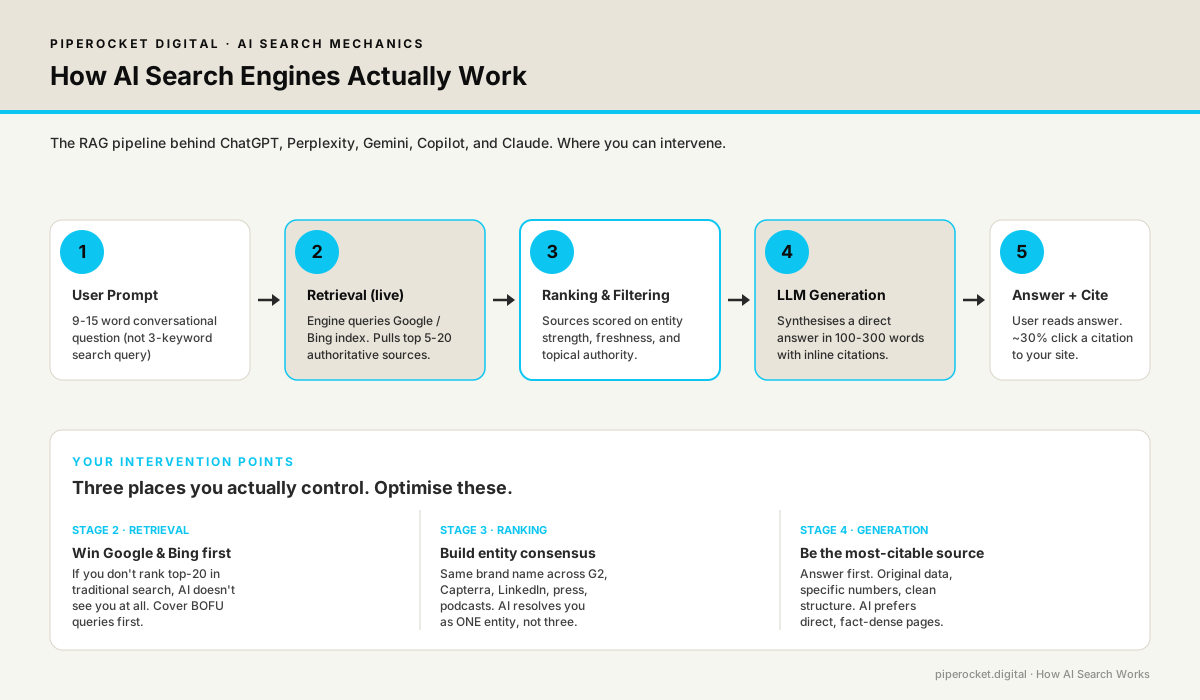
The machine isn’t just a database
AI search engines like ChatGPT and Perplexity use RAG (Retrieval-Augmented Generation): the LLM references authoritative external sources on the live web before generating a response, rather than relying only on its training data. It works as a loop between the index and the generation.
What that means for you:
- The AI isn’t just “knowing” things from its training; it’s actively grabbing information from the web and pulling it back to answer you.
- It’s not a closed box. It’s constantly looking for fresh signals, which is why the debate around is ChatGPT really replacing Google keeps growing.
- If your content isn’t retrievable and trusted at retrieval time, it never reaches the generation step.
The 15-word prompt shift: ChatGPT vs Google
Search behavior flipped. On Google people typed three or four keywords and got a directory of ten links to choose from. On ChatGPT they type full, intent-heavy sentences of nine to fifteen words and expect one synthesized answer. That difference changes how you write.
| Behavior | Google search | ChatGPT prompt |
|---|---|---|
| Query length | 3-4 keywords | 9-15 word full sentence |
| Example | “SaaS analytics” | “What’s the best SaaS analytics tool for a startup under $1,000 that integrates with Stripe?” |
| Intent detail | Broad, inferred | Specific, stated in the prompt |
| Output | Ten ranked links to choose from | One synthesized answer with a few cited sources |
| What wins | Keyword and link authority | A direct, extractable answer plus web-wide consensus |
Google always struggled with those specific questions because it wanted to hand you ten pages. ChatGPT just wants to give the answer, so your content has to already contain it.
Live crawling is the new normal
We keep seeing ChatGPT deploy these crawlers to read your site in real-time. If someone asks about your pricing or wants a demo, the engine isn’t relying on what it learned two years ago, it’s looking at your site right now.
Here’s where I want to refresh everyone on the fact that ChatGPT uses Google and Bing rankings to source its data. If you aren’t visible on the traditional search engines, the AI doesn’t even know you exist. It’s using those rankings as a filter for what’s actually authoritative. If the search engine trusts you, the AI likely will too.
Two practical moves fall out of this. First, don’t block the OpenAI crawlers in robots.txt. GPTBot (training), OAI-SearchBot (search retrieval), and ChatGPT-User (live browsing on a user’s request) all need access to read your pages. Second, because ChatGPT leans heavily on Bing, verify your site in Bing Webmaster Tools and confirm your key pages are actually indexed there, not just in Google.
Why Are Most “ChatGPT SEO” Tactics Completely Wrong?
Most “ChatGPT SEO” tools guess at a black-box algorithm that changes daily and can’t prove they moved anything. We audited over 70 of them and found none add real value. There is no score you can hit that makes an LLM cite you.
The market is just saturated with hype. We actually sat down and analyzed over 70 of these “AI SEO ” tools that claim they can guarantee you a spot in ChatGPT. We realized they offer zero actual value. They’re just guessing. There is no “score” you can hit that makes an LLM pick you.
These tools are trying to reverse-engineer a black box that changes every single day. I see companies spending thousands on these subscriptions and it just kills me because they’re chasing a ghost.
ChatGPT rankings are not permanent
ChatGPT rankings are not permanent. A mention today can vanish an hour later because every output is generated live and personalized. The goal is a consistent web-wide footprint, not a one-time win. Three reasons a mention disappears:
- It’s personalized. Every output is tailored to the user and their context, so no two answers are identical.
- The live data shifted. The engine re-pulls fresh sources each time, so a source that outranked you yesterday can replace you today.
- The model can hallucinate. Outputs aren’t deterministic, so you can’t treat a single citation like a static billboard.
You have to build a footprint that is so loud and so consistent that the AI can’t help but find you every time.
People think AEO / GEO is its own thing
Marketers love new acronyms. Now they’re talking about Answer Engine Optimization (AEO) and Generative Engine Optimization (GEO ) like it’s this separate department. It’s not. We view it as just another layer of your SaaS SEO , and our AI SEO services run AEO and GEO inside one program. There is no fundamental difference between optimizing for a keyword and optimizing for a prompt.
Google says the same thing. Its own AI-optimization guidance tells you there is no special work for AI features. You don’t need an llms.txt file or bespoke schema. Good SEO is the optimization. Anyone selling you a separate “GEO checklist” is selling you the same fundamentals with a new label.
If you ignore your top-of-funnel content because you’re “only doing AI SEO,” you’re going to fail. You need that authoritative content across the whole funnel because that’s where the context comes from. The AI needs to see that you know what you’re talking about at every stage.
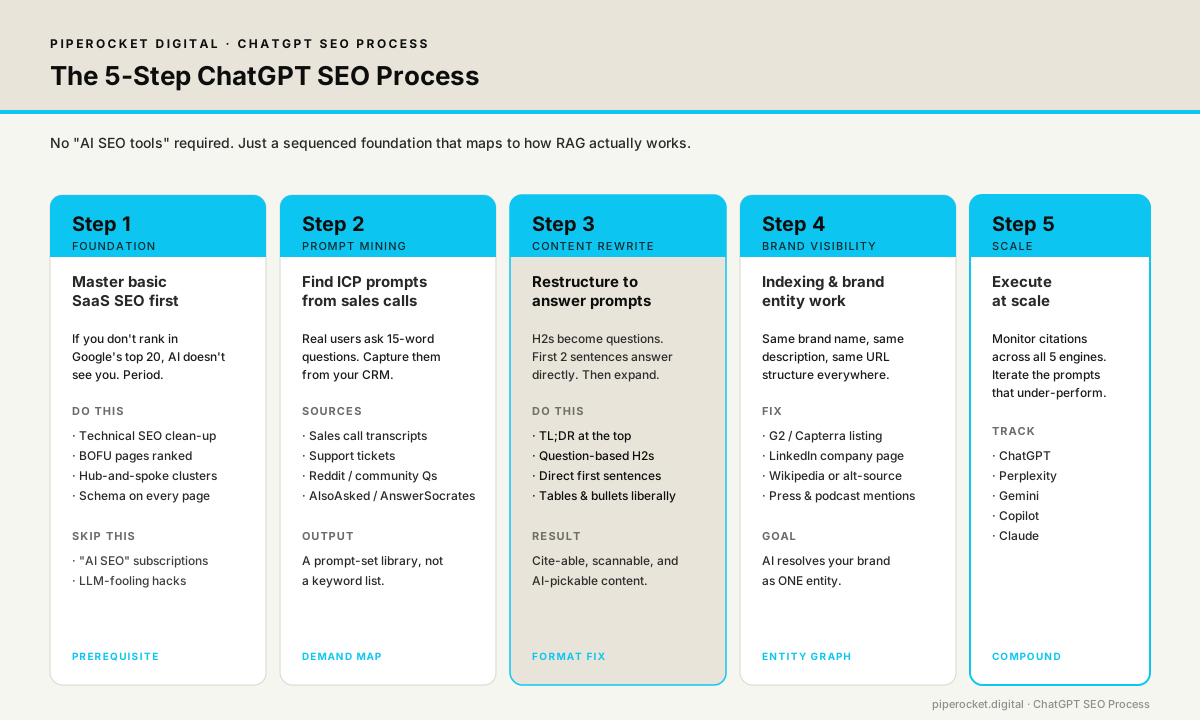
Step 1: Master Basic SaaS SEO First
Your technical debt is killing you
Fix your technical foundation before you optimize for any prompt: if the crawler can’t read your site, ChatGPT can’t cite it. Clear the 404s, messy redirects, and broken canonicals first, then map keywords to pages and answer search intent. LLM optimization on a broken site is building on a swamp.
The offenders below block AI citation more than any speed score does. Fix these before touching prompt-level tactics:
| Technical issue | Why it blocks AI citation | Fix |
|---|---|---|
| 404s and broken links | Crawlers hit dead ends and drop the page | Redirect or restore, keep internal links live |
| Messy 301 redirect chains | Crawler stalls in loops and never reaches content | Flatten to a single hop |
| Conflicting canonical tags | AI sees five versions of one page and gives up | Set one clean canonical per page |
| Main content buried in JavaScript | Text the machine can’t render is text it can’t quote | Serve core content in server-rendered HTML |
| Chasing a perfect 100 speed score | Over-hyped, top pages rarely have it | Skip it, prioritize crawlability instead |
The 100-speed-score myth
I need to say this because I see teams wasting weeks on it: you don’t need a perfect 100 speed score. I look at the top-ranking pages in SaaS every day, and almost none of them have perfect technical scores. It’s over-hyped. What actually matters is crawlability.
If the ChatGPT crawler hits your site and gets stuck in a redirect loop or can’t find your main content because it’s buried under ten layers of Javascript, you’re invisible. Focus on making it easy for the machine to read what you do. That’s the technical win.
Crawlability is the actual gatekeeper
We keep seeing people focus on the wrong technical metrics. I don’t care about your “SEO score” in a plugin. I care if Google and Bing are actually indexing your pages. We had a client recently who couldn’t figure out why they weren’t showing up in Perplexity. It turned out their canonical tags were a complete mess.
The AI was seeing five different versions of the same page and just gave up. You have to fix your 404s, your 301s, and those canonicals. Once the machine can read you, everything else gets easier.
Step 2: Find the Right Prompts for Your Ideal Customer Profile
Ask ChatGPT for questions people might ask
We have a custom ChatGPT we built to address this. What we do is, we feed the custom ChatGPT with our ICP details and ask it to build hundreds of questions users might have. For example, “What’s the best analytics tool for SaaS under $5k that integrates with HubSpot?” This collection of prompts becomes the playbook. We stop guessing and start answering.
Interview your Sales and CS teams
I always tell our team to go talk to the Sales and CS people. They are the ones on the front lines hearing the messy, complicated questions. A keyword tool like Ahrefs is great, but it’s looking at the past. Your Sales team is hearing the future.
They know the specific “pain” words that don’t even show up in the search volume tools yet. If you can answer those questions on your site before the volume even hits, you’ve already won the AI race for that topic.
Step 3: Restructure Your Content to Answer Prompts
Cut the fluff and just answer the thing
Put the direct answer in the first one or two sentences under every heading, then add context. ChatGPT skips long, winding intros, so lead with the nugget it needs to lift. Answer the prompt, then explain it.
If the question is about pricing, put the pricing there. If it’s about a feature, explain the feature in the first two sentences. We’re consciously embedding these direct answers throughout the site. You want to make it as easy as possible for the engine to find the “nugget” of info it needs.
Bullet points are for the AI too
I’m a big believer in structure, but not for the sake of looking “clean.” It’s about digestibility for the machine. We use a lot of lists. We use very clear headings. If someone asks for “the top three features,” and you have a section called “Our top three features” followed by a list, you’re basically handing the answer to the LLM on a silver platter.
It wants straightforward logic. It doesn’t want to dig through your flowery prose to find the facts.
Add schema markup so the machine understands the page
Add schema markup to label what a page is, so the AI can parse it without guessing. Use FAQPage schema on FAQ blocks, Article on posts, Product or SoftwareApplication on product pages, and Organization on your homepage. It doesn’t force a citation, but it removes ambiguity about your entities and structure.
Schema is not a separate “GEO” trick. It’s the same structured data that has always helped Google understand a page, and the same clarity helps an LLM extract the right fact. Match the schema type to the content, keep it consistent with the visible page, and validate it before you ship. Tools that generate and test schema markup make this a fast, repeatable step rather than hand-coded JSON-LD.
Originality is your only moat
Everyone is using AI to write SEO content now, which means everything is starting to sound exactly the same. If you want to rank, you have to add what I call the “human layer.” I’m talking about interviews with real experts. I’m talking about real-world complications you’ve seen.
If your content is just a rewrite of what’s already on page one of Google, the AI has no reason to cite you. It wants a unique perspective. It wants the “subject matter expert” voice. That’s what we push for, adding that layer of experience that a machine can’t just hallucinate.
Freshness compounds originality. Revisit your AI-facing pages on a regular cadence, roughly every 30 days for priority pages, and update stats, examples, and dates. The engines favor content that looks current, and a page you refreshed this month beats an identical page nobody has touched in a year.
Step 4: Handle Indexing and Brand Visibility
Force the index and don’t wait
Don’t wait weeks for a crawler to find new content: force indexation the day you publish. Submit the URL in Google Search Console and Bing Webmaster Tools, then monitor it daily until it’s indexed. ChatGPT retrieves through those indexes, so a page that isn’t indexed can’t be cited.
We don’t wait. If we publish something optimized for a specific prompt, we’re monitoring it every day. If it’s not showing up, we’re forcing that indexation .
You have to tell the engines that you have something new and relevant. If you just sit around waiting for a crawler to stumble across you, your competitors are going to beat you to the punch.
The consensus layer
This is the part most people miss: ChatGPT looks for consensus. If you say you’re the “best CRM for startups,” the AI is going to check if anyone else says that. It’s searching for a combined truth from multiple sources. We spend a lot of time building that external credibility.
You need your brand mentioned in other places, listicles, news sites, industry reports. If the AI sees your name mentioned alongside the big players on five different sites, it starts to trust that you’re a legitimate authority.
Two 2026 shifts make this consensus work pay off in measurable traffic:
- Clickable brand mentions : In May 2026 ChatGPT turned brand names in its answers into clickable callouts. One analytics vendor reported ChatGPT referrals jumping 157.7% week over week after the change (a trade/vendor figure, so treat it as directional rather than official OpenAI data). Being named in the answer now converts into real clicks.
- A paid lane is emerging: OpenAI’s ChatGPT ads test has grown into an ads platform with an account Overview tab, suggested ad drafts, and rollout into Japan and South Korea. That is a separate surface from the organic visibility this post covers. Know it exists, but do not confuse buying placement with earning consensus.
The platforms that build brand consensus
Get your brand onto the third-party platforms the engines already trust: G2 and Capterra reviews, a Wikipedia entry if you qualify, and industry listicles. These are the sources ChatGPT cross-checks when it decides whether your claim is a consensus or a solo boast.
Keep your entity consistent everywhere it appears. Use the same brand name, one-line description, category, and founding details across G2, Capterra, LinkedIn, Crunchbase, and your own site. When those profiles agree, the AI reads one confident entity. When they conflict, it hedges or drops you. A few concrete moves:
- Claim and complete your G2 and Capterra profiles, and keep review volume growing.
- Earn a Wikipedia entry only if you meet notability, then keep it factual and sourced.
- Standardize your name and description across every profile so the entity never contradicts itself.
- Chase mentions in the listicles and industry reports your ICP actually reads.
Being in the right room
You have to think about who you’re being associated with. I tell our clients all the time, it’s not just about getting any link, it’s about being in the “right room.” If you’re a CRM and you’re being mentioned on sites that talk about HR software, you’re confusing the engine. You want to be mentioned in the places your ICP hangs out.
ChatGPT is looking for that topical alignment. It wants to see that you are an authority in your specific niche, not just a random site on the internet.
Step 5: Execute This at Scale
The batch-and-measure rule
Work in small batches: pick about five specific prompts, go deep on each, then measure before scaling. Trying to rank for a thousand prompts overnight just produces a pile of mediocre content. We optimize the site, we build the external mentions, and then we measure.
Once a batch is live, measure it before moving on (see how to track ChatGPT visibility below), then take the next five prompts. That loop is how you scale without drowning in mediocre content.
Handling the query fan-out
One search for an “analytics platform” isn’t just one query. It fans out into a hundred different things, pricing, features, comparisons, integration questions. We group these into topic clusters. You need content that covers the entire topic, not just one keyword.
We use strong entity words, specific names of features and competitors, to get cited faster. You want to be the “source of truth” for the entire cluster, not just one lucky answer.
Forget the Reddit hacks
I know everyone was talking about using Reddit to manipulate AI citations. We saw it too. But that bubble has already popped. Reddit citations dropped off sharply through 2026. If you’re relying on “hacking” a forum to get your brand mentioned, you’re on borrowed time.
How Do You Track Your ChatGPT Visibility?
Track ChatGPT visibility with two free sources: Google Search Console now reports AI Overview and AI Mode impressions inside the standard performance report, and Google Analytics 4 shows referral sessions from chatgpt.com. Together they tell you when a page surfaces in AI answers and when it drives clicks.
- Google Search Console: As of mid-2026, impressions from AI Overviews and AI Mode appear in the standard performance data. Click figures aren’t broken out yet, but you can finally see when a page is surfacing in AI answers instead of guessing.
- GA4 referral filter: In GA4, filter Traffic acquisition by session source and look for
chatgpt.com(andperplexity.ai) to see real referral sessions from AI answers. Save it as a segment so you can watch the trend. - Ask the engine directly: If you don’t show up, ask ChatGPT why it isn’t citing you for a specific query. It usually returns a list of gaps you can go fix right then.
Set a baseline, then re-check on the same cadence you refresh content so you can tie visibility changes to specific edits.
Keep the win in perspective while you’re tracking it. Across the 53 B2B SaaS brands in our AI SEO statistics , organic leads converted to Sales Qualified Leads at 33.3%, versus 28.6% for AI-sourced leads. ChatGPT visibility is worth chasing, but it’s a complement to your organic foundation, not a replacement for it — the SQL math still favors the channel you’ve been building all along.
Common Mistakes to Avoid When Ranking on ChatGPT
Most ChatGPT visibility failures come from a handful of repeatable mistakes: buying AI SEO tools , chasing a permanent ranking, skipping the technical foundation, and relying on forum hacks. Avoid these four and you’re ahead of most competitors.
Buying “AI SEO” tools that promise a guaranteed spot
There is no score that makes an LLM cite you. We audited over 70 tools that claim to guarantee a ChatGPT spot and found none add real value, because they’re reverse-engineering a black box that changes daily. Spend that budget on expert content and technical health instead.
Treating a ranking as permanent
A mention today can vanish an hour later, because every output is generated live and personalized. Don’t declare victory off one citation. Build a footprint so consistent across the web that the AI keeps finding you, rather than optimizing for a single moment.
Skipping the technical foundation
If the crawler can’t read your site, ChatGPT can’t cite it. Teams chase prompt-level tactics while their site is full of 404s, redirect loops, and conflicting canonicals. Fix crawlability and confirm Google and Bing are indexing your pages before you optimize a single prompt.
Relying on Reddit and forum hacks
Manipulating forum threads to force citations is on borrowed time. Reddit citations dropped off sharply through 2026, so a strategy built on gaming a forum collapses when the engine reweights its sources. Earn genuine consensus on platforms your ICP trusts instead.
Few agencies can show a citation they actually earned inside an AI answer, and our SaaS SEO agency comparison records which ones treat this as core scope.
Stop Guessing and Let PipeRocket Digital Build Your Engine
Look, I’m being honest here, executing a strategy like this is a massive amount of work. It takes hours of interviewing Sales staff, mapping out your Total Addressable Market , and building these technical clusters.
You probably don’t have the time to do this yourself while you’re trying to run a company. That’s why we built PipeRocket Digital , one of the best AEO agencies for AI visibility tracking and reporting .
We identify the exact prompts your ICP is using. We restructure your content so the AI can actually read it. We build the external brand authority that makes these engines trust you. We turn organic search into a predictable revenue pipeline.
If you’re tired of tying AEO and SEO together, let’s talk!
Conclusion
Mastering how to rank on ChatGPT isn’t some dark art that only a few people understand. It’s just about stripping away the hype and focusing on foundational authority. You have to fix your technical debt. You have to map conversational prompts directly to what your customers actually care about.
You have to provide straightforward, honest answers and build a consensus across the web that you’re the expert.
If you stop chasing the newest “hack” and start building a durable engine based on intent and authority, you’re going to win. The noise is only getting louder, and the only way to be heard is to be the most relevant, most trusted voice in the room. Don’t wait for the search landscape to finish changing before you act. Start building that authority now.
Frequently Asked Questions
1. How to appear on ChatGPT?
To appear on ChatGPT, you have to build undeniable consensus across the web by getting mentioned alongside category leaders on authoritative sites so the LLM associates your brand with the solution. You must answer conversational prompts directly, ditch the fluff and give the machine clear, factual data it can actually cite.
2. How do I find the right prompts to target?
Don’t guess. We take the Ideal Customer Profile document and feed it into our systems, but the real answers come from your Sales and CS teams. They hear the messy, specific questions every day. That’s your prompt list. If you just use a keyword tool, you’re missing the high-intent phrases that actually drive sales.
3. Why is my brand disappearing from ChatGPT outputs?
AI outputs are generated live and they’re highly personalized. You might show up today and be gone tomorrow. Usually, it’s because your external brand authority is weak. If the AI doesn’t see a consensus across multiple sources that you’re the best answer, it will eventually stop citing you. You have to keep building that footprint.
4. Is AEO totally different from SEO?
Absolutely not. I tell people to treat it as one additional layer. If your fundamental SEO is broken, you have zero chance of ranking in an LLM. You have to have the technical basics and the high-quality content first. AEO is just the way we frame that content for conversational prompts.
5. Why should I ignore AI SEO tools?
We’ve audited over 70 of them and they just don’t work. They’re guessing how a black-box algorithm functions. They might give you a “score,” but that score doesn’t mean anything to ChatGPT or Perplexity. You’re better off spending that budget on real expert content and technical health, or an AI SEO consultant who does that work.
6. How do I get my site indexed for ChatGPT?
ChatGPT retrieves through Google and Bing, so getting indexed there is the job. Fix 404s, redirects, and canonicals, then submit your URLs in Google Search Console and Bing Webmaster Tools. If it isn’t indexed, it can’t be cited.
7. How do I rank on AI results beyond ChatGPT?
The same fundamentals apply across AI Overviews, Perplexity, and Gemini: strong technical SEO , direct answers to conversational prompts, and web-wide consensus. There’s no separate playbook per engine, just good SEO framed for prompts.